
The Green Gavel: Bridging the Assurance Gap and the ‘Contractualization’ of ESG Risk in India’s Value Chain Mandate
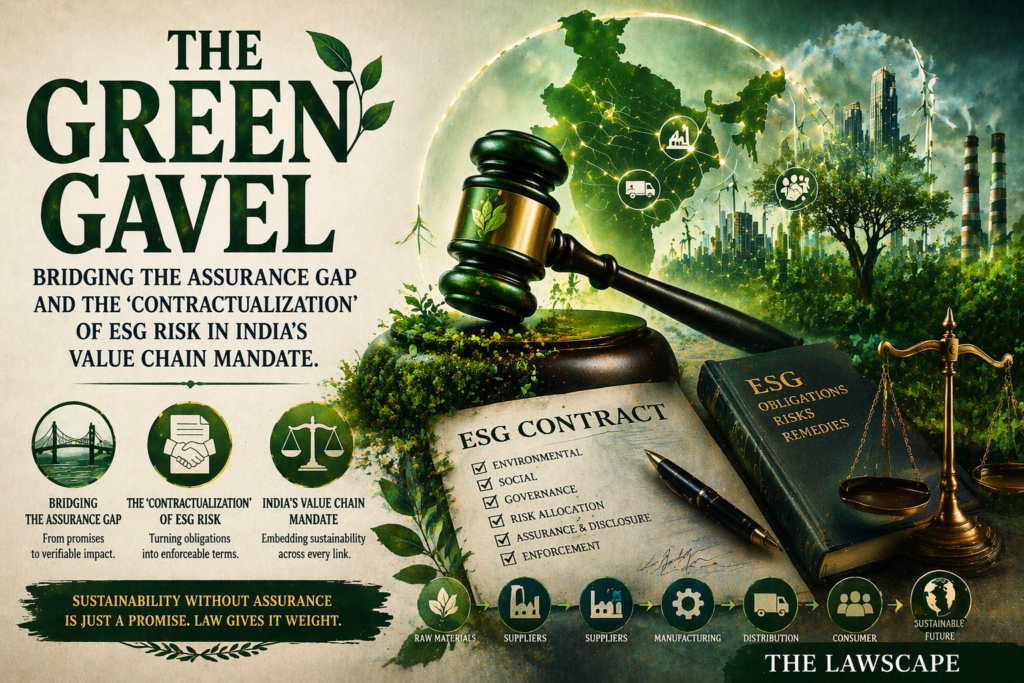
Author: Swapnil Prakash Chavan
Student, Nirmal Education Society’s Subhash Desai College of Law (Mumbai University)
————————————————————————————-
💡 3 Quick Takeaways
SEBI’s BRSR Core mandate for value chain reporting is triggering a “Contractualization of ESG” — where public regulatory obligations are being enforced through private indemnity, audit, and termination clauses in commercial contracts, pushing the compliance burden onto unlisted MSMEs.
The friction between these new “Green Clauses” and foundational principles of the Indian Contract Act, 1872 — particularly unconscionability under Section 23 and impossibility under Section 56 — raises serious questions about contractual equity and the limits of private law as a regulatory tool.
Without a Model ESG Clause framework or statutory safe harbours, India’s drive for corporate sustainability risks institutionalising a new era of contractual exploitation, where the “Polluter Pays” principle is effectively replaced by the “Weaker Party Pays” principle.
Abstract
As India transitions to mandatory ESG Value Chain reporting in 2026, a quiet revolution is occurring in private law. This article examines the “Contractualization of ESG” — a phenomenon where SEBI’s regulatory mandates, specifically the BRSR Core, are being converted into aggressive indemnity, audit, and termination clauses within commercial supply chain agreements. While SEBI’s framework targets the top 250 listed entities, the legal burden is being cascaded onto unlisted MSMEs through private law instruments. By analysing the friction between the Indian Contract Act, 1872 and the SEBI (LODR) Regulations, this article identifies a growing Assurance Gap. It argues that the shift toward Reasonable Assurance has incentivised listed firms to utilise their dominant bargaining power to shift the entirety of regulatory and reputational risk onto smaller partners. Drawing on landmark precedents and emerging climate jurisprudence, the article concludes that without a Model ESG Clause framework and statutory safe harbours, the drive for corporate sustainability risks institutionalising a new era of contractual unconscionability. It calls for a balanced regulatory approach that harmonises environmental accountability with the foundational principles of contractual equity.
“Earth provides enough to satisfy every man’s need, but not every man’s greed.” — Mahatma Gandhi
“Sustainability is the ability to meet the needs of the present without compromising the ability of future generations to meet their own needs.” — Gro Harlem Brundtland, Our Common Future (1987)
Keywords: ESG, BRSR Core, Contractualization, Value Chain, SEBI, MSMEs, Greenwashing, Indian Contract Act, Unconscionability.
Introduction
In recent years, the concept of corporate responsibility has evolved well beyond traditional financial performance. Environmental, Social, and Governance (ESG) factors have emerged as critical indicators of a company’s long-term sustainability and ethical business conduct. ESG reporting has become a strategic tool for corporate accountability, enabling businesses to disclose their sustainability initiatives, ethical commitments, and governance practices to stakeholders including investors, regulators, and the public.
Regulatory bodies such as the Securities and Exchange Board of India (SEBI), the European Union (EU), and the U.S. Securities and Exchange Commission (SEC) have introduced frameworks requiring companies to integrate ESG disclosures into their financial reporting. International standards such as the Global Reporting Initiative (GRI), the Sustainability Accounting Standards Board (SASB), and the Task Force on Climate-Related Financial Disclosures (TCFD) have been developed to guide companies in ensuring transparency and comparability. This shift reflects a broader change in corporate responsibility, where businesses are expected to align their operational strategies with global sustainability goals such as the United Nations Sustainable Development Goals (SDGs).
SEBI introduced the Business Responsibility and Sustainability Report (BRSR) in 2021, making ESG disclosures mandatory for the top 1,000 listed companies. The BRSR framework aligns with global reporting standards and emphasises climate risks, corporate ethics, diversity, and human rights. The Reserve Bank of India (RBI) has also issued guidelines for green financing, encouraging financial institutions to integrate ESG principles into lending and investment decisions. Despite this regulatory momentum, significant challenges persist — including the absence of uniform ESG metrics, regulatory gaps, and concerns over greenwashing. Addressing these issues through policy refinement, stakeholder collaboration, and capacity building remains crucial for India to align with global ESG best practices.
As of the FY 2025–2026 reporting cycle, the top 250 listed entities in India are no longer simply reporting on their internal operations — they are legally accountable for the ESG performance of their entire “Value Chain.” This mandate has given rise to what this article defines as the “Contractualization of ESG”: a phenomenon where public law mandates are enforced through private law instruments, namely contracts. This article explores the legal friction points where these new “Green Clauses” clash with established principles of Indian contract law.
The Architecture of BRSR Core and Value Chain Reporting
BRSR Core
The BRSR Core represents a subset of nine specific Key Performance Indicators (KPIs) that SEBI has identified as high-priority for the Indian market, including greenhouse gas (GHG) footprint, water footprint, and India-specific indicators such as job creation in small towns.
SEBI’s introduction of the BRSR framework marked a significant step towards formalising ESG disclosures in India. From FY 2022–23, the top 1,000 listed companies have been required to disclose detailed information across environmental, social, and governance indicators. However, a closer examination reveals a fundamental gap in enforceability: there are no legal consequences for poor ESG performance per se. A company could disclose deeply harmful practices and, as long as it does so transparently, remain technically compliant with SEBI’s requirements. SEBI’s enforcement powers are primarily directed at investor protection and market conduct under the SEBI Act, 1992, and do not extend to penalising substantive ESG failures.
A related concern is greenwashing — the practice of projecting an appearance of sustainability without meaningful underlying action. BRSR reports are presently largely self-declared, and while some disclosures may be subject to third-party assurance, this is not yet mandatory. Without a robust audit or verification mechanism, misleading or selective disclosures remain a real risk.
The case of Reckitt Benckiser (India) Ltd. v. Hindustan Unilever Ltd. (CS(OS) 1834/2012, Delhi High Court) offers an instructive analogy. Although the dispute centred on comparative advertising rather than ESG enforcement specifically, it illustrated how corporations may deploy environmentally friendly messaging as a competitive tool rather than as a reflection of genuine practice — a dynamic that underscores the need for greater scrutiny of ESG disclosures. Indian courts have not, however, been reluctant to hold businesses accountable for environmental harm even in the absence of formal ESG legislation. In M.C. Mehta v. Union of India (1988 AIR 1115), the Supreme Court held industries responsible for pollution of the Ganga River, affirming the Polluter Pays and Precautionary Principles as foundational to Indian environmental jurisprudence. While not framed in ESG terms, this precedent demonstrates that Indian law already supports strong environmental accountability capable of complementing future ESG regulation.
For the BRSR framework to move beyond a reporting exercise, stronger oversight is necessary — including clear liability for misleading disclosures and meaningful coordination between SEBI, the Ministry of Environment, and the Ministry of Corporate Affairs.
Value Chain Integration in BRSR Disclosures
A company’s value chain comprises the entire spectrum of value-addition activities, from the procurement of raw materials and services to the distribution and sale of its offerings. It extends beyond direct operations to encompass upstream and downstream activities, making it central to a company’s overall sustainability and ESG profile.
In May 2021, SEBI amended Regulation 34(2)(f) of the SEBI (LODR) Regulations, 2015 by introducing the BRSR, mandating the top 1,000 listed entities by market capitalisation to file BRSR as part of their annual reports. The BRSR Core consists of KPIs based on nine ESG attributes — covering greenhouse gas emissions, water and energy footprint, circularity, and employee well-being, among others.
In July 2023, SEBI’s master circular further introduced the BRSR Core framework for assurance and ESG disclosures for the value chain. Under this framework, the top 250 listed entities by market capitalisation must disclose BRSR Core assurance and ESG disclosures for value chain partners cumulatively comprising 75% of total purchases and sales respectively, on a “comply or explain” basis from FY 2024–2025 onwards.
This amendment created a significant ripple effect by bringing unlisted companies and MSMEs — forming part of these listed entities’ value chains — within the scope of ESG reporting and accountability. It effectively necessitated a collaborative approach between listed entities and their value chain partners, incorporating enhanced due diligence, ESG clauses in supply and distribution contracts, risk management mechanisms, and compliance monitoring systems.
Expert Committee Views on Redefining Value Chain Partners
SEBI’s consultation paper on BRSR noted that in the FMCG, technology, chemicals, and industrial machinery sectors, the number of value chain partners cumulatively covering 75% of purchases and sales ran into the hundreds, and in some cases thousands. This created a significant cost and compliance burden on listed entities, who were required to undertake capacity building, training, mapping, and data collection across this vast network of partners.
To address this, the Expert Committee recommended redefining “value chain partners” to encompass only those upstream and downstream partners individually comprising 2% or more of the listed entity’s purchases or sales by value respectively. The Committee also recommended replacing the “comply or explain” approach with a “voluntary disclosure” approach for value chain disclosures in the BRSR.
Cross-Jurisdictional Perspectives on Value Chain Disclosure
European Union
The Corporate Sustainability Reporting Directive (CSRD), which came into force on 5 January 2023, modernised and strengthened ESG reporting requirements across the EU. It makes sustainability disclosures mandatory for large companies, SMEs, and non-EU companies generating over EUR 150 million in the EU market, in respect of their “material” value chain partners. The draft European Sustainability Reporting Standards (ESRS-1) apply a “double materiality” standard encompassing both financial materiality — whether a matter triggers financial effects on enterprise value — and impact materiality, covering ESG disclosures relating to workers and climate change across the value chain.
United States
In March 2022, the SEC proposed climate-related disclosure requirements for value chain activities, broadly aligned with the double materiality approach endorsed by the CSRD. The proposal required extensive disclosure of climate-related financial impacts across supply chains, reflecting a convergence in global regulatory expectations.
Analysis of the BRSR and the Way Forward
The BRSR assurance and value chain disclosure framework currently applies only to the top 250 listed entities by market capitalisation. Given that upstream and downstream activities of these entities typically involve substantial cash flows and high-value transactions, the Committee’s recommendation to limit the scope to value chain partners individually accounting for 2% or more of the relevant activity is a pragmatic and proportionate starting point. It brings financially significant supply chain partners within the ambit of sustainability reporting while managing compliance costs.
However, the recommendation’s reference to “value chain partners individually” requires further refinement. It is suggested that the computation of the applicable value threshold should also account for subsidiary companies, holding companies, and associate companies of the value chain partner, to prevent group structures from being used as a mechanism to circumvent assurance and ESG disclosure obligations.
The Committee’s recommendation to replace the “comply or explain” approach with “voluntary disclosure” is, with respect, a step in the wrong direction. Regulators worldwide are moving towards mandatory ESG disclosures. A voluntary approach risks creating the perception that India is a laggard in ESG regulation, thereby disincentivising global investors. It also allows entities to simply opt out of disclosure, directly contradicting the principles of transparency and accountability that underpin the listing regulations. The “comply or explain” approach should be retained as the appropriate balance between ESG disclosure obligations and ease of doing business.
The most consequential legal development for FY 2025–2026 is the 2% individual threshold combined with the 75% cumulative coverage rule: a listed entity must now report on any supplier or customer accounting for 2% or more of its business, making value chain ESG compliance a direct contractual reality.
Greenwashing, Greenhushing, and Greenwishing
As ESG reporting transitions from aspiration to norm, a new vocabulary of corporate sustainability failures has emerged. Three concepts are particularly relevant to understanding the limitations of the current framework.
Greenwashing refers to the practice of representing a business as more sustainable than it truly is — whether through misleading product claims, selective disclosure, or labelling financial instruments as “green” without substantive basis. Greenwashing is not a static concept; it operates on a spectrum from outright deceit to wishful self-promotion, and erodes investor and public trust in ESG frameworks broadly.
Greenhushing refers to a company’s deliberate refusal to publicise ESG information, motivated by fear of stakeholder pushback regarding inadequate sustainability performance or by investor resistance to ESG-linked costs. While not overtly dishonest, greenhushing limits the availability of publicly accessible sustainability data, making it difficult to analyse corporate climate targets, share decarbonisation best practices, or calculate Scope 3 emissions — which, by definition, require widespread and transparent reporting across value chains.
Greenwishing, or unintentional greenwashing, describes a situation where a company commits to sustainability targets it genuinely cannot achieve — due to financial, technological, or organisational constraints. Driven by external pressure to set ambitious ESG goals, companies may overcommit and underdeliver, undermining trust in both the specific entity and the broader ESG reporting system.
These three phenomena collectively highlight the urgency of robust verification, mandatory assurance, and legal accountability in India’s evolving ESG framework.
The Contractualization of ESG: Key Legal Friction Points
The most significant and under-examined consequence of SEBI’s value chain mandate is the conversion of public regulatory obligations into private contractual burdens. As listed entities seek to protect themselves from regulatory and reputational exposure arising from their value chain partners’ ESG non-compliance, they are embedding aggressive indemnity, audit, and termination clauses into commercial supply and distribution agreements. This is the “Contractualization of ESG.”
The legal friction this creates with established Indian contract law is substantial. In Central Inland Water Transport Corporation v. Brojo Nath Ganguly (1986 AIR 1571), the Supreme Court held that courts will not enforce — and will strike down — an unfair and unreasonable clause in a contract entered into between parties who are not equal in bargaining power. In 2026, an MSME in a Tier-2 city possesses near-zero bargaining power when a large listed entity demands an ESG indemnity clause that could, in practice, bankrupt the smaller firm. Where such a clause is “monstrously one-sided,” it may be struck down as opposed to public policy under Section 23 of the Indian Contract Act, 1872.
Section 56 of the Indian Contract Act, dealing with impossibility of performance, raises an equally pointed concern. For many MSMEs, providing “Reasonable Assurance” data on Scope 3 emissions is not merely inconvenient — it is a technical impossibility, given their limited infrastructure and resources. If the law does not compel the impossible, the question becomes whether a contract lawfully can.
The Vanashakti v. Union of India (2025) decision of the Supreme Court further illustrates the evolving judicial approach to environmental accountability. Initially banning ex-post facto environmental clearances to enforce strict compliance, the Court later recalled this order, permitting retrospective approvals under specific conditions. The majority ruling — holding by 2:1 that retrospective Environmental Clearances may be granted for “permissible activities” with the imposition of fines — reflects a judicial balancing of economic investment against environmental rigour. This case has effectively redefined how the Precautionary Principle and the Polluter Pays Principle are applied in the context of ESG mandates, signalling that businesses must prioritise proactive, ex-ante environmental diligence to meet both legal and investor expectations.
Conclusion: The Horizon of Contractual Equity in the Green Era
The mandatory transition to Value Chain reporting in 2026 marks the end of ESG’s “voluntary” era in India. What was once a boardroom aspiration has been codified into a complex web of private law obligations. As this article has demonstrated, the “Contractualization of ESG” is not merely a bureaucratic shift but a profound redistribution of legal risk. By converting SEBI’s public mandates into private indemnity and audit clauses, India’s top 250 listed entities have effectively created a parallel regulatory regime — one that operates without the traditional safeguards of administrative law.
While the shift to “Reasonable Assurance” under BRSR Core ensures that Indian corporate sustainability data meets global standards, it has simultaneously incentivised a culture of Defensive Contracting. The friction between the Indian Contract Act and these new-age “Green Clauses” is inevitable. Without judicial or legislative intervention, the “Polluter Pays” principle risks being replaced by a “Weaker Party Pays” principle, where MSMEs bear the financial and legal consequences of data inaccuracies that are often beyond their technical capacity to address.
Ultimately, the success of India’s 2026 ESG mandate will not be measured by the thickness of the BRSR reports filed with SEBI, but by the fairness of the contracts that sit beneath them. As the Indian judiciary begins to interpret these first-generation ESG disputes, it must ensure that the drive for a sustainable future does not come at the cost of contractual equity. The quiet revolution in private law must now become a loud dialogue on fairness — ensuring that as India goes green, its legal foundations remain just.
Disclaimer: The views expressed in this article are those of the author and do not necessarily reflect the views of The Lawscape.
The Lawscape — clear, practical legal insight for students and future lawyers.