
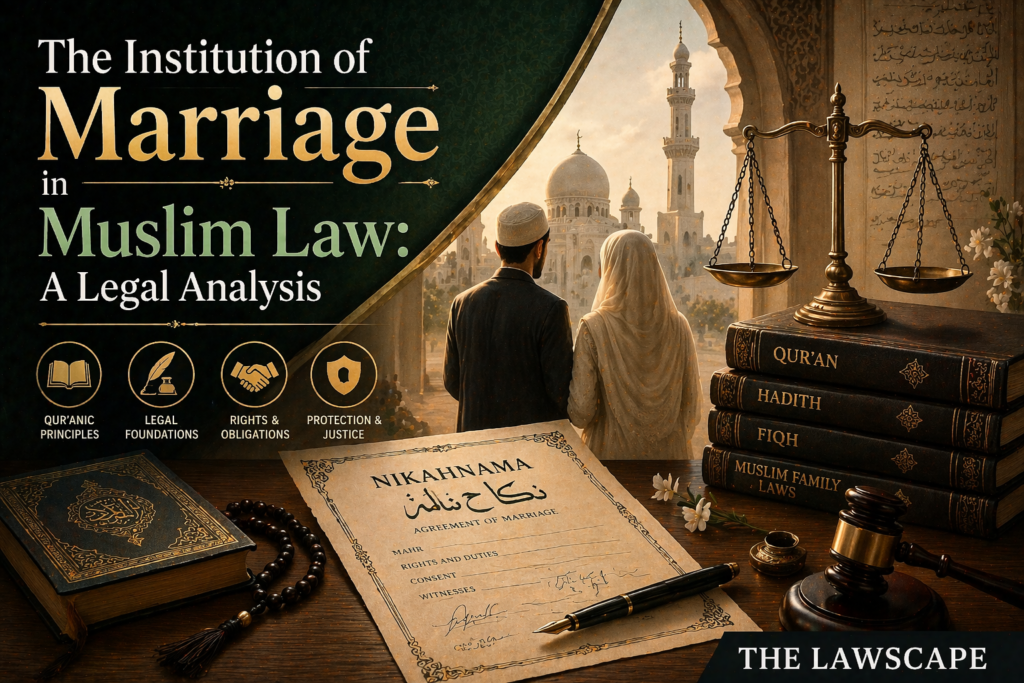
The Institution of Marriage in Muslim Law: A Legal Analysis
Author: Khushboo Sanjay Gupta
Student, MKLM Adhia College of Law
————————————————————————————-
💡 3 Quick Takeaways
Marriage under Muslim law — known as Nikah — is treated as a civil contract rather than a sacrament, creating mutual rights and legal obligations between spouses upon the fulfilment of clearly defined essential conditions.
Muslim law classifies marriages into four categories — Sahih (valid), Batil (void), Fasid (irregular), and Muta (temporary) — each carrying distinct legal consequences for the parties and for the legitimacy of children born from the union.
Judicial decisions such as Sarla Mudgal v. Union of India have reinforced the principle that personal laws must operate within the broader framework of constitutional justice, preventing the misuse of religious conversion to circumvent matrimonial obligations.
Abstract
Marriage is an important institution under Muslim law, commonly known as Nikah. It plays a significant role in regulating family relations within the Muslim community. Prophet Muhammad introduced several reforms in Arabian society that brought meaningful changes to the status of women — emphasising justice and recognising certain rights for women, thereby improving their position in society. During the pre-Islamic period in Arabia, there was no definite concept or formal structure of marriage. Women were often treated as possessions under male authority and were deprived of several rights including inheritance, education, and maintenance. With the introduction of Islamic law, the institution of marriage acquired a definite form and legal recognition, with clear principles governing marital relations. This article examines the concept of marriage under Muslim law, its essential conditions, the different types of marriage recognised under Muslim law, and the concept of Mahr — a right of the wife that forms an important part of the marital relationship.
Introduction
Marriage under Muslim law is known as Nikah, and unlike certain other personal laws, it is considered a civil contract rather than a sacrament. The primary objectives of marriage are to regulate sexual relations, legitimise children, and establish a stable family structure. Through marriage, mutual rights and legal obligations are created between both spouses. A Nikah is generally conducted under the guidance of an Imam, who acts as a religious authority and supervises the marriage ceremony and the formalities involved in the agreement.
One of the important rights granted to a Muslim woman in marriage is the right to Mahr — a sum of money or property that the husband agrees to give to the wife at the time of marriage. Mahr is considered an essential element of a valid Muslim marriage. Another important requirement of a valid Nikah is the presence of witnesses. Under Sunni law, the presence of at least two Muslim male witnesses, or one male and two female witnesses, is generally required to validate the marriage.
Muslim law also permits polygamy, allowing a Muslim man to marry up to four wives, provided he treats them with justice and equality — a practice that continues to be debated in modern society. Muslim law further recognises different forms of marriage, including Muta marriage, a temporary form of marriage recognised under Shia law but not permitted under Sunni law. In addition to marriage, Muslim law provides for divorce, known as Talaq, which allows for the dissolution of marriage under certain prescribed circumstances.
Essentials of a Valid Marriage Under Muslim Law
A marriage that fulfils all the necessary legal requirements under Muslim law is considered a valid marriage, or Sahih Nikah. Since Nikah is regarded as a civil contract, certain essential conditions must be satisfied for it to be legally valid.
1. Offer (Ijab)
Offer, known as Ijab under Sharia law, is one of the fundamental requirements of a valid Muslim marriage. Since marriage in Muslim law is treated as a civil contract, the first essential element is the proposal made by one party to another. The offer must be clear, definite, and free from ambiguity. The presence of witnesses is also necessary at the time of the marriage. Under Sunni law, the marriage must be performed in the presence of two male witnesses or one male and two female witnesses.
2. Acceptance (Qubul)
Acceptance, known as Qubul, is the second essential element. Once an offer of marriage is made by one party, it must be accepted by the other. Only after such acceptance does the marriage become valid. An important condition is that the offer and acceptance must take place in the same meeting — if the offer is made in one meeting and accepted in another, the marriage will not be considered valid.
3. Competent Parties
For a valid marriage under Muslim law, both parties must be competent to enter into the contract of marriage. Competency includes the following requirements.
Age of Majority (Puberty): Both parties must have attained puberty in order to contract a valid marriage. Under Hanafi law, puberty is presumed to be attained at the age of fifteen years unless proven otherwise. Even if a person is a minor but has attained puberty, the marriage may still be valid. However, in the case of a minor, the marriage generally requires the consent of a guardian (wali), which may include the father, paternal grandfather, paternal uncle, brother, or another male relative according to the established order of guardianship.
Sound Mind: Both parties must be of sound mind and must have the mental capacity to understand the nature of the marriage contract and the obligations arising from it. If either party is of unsound mind, the marriage cannot be considered valid.
Muslim Identity: Generally, both parties should be Muslims for the marriage to be valid. However, a Muslim man is permitted to marry a woman belonging to the “People of the Book” (Ahl al-Kitab), which includes Christians and Jews according to Islamic jurisprudence. A Muslim woman, on the other hand, is not permitted to marry a non-Muslim man under traditional Muslim law.
4. Free Consent
Free consent is an essential requirement for a valid Muslim marriage. The acceptance of marriage must be given voluntarily and without coercion, fraud, undue influence, or misrepresentation. If consent is obtained through any of these means, the marriage may be considered invalid.
5. Dower (Mahr)
Dower, also known as Mahr, is an essential part of a Muslim marriage. It refers to the amount of money or property given by the husband to the wife at the time of marriage. Mahr is considered the absolute right of the wife and symbolises respect and financial security for her within the marital relationship.
6. Absence of Legal Disabilities
For a marriage to be valid under Muslim law, there must be no legal disabilities or prohibitions between the parties. These prohibitions are generally divided into absolute prohibitions and relative prohibitions.
Absolute Prohibitions are those restrictions that render the marriage void (Batil). They are based primarily on consanguinity, affinity, and fosterage.
Consanguinity refers to blood relationships. Muslim law prohibits marriage between persons closely related by blood. A man cannot marry his ascendants (such as his mother or grandmother), his descendants (such as his daughter or granddaughter), relations of the second degree such as sisters and their descendants, or his paternal and maternal uncles and aunts. Marriage within these relations is strictly prohibited and such unions are considered void.
Affinity refers to relationships created through marriage. A man cannot enter into a valid marriage with his wife’s daughter or granddaughter, his father’s wife or other ascendant’s wife, or his son’s wife or other descendant’s wife. Any marriage within these prohibited degrees of affinity is void.
Fosterage arises from the act of suckling. Under Muslim law, a child who has been breastfed by a woman is considered similar to her biological child, and marriage between such foster relations is therefore prohibited. Fosterage creates a relationship analogous to consanguinity and operates as a bar to marriage.
Relative Prohibitions do not necessarily render a marriage permanently void but may render it irregular (Fasid) until the prohibition is removed. These include unlawful conjunction — whereby a Muslim man cannot simultaneously marry two women who are related to each other within prohibited degrees, such as two sisters; the absence of proper witnesses, which under Sunni law renders a marriage irregular; differences of religion, subject to the exceptions described above; and marriage during the iddah period — the waiting period a woman must observe after divorce or the death of her husband, during which she cannot validly remarry.
7. Registration of Marriage
Registration of marriage is not traditionally considered an essential requirement for the validity of a Muslim marriage. However, registration serves as important legal evidence of marriage and helps in preventing disputes. The Supreme Court of India has emphasised the importance of compulsory registration of marriage to protect the rights of women and to prevent child marriages and fraudulent unions. The significance of registration was recognised by the Supreme Court in Seema v. Ashwani Kumar ((2006) 2 SCC 578).
Types of Marriage Under Muslim Law
Muslim law recognises different forms of marriage depending on whether the legal requirements of a valid marriage are fulfilled. Based on their validity, marriages are generally classified into Sahih (valid), Batil (void), Fasid (irregular), and Muta marriage.
1. Sahih Nikah (Valid Marriage)
Sahih Nikah refers to a valid marriage under Muslim law — the word Sahih literally means correct or proper. A marriage is Sahih when it fulfils all the essential legal requirements, including offer and acceptance, competent parties, free consent, and the presence of witnesses where required, with no legal prohibitions between the parties. A valid marriage creates mutual rights and obligations between husband and wife, including the right to cohabitation, maintenance, inheritance, and the legitimacy of children.
2. Batil Nikah (Void Marriage)
Batil Nikah refers to a marriage that is void from its very inception — void ab initio. Such a marriage is completely invalid under Muslim law and has no legal effect. A Batil marriage typically occurs when contracted in violation of absolute prohibitions, such as marriage within prohibited degrees of blood relationship. A void marriage does not create any legal rights or obligations between the parties, and the legitimacy of children born from such a marriage may be affected depending on the circumstances.
3. Fasid Nikah (Irregular Marriage)
Fasid Nikah refers to an irregular marriage. Unlike a void marriage, an irregular marriage is not completely invalid but suffers from certain temporary defects or procedural irregularities that can be corrected. Once the irregularities are removed, the marriage may become valid. Examples include a marriage conducted without the required witnesses or a marriage contracted with certain temporary prohibitions in place. Fasid marriages are therefore considered defective but capable of being validated upon rectification of the relevant irregularity.
4. Muta Marriage
Muta marriage refers to a temporary marriage contracted for a fixed period of time. The term Muta literally means enjoyment. In this form of marriage, the duration and the amount of dower (Mahr) are specified at the time of the contract. Muta marriage is recognised under Shia law and is not recognised under Sunni law. Its historical purpose was to regulate relations between a man and a woman for a specified period in order to avoid illicit relationships, which are considered sinful (zina) under Islamic law.
Judicial Interpretation
Sarla Mudgal v. Union of India (1995 AIR 1531)
A landmark case dealing with the misuse of religious conversion for the purpose of contracting a second marriage is Sarla Mudgal v. Union of India (1995 AIR 1531).
The case arose from several petitions filed by women whose husbands had converted to Islam in order to contract a second marriage without dissolving their first marriage under Hindu law. One of the petitioners was the president of “Kalyani,” a registered organisation working for the welfare of families and women in distress. Another petitioner, Meena Mathur, was married to Jitendra Mathur under Hindu law and had three children. In 1988, she discovered that her husband had converted to Islam and married another woman, Sunita Narula (who later adopted the name Fathima). Meena Mathur argued that the conversion was undertaken solely to avoid liability under Section 494 of the Indian Penal Code, which penalises the offence of bigamy. Sunita Narula herself also approached the court, stating that she had converted to Islam for the purpose of marrying Jitendra Mathur and had a child with him, but that he subsequently abandoned her and returned to his first wife. Two further petitioners — Geeta Rani and Sushmita Ghosh — raised similar grievances, alleging that their husbands had converted to Islam in order to remarry without legally dissolving their existing marriages.
The petitions raised a common legal question: whether conversion to Islam could be used as a mechanism to lawfully contract a second marriage without dissolving a subsisting Hindu marriage, and whether such conduct could attract liability for bigamy under Section 494 IPC.
The Supreme Court held that conversion to another religion does not automatically dissolve an existing marriage. A Hindu marriage solemnised under the Hindu Marriage Act, 1955 continues to subsist unless legally dissolved through divorce under that Act. The Court held that a Hindu husband cannot escape the provisions of Hindu matrimonial law by converting to Islam solely for the purpose of contracting a second marriage — if he does so while his first marriage remains subsisting, he is guilty of bigamy under Section 494 IPC. The Court emphasised that such conduct defeats the principles of justice, equity, and good conscience, and discussed the importance of implementing a Uniform Civil Code under Article 44 of the Constitution to prevent conflicts between different personal laws. The Court also referred to the earlier decision in Mohd. Ahmed Khan v. Shah Bano Begum as highlighting the need for uniform legal principles governing family matters.
Conclusion
Marriage is regarded as a significant institution across religious traditions, and under Muslim law it occupies an important legal and social position. Unlike certain other personal laws where marriage is treated as a sacrament, Muslim law considers Nikah to be a civil contract that creates mutual rights and obligations between the spouses. The primary objectives of marriage include the regulation of sexual relations, the legitimacy of children, and the establishment of a stable family structure. For a marriage to be valid, it must fulfil essential legal requirements including offer and acceptance, competency of parties, soundness of mind, free consent, and the payment of Mahr. The classification of marriages into Sahih, Batil, Fasid, and Muta reflects the structured and nuanced legal framework governing matrimonial relations under Muslim law.
Judicial interpretations — particularly in Sarla Mudgal v. Union of India — have reinforced the principle that personal laws must operate within the broader framework of constitutional justice and legal accountability, preventing the misuse of religious conversion to circumvent matrimonial obligations. The institution of marriage under Muslim law thus continues to balance religious principles with legal regulation, ensuring fairness and the protection of rights within matrimonial relationships.
Disclaimer: The views expressed in this article are those of the author and do not necessarily reflect the views of The Lawscape.
The Lawscape — clear, practical legal insight for students and future lawyers.