
Kedar Nath Singh v. State of Bihar (1962): Sedition, Free Speech, and the Constitutional Line Between Dissent and Disorder
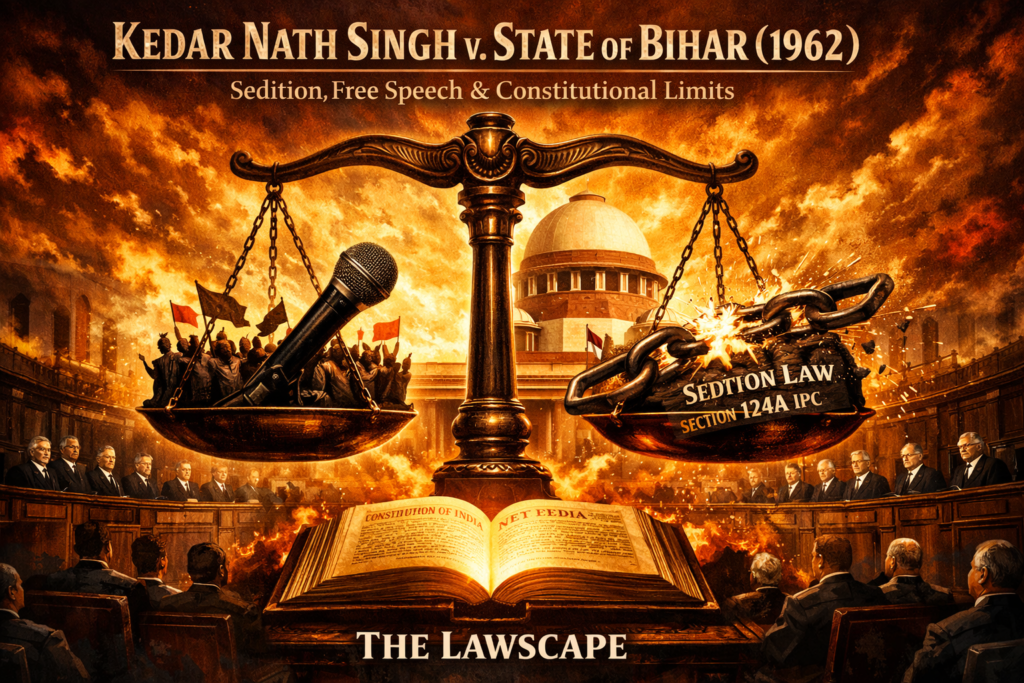
Author: Shaikh Shama Parveen
Student, KES Shri Jayantilal H. Patel Law College
——————————————————————————————-
💡 3 Quick Takeaways
1. The Supreme Court upheld Section 124A IPC but decisively narrowed its scope — sedition applies only to speech that incites violence or tends to cause public disorder, not to criticism of the Government however strong or harsh.
2. The Court drew a crucial constitutional distinction between the Government and the State — disapproval of those in power is not the same as undermining national sovereignty, and the law may only punish the latter when linked to incitement.
3. With Section 124A repealed and replaced by Section 152 of the Bharatiya Nyaya Sanhita, 2023, the principles established in Kedar Nath remain the constitutional benchmark for assessing the validity of speech-related state-security offences.
Case Title: Kedar Nath Singh v. State of Bihar
Citation: AIR 1962 SC 955; 1962 SCR (Supp.) 769
Court: Supreme Court of India
Bench: Chief Justice Bhuvneshwar P. Sinha, Justice A.K. Sarkar, Justice J.R. Mudholkar, Justice N. Rajagopala Ayyangar, and Justice S.K. Das
Date of Judgment: 20 January 1962
Introduction
Few criminal laws in India have caused as much constitutional concern as sedition. Section 124A of the Indian Penal Code, 1860 made it a crime to bring the Government into “hatred or contempt” or to “excite disaffection.” After the Constitution was enacted, this language conflicted directly with Article 19(1)(a), which guarantees freedom of speech and expression. The question shifted from whether a colonial government could punish dissent to whether a constitutional democracy could do the same.
Kedar Nath Singh v. State of Bihar marked a turning point in this debate. The Supreme Court faced a choice: declare Section 124A unconstitutional on account of its breadth, or retain it with significant interpretive limitations. The Court chose the latter. It did not endorse sedition in its colonial form — it confined the offence to speech that incites violence or is likely to cause public disorder, thereby transforming a broad colonial tool into a narrowly defined public order provision, at least in constitutional terms.
Today, Section 124A has been repealed and replaced by Section 152 of the Bharatiya Nyaya Sanhita, 2023, which criminalises acts threatening the sovereignty, unity, and integrity of India. While the wording has changed, the underlying constitutional concern remains. The central question is whether the limits set by Kedar Nath continue to govern the new provision, or whether the same tension between political expression and state security is being replayed under a different statutory label.
Facts of the Case
The case began with a political speech delivered in 1953 by Kedar Nath Singh, a member of the Forward Communist Party, at a public gathering in Begusarai, Bihar. He sharply criticised the ruling Congress Government, accusing those in power of corruption, class exploitation, and betrayal of the people’s interests. At one point, he hinted at the possibility of a “revolution” to overturn the existing political order. His tone was confrontational and his rhetoric was openly hostile toward the Government.
Based on this speech, Singh was charged under Section 124A of the Indian Penal Code for sedition and under Section 505 for statements causing public mischief. The trial court convicted him under Section 124A and sentenced him to rigorous imprisonment. The Patna High Court upheld the conviction, holding that his speech was likely to excite disaffection against the lawfully established Government.
The matter came before the Supreme Court at a time when constitutional challenges to Section 124A were pending in various High Courts, with conflicting judicial views on its validity. The case was therefore not merely an appeal against a conviction — it was a constitutional test of whether a colonial offence of sedition could survive in a democratic framework.
Issues Raised
- Whether Section 124A IPC imposed an unreasonable restriction on the freedom of speech and expression guaranteed by Article 19(1)(a) of the Constitution.
- Whether sedition could be justified under the permissible grounds for restriction in Article 19(2), particularly “security of the State” and “public order.”
- Whether the terms “hatred,” “contempt,” and “disaffection” in Section 124A were too broad, rendering them capable of criminalising legitimate political dissent.
- Whether Section 124A should be struck down as unconstitutional or interpreted narrowly to align with constitutional guarantees.
Arguments of the Parties
Appellant (Kedar Nath Singh)
Counsel for the appellant argued that Section 124A fundamentally conflicted with the constitutional guarantee of free speech. The provision criminalised expressions of “disaffection” — a term broad enough to cover political dissatisfaction, criticism, or strong dissent. In a democracy, the Government is not the same as the State, and disapproval of those in power should not be treated as a threat to national security. It was submitted that the wording of Section 124A exceeded the limits permissible under Article 19(2). By penalising mere tendency to create disaffection without requiring incitement to violence, the law imposed disproportionate restrictions on political expression.
Respondent (State of Bihar)
The State defended the constitutionality of Section 124A on the ground that the stability of the lawfully established Government is essential to State security. Speech that stirs hostility or rebellion against lawful authority, even if it does not immediately lead to violence, can gradually erode public order. The State maintained that the Constitution expressly allows reasonable restrictions in the interest of public order and State security, and presented Section 124A as a protective measure against activities that threaten the integrity and stability of the State. It was contended that the provision was not aimed at silencing legitimate criticism but at preventing disruptive conduct that undermines the constitutional order.
Judgment
The Supreme Court declined to strike down Section 124A in its entirety. Instead, it took a carefully calibrated approach — upholding the constitutional validity of the provision while significantly narrowing its scope through interpretation. The Court drew a clear distinction between mere criticism of the Government and speech that actually threatens the stability of the State through violence or disorder.
The Court affirmed that the Constitution protects even strong and unpopular political speech, since democratic governance inherently involves public criticism of those in power. At the same time, the Constitution permits restrictions on speech that threatens public order or State security. To reconcile these principles, the Court held that Section 124A must be confined to actions involving incitement to violence or speech with an intention to create public disorder. Expressions of disapproval of government actions, no matter how forcefully stated, would not constitute sedition unless they were linked to an incitement to violence or a tendency to produce public disorder.
Applied to the facts, the Court upheld the appellant’s conviction, finding that his speech, considered as a whole, crossed the constitutional line by seeking to provoke violent rebellion against the Government. Through this ruling, the Court preserved Section 124A while fundamentally redefining its practical scope. Sedition would no longer be treated as synonymous with political disagreement — it would be confined to speech that directly threatens public order.
Ratio Decidendi and Constitutional Significance
The central principle of Kedar Nath is that sedition under Section 124A applies only to expressions that involve incitement to violence or are closely connected with the creation of public disorder. Criticism of the Government, however strong or hostile, does not constitute the offence.
This interpretive shift is significant on two levels. First, the Court established a requirement of proximate connection between speech and disorder, rejecting the notion that abstract hostility toward the Government could alone attract criminal liability. Second, it drew a constitutional distinction between the Government and the State — criticism of those in power does not amount to an attack on national sovereignty.
The Court’s reasoning also recognised the dangers of vague criminal laws. If “disaffection” were read literally, almost any speech opposing the Government could be punished. By confining the offence to incitement, the Court ensured that the sedition law would not hollow out the very freedom it purported to regulate. This approach anticipated later constitutional thinking — that broad and vague speech restrictions chill democratic participation and are constitutionally unsustainable.
The lasting significance of Kedar Nath lies in this constitutional recalibration. It established that political speech occupies a privileged position in the constitutional framework and can only be restricted where there is a clear and proximate threat to public order. This principle has shaped subsequent free speech jurisprudence and continues to act as a safeguard against overly expansive interpretations of state-security offences.
Contemporary Relevance in the Era of the Bharatiya Nyaya Sanhita
With the introduction of the Bharatiya Nyaya Sanhita, 2023, Section 124A of the Indian Penal Code has been formally repealed. Its replacement, Section 152, criminalises acts that compromise India’s sovereignty, unity, and integrity — including incitement to secession, armed rebellion, or subversive activities through speech, electronic communication, or financial support. The shift in language from “disaffection” to concepts such as “sovereignty” and “secession” reflects a move away from colonial terminology toward a framework centred on national integrity.
However, the structural concern identified in Kedar Nath persists. Section 152, like its predecessor, is capable of broad interpretation. Terms such as “subversive activities” and “encouragement of separatist feelings” remain undefined, and without judicial restraint, they could be stretched beyond incitement to violence to encompass speech that is merely radical, unpopular, or politically disruptive. The constitutional principles from Kedar Nath are therefore more important, not less, in the current legal landscape.
If Section 152 is interpreted in line with the standards established in 1962, its application would need to demonstrate a clear and proximate link between the disputed expression and imminent public disorder or violence. Without such limits, the new provision risks reviving the excessive breadth that the Court sought to curtail in Kedar Nath. In this sense, the 1962 judgment remains a living reference point for contemporary debates on the constitutional limits of sovereignty-based offences.
The future development of Section 152 will ultimately depend on whether courts uphold the incitement threshold established in Kedar Nath or permit a broader interpretation of state-security offences. The challenge of balancing political dissent and State stability has once again been placed before the judiciary.
Conclusion
Kedar Nath Singh v. State of Bihar holds an enduring place in India’s constitutional history — not because it upheld sedition, but because it fundamentally reshaped its meaning. By restricting the offence to incitement of violence and public disorder, the Supreme Court affirmed that protecting political dissent is essential to democratic legitimacy. The repeal of Section 124A does not diminish this significance. The introduction of Section 152 in the Bharatiya Nyaya Sanhita, 2023 ensures that the principles established in 1962 continue to inform the constitutional assessment of speech-related offences. Whether the new law strengthens or weakens these protections will ultimately depend on how the judiciary applies the constitutional standards that Kedar Nath put in place.
Disclaimer: The views expressed in this article are those of the author and do not necessarily reflect the views of The Lawscape.
The Lawscape — clear, practical legal insight for students and future lawyers.