
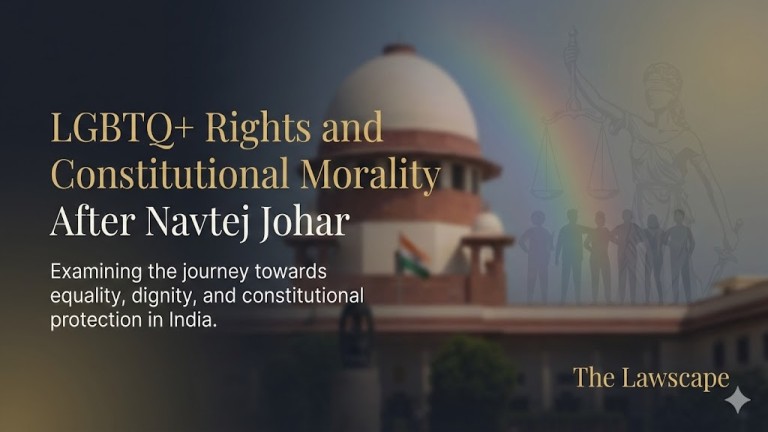
LGBTQ+ Rights and Constitutional Morality After Navtej Johar: Reimagining Equality in Modern Governance
Author: Syed Mohd. Muaz
Student, Aligarh Muslim University, Aligarh, Uttar Pradesh
—————————————————————————————————————-
I. Introduction
The recognition of LGBTQ+ rights in India has marked a long and evolving journey from criminalization to constitutional inclusion. For decades, sexual minorities lived on the fringes of legal protection, facing stigma, discrimination, and social exclusion. The Supreme Court’s historic Navtej Singh Johar v. Union of Indiajudgment in 2018 did not merely strike down a colonial-era law; it redefined the moral compass of the Indian Constitution, reaffirming that dignity, liberty, and equality are not privileges but birthrights.
As India continues to evolve socially and politically, the judgment remains a beacon of how constitutional morality can guide modern governance toward greater inclusivity and justice.
II. From Victorian Morality to Constitutional Morality
Section 377 of the Indian Penal Code, inherited from the British colonial framework, criminalized “carnal intercourse against the order of nature.” Rooted in 19th-century Victorian morality, this provision reflected imported notions of public morality rather than India’s pluralistic ethos.
The Supreme Court’s earlier verdict in Suresh Kumar Koushal v. Naz Foundation (2013) upheld Section 377, claiming that the LGBTQ+ community constituted a “minuscule minority.” This reasoning was later criticized as antithetical to the Constitution’s commitment to individual rights. However, a five-judge Constitution Bench in Navtej Singh Joharoverturned the ruling in the Naz Foundation caseand partially struck down Section 377, declaring that consensual acts between adults cannot be criminalized. Justice D.Y. Chandrachud aptly observed that the Constitution protects “the moral autonomy of individuals.” and that “constitutional morality must prevail over social morality.” This shift from societal prejudice to constitutional principle reoriented the legal understanding of morality itself.
III. Constitutional Morality as the New Foundation
Constitutional morality, a concept originally emphasized by Dr. B.R. Ambedkar during the Constituent Assembly Debates, requires adherence to the core values of the Constitution: liberty, equality, fraternity, and justice, even when societal norms resist them.
In Navtej Johar, the Court recognized that the role of governance is not to mirror prevailing moral sentiments but to uphold the enduring spirit of constitutional values. The decision highlighted that majoritarian beliefs cannot override the rights of minorities. This marked a decisive rejection of popular morality as the measure of legitimacy.
Justice Indu Malhotra poignantly stated that “history owes an apology to the members of the LGBTQ+ community.” This statement captured not just a judicial sentiment but a civilizational reckoning, a collective realization that constitutional morality must transcend the prejudices embedded in societal traditions.
IV. Modern Governance through the Lens of Inclusion
Following Navtej Johar, the task of governance extends beyond decriminalization to active inclusion. The judgment opened doors for legislative, administrative, and social reform to ensure that LGBTQ+ persons can live with dignity, access opportunities, and participate as equal citizens. Modern governance rooted in constitutional morality must therefore address questions of representation, non-discrimination, and identity affirmation. For instance, while several states now include “transgender” as a category in government forms and employment reservations, the policies addressing mental health support, housing, and safety remain inconsistent.
True inclusion demands that governance move from tokenistic recognition to structural reform. It must create safe spaces, frame anti-discrimination laws, ensure gender-neutral facilities, and incorporate sensitization programs across educational and professional institutions. The values of liberty and equality cannot be confined to the courtroom; they must reflect in the everyday functioning of the State.
V. Interpreting Equality in a Transformative Constitution
The Indian Constitution, unlike mere legal codes, is a living and transformative document. Articles 14, 15, and 21 were interpreted expansively in Navtej Johar to protect sexual orientation and identity as intrinsic to personal liberty and human dignity.
Article 14 ensures equality before the law, and the Court clarified that this equality requires more than identical treatment; it calls for the removal of systemic disadvantage. Article 15 prohibits discrimination on several grounds, and the judgment harmonized this with the evolving understanding that discrimination based on “sex” includes sexual orientation and gender identity.
Article 21, which guarantees the right to life and personal liberty, became the moral centerpiece. The Court interpreted it to include the right to privacy, intimacy, and individual autonomy, building upon its previous landmark in Justice K.S. Puttaswamy v. Union of India (2017). The synergy of these provisions painted a holistic picture of constitutional morality in action, one that sees every citizen not as part of a collective identity but as a dignified individual deserving respect.
VI. The Social Dimension: Law beyond the Courtroom
While Navtej Johar redefined legal morality, its social acceptance remains uneven. Deep-rooted prejudices, cultural conservatism, and lack of awareness continue to hinder real progress. The challenge for modern governance, therefore, is to translate judicial ideals into civic culture.
Law can lay the foundation, but social institutions schools, families, workplaces, and media, must nurture the values it upholds. Constitutional morality cannot thrive in isolation; it must become a shared social ethic. Educational curricula should include sensitivity training on gender and sexuality. Public discourse should humanize, not sensationalize, the LGBTQ+ experience.
Moreover, governance must extend equal protection beyond sexuality to intersecting identities: caste, religion, disability, and class. This intersectional lens ensures that equality is not superficial but substantive, responding to the complex realities of discrimination.
VII. Navigating Future Challenges
Despite the moral victory, the path toward equality remains incomplete. Questions concerning same-sex marriage, adoption rights, and inheritance highlight the continuing friction between law and societal acceptance.
The Supreme Court’s 2023 verdict declining to legalize same-sex marriage emphasized the limits of judicial activism and the need for legislative intervention. This outcome reiterates that constitutional morality is not exclusively a judicial idea; it must inform parliamentary reasoning and policymaking.
For governance in the 21st century, this means embracing what Justice D. Y. Chandrachud called the pluralism of values, governing not through uniformity but through respect for diversity. The future of Indian democracy depends on how effectively it harmonizes these diverse identities within the constitutional framework.
VIII. Toward a Constitutional Culture of Empathy
Ultimately, Navtej Johar is not just a judgment; it is a dialogue between law and life. It challenges both the state and society to view morality not as conformity, but as compassion. It reminds us that the Constitution protects love in all its forms because it recognizes the humanity in all individuals.
The test of modern governance lies in whether it can translate this recognition into lived equality. As India charts its democratic journey, constitutional morality must become the compass that guides every citizen, policymaker, and institution toward empathy, justice, and freedom.
In a nation as diverse as ours, governance rooted in constitutional morality is not an ideal: it is a necessity. For the progress of any modern republic, respect for dignity must stand above prejudice, and inclusion must replace exclusion. Navtej Johar illuminated that path; now society and the state must walk it together.
** Disclaimer: The views expressed in this article are those of the author and do not necessarily reflect the views of The Lawscape.
The Lawscape — clear, practical legal insight for students and future lawyers.