
Mental Health and Law: Legal Progress and Societal Challenges in Modern India
Author: Bhumika Kiran Dubey
Student, KES’s Shri Jayantilal H. Patel Law College, Mumbai
————————————————————————————-
3 Quick Takeaways
India’s mental health legal framework has transformed from custodial control to a rights-based model, culminating in the Supreme Court recognising mental health as a fundamental right under Article 21 of the Constitution.
Despite the progressive Mental Healthcare Act, 2017 and landmark judicial pronouncements, implementation remains severely hampered by underfunding, professional shortages, and weak institutional accountability.
Legal reform alone cannot resolve India’s mental health crisis: dismantling deep-rooted social stigma and building genuine societal acceptance are as essential as any statute or court order.
“Unfortunately, we force people to break the law in order to get any kind of mental health treatment.”
~ Pete Earley
Abstract
This article examines the intersection of mental health and jurisprudence in India, tracing the slow but significant shift from custodial, institutionally focused regulation under the Mental Health Act, 1987, to the rights-based framework established through the Mental Healthcare Act, 2017. By shedding light on the Supreme Court’s decision in Sukdeb Saha v. State of Andhra Pradesh, 2025 INSC 893, the article also elucidates how the judiciary has constitutionalised mental health as an essential component of the right to dignity and life under Article 21.
Despite these judicial milestones, the article identifies a persistent gap in implementation, attributable primarily to systemic underfunding, infrastructure deficits, and acute shortages of mental health professionals across both urban and rural India. It further highlights that institutional progress remains hampered by entrenched socio-cultural stigma that continues to persist in our society.
Ultimately, the argument put forward is that while statutory standards provide a necessary foundation, meaningful reform requires moving beyond legal mandates and towards a societal shift: from silence to action, and from ignorance to understanding. This alone can ensure that constitutional promises become a lived reality rather than a mere afterthought.
Keywords: Mental Health; Law; India; Society.
Introduction
“The only difference between a flower and a weed is judgement.”
~ Wayne Dyer
India has long treated mental health as a taboo subject. The older generation has associated mental health issues with social ostracism. Talking about therapy or depression is like walking across a field of landmines. But with the new generation, we are beginning to remove the stigma that has long been attached to it. I was once told that when we overuse our hands or legs, when we write or run and push ourselves, we feel confident and good about ourselves, because we can see our arms and legs. When we get hurt, we go to the doctor instantly. So why do we not go to a therapist or psychologist when our brain is tired, overused, and screaming for help? It is often because we do not even consider it a body part. We cannot see it, so we assume it is fine. We think the stress will go away on its own. But in most cases it does not; instead, it becomes something worse, something that is harder to heal.
This is where change is beginning to emerge. Today’s generation is talking about mental health and emotions, and we are moving in a better direction. So is the law. India is witnessing a slow and quiet but very significant transformation in how mental health is understood, both by society and by the legal system. Over the past decade, the legal framework has made several important strides in this area.
Law and mental health intersect at one of the most sensitive points: the balance between individual liberty and collective safety. For years, mental health law in India leaned towards the custodial side. The Mental Health Act, 1987 focused primarily on institutional regulation, and the rights of mental health patients were treated as a secondary concern. Persons with mental illness were not seen as individuals holding rights but rather as subjects to be controlled and managed.
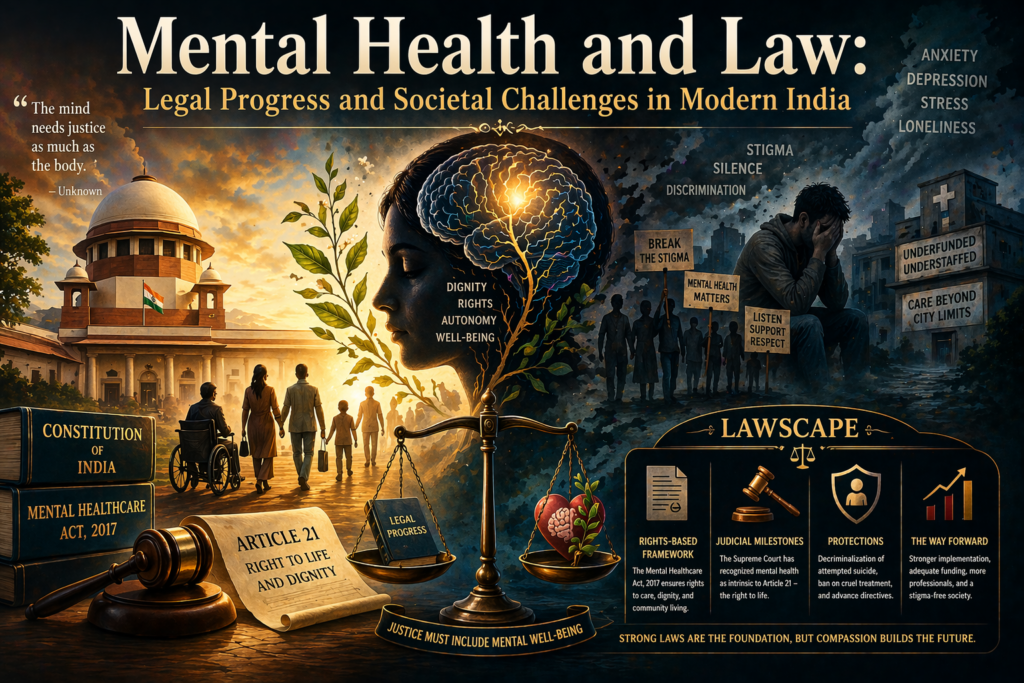
The Mental Healthcare Act, 2017 changed this. It brought a rights-based framework into focus for the first time. Indian law began recognising persons with mental illness as autonomous individuals entitled to legal rights. The Act guaranteed the following:
- The right to access affordable and quality mental healthcare facilities.
- The right to community living and protection from cruel, inhumane, and degrading treatment.
- The right to appoint a nominated representative.
In addition to these rights, the Act also brought about a significant change through the decriminalisation of attempted suicide under Section 115. Overall, the Act represents a fundamental shift in India’s approach to mental health, moving from a custodial model to one grounded in dignity and rights. It recognises individuals with mental illness as rights-bearing persons entitled to equality and respect.
More recently, in Sukdeb Saha v. State of Andhra Pradesh, 2025 INSC 893, this transformation deepened when the Supreme Court held that mental health is an intrinsic component of Article 21, the right to life. The Court expanded existing jurisprudence to acknowledge psychological well-being alongside the rights to dignity, privacy, and autonomy that have long been read into Article 21.
Under this new constitutional recognition, mental health is now judicially enforceable. State inaction amounts to a constitutional violation, and institutions can be held accountable for systemic neglect. The Court also issued binding guidelines for educational institutions, mandating mental health policies, counselling mechanisms, suicide prevention protocols, and grievance redress systems.
With these two major developments, the law has spoken clearly. But whether these standards are being implemented in reality or remain confined to paper is a question we must continue to ask ourselves.
The reality is that we are still far behind. We are improving and growing more open about mental health, but we are still lacking in practice. Our collective mindset has not yet reached a place where there is no shame in speaking about mental health. At the same time, India’s mental healthcare system remains structurally weak. The country still lacks adequate psychiatrists, psychologists, and mental health nurses. Schools and colleges often have unfilled counsellor positions or, particularly in rural areas, no such posts at all. Awareness about mental health and mental illness remains deeply inadequate, making the constitutional right an empty promise in far too many parts of the country.
Financially, the mental health sector is neglected. It receives only a small fraction of the overall health budget. Infrastructure is poor, government hospitals are overburdened, and the quality of care provided is frequently insufficient. In many cases, the personnel assigned to handle patients are not adequately qualified.
Students, under growing academic and competitive pressure, are among those most severely affected. Many spend their entire youth moving between schools and coaching centres, with no guarantee of a seat in a good institution at the end of it.
The Sukdeb Saha case arose from the tragic death of a student facing immense academic pressure: a seventeen-year-old girl with dreams and ambitions, preparing for the NEET examination at a coaching centre in Visakhapatnam, who was found dead under suspicious circumstances in July 2023. This case is not an isolated one. Every year, news emerges of students taking their own lives due to academic pressure, the fear of failure in competitive examinations, and environments that are psychologically deeply unhealthy.
Educational institutions frequently lack trained counsellors, parents and teachers often miss early warning signs, and in the race for good scores and coveted college admissions, mental health remains an afterthought. Despite the legal guidelines that now exist, monitoring and compliance remain weak.
Yet the harder truth is that these challenges cannot be resolved through law and awareness programmes alone. The greatest obstacle our society faces is not a lack of infrastructure or even a lack of information: it is the stigma surrounding mental illness. Mental illness is still seen by many as a weakness. It is associated with shame. People hide it from friends and family. It is dismissed as overthinking or a lack of willpower. Many fear that if they speak up, they will be seen as weak, pitied, or considered dangerous. Families delay seeking treatment out of fear of social judgment. The question “What will people think?” remains the first thought to arise. Until it is replaced by “Our loved one needs help, and we should get that help as soon as possible,” real change will be difficult to achieve. As long as this stigma persists, law alone cannot bring about the transformation that is needed.
Why Law Alone Will Never Be Enough
Law is a powerful instrument of change, but it cannot create change simply by existing. Legal statutes cannot automatically produce trained therapists, generate cultural acceptance, cultivate empathy, or raise funds for the construction and maintenance of institutions. Legal reform is the beginning, not the end, of the change our society requires. Legal solutions must work hand in hand with systemic transformation to address the multi-dimensional crisis of mental health in India.
To translate the constitutional promise of mental health into a lived reality, India must pursue reform at multiple levels. District-level mental health centres should be established, mental health should be integrated into primary healthcare, and the mental health sector must receive significantly higher funding. For any law to function and any right to have meaning, adequate resources are indispensable. India must also increase postgraduate seats in psychiatry, train general practitioners in basic psychiatric care, and promote online and hybrid counselling models. Capacity building is urgent and deserves immediate attention.
The Sukdeb Saha case makes clear that educational institutions in particular have a long way to go. They must move beyond token counsellors and embed emotional education into their curricula, conduct periodic mental health screenings, and train teachers to recognise warning signs. The hyper-competitive academic environment must be moderated, and students must be allowed to learn and grow at their own pace.
In the era of globalisation and rapid industrialisation, loneliness and alienation have become widespread, particularly among those in the corporate sector. Work-life balance has nearly ceased to exist for many. People have been conditioned to believe that rest is a setback, that ambition must never pause, and that one’s worth is measured by productivity. Many give up their dreams, hobbies, and personal lives to conform to the expectations that society has normalised. In the midst of all this, silent suffering persists: depression, the feeling of inadequacy, the relentless pressure to keep moving forward. Addressing this crisis requires acknowledging that mental health does not belong only in hospitals or schools: it must be addressed in every sphere of life. Safe work environments must be created, employee assistance programmes must be introduced, toxic workplace cultures must be dismantled, and employees must be protected from discrimination. Mental health insurance coverage should be made universally available in workplaces, and mental health leave should be normalised alongside sick leave.
Finally, the cycle returns to law. Judicial monitoring must take place to assess how effectively existing legislation is being implemented. Judicial oversight can be a powerful catalyst for executive action. However, even with perfect laws and adequate funding, mental health reform ultimately requires a shift in collective consciousness: a move from silence to action, from shame to acceptance, from blame to support, and from punishment to care.
Conclusion
India’s mental health journey reflects two contrasting sides of the same coin. On paper, India has one of the most progressive mental healthcare statutes in the world. Its Supreme Court has recognised mental health not merely as a subject of policy discussion but as a fundamental right. Judicial guidelines now mandate institutional responsibility. And yet, when we look at practical reality, a vast gap remains. Access is unequal between urban and rural areas, infrastructure is insufficient, public awareness of legal rights is low, the subject is still not discussed openly, stigma persists, and implementation of the law remains inconsistent and weak. The law has moved forward, but society is yet to keep pace.
This should not be viewed as failure. It should be seen as an opportunity to move ahead.
Law exists to set standards and to lead social reform. It does not drag society along by force; it walks forward, and society follows in time. The question is whether policymakers, institutions, professionals, and citizens will be willing to follow. Whether they will rise to meet the vision the Constitution has set. Whether they will be ready to change.
Mental health is no longer optional. It is no longer an afterthought. It is now a right, and we as citizens carry the responsibility of recognising it as such. The task before India today is not to draft new laws or introduce new statutes. The task is to bring to life the laws that already exist. Only then will the promise of dignity under Article 21 become a lived reality for millions.
Disclaimer: The views expressed in this article are those of the author and do not necessarily reflect the views of The Lawscape.
The Lawscape — clear, practical legal insight for students and future lawyers.