
Reimagining Constitutional Values in the Age of Technology and Governance
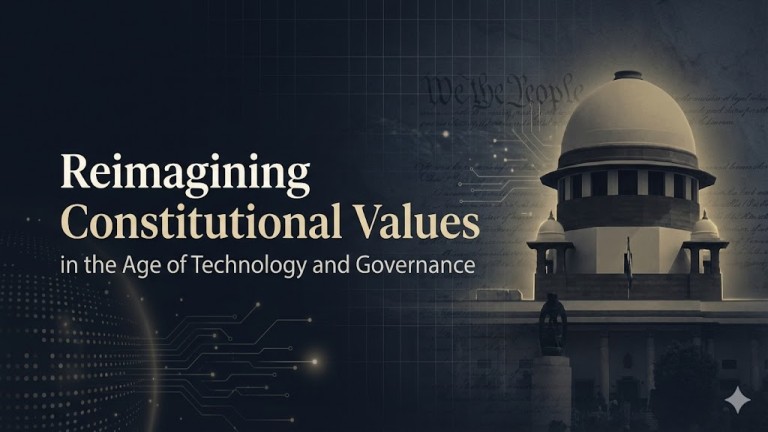
Author: Prothoma Kalidaha
Student, West Bengal University of Animal & Fishery Sciences, Kolkata
—————————————————————————————————————-
The Constitution of India is more than a legal document; it is the foundational framework of Indian democracy and a moral compass for governance. As society transforms through technology, globalisation, social awareness, and digital progress, the interpretation of constitutional values assumes greater significance. Modern governance must protect the core principles of justice, liberty, equality, and dignity, while simultaneously responding to emerging realities.
Dr. B.R. Ambedkar beautifully captured this when he observed, “The Constitution is not a mere lawyer’s document; it is a vehicle of life.” In the contemporary era, this “vehicle” must continue to move forward with renewed clarity and constitutional commitment. This reminder becomes crucial at a time when governance faces unprecedented challenges, including artificial intelligence, online misinformation, expanding state surveillance, and debates on personal autonomy and accountability. Modern India cannot rely solely on old interpretations; it must continuously engage with the Constitution’s spirit to ensure justice, liberty, equality, and dignity for all citizens.
India has witnessed major social transformations, including changing family structures, evolving understanding of gender, and expanding conversations on equality and inclusion. A landmark example is the recognition of LGBTQ+ rights. In Navtej Singh Johar v. Union of India (2018), the Supreme Court decriminalized consensual same-sex relations by affirming that constitutional morality must prevail over social morality. The judgment reinforced the principle that the Constitution protects individual dignity, even when such protection challenges popular opinion. As the Court famously noted, “History owes an apology to the LGBTQ+ community.” This judgment reaffirmed that the Constitution grows alongside society and is not static. Governance today must continue interpreting rights with empathy, fairness, and inclusivity.
Constitutional morality refers to conduct that aligns with the spirit, values, and objectives of the Constitution, rather than a narrow reading of its text. It demands fairness, respect for diversity, and responsible use of power. In modern governance, this means laws and policies that uphold human dignity, protect vulnerable communities, and defend democratic institutions, even under political or social pressure. Nani Palkhivala aptly stated, “A Constitution is meant to protect the people from the government, and the government from itself.” This insight underscore why constitutional morality remains indispensable to the survival of democracy.
India’s digital transformation has led to remarkable progress, including expanded access to public services, digital payments, online education, and e-governance platforms. However, it has also introduced serious concerns such as data breaches, online harassment, cybercrime, algorithmic bias, and the spread of misinformation. In this evolving landscape, constitutional values serve as the anchor for accountability and restraint.
The right to privacy, recognised as a fundamental right in Justice K.S. Puttaswamy v. Union of India (2017), illustrates how constitutional interpretation evolves with time. In the digital era, protecting privacy is not merely a legal obligation; it is a constitutional and ethical responsibility. Governance must ensure that technology empowers citizens rather than enabling excessive surveillance or control. Transparency, proportionality, checks and balances, and fairness must remain central to all digital reforms and data governance frameworks.
As rightly observed, “Technology is a useful servant but a dangerous master.” The Constitution guides the state to ensure that technological advancement never undermines human autonomy or democratic accountability.
Institutions such as the Election Commission of India play a crucial role in maintaining constitutional integrity. Free and fair elections remain the lifeline of democracy. Modern challenges such as digital misinformation, hate speech, online manipulation, and declining public trust require stronger institutional vigilance and transparency. The Constitution expects constitutional bodies to remain neutral, fearless, and committed to the public interest. This expectation is even more significant in an era of polarized politics and digital influence. Ensuring electoral transparency, curbing undue influence, and promoting informed voting are essential to preserve the democratic ethos enshrined in the Constitution. “Democracy is not just a system; it is a habit of the heart.” As has been rightly put, the democratic institutions must continue nurturing this habit through integrity, independence, and public confidence.
Artificial Intelligence is increasingly being deployed across sectors such as healthcare, security, welfare delivery, social media governance, and even policing. While AI brings efficiency, it also presents serious constitutional risks, including opaque decision-making, biased algorithms, mass surveillance and reduced human accountability. The Constitution insists on equality, due process, and dignity. Therefore, AI systems must operate within clear legal frameworks, ethical guidelines. Artificial Intelligence must never replace human conscience. Modern governance must ensure that technology strengthens rights rather than eroding constitutional protections.
Rights and duties are two sides of the same coin. Today, citizenship extends beyond traditional civic duties. Citizens now must now use digital platforms responsibly, verify information before dissemination, respect diversity, protect the environment, and uphold constitutional values while promoting scientific and ethical reasoning. Mahatma Gandhi’s reminder remains deeply relevant: “The true source of rights is duty.” A strong democracy depends on responsible citizens who actively protect the values they seek to enjoy.
Courts continue to play a vital role in interpreting the Constitution for new realities. Landmark judgments on privacy, LGBTQ+ rights, women’s rights, and environmental protection demonstrate how judicial interpretation allows constitutional principles to remain relevant in a changing society. Justice D.Y. Chandrachud aptly remarked, “The Constitution must continue to speak to a changing India.” Through such judicial guidance, constitutional values remain resilient even amid digital expansion and technological disruption.
Modern governance is more complicated than ever. Challenges such as cybercrime regulation, data protection, misinformation, climate change, and AI ethics were unimaginable at the time of constitutional drafting. Yet, the values enshrined 1950, equality, liberty, justice, and fraternity, continue to offer timeless guidance. To meet modern challenges, the Constitution must be understood as a living document that adapts without losing its moral foundation.
A simple truth captures this relationship: “The Constitution is our shared promise; governance is how we honour that promise.” Interpreting constitutional values in modern governance is not the responsibility of courts or policy maker alone; it is a collective constitutional duty. Governments must act with constitutional morality, institutions must remain independent, technology must be regulated responsibly, elections must remain fair, artificial intelligence must be ethical, and citizens must uphold their constitutional duties.
In an era of rapid change, the Constitution remains India’s strongest anchor. When governance aligns with constitutional values, the nation advances with both progress and humanity. As aptly stated, “Democracy is a daily practice, not a one-time achievement.” By continually reinterpreting and reaffirming constitutional values, India can build a future that is just, inclusive, and truly democratic.
** Disclaimer: The views expressed in this article are those of the author and do not necessarily reflect the views of The Lawscape.
The Lawscape — clear, practical legal insight for students and future lawyers.