
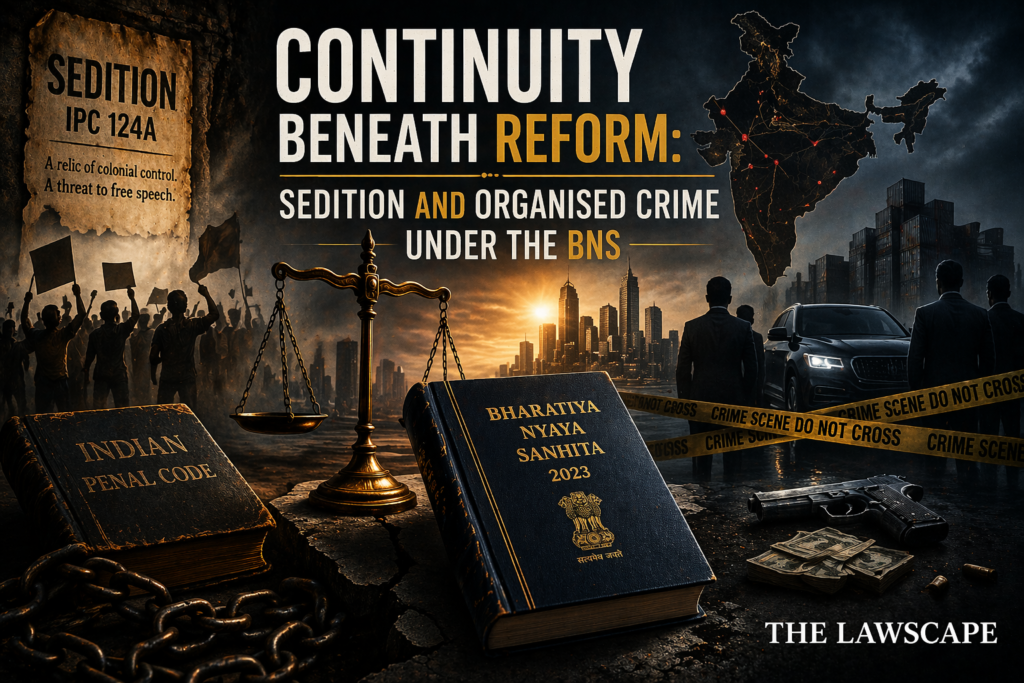
Continuity Beneath Reform: Sedition and Organised Crime under the BNS
Author: Shama Parveen Shaikh
Student, KES Shri jayanti Lal H patel law college
————————————————————————————-
3 Quick Takeaways
The Bharatiya Nyaya Sanhita, 2023 replaces the Indian Penal Code, 1860 in name and structure, but its treatment of sedition and organised crime reflects consolidation and expansion of existing doctrine rather than a genuine overhaul of criminal law principles.
The shift from Section 124A IPC to Section 152 BNS broadens the textual scope of the sedition-adjacent offence while removing the judicially developed proximity requirement linking speech to disorder, leaving constitutional safeguards implied rather than embedded in the statute.
The organised crime framework under Section 111 BNS nationalises a model already developed at the state level but creates new problems of jurisdictional overlap, undefined terms, and inconsistent bail standards across concurrent statutory frameworks.
Abstract
The replacement of the Indian Penal Code, 1860 with the Bharatiya Nyaya Sanhita, 2023 marks a formal departure from colonial criminal law. The reform narrative offers promises of decolonisation, modernisation, and clarity. However, whether this change brings true structural transformation or simply continues existing practices remains a matter of genuine debate.
This article explores that question by studying two key areas: the changes to sedition and the addition of organised crime in the new code. By comparing the previous judicial framework to the current statute, it assesses shifts in protected interests, definitions, procedures, and legislative techniques. The analysis places these changes within the context of constitutional free speech rights and the broader framework of special criminal laws.
The article argues that while the BNS consolidates and nationalises existing provisions, it also broadens textual scope and leaves critical terms unclear. The success and legitimacy of this reform will ultimately depend on how courts interpret its expanded language and whether those interpretations align with constitutional protections.
By examining both doctrinal continuity and textual innovation, the article highlights the tension between legislative ambition and constitutional restraint, and questions whether symbolic replacement alone can satisfy the deeper demands of substantive criminal law reform.
Keywords: Bharatiya Nyaya Sanhita; Sedition; Organised Crime; Constitutional Adjudication; Criminal Law Reform.
Introduction
For over 150 years, the Indian Penal Code, 1860 shaped the language, structure, and understanding of criminal law in India. Drafted during colonial rule, it continued to exist through constitutional changes, social upheaval, and technological developments. Its longevity was not merely a matter of convenience: it became the basic framework that courts, police, and citizens used to understand crime and punishment. However, its colonial origins increasingly conflicted with modern claims of constitutional independence and democratic growth.
The introduction of the Bharatiya Nyaya Sanhita, 2023 marks a formal break from this history. The new code presents itself as a significant step toward decolonisation, simplification, and modernisation. By repealing the IPC and introducing a new statute, Parliament suggests that India is not merely revising an old text but launching a new vision for its penal system. The rhetoric around this transition emphasises national identity, citizen-centred justice, and responsiveness to new forms of criminal behaviour.
However, repeal does not automatically lead to reconstruction. A closer examination poses a more challenging question: does the new code fundamentally change the structure of criminal law, or does it merely rename and expand existing doctrines? To answer this, we must look beyond symbolism and examine real changes. Through an analysis of sedition and organised crime, this article contends that the Bharatiya Nyaya Sanhita represents a consolidation and expansion of text rather than a complete rethinking of criminal law principles.
Part A: Sedition
A. Section 124A IPC: Judicially Contained Power
Section 124A of the IPC, added in 1870, arose at a time when colonial governance treated dissent as a threat to stability. This provision made it illegal to promote hatred, contempt, or disloyalty against the government. Its wide scope was intentional: it permitted the colonial state to respond not only to violent uprisings but also to ideological challenges. After independence, this provision faced a dramatically different constitutional landscape. The protection of free speech under Article 19(1)(a) turned what was once a tool of empire into a constitutional question.
The First Constitutional Amendment in 1951 added “public order” and “security of the State” as permissible grounds for restricting speech, effectively allowing sedition to persist. However, this survival was not guaranteed. In Kedar Nath Singh v. State of Bihar, (1962) Supp. 2 S.C.R. 769 (India), the Supreme Court reframed the offence. Instead of striking it down, the Court applied a narrow interpretation, holding that only speech with the intention or tendency to cause public disorder or incite violence could be penalised. This shift was crucial. The Court turned a broad colonial law into a narrowly defined security measure.
Later, in Balwant Singh v. State of Punjab, (1995) 3 S.C.C. 214 (India), the Court reiterated that merely shouting slogans, even politically charged ones, did not constitute sedition without a clear link to disorder. Through such rulings, the judiciary established a threshold: criticism, even if harsh or unpopular, remained protected unless it crossed into incitement. In practice, sedition survived not because of clear legislation but due to judicial interpretation that limited its scope. Courts allowed sweeping statutory language to become a constitutionally acceptable offence by insisting on a connection to violence and tangible disruption.
B. Section 152 BNS: Textual Reconfiguration and Expansion
The Bharatiya Nyaya Sanhita replaces Section 124A with a new provision addressing acts that threaten the sovereignty, unity, and integrity of India. The change in wording is significant. Instead of safeguarding the “Government established by law,” the new provision aims to protect “India” as a political and territorial entity. This shift broadens the focus from institutional authority to the nation as a whole.
The new provision covers secession, armed rebellion, subversive actions, and inciting separatist sentiments. It also holds individuals accountable for acts carried out through electronic means or financial channels, reflecting modern methods of mobilisation. The inclusion of “subversive activities” and “inciting feelings” broadens the text beyond direct incitement to violence. Unlike the earlier judicially narrowed interpretation, the new statutory language does not require imminent disorder.
Several terms remain undefined. What counts as subversive? When does political advocacy cross into inciting separatism? The provision acknowledges that non-inciting disapproval is not punishable. However, this assurance is broad rather than precise. Unlike the protective standards developed by the courts around Section 124A, the new wording relies heavily on interpretive limits that are not explicitly stated in the text.
C. Constitutional Implications
The expanded wording of Section 152 raises familiar constitutional questions in a new light. The vagueness doctrine requires criminal laws to be defined with clear standards: undefined terms such as “subversive activities” risk being applied unevenly. When definitions are unclear, enforcement may rely more on discretion than on established rules. This uncertainty engages Article 14 concerns by permitting differential treatment without clear criteria.
The implications for Article 19 are also concerning. A provision that could reach ideological advocacy, without an explicit proximity test, may produce a chilling effect. Speakers often adjust their expressions based on the apparent breadth of legal language rather than on precedent. Without a defined requirement linking speech to imminent disorder, courts must again supply constitutional limits.
In effect, the new provision broadens the textual scope while leaving essential protections implied. The movement from Section 124A to Section 152 indicates expansion without built-in constitutional constraints, placing increased pressure on judicial interpretation to supply what the statute withholds.
Part B: Organised Crime
A. Replication from State Legislation
The inclusion of organised crime in the Bharatiya Nyaya Sanhita represents a significant structural development. Section 111 defines organised crime in terms closely resembling state laws such as the Maharashtra Control of Organised Crime Act, 1999 and the Gujarat Control of Terrorism and Organised Crime Act, 2015. The framework, built around ongoing illegal activity, syndicate operations, and material benefit, mirrors these earlier statutes. Rather than creating a new theory of collective criminality, the BNS appears to nationalise an existing model.
This approach has practical advantages. It creates consistency across states that previously operated under different special laws, and it integrates organised crime into the general penal code. However, the change is evolutionary rather than revolutionary. The offence does not transform the principles of criminal responsibility: it collects and centralises a framework that has already been functioning at the state level. The advancement lies in geographical scope, not in new legal concepts.
By incorporating organised crime into the primary code, Parliament signals that such offences are now standardised and no longer restricted to specific regions. Yet this borrowing comes with complications. A model designed to respond to entrenched criminal groups now operates within a wider legal framework, raising questions about interpretive consistency and overlap with existing legislation.
B. Jurisdictional Conflict and Institutional Tension
One immediate issue concerns forum. Under statutes like MCOCA, specialised courts handle organised crime cases. The BNS, together with its procedural counterpart, assigns these offences to Sessions Courts. This difference creates potential conflict when both state special laws and the central code apply to the same conduct.
The principle that a special law takes precedence over a general law provides some guidance. However, practical confusion persists. Prosecutors may choose between frameworks based on perceived procedural or evidentiary advantages. The choice of forum affects bail, trial management, and appeals. The presence of overlapping legal frameworks risks inconsistent implementation, particularly in states where special laws remain in force.
The unifying intention of the BNS may therefore unintentionally create institutional overlap. Rather than reducing fragmentation, the central provision operates alongside specialised statutes, producing a layered and sometimes unclear enforcement environment.
C. Non-Bailable Classification
Bail rules further illustrate this tension. MCOCA classifies organised crime as non-bailable, imposing strict conditions for release. The BNS similarly designates organised crime as non-bailable in its First Schedule, reflecting comparable seriousness. However, the specific conditions and judicial considerations may vary depending on the statute being applied.
This raises practical concerns. Where similar conduct is prosecuted under different laws, the conditions for bail may differ. Such disparities affect not only personal liberty but also pre-trial strategy. While the classification underscores the gravity of the offence, consistency across jurisdictions remains uncertain.
D. Vagueness and Overbreadth in Definition
Section 111 lists a wide range of activities including hawala transactions, cyber-crime, land grabbing, contract killing, and economic offences. Many of these terms lack clear definitions within the BNS. They rely on or overlap with specialised legislation concerning financial regulation, narcotics, information technology, and property. The absence of clear internal definitions expands interpretive discretion.
Concerns arise when loosely defined categories combine with elevated penalties. For instance, “cyber-crime” can range from minor digital fraud to sophisticated international attacks. Without clear boundaries, routine repeat offences might fall under the organised crime label if they meet syndicate-related criteria, thereby undermining the distinctive character of the offence.
The principle of legality requires that criminal laws define conduct with reasonable clarity. When definitions rely on external statutes or undefined concepts, boundaries may shift depending on interpretation. This flexibility increases prosecutorial authority while complicating accessibility and predictability for the public.
E. Structural and Federal Dimensions
The organised crime provision also carries federal implications. By integrating a state-developed model into a central code, the BNS centralises an area previously shaped by regional experience. While uniformity can improve coordination, it may also limit adaptability to local conditions. Alignment with existing special laws remains incomplete, and clear guidance on precedence would help reduce uncertainty in enforcement.
In summary, the organised crime framework reflects consolidation and centralisation rather than a fundamental rethinking, and it brings with it definitional and institutional ambiguities that will require sustained attention.
Conclusion
The shift from the Indian Penal Code to the Bharatiya Nyaya Sanhita is framed as a decisive break from colonial history. However, examining sedition and organised crime suggests that the change is better characterised as consolidation paired with expansion. The structure of liability, the reliance on broad categories, and the dependence on judicial interpretation all continue beneath the new statutory surface.
In the area of sedition, the transition from Section 124A to Section 152 replaces one set of terms with another while broadening the textual scope. The earlier offence survived constitutional challenge because courts enforced a proximity requirement linking speech to disorder. The new provision introduces broad concepts such as sovereignty, unity, and subversion without incorporating those judicially established limits. The safeguard therefore remains outside the statute, awaiting fresh constitutional review.
Similarly, the organised crime framework nationalises a state-level model without resolving problems of jurisdictional overlap or definitional breadth. It centralises exceptional laws while leaving open questions of forum, bail, and interpretation. Undefined terms and cross-references to other statutes add to unpredictability, even as they expand prosecutorial authority.
Taken together, these developments suggest that the BNS does not overhaul the fundamental principles of criminal law. It reorganises, consolidates, and extends existing doctrines under a new legislative framework. Whether this amounts to true reform will depend on judicial engagement. Courts will again be called upon to supply clarity, balance expansion with constitutional rights, and determine whether the promise of transformation is fulfilled in practice or remains largely theoretical.
Beyond individual provisions, the broader concern lies in legislative technique. Criminal law demands precision, restraint, and clarity, especially where it authorises the deprivation of liberty. The BNS, while symbolically marking a departure from colonial nomenclature, often relies on expansive phrasing and deferred judicial correction rather than textual safeguards. Such drafting choices raise structural questions about the balance between legislative intent and constitutional discipline. In a system governed by the rule of law, reform must not only replace terminology but also embed constitutional limits within the statute itself. The durability of the BNS will therefore be measured not merely by its enactment, but by its capacity to withstand sustained constitutional scrutiny.
Disclaimer: The views expressed in this article are those of the author and do not necessarily reflect the views of The Lawscape.
The Lawscape — clear, practical legal insight for students and future lawyers.