
UNIFORM CIVIL CODE:
Law, Identity, and the Future of Personal Laws in India
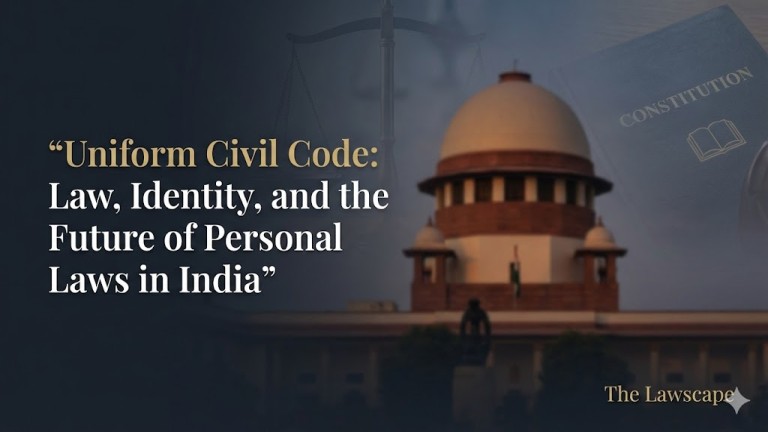
Author: Shivani Chaudhary
Student, Starex University, Haryana
—————————————————————————————————————-
I. Introduction
UCC is a commonly used abbreviation for Uniform Civil Code. The term Uniform is used to include all the citizens of India, irrespective of religion. The term “civil” refers to laws governing personal matters rather than criminal or political rights. Uniform Civil Code is purposed to maintain uniformity across the country and strengthen the unitary legal framework of the nation.
This blog highlights how UCC applies to all citizens and how it aims to replace individual personal laws.
II. Meaning and Scope of the Uniform Civil Code
The focus of Uniform Civil Code is to maintain equality for all citizens. It seeks to eliminate discrimination arising out of religion-based personal laws, particularly in matters affecting women and vulnerable groups. UCC is also called a Secular Civil Code, meaning that while citizens are free to practice and profess their religion, civil relationships such as marriage and inheritance are governed by common laws.
The UCC refers to a proposed Indian law to ensure uniform personal laws across all religions, promoting equality and secularism. It aims to remove religion-based personal laws and apply a uniform set of civil laws to all citizens, irrespective of religion. Matter covered under personal laws include marriage, divorce, maintenance, inheritance, adoption and succession of property.
III. Constitutional Basis of the UCC
The constitutional foundation of the Uniform Civil Code lies in Article 44 of the Constitution of India, which forms part of the Directive Principle of State Policy (DPSP). Article 44 states that the State shall endeavor to secure a Uniform Civil Code for all its citizens. Although DPSPs are not enforceable by courts, they serve as guiding principles for governance and legislative action.
The objective of Article 44 is to promote national integration and equality before law while gradually reforming personal laws. The main objective of UCC is to bring consistency in personal laws across different communities and remove religious barriers in civil matters.
IV. Latest Updates Regarding UCC
Uttarakhand became the first state in India to implement a version of the Uniform Civil Code. The government of Uttarakhand notified amendments to its UCC framework in October 2025, addressing issues related to marriage registration involving citizens of Nepalese, Bhutanese, and Tibetan origin. This move was aimed at removing procedural ambiguity and ensuring inclusive application of civil laws.
Meanwhile, the Assam government has also actively taken steps aligned with the objectives of the Uniform Civil Code. Recently, by passing legislation, it prohibited polygamy, signaling reform in personal laws. Although Assam has not enacted a comprehensive UCC, these reforms reflect a gradual movement toward uniform civil principles.
The Delhi High Court has emphasized the need to address conflicts between personal laws and national legislation, particularly in cases involving child marriage. The Court raised the question, “is it not time for a Uniform Civil Code?” Justices Arun Monga, a single-bench judge, observed that while certain interpretations of Islamic law permit marriage upon attainment of puberty, Indian criminal law strictly prohibits child marriage. The observation was made in Hamid Raza v. State of NCT of Delhi, highlighting the need for uniformity in civil laws to protect constitutional rights.
Similarly, the Karnataka High Court has urged Parliament and State Legislatures to make sincere efforts towards implementing the Uniform civil Code. The Court noted that the UCC would give true meaning to the word “secular” in the Preamble of the Constitution of India. Such judicial pronouncements reflect increasing constitutional concern over legal fragmentation in personal laws.
Above all, the ruling Party has also shown repeatedly its will to implement the UCC, the Union Home Minister has publically addressed the issue of the Uniform Civil Code, stating that the government remains committed to examining and implementing UCC reforms in the future. This positions the UCC not merely as a legal issue but as a significant policy question in contemporary governance.
V. Challenges faced while implementing the UCC
The government faces significant challenges in implementing the Uniform Civil Code, including:
- Political Concerns: Political parties may resist such reforms due to concerns over electoral consequences. Personal laws are closely linked with religious identity, making the issue politically sensitive.
- Religious and Customary Issues: India is a country with immense religious and cultural diversity. Different communities follow distinct customs and traditions governing marriage, adoption, and inheritance, making it difficult to design a single law acceptable to all.
- Inadequate Public Awareness: Many citizens are not fully aware of the objectives and scope of the UCC, leading to misinformation and fear. Greater public dialogue and awareness are essential for informed democratic participation.
VI. Conclusion
The Uniform Civil Code represents a constitution aspiration rooted in equality, secularism, and justice. While Article 44 provides the directive, its realization requires careful balancing of reform and cultural pluralism.
The objective of the UCC is not to erase religious diversity but to ensure uniform civil rights and gender justice across communities. As India continues to evolve, the debate around the UCC must be guided by constitutional morality, inclusive dialogue, and democratic consensus rather than political polarization.
** Disclaimer: The views expressed in this article are those of the author and do not necessarily reflect the views of The Lawscape.
The Lawscape — clear, practical legal insight for students and future lawyers.