
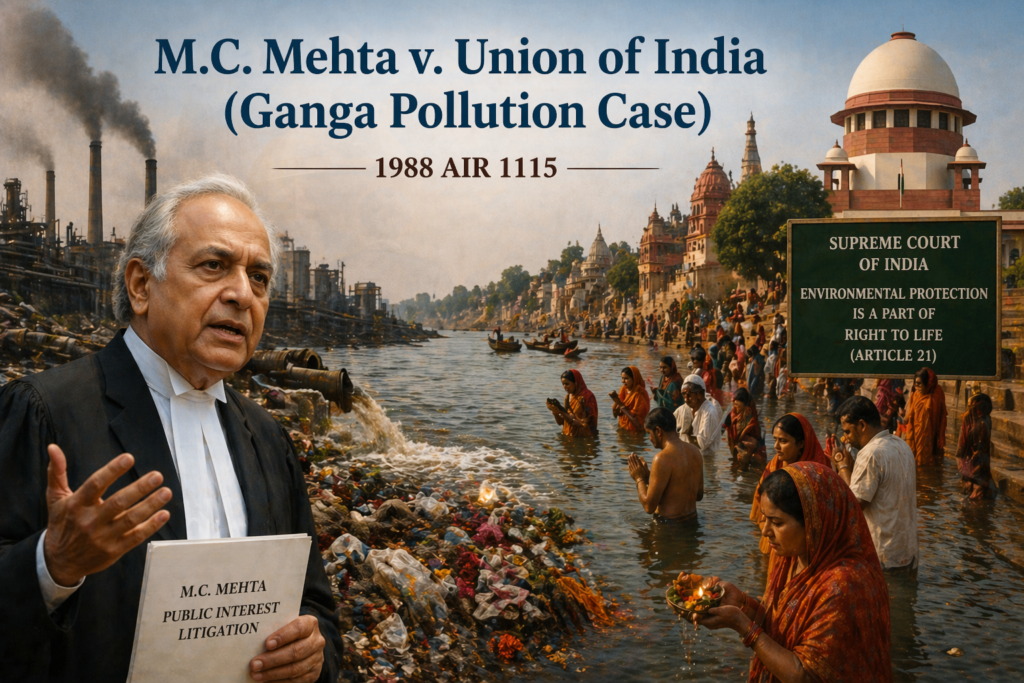
M.C. Mehta v. Union of India (Ganga Pollution Case), 1988 AIR 1115
Author: Vishnupriya Arvind Shukla
Student, KES Shri Jayantilal H Patel Law College, Mumbai
—————————————————————————————————
💡 3 Quick Takeaways
- The Supreme Court expanded Article 21 to include the right to a clean and healthy environment.
- Industries were held accountable and required to install pollution control mechanisms or face closure.
- The case strengthened Public Interest Litigation as a tool for environmental protection.
INTRODUCTION
Environmental protection has emerged as one of the most crucial legal and social concerns in modern India. Rapid industrialization, urbanization, and population growth have significantly strained the country’s natural resources, particularly its rivers. Among these rivers, the Ganga holds immense cultural, religious, and economic significance. However, over time, the river has suffered severe degradation due to industrial waste, sewage discharge, and other pollutants.
The Ganga Pollution Case, popularly known as M.C. Mehta v. Union of India, stands as one of the most significant environmental cases in Indian constitutional law. The case was initiated by M.C. Mehta, a well-known environmental lawyer and activist who has played a major role in shaping environmental jurisprudence in India through public interest litigation. Concerned about the alarming level of pollution in the River Ganga, he approached the Supreme Court of India under Article 32 of the Constitution, seeking judicial intervention to enforce environmental protections and safeguard the fundamental rights of citizens. The case represents a milestone in Indian environmental law because it expanded the interpretation of Article 21 (Right to Life) to include the right to a clean and healthy environment.
Through this judgment, the Court not only addressed the issue of industrial pollution in the Ganga but also laid down important legal principles such as corporate responsibility, strict environmental regulation, and judicial activism in environmental matters.
FACTS OF THE CASE
The River Ganga is considered the most sacred river in India and serves as a vital source of water for millions of people. Despite its importance, the river has been subjected to extensive pollution due to industrialization and inadequate waste management practices.
Industries located along the riverbanks discharged untreated chemical waste, while municipalities released untreated sewage directly into the river. Tanneries in Kanpur were among the major contributors to pollution, as they released hazardous chemicals and toxic effluents into the river without proper treatment.
Concerned about the deteriorating condition of the Ganga, M.C. Mehta filed a Public Interest Litigation (PIL) before the Supreme Court of India. The petition sought action against industries and authorities responsible for polluting the river and demanded stricter enforcement of environmental laws.
The petitioner argued that pollution of the Ganga violated the fundamental rights of citizens, particularly the right to life guaranteed under Article 21 of the Constitution.
ISSUES RAISED
• Whether discharge of untreated industrial waste into the River Ganga violated the fundamental rights under Article 21.
• Whether industries could be held legally responsible for environmental pollution.
• Whether the Supreme Court could enforce environmental protection through PIL under Article 32.
• Whether municipalities and authorities were accountable for sewage entering the river.
• Whether economic development could justify environmental degradation.
ARGUMENTS IN FAVOUR OF THE PETITION
The petitioner argued that the Right to Life under Article 21 includes the right to a clean and healthy environment. Pollution of the Ganga endangered the health of millions of people who depended on the river for drinking water, agriculture, and daily use. Therefore, industrial pollution constituted a direct violation of fundamental rights. It was further contended that industries were discharging toxic chemicals and untreated waste into the river without complying with environmental norms. This not only degraded the ecosystem but also posed serious health risks to the population.
The petitioner also highlighted the failure of government authorities in regulating pollution. Municipal bodies were responsible for proper sewage management but had failed to prevent untreated waste from entering the river.
Additionally, it was emphasized that economic development cannot come at the cost of environmental destruction. Sustainable development must be prioritized, and industries must be held accountable for the harm caused.
ARGUMENTS AGAINST THE PETITION
Industries argued that shutting down factories would result in severe economic consequences, including loss of employment for thousands of workers. They contended that installing pollution control mechanisms such as Effluent Treatment Plants (ETPs) required substantial financial investment, which could not be immediately borne by all industries.
The respondents also argued that pollution of the Ganga was not solely due to industrial activities. Domestic sewage, religious practices, and other human activities also contributed significantly to contamination. Therefore, responsibility should not be imposed exclusively on industries.
JUDGMENT
The Supreme Court delivered a landmark judgment emphasizing the importance of environmental protection. It held that the right to a clean and healthy environment is an integral part of the Right to Life under Article 21 of the Constitution. The Court directed all industries discharging waste into the Ganga to install Effluent Treatment Plants (ETPs). It further ordered that industries failing to comply with these directions would be shut down. This marked a strong stance by the judiciary in enforcing environmental accountability.
Municipal authorities were also directed to establish proper sewage treatment systems to prevent untreated waste from entering the river. The Court stressed that public authorities cannot neglect their duty to maintain environmental standards.
The judgment also reinforced the principle of sustainable development and highlighted the need for preventive measures. The Court emphasized that environmental harm must be addressed at its source and that industries must bear the cost of preventing pollution. This decision strengthened the concept that environmental protection is not optional but a legal obligation, binding on both industries and the State.
CONCLUSION
The decision in M.C. Mehta v. Union of India represents a landmark moment in the development of environmental law in India. The case demonstrated the power of Public Interest Litigation as a tool for protecting the environment and safeguarding citizens’ rights. By interpreting Article 21 to include the right to a clean and healthy environment, the Supreme Court significantly expanded the scope of fundamental rights. Although the case resulted in major legal reforms, the challenge of cleaning the Ganga continues due to issues such as weak enforcement and infrastructural limitations.
Nevertheless, the case laid the foundation for modern environmental governance in India and continues to influence environmental policies and conservation efforts. It remains a powerful example of judicial intervention in protecting both the environment and fundamental rights.
Disclaimer: The views expressed in this article are those of the author and do not necessarily reflect the views of The Lawscape.
The Lawscape — clear, practical legal insight for students and future lawyers.