
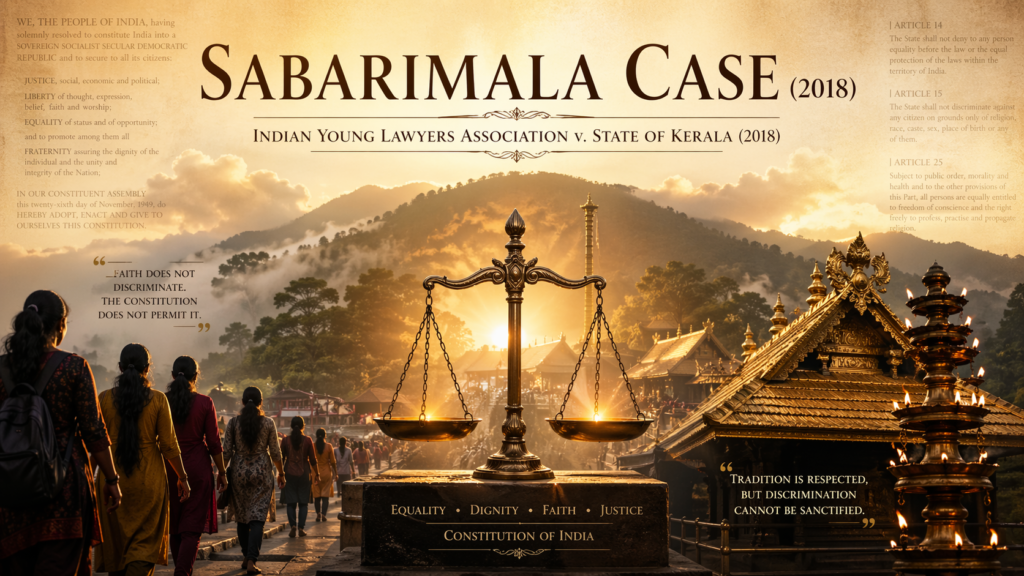
Indian Young Lawyers Association v. State of Kerala (2018) 10 SCC 689 (Sabarimala Case)
Author: Prity Bhagat
Student, KES Shri Jayantilal H Patel Law College
———————————————————————————————
💡 3 Quick Takeaways
- The Supreme Court held that exclusion of women from Sabarimala violated Articles 14, 15, and 25.
- The “essential religious practices” doctrine was central in determining constitutional protection.
- The judgment reinforced that constitutional morality prevails over discriminatory religious customs.
INTRODUCTION
The Indian Constitution guarantees both fundamental rights and religious freedom, often requiring courts to strike a delicate balance between the two. One of the most significant cases reflecting this tension is Indian Young Lawyers Association v. State of Kerala, popularly known as the Sabarimala Temple case.
This case addressed the long-standing practice of prohibiting women between the ages of 10 and 50 from entering the Sabarimala Temple in Kerala. The restriction was based on the belief that Lord Ayyappa is a celibate deity, and the presence of women of menstruating age would violate this celibacy.
The case raised important constitutional questions regarding gender equality, religious freedom, and the scope of judicial intervention in matters of faith. The Supreme Court’s judgment became a landmark decision in Indian constitutional law, emphasizing that fundamental rights cannot be overridden by discriminatory religious practices.
FACTS OF THE CASE
The Sabarimala Temple in Kerala is dedicated to Lord Ayyappa and is one of the most visited pilgrimage sites in India. For decades, the temple followed a practice of restricting entry of women between the ages of 10 and 50, citing religious traditions.
The restriction was supported by Rule 3(b) of the Kerala Hindu Places of Public Worship (Authorisation of Entry) Rules, 1965, which allowed exclusion of women at certain times based on custom.
In 2006, the Indian Young Lawyers Association filed a Public Interest Litigation under Article 32 of the Constitution before the Supreme Court. The petition challenged the constitutional validity of the practice, arguing that it violated fundamental rights of women.
The matter was referred to a Constitution Bench due to the substantial questions of constitutional interpretation involved.
ISSUES RAISED
• Whether the exclusion of women from Sabarimala Temple violated Article 14 (Right to Equality).
• Whether the practice constituted discrimination under Article 15.
• Whether the restriction violated women’s right to worship under Article 25.
• Whether the practice was protected as an essential religious practice.
• Whether Rule 3(b) of the 1965 Rules was constitutionally valid.
ARGUMENTS OF THE PETITIONERS
The petitioners argued that the exclusion of women was a clear violation of Article 14, as it denied equal access to a public religious institution. The practice was arbitrary and based on biological factors, thereby constituting gender discrimination under Article 15.
They further contended that Article 25 guarantees the right to freely practice religion, and this right extends equally to women. Denying women entry to the temple deprived them of their right to worship.
It was also argued that the practice of excluding women was not an essential religious practice of Hinduism. Many temples across India allow entry to women, indicating that such exclusion is not fundamental to the religion.
Additionally, the petitioners emphasized that constitutional morality must prevail over social or religious practices that are discriminatory in nature.
ARGUMENTS OF THE RESPONDENTS
The respondents, including the Travancore Devaswom Board, argued that the Sabarimala Temple has a unique religious tradition that must be preserved. The restriction on women was based on the celibate nature of Lord Ayyappa and formed an integral part of temple customs. They contended that under Article 25, religious denominations have the right to manage their own affairs in matters of religion. Judicial interference in such practices would violate religious freedom.
It was further argued that the restriction was not discriminatory but based on religious beliefs and customs, and therefore should be protected under the Constitution.
JUDGMENT
The Supreme Court, in a 4:1 majority, held that the exclusion of women from the Sabarimala Temple was unconstitutional. The Court struck down Rule 3(b) of the Kerala Hindu Places of Public Worship Rules, 1965, as being violative of fundamental rights. The majority held that the practice violated Article 14 by denying equality and equal access to women. It also violated Article 15 as it constituted discrimination based on sex. Further, the Court held that the restriction infringed upon women’s right to freely practice religion under Article 25. The judges observed that the right to worship cannot be denied on the basis of gender.
On the issue of essential religious practices, the Court held that the exclusion of women was not an essential part of the religion. Therefore, it did not qualify for constitutional protection.
Justice D.Y. Chandrachud, in his opinion, emphasized the concept of constitutional morality and stated that practices rooted in discrimination cannot be upheld merely because they are traditional.
Justice Indu Malhotra dissented, holding that matters of deep religious faith should not be ordinarily interfered with by courts, and that the determination of essential religious practices should be left to the religious community.
CONCLUSION
The Sabarimala judgment represents a significant step in advancing gender equality and reinforcing constitutional supremacy. It clarified that religious practices must conform to fundamental rights and cannot be used to justify discrimination. The decision also highlighted the importance of constitutional morality as a guiding principle in interpreting rights and freedoms. At the same time, the dissenting opinion reflects the ongoing debate regarding the extent of judicial intervention in religious matters. Overall, the case stands as a landmark in Indian constitutional jurisprudence, demonstrating the evolving relationship between law, religion, and social reform.
Disclaimer: The views expressed in this article are those of the author and do not necessarily reflect the views of The Lawscape.
The Lawscape — clear, practical legal insight for students and future lawyers.