
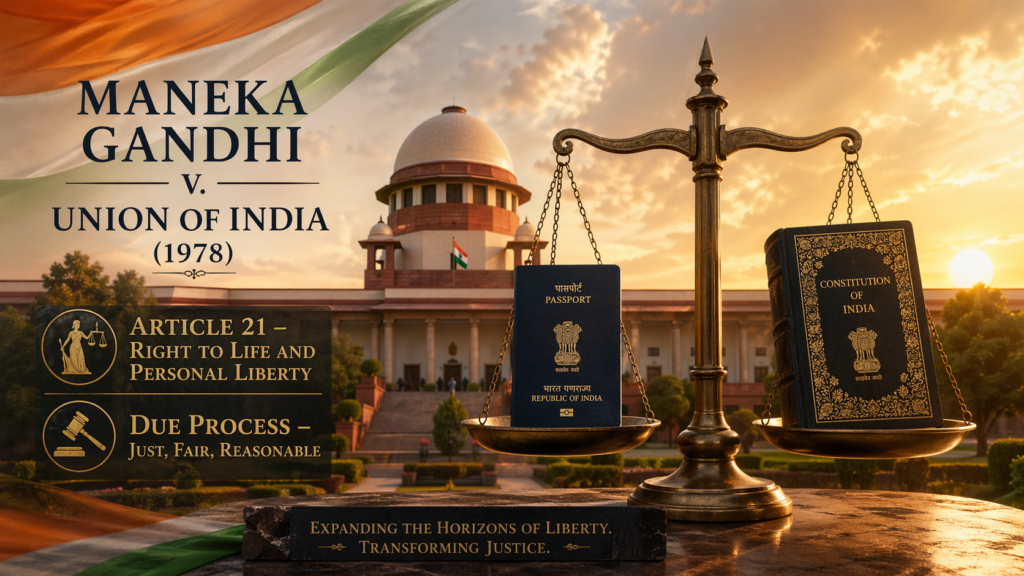
Maneka Gandhi v. Union of India and Another
AIR 1978 SC 597 | (1978) 1 SCC 248
Author: Yashvi Pramanick
Student, KES Shri Jayantial H Patel Law College
—————————————————————————————-
3 Quick Takeaways
- Maneka Gandhi v. Union of India (1978) is the landmark Supreme Court decision that transformed the interpretation of Article 21, holding that “procedure established by law” must be just, fair, and reasonable, thereby extending constitutional protection against arbitrary legislative action and not merely arbitrary executive action.
- The Court introduced the “Golden Triangle” doctrine, establishing that Articles 14, 19, and 21 are not mutually exclusive but are interdependent, and that any law depriving a person of personal liberty must withstand scrutiny under all three provisions simultaneously.
- By expressly overruling A.K. Gopalan v. State of Madras (1950), the Supreme Court expanded the scope of fundamental rights to include the right to travel abroad as part of personal liberty under Article 21, and introduced the doctrine of post-decisional hearing as an instrument of procedural fairness.
Background of the Case
This case marks a significant turning point in the development of Indian constitutional law, especially concerning the interpretation of Article 21 of the Constitution, which safeguards the right to life and personal liberty. This landmark ruling by the Supreme Court greatly broadened the definition of fundamental rights and changed the dynamics between individual rights and the powers of the state.
The dispute originated when Maneka Gandhi, a prominent journalist, challenged the impoundment of her passport by the Indian Government, which prevented her from travelling abroad. The case is not only landmark with respect to the interpretation of Article 21 but also provided a completely new approach to Part III of the Indian Constitution as a whole. Prior to this decision, Article 21 had been understood as protecting the right to life and personal liberty primarily against arbitrary executive action. This case expanded that protection to cover legislative actions as well. The Supreme Court also introduced the “Golden Triangle” rule, strengthening its role as the guardian of constitutional democracy. The decision pronounced on 25 January 1978 signalled the beginning of a new phase in the interpretation and understanding of fundamental rights under the Constitution.
Facts of the Case
The petitioner Maneka Gandhi’s passport was issued on 1 June 1976 under the Passports Act, 1967. On 2 July 1977, the Regional Passport Office in New Delhi sent a letter to the petitioner directing her to surrender her passport, without stating any grounds for doing so.
The petitioner immediately addressed a letter to the Regional Passport Officer requesting a copy of the statement of reasons for the order, as provided under Section 10(5) of the Act. A reply was sent by the Government of India, Ministry of External Affairs, on 6 July 1977, stating that the Government had decided to impound her passport “in the interest of general public” as provided under Section 10(3)(c) of the Act, and further that the Government would not furnish her a copy of the statement of reasons for making the order.
The petitioner accordingly invoked the Supreme Court’s writ jurisdiction and contended that the impoundment of her passport constituted a clear infringement of her right to personal liberty guaranteed under Article 21. In response, the authorities stated that it was not in the “interest of general public” to disclose the reasons. The petitioner responded by filing a writ petition under Article 32, claiming that Section 10(3)(c) of the Passports Act violated her fundamental rights under Articles 14, 19, and 21 of the Constitution.
Issues Involved
- Whether the nature of fundamental rights is absolute or conditional, and what is the extent of the rights guaranteed to Indian citizens under the Constitution.
- Whether the right to travel abroad falls within the scope and protection of Article 21 of the Constitution.
- Whether there is an interrelationship or nexus between Articles 14, 19, and 21 of the Constitution.
- The meaning and scope of the phrase “procedure established by law” as used in Article 21.
- Whether Section 10(3)(c) of the Passports Act, 1967, violates the fundamental rights of citizens, and if so, whether such legislation can be regarded as valid law.
- Whether the impugned order of the Regional Passport Officer was in contravention of the principles of natural justice.
Analysis
A. Contentions of the Petitioner
By seizing the passport of the petitioner, the State had clearly violated and encroached upon her fundamental rights, including the right to life and personal liberty and the right to travel abroad. The right to travel abroad is a derivative of the right to “personal liberty” under Article 21, and no citizen can be deprived of this right except according to a procedure established by law.
The petitioner argued that Articles 14, 19, and 21 are complementary to each other and must be interpreted harmoniously and conjunctively, without conflict. To uphold the intention of the Constituent Assembly and to give effect to the spirit of the Constitution, these articles must be read together. Fundamental rights are guaranteed to every citizen by virtue of their humanity and exist as protections against exploitation by the state. They should therefore be interpreted expansively and comprehensively to provide the fullest possible protection.
Any procedure established by law must be free from arbitrariness and must comply with the principles of natural justice. An essential constituent of natural justice is the principle of “Audi Alteram Partem,” meaning that every individual must be given a reasonable opportunity to be heard. This opportunity was not granted to the petitioner. The Central Government further violated Article 21 by failing to offer the petitioner a hearing before impounding her passport, and the impoundment order was therefore in contravention of the principles of natural justice.
The petitioner also argued that Section 10(3)(c) of the Passports Act is violative of Article 21 to the extent that it infringes upon the broad protections of the right to life and personal liberty. The Passports Act, 1967, does not prescribe any procedure for confiscating, revoking, or impounding the passport of its holder. The provision is therefore unreasonable and arbitrary.
The petitioner highlighted the importance of judicial review in cases dealing with administrative action and law. The judiciary has a vital role in scrutinising the legality of executive orders, and the petitioner sought judicial examination of whether the impoundment of her passport was constitutionally valid.
B. Contentions of the Respondents
The respondent informed the court that the petitioner’s passport was impounded because she was required to appear before a government committee for a hearing. The respondent contended that the Passports Act was not enacted to adversely affect fundamental rights in any manner, and that the government should not be compelled to disclose its reasons for impounding a passport when the action is taken for the public good.
Relying upon the principle laid down in A.K. Gopalan v. State of Madras (1950), the respondent contended that the word “law” in Article 21 cannot be understood in light of the fundamental rules of natural justice, since those rules are vague and ambiguous and the Constitution should not import such vague provisions.
The respondent further argued that the phrase “procedure established by law” in Article 21 does not require that such procedure must pass the test of reasonableness or be in consonance with Articles 14 and 19. The members of the Constituent Assembly had deliberated at length on both the British concept of “procedure established by law” and the American concept of “due process of law,” and the apparent omission of the “due process” clause from the final Constitution demonstrated the intent of the framers to exclude it.
Finally, the respondent contended that the right to travel abroad was never covered under any clause of Article 19(1), and that Article 19 is therefore not relevant to testing the reasonableness of the actions taken by the Central Government.
Judgment
The Supreme Court upheld its earlier decision in Satwant Singh Sawhney v. D. Ramarathnam (1967) and reaffirmed that the right to personal liberty under Article 21 includes the right to travel abroad as a fundamental right. The Court held that “personal liberty” must be understood broadly and liberally and should not be given a narrow or strict meaning. Since the State had not made any law regulating or restricting the right to travel abroad in the circumstances applicable to the petitioner, the impoundment of her passport was in violation of Article 21, and the absence of any stated reason rendered the order arbitrary and therefore in violation of Article 14.
The Court further held that clause (c) of Section 10(3) of the Passports Act, 1967, requires that when the state finds it necessary to seize or impound a passport in the interests of the sovereignty or integrity of the nation, the authority must record the reasons in writing and, on demand, furnish a copy of those reasons to the passport holder. The Central Government had not disclosed any reasons for impounding the petitioner’s passport; rather, she was informed only that the act had been done in “the interests of general public,” which was wholly insufficient.
Overruling of A.K. Gopalan: The Court expressly overruled A.K. Gopalan v. State of Madras (1950), holding that there is a unique and indispensable relationship between the provisions of Articles 14, 19, and 21, and that every law depriving a person of their liberty must pass the tests prescribed by all three provisions. In Gopalan, the majority had held that these provisions were mutually exclusive. The Court in Maneka Gandhi corrected this position, holding that these provisions are not mutually exclusive but are interdependent and must be read together.
The Golden Triangle: The Court propounded that Articles 14, 19, and 21 constitute the “Golden Triangle” of the Constitution. This means that the protection afforded under any one of these articles must also withstand the tests laid down under the others. Any law depriving a person of personal liberty through a procedure established by law must therefore also satisfy the standards of Articles 14 and 19. As the Court stated: “The fundamental rights conferred in Part III of the Constitution are not distinctive nor mutually exclusive. Any law depriving a person of liberty has to stand the test of one or more of the fundamental rights conferred under Article 19.”
Procedure Established by Law: The Court declared that the “procedure established by law” mentioned in Article 21 does not merely mean that a procedure exists in statute and is being followed by the executive. It also requires that the procedure so established is just, fair, and reasonable. Through this ruling, constitutional protection was extended from executive actions to legislative actions as well, meaning that the validity of a law itself is now subject to scrutiny. The Court effectively narrowed the distinction between “due process of law” and “procedure established by law” in the Indian context.
Principles of Natural Justice: The Court held that the impoundment of the petitioner’s passport constituted a clear infringement of the basic principle of natural justice known as audi alteram partem, the right to be heard, which cannot be set aside as unfair or unjust even where a statute is silent on the matter. An administrative decision that affects the fundamental rights of a citizen must be taken in adherence to the principles of natural justice. Even an administrative body is bound by these principles, precisely because its decisions are likely to affect the fundamental rights of individuals that must be safeguarded against arbitrary executive action.
Rights Beyond Territorial Boundaries: The Court observed that it is possible for rights related to human values to be protected by fundamental rights even if not explicitly mentioned in the Constitution, such as freedom of the press being covered under Article 19(1)(a). The Court further noted that merely because the state’s action is restricted to its territory, this does not mean that fundamental rights are similarly restricted in their scope.
Post-Decisional Hearing: The respondents had contended that strictly following the rule of audi alteram partem would frustrate the very purpose of impounding the passport, and that it is not always possible to give every individual a prior hearing. The Court rejected this contention and introduced the concept of the post-decisional hearing. This means that when a pre-decisional hearing is not practicable, an authority may pass a temporary order and then afford the individual an opportunity to be heard before taking the final decision. This ensures administrative efficiency while also preserving fairness to the individual.
Conclusion
The decision in Maneka Gandhi v. Union of India has come to be regarded as one of the most significant judgments in Indian constitutional history. It provided a fresh and expanded understanding of what life and personal liberty under Article 21 of the Constitution mean. It also broadened the scope of freedom of speech and expression so that the right is no longer confined strictly by the nation’s territorial limits. Judicial activism played a great role in this case, adding a new chapter to the history of fundamental rights and their interpretation. Commonly known as the “Golden Triangle Case,” it involved simultaneous challenges to Articles 14, 19, and 21, all of which were effectively and comprehensively addressed by the Supreme Court. The judgment remains the foundational authority for the proposition that any law touching upon the personal liberty of a citizen must be just, fair, and reasonable in substance, not merely in form.
References
- Maneka Gandhi v. Union of India, (1978) 1 SCC 248 (India).
- A.K. Gopalan v. State of Madras, AIR 1950 SC 27 (India).
- Satwant Singh Sawhney v. D. Ramarathnam, AIR 1967 SC 1836 (India).
- Pooja Kumari, Case Comment on Maneka Gandhi v. Union of India, 4(2) Indian J. Integrated Rsch. L. 150 (2024).
- Maneka Gandhi v. Union of India: A Blueprint for Article 21, Indian J.L. and Legal Rsch. (IJLMH).
- Maneka Gandhi v. Union of India, iPleaders (Feb. 20, 2024).
Disclaimer: The views expressed in this article are those of the author and do not necessarily reflect the views of The Lawscape.
The Lawscape — clear, practical legal insight for students and future lawyers.