Protecting Children in the Digital Age: A Commentary on Just Rights for Children Alliance v. S. Harish (2024 INSC 716)
Author: Siddhi Ruparel
——————————————————–
3 Quick Takeaways
- The Supreme Court’s ruling firmly established that the mere possession, storage, or viewing of child sexual exploitative and abuse material (CSEAM) constitutes an offence under Section 15 of the POCSO Act and Section 67B of the Information Technology Act, overturning the Madras High Court’s dangerously narrow reading of the law.
- The Court held that Section 30 of POCSO, which presumes the existence of a culpable mental state, plays a crucial role in cases involving CSEAM possession, and that prolonged storage of such material can itself be evidence of intent to transmit or share it.
- This judgment reinforces that fundamental rights, including the right to privacy, cannot serve as a shield for acts involving the sexual exploitation of children, and calls on the State, institutions, and society collectively to combat child exploitation in the digital age.
Court: Supreme Court of India Citation: 2024 INSC 716 Bench: Chief Justice D.Y. Chandrachud and Justice J.B. Pardiwala Date: 23 September 2024
Introduction
In Just Rights for Children Alliance v. S. Harish, 2024 INSC 716, the Supreme Court of India addressed one of the most pressing questions in the intersection of child protection law and digital technology: does the possession and consumption of child sexual exploitative and abuse material (CSEAM) constitute a punishable offence under Indian law, even in the absence of transmission or publication?
The bench comprising Chief Justice D.Y. Chandrachud and Justice J.B. Pardiwala answered this question with clarity and conviction. The judgment clarified the scope of the relevant provisions of the Protection of Children from Sexual Offences Act, 2012 (POCSO Act) and the Information Technology Act, 2000, and sent an unambiguous message: in the digital age, passive consumption of CSEAM is not a victimless act, and the law will not treat it as one.
This commentary examines the factual background of the case, the legal issues raised, the Supreme Court’s reasoning, and the broader implications of the judgment for child protection law in India.
Background
On 29 January 2020, the All-Women Police Station in Ambattur, Chennai, received a Cyber Tipline report through the National Crime Records Bureau (NCRB), originating from the National Center for Missing and Exploited Children (NCMEC). The report indicated that a person named S. Harish had been actively consuming child pornographic content on his mobile device for over two years.
Upon forensic examination of Harish’s mobile phone, multiple pornographic videos featuring children being sexually exploited were discovered, including material involving children who had been reported missing. An FIR was registered, and a charge sheet was subsequently filed against Harish under Section 15(1) of the POCSO Act and Section 67B of the Information Technology Act.
Harish approached the Madras High Court seeking to quash the criminal proceedings against him. The High Court ruled in his favour, cancelling the charges on the ground that the mere possession or viewing of child pornographic material did not constitute an offence without proof of transmission or publication. It further held that Section 14(1) of POCSO required that a child be directly used by the accused for pornographic purposes, which it found was not established in this case.
This ruling was challenged before the Supreme Court by Just Rights for Children Alliance, a coalition of five NGOs working against child trafficking and sexual exploitation, along with another child rights organisation. The appellants argued that the High Court’s interpretation created a dangerous loophole: if mere possession was not punishable, individuals could store illegal material indefinitely without legal consequence, so long as they did not actively share it. They further argued that the demand for CSEAM is itself a driver of child exploitation, and that possession must therefore be treated as a serious offence in its own right.
Facts
On 29 January 2020, based on the NCRB Cyber Tipline report, police in Tamil Nadu filed an FIR against S. Harish for possession of child pornographic material.
During the investigation, CSEAM was found stored on Harish’s mobile phone. Some of the material involved children who had been sexually exploited and were also listed as missing persons.
Harish was charged under Section 15(1) of the POCSO Act and Section 67B of the IT Act. He then approached the Madras High Court, seeking to revoke the criminal proceedings.
In January 2024, the Madras High Court quashed the charge sheet, ruling that mere possession or viewing of child pornographic material did not amount to an offence under either the POCSO Act or the IT Act.
Just Rights for Children Alliance filed an appeal before the Supreme Court, arguing that the High Court’s ruling would establish a dangerous precedent by suggesting that downloading and possessing CSEAM was legally permissible.
Issues
The Supreme Court was called upon to determine the following:
Whether the possession or downloading of CSEAM, without proof of transmission or publication, constitutes an offence under Section 15 of the POCSO Act and Section 67B of the IT Act.
Whether the High Court erred in failing to consider Section 30 of the POCSO Act, which presumes the existence of a culpable mental state when an accused is found in possession of CSEAM.
Whether the provisions of Section 15 of the POCSO Act and Section 67B of the IT Act require a broader, purposive interpretation in light of the child protection objectives of the legislation.
Analysis
Broad versus Narrow Interpretation
The Supreme Court held that the Madras High Court had adopted an impermissibly narrow interpretation of Section 15(1) of the POCSO Act. The Court reasoned that the plain language and legislative intent of the section extended well beyond the limits suggested by the High Court. The POCSO Act, the Court emphasised, is a child-centric statute that must be interpreted to advance its protective purpose, not to curtail it.
Scope of Section 67B of the IT Act
The Court held that Section 67B of the Information Technology Act is not limited to acts of publication or transmission of CSEAM. It also expressly punishes acts of downloading, browsing, and possession. The High Court’s reading, which confined the section’s reach to active dissemination, was therefore inconsistent with the text and structure of the provision.
The Role of Section 30 of POCSO
Section 30 of the POCSO Act establishes a statutory presumption of culpable mental state in any prosecution under the Act. The Supreme Court emphasised that this provision plays a critical role in cases of CSEAM possession. The Court observed that where an accused has stored such material over a prolonged period and has failed to remove it, the inference of an intent to transmit or share the material is not only permissible but reasonable. Prolonged storage is itself indicative of purpose, even where no active distribution has yet occurred.
Upholding the Rights of Children
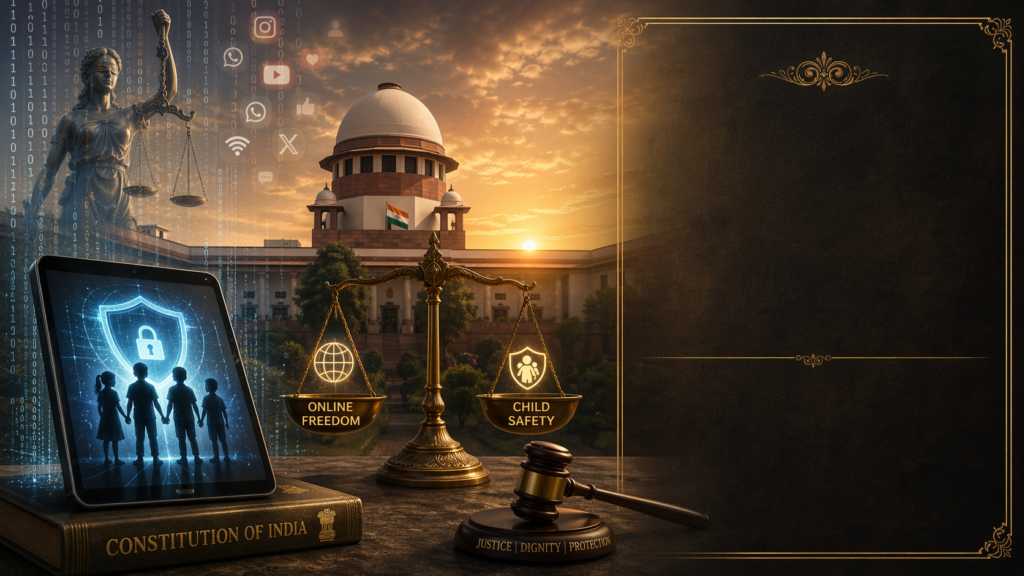
The Court underscored that the need to protect children as a vulnerable group requires courts to balance the personal liberty of the accused against the overriding societal interest in child protection. In cases involving children, this balance must be struck with a broad, welfare-oriented lens. The Court made clear that the right to privacy, while fundamental, cannot serve as a cover for conduct that causes grave harm to children. The constitutional promise of dignity and safety extends to every child, and no plea of personal liberty can override that commitment.
Case Law: Independent Thought v. Union of India (2017 INSC 1030)
The Supreme Court relied on its earlier ruling in Independent Thought v. Union of India, 2017 INSC 1030, which held that the POCSO Act must be interpreted in a manner consistent with the best interests and welfare of the child. That judgment recognised the child’s dignity as the foundational concern of the legislation, and the Court in the present case extended this principle to hold that laws designed to protect children from exploitation must not be read in ways that render their protection illusory.
Conclusion
The Supreme Court’s ruling in Just Rights for Children Alliance v. S. Harish is a pivotal judgment in India’s legal response to child sexual exploitation in the digital age. By clarifying that Section 15 of the POCSO Act covers all forms of engagement with CSEAM, including possession and viewing, and by affirming that Section 67B of the IT Act applies broadly to acts beyond mere publication, the Court has closed the dangerous interpretive gap that the Madras High Court had opened.
In striking down the lenient approach adopted below, the Supreme Court made clear that intentional possession of CSEAM is not a peripheral wrong: it is a direct contribution to the perpetuation of child exploitation, and it will be met with the full rigour of the law.
The judgment also makes a vital point about the limits of fundamental rights. Privacy is a right of profound constitutional importance, but it cannot be invoked to shield conduct that inflicts harm on the most vulnerable members of society. The dignity of the child must always prevail.
At the same time, the Court acknowledged that legal measures alone are insufficient. Combating child exploitation requires greater public awareness, responsible digital behaviour, comprehensive education from an early age, and robust reporting mechanisms. This judgment is both a legal landmark and a call to collective societal responsibility.
End Notes
- Just Rights for Children Alliance and Anr. v. S. Harish and Ors., 2024 INSC 716, Criminal Appeal Nos. 2161-2162 of 2024 (India)
- Sakshi Amit Sawant, The Voice of the Unheard: Reflection on the Just Rights for Children Alliance and Ors. v. S. Harish and Ors., 2 White Black Legal, No. 16 (Nov. 2024).
- Just Rights for Children Alliance v. S. Harish, Dhyeya Law, https://www.dhyeyalaw.in/just-rights-for-children-alliance-v-s-harish (last visited Mar. 9, 2026).
- Independent Thought v. Union of India and Anr., 2017 INSC 1030, (2017) 10 S.C.C. 800 (India)
- Comprehensive Commentary on Just Rights for Children Alliance v. S. Harish, 2024 INSC 716, CaseMine, available at https://www.casemine.com
Disclaimer: The views expressed in this article are those of the author and do not necessarily reflect the views of The Lawscape.
The Lawscape — clear, practical legal insight for students and future lawyers.