
Shayara Bano v. Union of India: Triple Talaq, Constitutional Morality, and Gender Justice
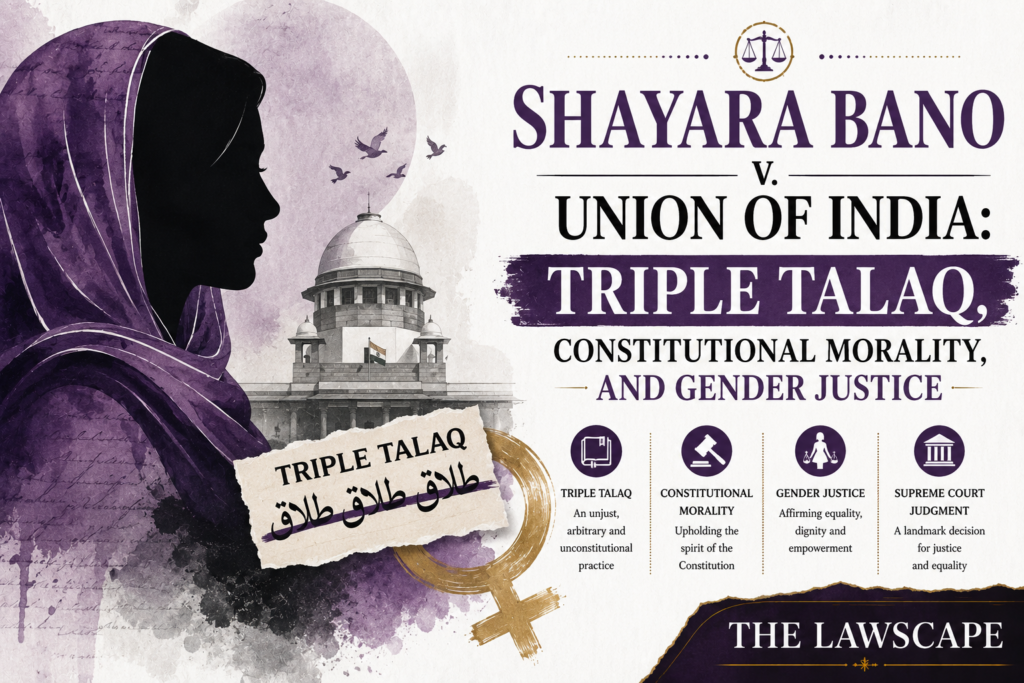
Author: Hrishikesh Deokar
—————————————————————————————————-
💡 3 Quick Takeaways
- The Supreme Court declared Triple Talaq unconstitutional for being arbitrary and violative of fundamental rights.
- The judgment reinforced the constitutional principles of equality, dignity, and gender justice.
- The decision clarified that religious practices are subject to constitutional scrutiny when they infringe fundamental rights.
Introduction
The decision in Shayara Bano v. Union of India is one of the most significant judgments concerning gender justice and constitutional rights in India. The case dealt with Triple Talaq, or Talaq-e-Biddat, which enabled a Muslim husband to instantly dissolve a marriage by pronouncing the word “talaq” three times. The case raised important questions regarding the relationship between personal laws and the fundamental rights guaranteed under the Constitution of India. It required the Supreme Court to determine whether religious practices could continue to receive constitutional protection when they conflicted with principles such as equality, dignity, and non-discrimination.
The judgment is regarded as a landmark decision because it strengthened constitutional morality and advanced the rights of Muslim women while simultaneously addressing the limits of religious freedom under the Constitution.
Case Details
Case Citation: Shayara Bano v. Union of India, (2017) 9 SCC
Court and Bench: Supreme Court of India (Five-Judge Constitution Bench)
Judges: Chief Justice J.S. Khehar, Justice Kurian Joseph, Justice Rohinton Fali Nariman, Justice Uday Umesh Lalit, and Justice S. Abdul Nazeer
Date of Judgment: 22 August 2017
Parties: Petitioner – Shayara Bano; Respondents – Union of India, All India Muslim Personal Law Board, and other intervening parties and organizations involved in the proceedings.
Facts of the Case
The petitioner, Shayara Bano, was married to her husband for several years. During the marriage, she alleged that she had been subjected to cruelty and discrimination. In 2015, her husband dissolved the marriage by pronouncing Triple Talaq.
Shayara Bano challenged the constitutional validity of Triple Talaq before the Supreme Court. She argued that the practice violated her fundamental rights under Articles 14, 15, and 21 of the Constitution. The petition also challenged related practices such as polygamy and Nikah Halala. However, the primary focus of the case remained the legality and constitutional validity of Triple Talaq.
Considering the importance of the constitutional questions involved, the matter was referred to a Constitution Bench consisting of five judges representing different religious backgrounds.
Issues Raised
The Supreme Court considered the following issues:
- Whether Triple Talaq (Talaq-e-Biddat) is protected under Article 25 of the Constitution.
- Whether the practice violates the fundamental rights guaranteed under Articles 14, 15, and 21.
- Whether personal laws are subject to constitutional scrutiny.
- Whether the Court can invalidate a religious practice that is arbitrary and discriminatory.
- Whether Triple Talaq forms an essential religious practice within Islam.
Analysis
The judgment represents a significant development in Indian constitutional jurisprudence because it addressed the conflict between religious freedom and fundamental rights. A majority of the Court held that Triple Talaq was unconstitutional and invalid. The judges reasoned that a practice permitting unilateral and instantaneous dissolution of marriage without any opportunity for reconciliation was manifestly arbitrary and inconsistent with constitutional values.
The Court emphasized that Article 14 guarantees equality before the law and prohibits arbitrary action. A legal practice that grants unrestricted power to one spouse while denying similar rights to the other creates unequal treatment. Triple Talaq enabled Muslim men to terminate marriages instantly without procedural safeguards, thereby placing women in a vulnerable position.
The judgment also reinforced the importance of dignity under Article 21. The Court observed that personal liberty includes the right to live with dignity and security. Practices that expose women to the sudden deprivation of marital status undermine these constitutional protections.
An important aspect of the judgment concerned Article 25. Religious freedom is a fundamental right; however, it is not absolute. The Constitution permits reasonable restrictions and does not protect practices that are inconsistent with public order, morality, health, or other constitutional guarantees. The Court examined Islamic jurisprudence and concluded that Triple Talaq was not universally recognized as an essential religious practice. Several Islamic countries had already prohibited or regulated the practice. This weakened the argument that invalidating Triple Talaq would interfere with the core principles of Islam.
From a constitutional perspective, the judgment illustrates the principle of constitutional supremacy. The Court reaffirmed that all laws and practices, including those derived from personal law systems, must conform to constitutional values.
The judgment has been widely praised for promoting gender justice and protecting vulnerable individuals within personal law frameworks. It aligns with the broader constitutional objective of ensuring substantive equality rather than merely formal equality. However, some scholars have criticized the decision for permitting judicial intervention in matters traditionally considered religious. Critics argue that reforms to personal laws should ideally be undertaken through legislation rather than judicial interpretation.
Despite such criticisms, the judgment reflects a progressive understanding of constitutional rights. It recognizes that personal laws cannot remain immune from scrutiny when they affect individual dignity and equality.
The case also contributed significantly to the debate surrounding the Uniform Civil Code under Article 44 of the Constitution. While the Court did not directly mandate a Uniform Civil Code, the decision revived discussions regarding the reform of personal laws to ensure consistency with constitutional principles.
Another important consequence of the judgment was subsequent legislative action. Parliament enacted the Muslim Women (Protection of Rights on Marriage) Act, 2019, which declared Triple Talaq void and prescribed legal consequences for its practice.
The reasoning adopted by the Court demonstrates how constitutional interpretation can adapt to evolving social realities while preserving the fundamental structure of the Constitution. The judgment therefore represents a balance between respect for religious freedom and the protection of individual rights.
Conclusion
The judgment in Shayara Bano v. Union of India is a landmark decision in Indian constitutional law. By invalidating Triple Talaq, the Supreme Court reinforced the principles of equality, dignity, and gender justice. The case illustrates that constitutional rights occupy a superior position within the legal framework and that religious practices cannot be protected when they violate fundamental rights.
The decision strengthened the constitutional protection available to Muslim women and encouraged broader discussions regarding the reform of personal laws. Despite continuing debates regarding the extent of judicial intervention in religious matters, the judgment remains a significant example of the judiciary’s role in safeguarding constitutional values. Its long-term impact extends beyond Muslim personal law and contributes to the continuing evolution of equality jurisprudence in India.
Disclaimer: The views expressed in this article are those of the author and do not necessarily reflect the views of The Lawscape.
The Lawscape — clear, practical legal insight for students and future lawyers.