
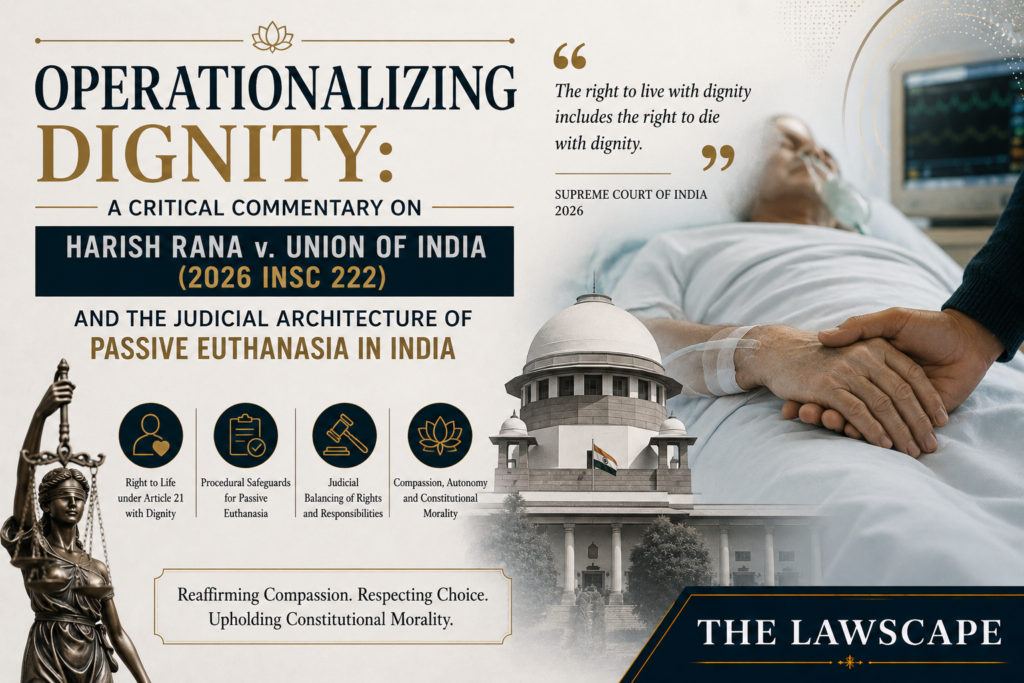
Operationalizing Dignity: A Critical Commentary on Harish Rana v. Union of India (2026 INSC 222) and the Judicial Architecture of Passive Euthanasia in India
Author: Anitta Lilly Joseph
Student, Kochi
————————————————————————————–
💡 3 Quick Takeaways
- Harish Rana v. Union of India marks the first successful implementation of India’s passive euthanasia framework established in Common Cause v. Union of India (2018).
- The Supreme Court classified Clinically Assisted Nutrition and Hydration (CANH) as medical treatment rather than basic care, thereby permitting its withdrawal under appropriate circumstances.
- While the judgment significantly advances the constitutional right to die with dignity, important concerns regarding surrogate decision-making, institutional safeguards, legislative backing, and equitable access remain unresolved.
Abstract
The Supreme Court of India’s landmark ruling in Harish Rana v. Union of India (2026 INSC 222) constitutes the first judicial operationalization of the passive euthanasia framework established by the Constitution Bench in Common Cause v. Union of India (2018). Delivered by Justices J.B. Pardiwala and K.V. Viswanathan, the judgment sanctioned the withdrawal of Clinically Assisted Nutrition and Hydration (CANH) from a patient who had remained in a Permanent Vegetative State (PVS) for over thirteen years. By classifying CANH unequivocally as “medical treatment” rather than basic palliative care, the Court dismantled one of the most formidable ethical barriers to passive euthanasia in India and aligned domestic law with the international consensus established in Airedale NHS Trust v. Bland [1993] and Lambert v. France (2015).
This commentary critically examines the judgment’s doctrinal contributions, assesses the procedural framework against comparative constitutional standards, identifies significant structural gaps—including the absence of a surrogate hierarchy, a conflict-of-interest flaw in the medical board mechanism, and a systemic access deficit—and argues that the Court’s purposive expansion of Article 21 jurisprudence, however commendable, demands urgent legislative consolidation through a comprehensive Medical Treatment Decisions Act.
Keywords: Passive Euthanasia, Article 21, Right to Die with Dignity, CANH, Permanent Vegetative State, Advance Directives, Best Interests Doctrine, Medical Law, Constitutional Law, Bioethics, End-of-Life Care
I. Introduction
On 23 March 2026, Harish Rana, a thirty-one-year-old engineering student from Chandigarh who had existed in a Permanent Vegetative State (PVS) since August 2013, died peacefully at the All India Institute of Medical Sciences, New Delhi, under supervised palliative care. Twelve days earlier, the Supreme Court of India, in Harish Rana v. Union of India, 2026 INSC 222, had sanctioned the withdrawal of his sole life-sustaining intervention: a percutaneous endoscopic gastrostomy (PEG) tube providing Clinically Assisted Nutrition and Hydration (CANH). In doing so, the Court accomplished what eight years of dormant jurisprudence had conspicuously failed to achieve—it transformed the theoretical right to die with dignity into an actionable constitutional guarantee.
The significance of this judgment lies not only in its outcome but in its architecture. The Constitution Bench in Common Cause v. Union of India, (2018) 5 SCC 1, had recognised the right to die with dignity as a fundamental right under Article 21 and constructed the edifice of Advance Directives (Living Wills). Yet, from 2018 to 2026, not a single petition before any Indian court succeeded in obtaining judicial sanction for the withdrawal of life support in a PVS case. The procedural machinery was elaborate; the implementation was nil.
Harish Rana broke this impasse. It is, in the most precise legal sense, the first case in which India’s passive euthanasia framework was actually implemented.
Case Details
| Particulars | Details |
|---|---|
| Case Name | Harish Rana v. Union of India |
| Citation | 2026 INSC 222 |
| Court | Supreme Court of India (Division Bench) |
| Bench | Justices J.B. Pardiwala and K.V. Viswanathan |
| Date of Judgment | 11 March 2026 |
| Patient Facts | PVS since August 2013; PEG-tube CANH sole life-sustaining measure; no Advance Directive executed |
| Core Issue | Whether withdrawal of CANH from an irreversible PVS patient constitutes lawful passive euthanasia under Article 21 read with Common Cause (2018) guidelines |
| Holding | CANH is “medical treatment” and may be withdrawn when no longer in the patient’s best interest, subject to two-tier medical board approval and palliative care supervision; Magistrate’s role is intimation, not permission |
| Significance | First actual implementation of passive euthanasia guidelines in Indian legal history |
This case commentary proceeds in five parts. Part II reconstructs the jurisprudential evolution leading to the present judgment. Part III constitutes the analytical core, critically examining the Court’s key doctrinal holdings and identifying structural gaps. Part IV assesses comparative frameworks. Part V advances policy recommendations. Part VI concludes by advocating legislative consolidation of a framework that currently rests, with considerable fragility, on judicial pronouncements alone.
II. Background: The Jurisprudential Evolution
A. The Constitutional Foundation: Article 21 and the Right to Life
Article 21 of the Constitution of India guarantees that no person shall be deprived of life or personal liberty except according to procedure established by law. The Supreme Court’s expansive reading of this provision, most decisively in Maneka Gandhi v. Union of India, transformed it from a procedural safeguard into a substantive guarantor of a dignified life. Bhagwati J.’s insistence that procedure must be “right, just and fair” opened the constitutional text to an implied jurisprudence of dignity that later benches repeatedly invoked.
Two textual observations frame the analytical problem. First, Article 21 is framed in the negative: it prohibits deprivation, not non-enablement. The right to die with dignity is therefore most naturally understood not as an affirmative entitlement to terminate life, but as a right to resist state-compelled imposition of futile medical intervention. Second, Article 21 protects life, not mere biological existence; the Court’s progressive jurisprudence has consistently held that the quality of life, not merely its duration, falls within the provision’s ambit.
B. Chronological Development of End-of-Life Jurisprudence
The development of Indian end-of-life jurisprudence reflects a gradual constitutional shift from preserving life at all costs to recognizing dignity in death.
The Constitution Bench decision in Gian Kaur v. State of Punjab (1996) held that Article 21 does not include a right to die. In Aruna Ramachandra Shanbaug v. Union of India (2011), passive euthanasia was recognised for the first time, although the petition itself failed. The Constitution Bench in Common Cause v. Union of India (2018) subsequently recognised the right to die with dignity and legalised Advance Directives. Procedural simplifications introduced in 2023 reduced bureaucratic hurdles but did not result in practical implementation.
Against this backdrop, Harish Rana emerged as the first successful operationalization of the framework, classifying CANH as medical treatment and applying the best interests doctrine through a supervised withdrawal protocol.
III. Analysis
A. The CANH Classification: The Judgment’s Most Consequential Holding
i. The Doctrinal Innovation and Its Ethical Weight
The most legally transformative aspect of Harish Rana is the Court’s definitive classification of Clinically Assisted Nutrition and Hydration as medical treatment rather than basic nursing care. This distinction carries extraordinary legal significance because the permissibility of withdrawal depends upon whether an intervention is characterised as treatment or care.
The Court reasoned that CANH involves clinical assessment, medical prescription, technical insertion of feeding mechanisms, continuous monitoring, and management of complications. These characteristics place it firmly within the category of medical treatment rather than ordinary care.
By adopting this position, the Court aligned Indian law with the approach taken in Airedale NHS Trust v. Bland, Lambert v. France, and contemporary medical guidelines.
“The critical question before us is not whether death is in the patient’s best interest, but whether the continuation of medical treatment here, CANH serves the patient’s best interest. These are not the same question.”
ii. Research Gap: The Unclear Boundary of Basic Care
Despite the clarity regarding CANH, the judgment leaves unresolved the broader question of what constitutes non-withdrawable basic care. Questions relating to oxygen support, physiotherapy, oral suctioning, and preventive nursing interventions remain unanswered. This ambiguity is likely to generate future litigation and inconsistent judicial approaches.
B. The Best Interests Standard: Operationalized but Under-Theorized
i. The Reformulated Question
The Court reformulated the inquiry from whether death is in the patient’s best interest to whether continuation of treatment is in the patient’s best interest. This distinction avoids framing judicial decision-making as a choice in favour of death and instead focuses on the utility and proportionality of continued treatment.
The procedural mechanism adopted by the Court, involving two medical boards, mandatory timelines, and palliative care supervision, represents a significant advancement over the earlier framework.
ii. Research Gap: The Autonomy Deficit and the Surrogate Hierarchy
A major unresolved issue concerns surrogate decision-making where no Advance Directive exists. The Court accepted the standing of the patient’s parents but did not establish a formal hierarchy identifying who should act as a surrogate decision-maker or how disputes should be resolved.
The absence of such a framework is particularly problematic within the Indian socio-legal context, where family structures and inheritance interests may complicate medical decision-making. Comparative jurisdictions provide far more detailed statutory mechanisms.
C. The Two-Tier Medical Board: Adequacy of Safeguards
The two-tier medical board mechanism is a substantial improvement over the 2018 framework but remains vulnerable to institutional conflicts of interest. Both boards are constituted by the treating hospital itself. Consequently, the same institution responsible for treatment also participates in reviewing the continuation or withdrawal of treatment.
This arrangement raises concerns regarding impartiality and institutional independence. The Court did not directly address these concerns despite prior recommendations by the Law Commission.
D. Article 21 Reconsidered: From Gian Kaur to Harish Rana
The constitutional evolution from Gian Kaur to Harish Rana reflects a profound transformation in the interpretation of Article 21. Although Gian Kaur rejected a right to die, later decisions distinguished between active self-destruction and refusal of futile medical treatment.
While these distinctions possess analytical merit, the absence of an explicit reconciliation between the two lines of authority leaves an unresolved doctrinal tension within Indian constitutional law.
E. The Legislative Vacuum: The Central Research Gap
The most fundamental criticism of the current framework is its entirely judge-made character. India presently lacks comprehensive legislation governing end-of-life medical decision-making.
Judicial guidelines, while valuable, cannot provide the democratic legitimacy, institutional permanence, enforcement mechanisms, and adaptability that legislation offers. Questions involving life, death, dignity, and medical autonomy demand parliamentary engagement.
A comprehensive Medical Treatment Decisions Act should address definitions of medical treatment and basic care, surrogate hierarchies, independent medical review mechanisms, liability provisions, Advance Directive registries, and palliative care infrastructure.
F. Access, Equity, and the Geography of Dignity
The judgment largely overlooks the issue of access. The procedural safeguards envisioned by the Court are heavily dependent upon tertiary medical institutions, specialist expertise, and palliative care infrastructure.
For large sections of rural India, these requirements may remain practically inaccessible. The constitutional right to die with dignity risks becoming geographically concentrated and available only to those with access to advanced healthcare facilities.
The shortage of palliative care services further compounds this challenge and raises serious concerns regarding the equitable realization of Article 21 rights.
G. The Judgment’s Strengths
Despite its limitations, Harish Rana possesses several notable strengths.
First, it establishes a carefully supervised withdrawal process rather than permitting abrupt discontinuation of treatment. Second, it refines the best interests doctrine with conceptual precision. Third, it reduces unnecessary judicial intervention by converting the Magistrate’s role from permission to intimation. Finally, its engagement with comparative jurisprudence reflects a mature and sophisticated judicial methodology.
IV. Conclusion
Harish Rana v. Union of India, 2026 INSC 222, represents a landmark development in Indian constitutional and medical law. By operationalizing the passive euthanasia framework established in Common Cause, classifying CANH as medical treatment, and providing a workable procedural model, the Supreme Court has significantly advanced the constitutional right to die with dignity.
At the same time, the judgment highlights several unresolved structural issues. The absence of a statutory surrogate hierarchy, ambiguity regarding basic care, institutional conflicts of interest, access inequalities, and the broader legislative vacuum remain significant concerns.
These challenges cannot be resolved solely through future judicial pronouncements. They require comprehensive legislative intervention. A Medical Treatment Decisions Act would provide democratic legitimacy, procedural clarity, and institutional stability to an area of law that directly implicates human dignity at the end of life.
Until such legislation is enacted, the right to die with dignity in India will continue to depend substantially upon judicial interpretation. While Harish Rana is a milestone, it should ultimately be viewed not as the culmination of reform but as the beginning of a broader legislative conversation on dignity, autonomy, and end-of-life decision-making.
Disclaimer: The views expressed in this article are those of the author and do not necessarily reflect the views of The Lawscape.
The Lawscape — clear, practical legal insight for students and future lawyers.