
Maneka Gandhi v. Union of India: A Constitutional Watershed for Personal Liberty and Due Process
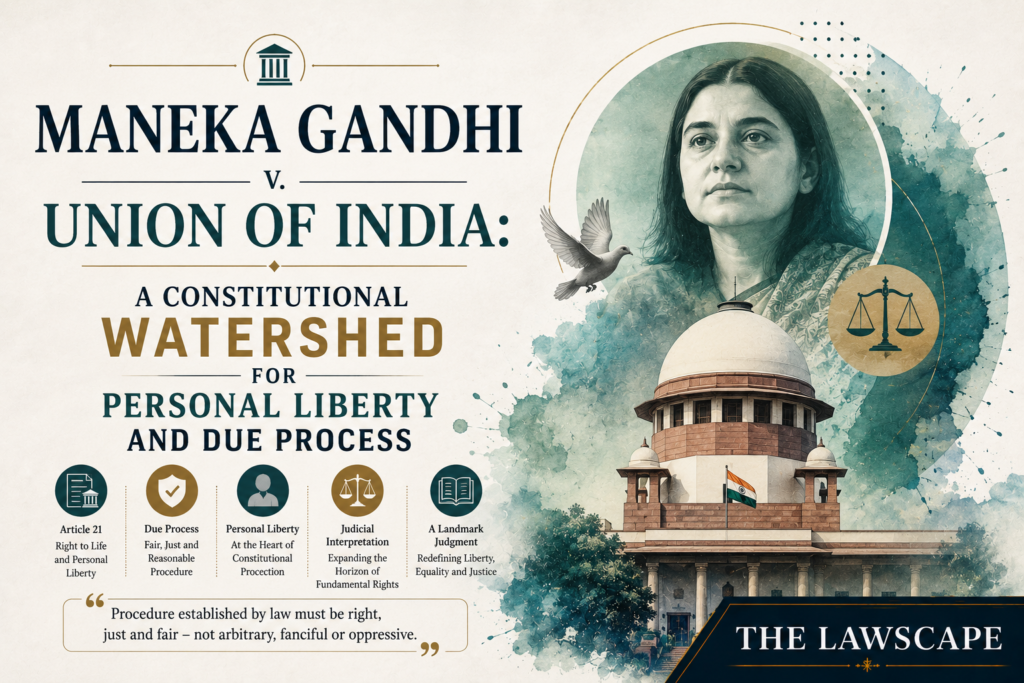
Author: MUSKAN KASHYAP
Student, DEEN DAYAL UPADAHYAY UNIVERSITY GORAKHPUR UTTAR PRADESH
——————————————————————————————————————————-
]
💡 3 Quick Takeaways
- Maneka Gandhi v. Union of India transformed Article 21 by requiring that any procedure depriving personal liberty must be fair, just, and reasonable.
- The judgment established the “Golden Triangle” doctrine, linking Articles 14, 19, and 21 as an integrated framework of fundamental rights.
- The decision laid the foundation for the expansion of numerous constitutional rights, including the rights to livelihood, health, education, and privacy.
Introduction
The case of Maneka Gandhi v. Union of India (AIR 1978 SC 597) stands as one of the most transformative judgments in the constitutional history of India. Decided by a seven-judge bench of the Supreme Court on 25 January 1978, in the immediate aftermath of the Emergency (1975–1977), the judgment radically recast the judicial understanding of personal liberty, procedural fairness, and the relationship between Articles 14, 19, and 21 of the Constitution.
The decision overruled the narrow construction adopted in A.K. Gopalan v. State of Madras and inaugurated an era of expansive and purposive constitutional interpretation that continues to shape Indian public law. The immediate occasion for the judgment was the summary impoundment of the petitioner’s passport by the Government of India under Section 10(3)(c) of the Passports Act, 1967, without prior notice, hearing, or assignment of reasons. The constitutional questions raised by this act of executive action struck at the very heart of the relationship between the citizen and the State.
Case Information
Case Name: Maneka Gandhi v. Union of India
Citation: AIR 1978 SC 597; (1978) 1 SCC 248; 1978 SCR (2) 621
Court: Supreme Court of India
Bench: Seven-Judge Constitutional Bench
Date of Decision: 25 January 1978
Jurisdiction: Original Jurisdiction under Article 32 of the Constitution of India
Judges: M. Hameedullah Beg C.J., N.L. Untwalia J., P.N. Bhagwati J., P.S. Kailasam J., S. Murtaza Fazal Ali J., V.R. Krishna Iyer J., and Y.V. Chandrachud J.
Facts of the Case
Maneka Gandhi, a journalist and public figure, was issued a valid passport on 1 June 1976 under the Passports Act, 1967. On 4 July 1977, the Regional Passport Office issued an order under Section 10(3)(c) of the Passports Act directing the impoundment of her passport “in the interests of the general public.”
The order was served without any prior notice or opportunity to make representations. When she requested the reasons for the impoundment, the Ministry of External Affairs declined to disclose them, again citing the “interests of the general public.”
The action was taken without notice, hearing, or reasons—three hallmarks of arbitrary executive conduct. Aggrieved by the decision, Maneka Gandhi filed a writ petition before the Supreme Court under Article 32 of the Constitution, challenging the impoundment order as violative of her fundamental rights under Articles 14, 19(1)(a), 19(1)(g), and 21.
Issues Raised
The Supreme Court was called upon to adjudicate the following principal legal questions:
Issue I: Whether the right to travel abroad forms part of the “personal liberty” guaranteed under Article 21 of the Constitution.
Issue II: Whether the procedure prescribed under Section 10(3)(c) of the Passports Act, 1967, constituted a valid “procedure established by law” within the meaning of Article 21 and whether such procedure was required to be reasonable, fair, and just.
Issue III: Whether the impoundment of a passport without notice, hearing, and reasons violated the principles of natural justice embodied in Articles 14 and 21.
Issue IV: Whether Articles 14, 19, and 21 are mutually exclusive or must be read together as an integrated code of fundamental rights.
Issue V: Whether the expression “procedure established by law” in Article 21 imports the substance of the American doctrine of “due process of law,” requiring the procedure to be fair, reasonable, and just.
Analysis
A. Expansive Interpretation of Personal Liberty
The Court decisively rejected the narrow reading of “personal liberty” articulated in A.K. Gopalan, which had largely confined the expression to freedom from physical detention. Justice P.N. Bhagwati, delivering the leading judgment, held that personal liberty under Article 21 is of the widest amplitude and encompasses a variety of rights that contribute to the full development of the human personality, including the right to travel abroad.
This purposive and liberal construction reflected the constitutional philosophy that fundamental rights must be interpreted in a manner that gives the fullest possible effect to their objectives.
B. Overruling the Doctrine of Mutual Exclusivity
In A.K. Gopalan, the Supreme Court had treated Articles 19, 21, and 22 as distinct and mutually exclusive compartments. The Court in Maneka Gandhi decisively departed from this position.
It held that the fundamental rights guaranteed under Part III form an integrated and harmonious code. Consequently, any State action depriving a person of personal liberty must simultaneously satisfy the requirements of Article 14, Article 19, and Article 21.
This framework later came to be celebrated as the doctrine of the “Golden Triangle” or the “Trinity Test” of constitutional rights.
C. Procedure Established by Law and the Due Process Dimension
The framers of the Constitution consciously adopted the phrase “procedure established by law” instead of the American expression “due process of law.” The Court acknowledged this distinction but clarified that it does not mean that any procedure, however arbitrary or oppressive, would satisfy Article 21.
Justice Bhagwati held that the procedure contemplated under Article 21 must be “right, just and fair” and must not be arbitrary, fanciful, or oppressive. Through this reasoning, the Court effectively infused Article 21 with substantive due process values while formally retaining the constitutional language adopted by the framers.
This interpretative innovation remains one of the most influential contributions of the judgment.
D. Natural Justice as a Constitutional Imperative
The Court held that the principles of natural justice—particularly audi alteram partem (hear the other side) and nemo judex in causa sua (no person shall be a judge in their own cause)—are not merely administrative law principles but form an integral component of constitutional fairness under Article 21.
A procedure that denies an affected individual the opportunity to be heard before an adverse decision affecting personal liberty cannot qualify as a valid constitutional procedure. Consequently, the impoundment of Maneka Gandhi’s passport without notice or hearing was held to be inconsistent with Articles 14 and 21.
E. The Golden Triangle Doctrine
Perhaps the most enduring contribution of the judgment is the crystallisation of the “Golden Triangle” doctrine. Under this approach, any law or executive action affecting personal liberty must satisfy all three constitutional guarantees simultaneously.
Article 14 ensures equality and non-arbitrariness, Article 19 protects fundamental freedoms subject to reasonable restrictions, and Article 21 requires the existence of a fair, just, and reasonable procedure. Together, these provisions operate as an interconnected constitutional safeguard against arbitrary State action.
The doctrine has since served as a foundational principle in Indian constitutional adjudication.
F. Concurring and Dissenting Opinions
Justice Y.V. Chandrachud delivered a partially concurring and partially dissenting opinion. While agreeing that Articles 14, 19, and 21 must be read together, he expressed caution regarding the extensive importation of American due process principles into Article 21, emphasizing that the framers had consciously chosen different constitutional language.
Justice Fazal Ali broadly agreed with the majority but voiced reservations regarding the expansive interpretation of personal liberty, expressing concern that such an approach might invite challenges to legislation on broad and indeterminate grounds.
These opinions highlight the continuing debate concerning judicial review, constitutional interpretation, and the limits of judicial intervention.
Conclusion
Maneka Gandhi v. Union of India is not merely a landmark judgment; it is a constitutional watershed. The decision transformed Article 21 from a narrow procedural safeguard into a broad substantive guarantee of human dignity and liberty.
The subsequent recognition of rights such as the right to livelihood in Olga Tellis, the right to health in Paschim Banga Khet Mazdoor Samity, the right to education in Unni Krishnan, and the right to privacy in K.S. Puttaswamy can all be traced, directly or indirectly, to the constitutional transformation initiated by this judgment.
The broader constitutional philosophy articulated by the Court—that the Constitution is a living document committed to dignity, liberty, and the rule of law; that fundamental rights must receive generous and purposive interpretation; and that executive action affecting liberty must conform to the highest standards of procedural fairness—continues to shape Indian constitutional jurisprudence.
At the same time, the judgment is not free from tensions. By introducing substantive due process principles into Article 21, it opened a path for judicial creativity that has occasionally generated concerns regarding institutional competence and judicial overreach. The caution expressed by Justices Chandrachud and Fazal Ali therefore remains relevant even today.
Nevertheless, Maneka Gandhi v. Union of India represents one of the finest moments in Indian constitutional adjudication. Nearly five decades later, it continues to define the relationship between the citizen and the State and remains a cornerstone of constitutional liberty in India.
Disclaimer: The views expressed in this article are those of the author and do not necessarily reflect the views of The Lawscape.
The Lawscape — clear, practical legal insight for students and future lawyers.