
Article 32: The Heart and Soul of the Indian Constitution
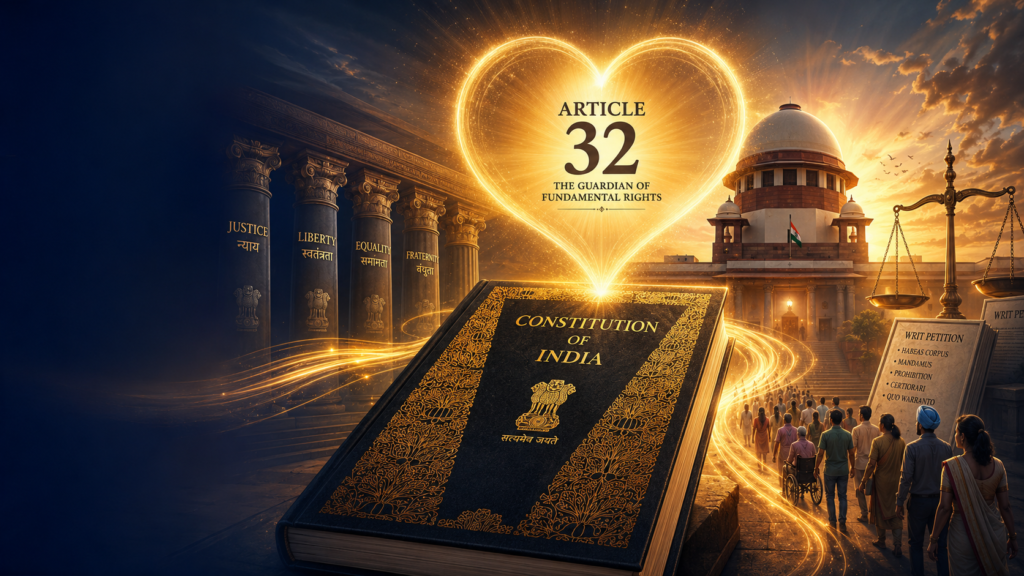
Author: Shristi Singh
Student, R.D. University, Jabalpur (Madhya Pradesh)
💡 3 Quick Takeaways
- Article 32 guarantees direct access to the Supreme Court for the enforcement of Fundamental Rights and is itself a Fundamental Right.
- The provision has evolved from a traditional constitutional remedy into a powerful instrument of social justice through Public Interest Litigation (PIL).
- While Article 32 remains central to protecting liberty, the Supreme Court increasingly exercises judicial restraint to prevent its misuse and manage growing case backlogs.
“If I was asked to name any particular article in this Constitution as the most important, an article without which this Constitution would be a nullity, I could not refer to any other article except this one. It is the very soul of the Constitution and the very heart of it.”
— Dr. B.R. Ambedkar
Abstract
Article 32 of the Indian Constitution, famously described by Dr. B.R. Ambedkar as its “heart and soul,” serves as a Fundamental Right guaranteeing citizens direct access to the Supreme Court for the enforcement of Fundamental Rights. This article traces the evolution of constitutional remedies from their restrictive colonial origins to their transformation into a robust instrument for social justice through the introduction of Public Interest Litigation (PIL).
While examining its vital role in safeguarding modern liberties—including digital privacy, environmental justice, and the rights of marginalized communities—the article also addresses the contemporary challenge of increasing Article 32 litigation. It critically analyses the Supreme Court’s growing emphasis on judicial self-restraint as it seeks to prevent the misuse of Article 32 as a procedural shortcut while balancing concerns regarding the selective application of constitutional remedies in different cases.
Introduction
Article 32 of the Constitution of India guarantees the right to constitutional remedies and is widely regarded as one of the most significant provisions within the constitutional framework. It empowers individuals to seek direct protection and enforcement of their Fundamental Rights before the Supreme Court of India.
The provision grants every citizen the right to move the Supreme Court whenever a Fundamental Right is violated. In addition to providing access to the Court, Article 32 empowers the Supreme Court to issue appropriate orders, directions, and writs necessary for the enforcement of Fundamental Rights.
More than a procedural provision, Article 32 reflects the constitutional commitment that rights must be accompanied by effective remedies. Without such a mechanism, Fundamental Rights would risk becoming merely symbolic guarantees.
Background and Evolution
The system of constitutional remedies in India evolved from restrictive colonial origins into one of the most accessible mechanisms for protecting civil liberties.
The authority to issue prerogative writs was introduced through British common law and the Regulating Act of 1773. However, these powers were confined largely to the presidency towns of Calcutta, Madras, and Bombay. As a result, the vast majority of Indians lacked meaningful legal remedies against administrative excesses.
Recognising these limitations, the framers of the Constitution sought to establish stronger protections during the Constituent Assembly debates of 1947–1949. Under the leadership of Dr. B.R. Ambedkar, Article 32 was incorporated as a Fundamental Right, guaranteeing direct access to the Supreme Court for the enforcement of constitutional freedoms. Simultaneously, Article 226 empowered High Courts throughout India to issue writs, ensuring broader geographical accessibility.
Following the Constitution’s adoption, the judiciary transformed constitutional remedies from a narrow legal mechanism into a dynamic instrument of social justice. Initially, courts adhered to strict rules of locus standi, permitting only directly affected individuals to seek relief. However, after the civil liberties concerns arising during the Emergency period, judges such as Justice P.N. Bhagwati and Justice V.R. Krishna Iyer pioneered the development of Public Interest Litigation.
Through PIL, courts relaxed standing requirements and permitted public-spirited individuals to approach the judiciary on behalf of disadvantaged groups. In many instances, even letters and postcards were treated as writ petitions. This innovation significantly expanded access to justice and strengthened constitutional accountability.
Today, courts continue to employ the traditional writs of Habeas Corpus, Mandamus, Prohibition, Certiorari, and Quo Warranto, ensuring that constitutional governance remains effective and responsive.
Dr. B.R. Ambedkar’s Vision: The “Heart and Soul” of the Constitution
Dr. Ambedkar viewed Article 32 as the ultimate safeguard of constitutional democracy. In his view, Fundamental Rights would be meaningless without an effective mechanism to enforce them.
His vision rested on three key principles:
A Right Within a Right
Ambedkar’s most significant innovation was making the constitutional remedy itself a Fundamental Right. This ensured that citizens could directly approach the Supreme Court and prevented the government from curtailing this protection through ordinary legislation.
A Powerful Constitutional Toolkit
By expressly incorporating traditional writ remedies within the constitutional framework, Article 32 provided the judiciary with a tested and effective set of tools for controlling arbitrary state action.
Protection Against Majoritarianism
Aware of India’s social diversity and historical inequalities, Ambedkar designed Article 32 as a safeguard for minorities, dissenters, and vulnerable groups against potential abuses of state power. It established the Supreme Court as the guardian of constitutional liberties.
Writ Jurisdiction Under Article 32
The Supreme Court may issue five constitutional writs under Article 32:
1. Habeas Corpus
The writ of Habeas Corpus protects personal liberty by securing the release of individuals unlawfully detained.
The significance of this writ was highlighted in Additional District Magistrate, Jabalpur v. Shivkant Shukla (1976), commonly known as the Habeas Corpus Case. Subsequently, the Forty-Fourth Constitutional Amendment ensured that protections under Article 21 could not be suspended even during an Emergency.
In State of Maharashtra v. Bhaurao Punjabrao Gawande (2008), the Supreme Court described the writ as a vital constitutional safeguard against illegal detention and emphasised its role in preserving civil liberty.
2. Mandamus
The writ of Mandamus compels a public authority to perform a legal duty that it has failed or refused to discharge.
Significant decisions include S.P. Gupta v. Union of India (1981), Bombay Municipality v. Advance Builders (1972), Binny Ltd. v. V. Sadasivan (2005), and Ramakrishna Mission v. Kago Kunya (2019), each clarifying the circumstances under which courts may direct public authorities to perform statutory obligations.
3. Prohibition
The writ of Prohibition prevents lower courts and tribunals from acting beyond their jurisdiction.
Cases such as S. Govind Menon v. Union of India (1967) and Hari Vishnu Kamath v. Ahmad Ishaque (1955) established that the writ may be issued where an authority acts without jurisdiction or exceeds its lawful powers.
4. Certiorari
The writ of Certiorari enables superior courts to quash orders passed by lower courts, tribunals, or quasi-judicial authorities acting without jurisdiction or in violation of legal principles.
The Supreme Court explained the scope of the writ in T.C. Basappa v. T. Nagappa (1954), Hari Vishnu Kamath v. Ahmad Ishaque (1955), and Surya Dev Rai v. Ram Chander Rai (2003).
5. Quo Warranto
The writ of Quo Warranto allows courts to examine whether a person lawfully occupies a public office.
In G.D. Karkare v. T.L. Shevde and Bharati Reddy v. State of Karnataka (2018), courts clarified that the writ serves to prevent unlawful occupation of public office and protect public administration.
Contemporary Importance of Article 32
The relevance of Article 32 continues to evolve as constitutional rights face new challenges.
Defining the Digital Frontier
In Shreya Singhal v. Union of India (2015), the Supreme Court struck down Section 66A of the Information Technology Act, recognising that vague restrictions on online speech violated freedom of expression.
Similarly, in Frank Vitus v. Narcotics Control Bureau (2024), the Court held that continuous electronic monitoring through location-sharing requirements could infringe the right to privacy protected under Article 21.
Environmental Justice and Climate Rights
In M.K. Ranjitsinh v. Union of India, the Court linked environmental protection and climate concerns directly with constitutional rights, recognising protection from adverse effects of climate change as an aspect of Articles 14 and 21.
Social Justice and Inclusion
In Rajeeb Kalita v. Union of India (2025), the Court emphasised that basic sanitation facilities and dignified public infrastructure for transgender persons form part of the constitutional guarantee of dignity and equality.
Judicial Discipline and Procedural Restraint
While Article 32 remains a powerful remedy, courts increasingly caution litigants against using it to bypass High Courts.
In Adil Ali Khalil Sulaiman v. State of Maharashtra (2026), the Supreme Court reiterated that Article 32 should not function as an appellate shortcut and stressed the importance of respecting constitutional hierarchy.
The Docket Explosion Under Article 32
One of the most pressing contemporary concerns is the dramatic increase in Article 32 petitions before the Supreme Court.
Several factors contribute to this phenomenon:
- Litigants frequently bypass High Courts despite the availability of effective remedies under Article 226.
- Routine procedural disputes are increasingly brought directly before the Supreme Court.
- The growing volume of original writ petitions contributes significantly to judicial backlog.
In response, the Court has adopted stricter standards regarding maintainability. It has repeatedly clarified that Article 32 cannot be used as a substitute for review proceedings, routine criminal challenges, or matters already pending before lower courts.
The Court has also imposed costs in cases involving frivolous or forum-shopping petitions.
Contrasting Judicial Approaches
Debates surrounding Article 32 intensified following differing judicial responses in high-profile matters.
Observations made during proceedings involving journalist Siddique Kappan generated discussion regarding whether the Court was discouraging direct Article 32 petitions. At the same time, the Court strongly affirmed the importance of Article 32 in proceedings involving television journalist Arnab Goswami.
These contrasting approaches prompted concerns among legal scholars and practitioners regarding consistency in access to constitutional remedies.
Similar debates arose in cases involving Prashant Kanojia, Varavara Rao, Sharjeel Imam, and Kafeel Khan, where differing outcomes led observers to question whether Article 32 was being applied uniformly.
Article 32 and Article 226: A Comparative Perspective
Although both provisions empower constitutional courts to issue writs, significant distinctions exist.
While Article 226 possesses broader jurisdiction, Article 32 remains unique because the remedy itself is a Fundamental Right.
Status of Writs in Other Countries
United States
The United States retains several traditional common law writs under the All Writs Act. Writs such as Habeas Corpus, Mandamus, Certiorari, and Quo Warranto continue to exist, though modern procedural rules have reduced their practical significance in many areas.
England and Wales
In England and Wales, several traditional writs have been replaced by modern judicial review remedies. Mandamus, Certiorari, and Prohibition have been reclassified as mandatory, quashing, and prohibiting orders respectively, while Habeas Corpus continues to retain special constitutional significance.
Conclusion
Article 32 embodies a remarkable constitutional paradox. It is simultaneously an absolute constitutional guarantee and a remedy increasingly regulated by judicial self-restraint.
Originally conceived by Dr. B.R. Ambedkar as an uncompromising safeguard against state excesses, Article 32 evolved into a transformative instrument through Public Interest Litigation and progressive constitutional interpretation. It has enabled the judiciary to protect not only traditional civil liberties but also emerging rights relating to privacy, environmental protection, and social justice.
However, this expansive role has produced significant institutional challenges. The growing volume of petitions has compelled the Supreme Court to regulate access more strictly and discourage routine invocation of its original jurisdiction. This shift has generated debate regarding whether Article 32 remains equally accessible to all litigants.
The future of Article 32 depends upon maintaining a delicate balance. The Supreme Court must continue filtering frivolous and routine matters while preserving the provision’s essential role as the ultimate constitutional safeguard against genuine violations of liberty and Fundamental Rights.
Disclaimer: The views expressed in this article are those of the author and do not necessarily reflect the views of The Lawscape.
The Lawscape — clear, practical legal insight for students and future lawyers.