
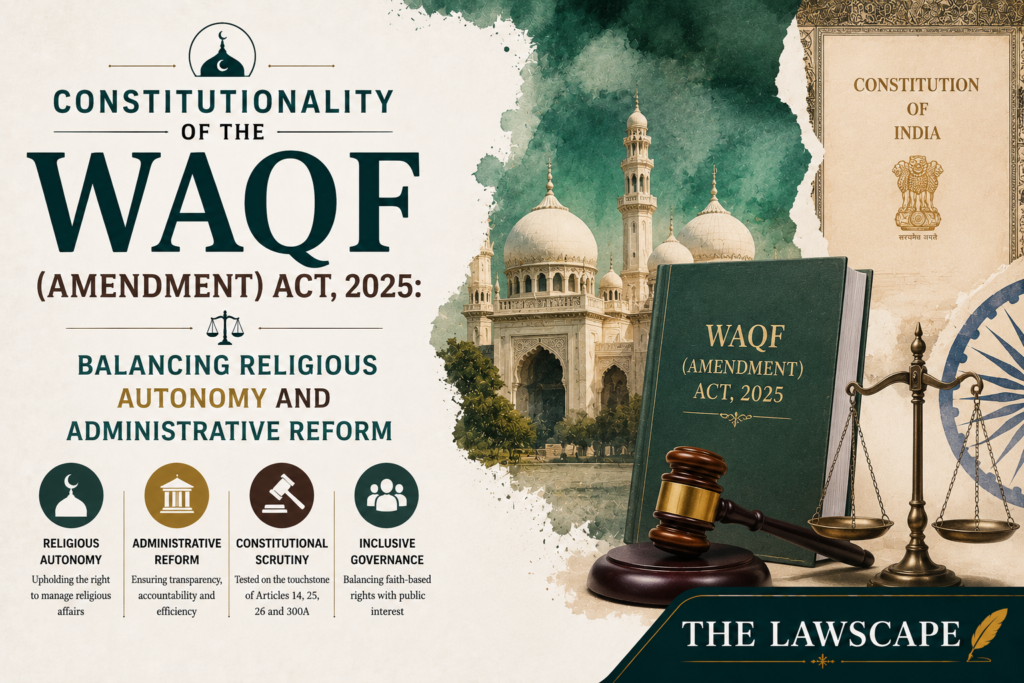
Constitutionality of the Waqf (Amendment) Act, 2025: Balancing Religious Autonomy and Administrative Reform
Author: Shristi Singh
Student, R D. University, Jabalpur
———————————————————————–
💡 3 Quick Takeaways
- The Waqf (Amendment) Act, 2025 introduces structural reforms to improve the administration, transparency, and management of Waqf properties.
- The legislation raises significant constitutional questions concerning Articles 25 and 26, particularly regarding religious autonomy and State regulation.
- The constitutional validity of several provisions continues to be examined by the Supreme Court, making the Act one of the most significant contemporary constitutional challenges.
Introduction
The Waqf (Amendment) Act, 2025, represents one of the most significant legislative reforms relating to the administration of Waqf properties in India. Introduced with the objective of streamlining the functioning of Waqf Boards and improving transparency, accountability, and governance, the legislation seeks to address longstanding concerns regarding the management of Waqf assets.
The Waqf (Amendment) Bill was introduced in the Lok Sabha on 8 August 2024. Parliament passed the Bill on 4 April 2025, and it received the assent of the President on 5 April 2025. The Act amends the Waqf Act, 1995 by introducing provisions relating to government regulation of Waqf properties, digital record management, revised definitions of Waqf, streamlined registration procedures, and improved dispute resolution mechanisms.
The constitutional validity of the legislation has been challenged before the Supreme Court of India. The petitions primarily question whether the amendments infringe the constitutional guarantees of religious freedom under Articles 25 and 26 while simultaneously expanding executive control over religious institutions.
Case Details
Case No.: W.P. (C) No. 269/2025
Court: Supreme Court of India
Petitioner: Asaduddin Owaisi
Respondent: Union of India
Current Bench: Division Bench comprising Chief Justice of India B.R. Gavai and Justice Augustine George Masih
Background
Prior to the 2025 amendment, the Waqf Act, 1995 provided the statutory framework governing the management, protection, and administration of Waqf properties throughout India. The legislation sought to safeguard Waqf assets by empowering State Waqf Boards and the Central Waqf Council.
Despite these statutory safeguards, the implementation of the Act encountered several challenges, including administrative inefficiency, legal ambiguities, political interference, financial irregularities, and encroachments upon Waqf properties. These difficulties substantially reduced the effectiveness of Waqf administration and limited the intended charitable and socio-economic benefits for the Muslim community.
The 2025 Amendment seeks to address these shortcomings through structural and administrative reforms.
Key Provisions of the Waqf (Amendment) Act, 2025
The principal amendments introduced by the Act include:
- Separation of private trusts from Waqf, ensuring that Muslim trusts created under other laws are not automatically treated as Waqf properties.
- Restricting Waqf dedication to practising Muslims who have professed Islam for at least five years.
- Protecting women’s inheritance rights by requiring inheritance distribution before property is dedicated as Waqf, with specific safeguards for widows, divorced women, and orphans.
- Deletion of Section 40 of the Waqf Act, 1995, thereby removing the Waqf Board’s unilateral authority to determine whether a property constitutes Waqf property.
- Reconstitution of Waqf Tribunals consisting of a District Judge, a senior State Government officer, and an expert in Muslim law and jurisprudence.
- Granting aggrieved parties the right to appeal Tribunal decisions before the concerned High Court within ninety days.
- Providing for investigation of disputes involving government land claimed as Waqf by officers above the rank of Collector.
- Reducing the mandatory annual contribution payable by Waqf institutions from seven per cent to five per cent.
- Introducing mandatory audits for institutions earning more than ₹1 lakh annually.
- Establishing a centralized digital portal for registration and management of Waqf properties.
- Requiring Mutawallis to register property details through the centralized portal.
- Expanding representation on Waqf Boards by including non-Muslim members and ensuring representation of women and different Muslim communities.
- Applying the Limitation Act, 1963 to Waqf property disputes in order to reduce prolonged litigation.
Legal Issues
1. Whether the Waqf (Amendment) Act, 2025 is contrary to the object of the Waqf Act, 1995?
The Union Government argues that the amendment does not depart from the objectives of the 1995 legislation but instead represents a necessary legislative evolution. According to the Government, the earlier framework suffered from administrative loopholes, lack of transparency, illegal encroachments, and financial mismanagement. The amendments therefore seek to modernize Waqf administration through digital governance, financial accountability, and clearer statutory definitions.
2. Whether restricting Waqf dedication to practising Muslims of at least five years violates the freedom of religion?
The Act provides that only practising Muslims who have professed Islam for a minimum period of five years may dedicate property as Waqf.
The challenge contends that this requirement interferes with the freedom guaranteed under Article 26 of the Constitution. During the proceedings, the Supreme Court expressed concern that, in the absence of objective statutory rules and verification procedures, the provision could result in arbitrary executive discretion. The Court observed that the provision should not be enforced until appropriate rules are framed by the Central Government.
3. Whether excluding “Waqf by User” is discriminatory?
The amendment substantially modifies the doctrine of “Waqf by User,” under which long-standing religious use could establish the existence of Waqf property.
The amended framework requires formal documentary evidence for future Waqf recognition. While this reduces legal uncertainty and improves record management, critics argue that it disadvantages community-based religious endowments, particularly in rural areas where documentary records may be unavailable.
4. Whether the inclusion of non-Muslim members in the Central Waqf Council and State Waqf Boards violates Article 26?
The amended legislation mandates the inclusion of non-Muslim members within Waqf Boards.
Critics contend that such participation infringes the community’s constitutional right to manage its own religious affairs under Article 26. Conversely, the Government maintains that non-Muslim members contribute administrative and technical expertise that improves institutional governance without interfering with religious practices.
Critical Analysis
The Waqf (Amendment) Act, 2025 seeks to address several longstanding deficiencies in the administration of Waqf properties, including poor governance, misuse of authority, inadequate judicial oversight, financial irregularities, and inefficient management.
Its principal objectives include improving administrative efficiency, modernizing registration procedures, updating statutory definitions, strengthening technological integration, and increasing transparency in institutional functioning.
The legislation introduces a centralized digital portal intended to improve identification, monitoring, and management of Waqf properties. Enhanced audit requirements and financial accountability measures are expected to reduce mismanagement while ensuring that Waqf assets continue to serve charitable purposes. Similarly, reforms relating to property registration and dispute resolution seek to reduce arbitrary administrative action and unauthorized occupation of Waqf lands.
The Act also strengthens the protection of inheritance rights, particularly for women, widows, children, and orphans, thereby aligning certain aspects of Waqf administration with broader constitutional commitments to equality. In addition, provisions restricting Waqf creation on Fifth and Sixth Schedule lands reinforce constitutional protections afforded to tribal communities.
Nevertheless, the amendments also generate important constitutional concerns. The central question remains whether the pursuit of administrative efficiency and transparency justifies greater governmental involvement in the management of religious institutions.
The inclusion of non-Muslim members on Waqf Boards, modifications to the doctrine of “Waqf by User,” and increased governmental oversight have prompted significant debate regarding the scope of religious autonomy guaranteed under Articles 25 and 26 of the Constitution.
Ultimately, the legislation attempts to balance the effective administration of religious endowments with public accountability and modern governance practices. Whether that balance has been constitutionally achieved remains the central issue before the Supreme Court.
Conclusion
The Waqf (Amendment) Act, 2025 represents a significant legislative effort to reconcile administrative modernization with the constitutional protection of religious institutions.
Through reforms such as centralized digital record management, mandatory financial audits, improved registration procedures, and enhanced governance mechanisms, the Act seeks to address longstanding concerns relating to transparency, accountability, and institutional efficiency. At the same time, safeguards relating to women’s inheritance rights and the protection of tribal lands reflect an attempt to harmonize Waqf administration with broader constitutional values.
However, the legislation has also generated substantial constitutional debate regarding the permissible extent of State regulation under Articles 25 and 26. The replacement of the doctrine of “Waqf by User,” increased governmental oversight, and mandatory inclusion of non-Muslim members on Waqf Boards have raised important questions concerning religious autonomy and institutional independence.
The constitutional validity of these provisions will ultimately depend upon judicial interpretation and the manner in which the legislation is implemented. The outcome of the pending proceedings before the Supreme Court is therefore likely to have lasting implications for the relationship between religious freedom, statutory regulation, and constitutional governance in India.
Disclaimer: The views expressed in this article are those of the author and do not necessarily reflect the views of The Lawscape.
The Lawscape — clear, practical legal insight for students and future lawyers.