
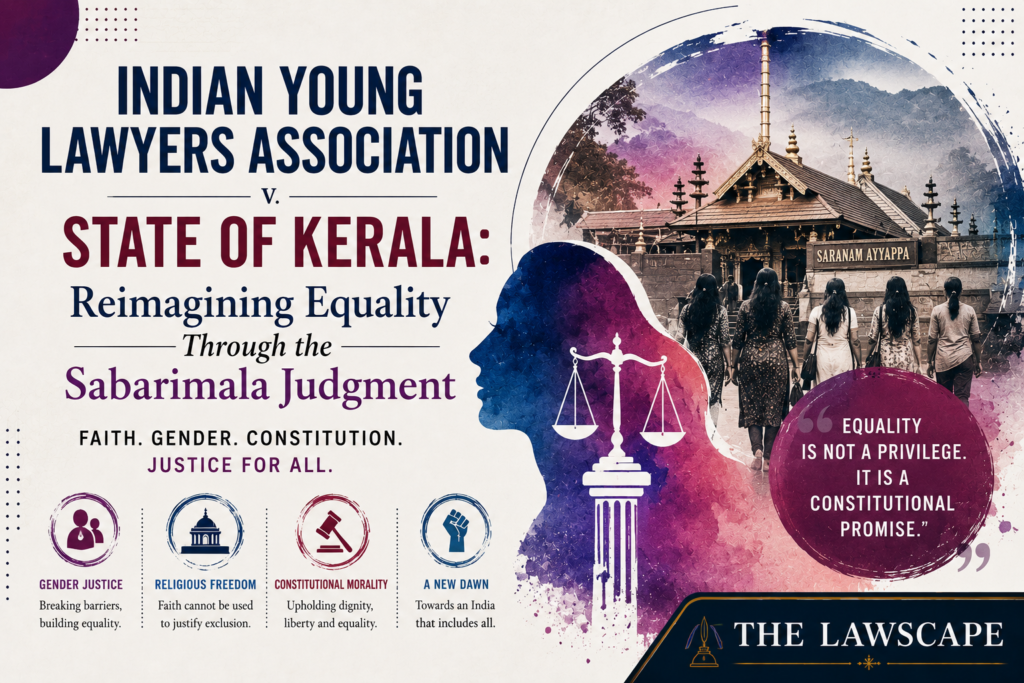
Indian Young Lawyers Association v. State of Kerala: Reimagining Equality Through the Sabarimala Judgment
Author: MANAN JHAMB
Student, Chandigarh University
—————————————————————————
💡 3 Quick Takeaways
- The Supreme Court held that the exclusion of women aged 10–50 years from the Sabarimala Temple violated constitutional guarantees of equality, dignity, and religious freedom.
- The majority ruled that the practice was not an essential religious practice protected under Article 26 of the Constitution.
- The judgment strengthened the doctrine of constitutional morality while continuing to generate debate on judicial review of religious practices.
Introduction
Indian Young Lawyers Association & Ors. v. State of Kerala & Ors. is one of the most significant constitutional decisions concerning the relationship between religious freedom and fundamental rights in India. Decided by a five-judge Constitution Bench of the Supreme Court on 28 September 2018, the case challenged the long-standing prohibition on the entry of women between the ages of ten and fifty into the Sabarimala Temple in Kerala.
Although the dispute arose from a temple-entry restriction, the constitutional questions before the Court extended far beyond the issue of access to a place of worship. The case required the Court to determine whether religious customs that discriminate on the basis of sex could continue to receive constitutional protection under Articles 25 and 26 when they conflict with the guarantees of equality, dignity, and individual liberty.
By a majority of 4:1, the Supreme Court held that the exclusion of women was unconstitutional. At the same time, Justice Indu Malhotra’s dissent highlighted the competing concern of judicial restraint in matters involving religious faith and essential religious practices. The decision therefore remains one of the most intellectually debated judgments in Indian constitutional jurisprudence.
Case Details
Case Name: Indian Young Lawyers Association & Ors. v. State of Kerala & Ors.
Citation: (2019) 11 SCC 1; AIR 2019 SC 1
Writ Petition: W.P. (Civil) No. 373 of 2006
Court: Supreme Court of India (Constitution Bench)
Date of Decision: 28 September 2018
Bench: Chief Justice Dipak Misra, Justice A.M. Khanwilkar, Justice R.F. Nariman, Justice D.Y. Chandrachud, and Justice Indu Malhotra
Decision: 4:1 Majority
Background
The Sabarimala Temple, situated within the Periyar Tiger Reserve in Kerala, is dedicated to Lord Ayyappa, who is worshipped as a Naishtika Brahmachari (eternal celibate). For centuries, women between the ages of ten and fifty were prohibited from entering the temple on the belief that their presence would affect the deity’s celibate character.
The legal basis for this exclusion was Rule 3(b) of the Kerala Hindu Places of Public Worship (Authorisation of Entry) Rules, 1965, which permitted restrictions based upon long-standing custom and usage.
The validity of this practice was earlier upheld by the Kerala High Court in S. Mahendran v. Secretary, Travancore Devaswom Board (1991), which held that the exclusion formed an integral part of the temple’s religious practices.
In 2006, the Indian Young Lawyers Association filed a writ petition before the Supreme Court challenging the constitutional validity of Rule 3(b). Owing to the importance of the constitutional questions involved, the matter was referred to a Constitution Bench in 2017.
Constitutional Issues
The Constitution Bench considered the following issues:
- Whether the Sabarimala Temple and its devotees constitute a religious denomination entitled to protection under Article 26.
- Whether the exclusion of women between the ages of ten and fifty amounts to discrimination prohibited under Articles 14 and 15.
- Whether the exclusion amounts to a form of untouchability prohibited under Article 17.
- Whether Rule 3(b) of the Kerala Hindu Places of Public Worship (Authorisation of Entry) Rules, 1965 is unconstitutional.
- Whether the exclusion of women constitutes an essential religious practice protected under Articles 25 and 26.
Arguments
Arguments on Behalf of the Petitioners
The petitioners argued that the right to worship is guaranteed to every individual under Article 25(1) of the Constitution irrespective of gender. They contended that denying women access to a public temple solely because of their biological characteristics amounts to discrimination prohibited under Articles 14 and 15.
The petitioners further submitted that the stigma attached to menstruation undermines women’s dignity under Article 21. Since the temple is managed by the Travancore Devaswom Board, a statutory authority, its actions are subject to constitutional scrutiny.
They also argued that the devotees of Lord Ayyappa do not constitute a separate religious denomination entitled to exclusive protection under Article 26.
Arguments on Behalf of the Respondents
The respondents contended that the Sabarimala Temple represents a unique religious denomination with distinct customs and traditions. According to them, the exclusion of women of menstruating age forms an essential religious practice connected with the celibate nature of Lord Ayyappa.
It was further argued that courts should exercise restraint while examining matters involving faith and religious belief. Since Article 26 guarantees religious denominations the right to manage their own affairs in matters of religion, judicial interference would undermine constitutional protection afforded to religious autonomy.
Judgment
Majority Opinion
Chief Justice Dipak Misra and Justice A.M. Khanwilkar delivered the lead judgment. The majority held that devotees of Lord Ayyappa do not constitute a separate religious denomination and, therefore, cannot claim protection under Article 26 for excluding women from temple entry.
The Court further held that the exclusion of women based upon menstruation amounts to discrimination founded upon physiological characteristics unique to women and therefore violates Articles 14, 15, and 25.
Rule 3(b) of the Kerala Hindu Places of Public Worship (Authorisation of Entry) Rules, 1965 was declared unconstitutional because it authorised sex-based discrimination beyond the scope of the parent legislation.
Justice R.F. Nariman, in his concurring opinion, independently applied the Essential Religious Practices doctrine and concluded that excluding women was not indispensable to the practice of the religion. He also held that Rule 3(b) was ultra vires the parent Act.
Justice D.Y. Chandrachud delivered a separate concurring opinion emphasizing transformative constitutionalism. He held that menstruation-based exclusion perpetuates patriarchal notions of impurity and violates Articles 14, 15, 17, and 21. According to him, constitutional courts have an obligation to dismantle historical forms of exclusion and ensure equal participation in public religious life.
Dissenting Opinion
Justice Indu Malhotra dissented from the majority.
She held that the devotees of Lord Ayyappa constitute a distinct religious denomination entitled to protection under Article 26. According to her, courts should avoid determining whether a particular religious practice is essential, as such questions are fundamentally theological rather than constitutional.
Justice Malhotra further observed that issues concerning religious customs should ordinarily be resolved within the religious community rather than through judicial intervention.
Ratio Decidendi
The Court laid down the following principles:
- Excluding women from public temples on physiological grounds violates Articles 14, 15, 17, 21, and 25 of the Constitution.
- Devotees of a particular Hindu deity do not automatically constitute a separate religious denomination under Article 26.
- The Essential Religious Practices doctrine protects only those practices that are fundamental to the existence of the religion itself.
- Rule 3(b) of the Kerala Hindu Places of Public Worship (Authorisation of Entry) Rules, 1965 is unconstitutional.
- Constitutional morality prevails over prevailing social or majoritarian morality.
Aftermath of the Judgment
The judgment generated significant public debate throughout the country.
While many constitutional scholars and women’s rights groups welcomed the decision, several religious organisations and devotees opposed the ruling. Women attempting to enter the temple encountered widespread protests, requiring police protection.
On 2 January 2019, Bindu Ammini and Kanakadurga became the first women of menstruating age to enter the temple following the judgment. Their entry triggered fresh protests and temporary closure of the temple for purification rituals.
Subsequently, multiple review petitions were filed before the Supreme Court. In 2019, broader constitutional questions concerning essential religious practices and related issues were referred to a larger Bench. The reference did not overrule the 2018 judgment but left certain constitutional questions open for future determination.
Critical Analysis
The majority judgment represents an important affirmation of gender equality and constitutional dignity. By rejecting biological differences as a valid ground for exclusion from places of public worship, the Court reinforced the constitutional commitment to substantive equality.
The emphasis placed upon constitutional morality over prevailing social morality reflects the transformative character of the Indian Constitution. Justice Chandrachud’s reasoning is particularly significant because it views exclusion based on menstruation as a manifestation of historical discrimination incompatible with constitutional values.
At the same time, Justice Indu Malhotra’s dissent identifies important constitutional tensions. The question of who determines what constitutes an essential religious practice remains a difficult one. Courts, composed of judges trained in law rather than theology, inevitably confront institutional limitations when adjudicating matters deeply rooted in religious belief.
The judgment also highlights the practical challenges of implementing constitutional rights where significant sections of the affected community continue to support the impugned practice. While constitutional rights cannot depend upon public opinion, effective constitutional transformation often requires broader social acceptance alongside judicial intervention.
Constitutional Principles Established
The judgment articulated several important constitutional principles:
- Constitutional morality prevails over majoritarian social morality.
- Only genuinely essential religious practices receive constitutional protection.
- Menstruation-based exclusion violates dignity and equality guaranteed under the Constitution.
- Constitutional rights may apply where religious institutions perform public or statutory functions.
- The Constitution functions as an instrument of transformative social change.
Conclusion
Indian Young Lawyers Association v. State of Kerala is far more than a dispute concerning temple entry. It represents a continuing constitutional dialogue regarding equality, dignity, religious freedom, and the proper role of courts in reviewing religious practices.
The majority held that constitutional guarantees cannot yield to discriminatory customs rooted in biological distinctions. Justice Indu Malhotra’s dissent, however, reminds us that constitutional adjudication involving religion requires sensitivity toward religious autonomy and institutional restraint.
Although several issues remain pending before a larger Bench of the Supreme Court, the 2018 judgment has permanently reshaped constitutional discourse on gender equality and religious freedom. It stands as one of the defining constitutional decisions of modern India, ensuring that questions of faith and tradition continue to be examined through the lens of constitutional values.
Disclaimer: The views expressed in this article are those of the author and do not necessarily reflect the views of The Lawscape.
The Lawscape — clear, practical legal insight for students and future lawyers.