
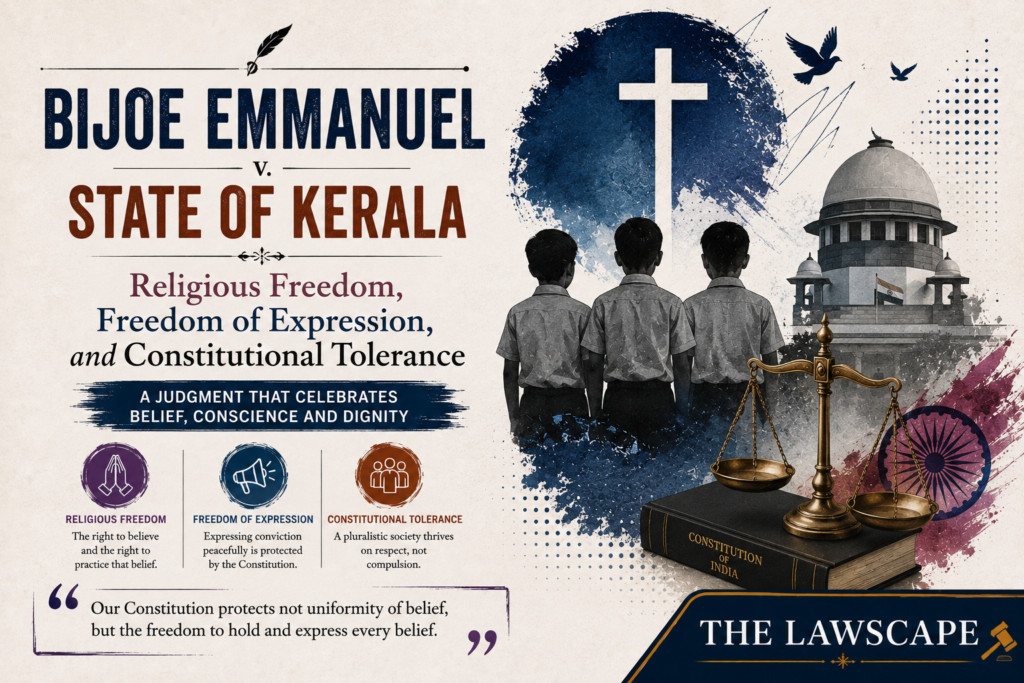
Bijoe Emmanuel v. State of Kerala: Religious Freedom, Freedom of Expression, and Constitutional Tolerance
Author: Khushboo Gupta
Student, MKLM’s Adhia College of Law, Mumbai
————————————————————————————————————–
💡 3 Quick Takeaways
- The Supreme Court held that respectfully refusing to sing the National Anthem on genuine religious grounds does not amount to disrespect towards the nation.
- The judgment reaffirmed that freedom of conscience and freedom of expression under Articles 19(1)(a) and 25(1) cannot be curtailed without statutory authority.
- The decision established that Fundamental Duties cannot override constitutionally guaranteed Fundamental Rights.
Introduction
Bijoe Emmanuel and Others v. State of Kerala is one of the most significant constitutional decisions concerning the protection of religious freedom and freedom of expression in India. Delivered by the Supreme Court on 11 August 1986, the judgment examined whether school authorities could expel students for refusing to sing the National Anthem despite their sincere religious beliefs.
The case arose when three schoolchildren belonging to the Jehovah’s Witnesses denomination refused to sing Jana Gana Mana during the morning assembly. Although they stood respectfully throughout the recitation of the National Anthem, they abstained from singing because their religious beliefs prohibited them from offering praise to any authority other than God.
The Supreme Court was therefore required to balance respect for national symbols with the constitutional guarantees of freedom of conscience, religious liberty, and freedom of speech and expression. The judgment ultimately reaffirmed that constitutional patriotism cannot be measured by compelled participation where no disrespect is shown towards national symbols.
Case Details
Case Name: Bijoe Emmanuel and Others v. State of Kerala and Others
Citation: (1986) 3 SCC 615
Court: Supreme Court of India
Bench: Justice O. Chinnappa Reddy and Justice M.M. Dutt
Date of Judgment: 11 August 1986
Facts of the Case
The petitioners, Bijoe Emmanuel, Binu Mol Emmanuel, and Bindu Emmanuel, were schoolchildren residing in the State of Kerala and followers of the Jehovah’s Witnesses denomination. According to their religious beliefs, singing the National Anthem amounted to an act of worship that could be directed only towards God.
Consequently, during the school assembly, the children respectfully stood while the National Anthem was sung but refrained from singing it themselves. Their conduct was neither disruptive nor disrespectful towards the anthem.
In July 1985, the issue was raised before the Kerala Legislative Assembly after allegations that the children were “unpatriotic.” Following directions issued by educational authorities, the Headmistress expelled the students from school on 26 July 1985.
The children’s parents challenged the expulsion before the Kerala High Court, contending that it violated their fundamental rights under Articles 19(1)(a) and 25(1) of the Constitution. Both the Single Judge and the Division Bench dismissed the petition, following which the petitioners approached the Supreme Court through a Special Leave Petition under Article 136 of the Constitution.
Issues Before the Court
The Supreme Court considered the following issues:
- Whether the expulsion of the students violated their fundamental rights under Articles 19(1)(a) and 25(1) of the Constitution.
- Whether the expulsion was justified under the Kerala Education Act, 1958, the Kerala Education Rules, 1959, and the Prevention of Insults to National Honour Act, 1971.
Arguments of the Parties
Petitioners
The petitioners argued that Article 19(1)(a) guarantees freedom of speech and expression, while Article 25 protects freedom of conscience and the right to freely profess and practise religion.
They submitted that the children had never shown disrespect towards the National Anthem. Instead, they stood respectfully throughout its recitation and remained silent solely because of their sincere religious convictions.
The petitioners further argued that neither the Kerala Education Act nor the Kerala Education Rules authorised the expulsion of students merely because they declined to sing the National Anthem. Since their conduct neither disturbed public order nor violated any statutory provision, the action taken against them was unconstitutional.
Respondents
The respondents contended that Jehovah’s Witnesses do not constitute a separate religious denomination and therefore could not claim protection under Article 26.
Reliance was also placed upon Article 51A(a), which imposes a Fundamental Duty upon every citizen to respect the National Flag and the National Anthem. According to the respondents, refusing to sing the National Anthem amounted to disrespect towards national symbols.
The respondents additionally relied upon departmental circulars issued by the Director of Public Instruction requiring schools to conduct morning assemblies where students were expected to participate in singing the National Anthem.
Decision of the Kerala High Court
The Kerala High Court upheld the expulsion of the students.
The Court observed that Fundamental Duties introduced by the Forty-Second Constitutional Amendment serve to strengthen national unity and impose moral obligations upon citizens. It concluded that respect for the National Anthem must prevail over the religious objections raised by the petitioners.
The High Court further held that Jehovah’s Witnesses did not constitute a separate religious denomination entitled to constitutional protection in the manner claimed.
Judgment of the Supreme Court
The Supreme Court unanimously reversed the judgment of the Kerala High Court.
The Court observed that the High Court had incorrectly focused upon the wording of the National Anthem rather than the genuine religious beliefs of the petitioners. The objection was not directed towards the content of the anthem but towards the act of singing itself, which the petitioners sincerely believed amounted to worship.
The Court referred to comparative jurisprudence, including Adelaide Company of Jehovah’s Witnesses v. The Commonwealth (1943) and Minersville School District v. Gobitis (1940), while recognising that unusual religious beliefs cannot automatically be equated with disloyalty towards the nation.
Examining Article 19(1)(a), the Court rejected the contention that the Kerala Education Act and the Kerala Education Rules imposed a legally enforceable obligation upon every student to sing the National Anthem.
The Court also analysed the Prevention of Insults to National Honour Act, 1971. It held that neither the Act nor any other statutory provision declared respectful silence during the National Anthem to constitute disrespect or insult.
The Court noted that the petitioners stood respectfully throughout the anthem, created no disturbance, and displayed complete decorum. Consequently, their conduct did not violate the Prevention of Insults to National Honour Act.
The Supreme Court further observed that the circulars issued by the Director of Public Instruction lacked statutory force. Even if interpreted as requiring compulsory participation, such circulars could not override the Fundamental Rights guaranteed under Articles 19(1)(a) and 25(1).
Accordingly, the Court held that the expulsion of the students violated their constitutional rights. The judgment of the Kerala High Court was set aside, and directions were issued for the reinstatement of the children.
Significance of the Judgment
The decision established that genuine religious belief deserves constitutional protection so long as its exercise does not disturb public order or infringe the rights of others.
The judgment also clarified that respect for national symbols does not necessarily require compulsory participation in symbolic acts. Standing respectfully during the National Anthem, without singing it, does not amount to disrespect where the conduct is motivated by sincere religious conviction.
Importantly, the Court reaffirmed that executive circulars lacking statutory authority cannot curtail Fundamental Rights.
The judgment also illustrates that Fundamental Duties, although constitutionally significant, cannot be enforced in a manner that extinguishes Fundamental Rights guaranteed under Part III of the Constitution.
Conclusion
Bijoe Emmanuel v. State of Kerala remains one of the leading authorities on religious freedom, freedom of conscience, and freedom of expression under the Indian Constitution.
By protecting students who respectfully declined to sing the National Anthem because of their sincerely held religious beliefs, the Supreme Court reaffirmed that constitutional patriotism is founded upon liberty rather than compulsion. The Court recognised that respect for national symbols can coexist with the protection of individual conscience.
As Justice Chinnappa Reddy memorably observed:
“Our tradition teaches tolerance; our philosophy preaches tolerance; our Constitution practices tolerance; let us not dilute it.”
The judgment continues to stand as an enduring reminder that constitutional democracy protects not only popular beliefs but also the conscientious convictions of minorities, provided they do not threaten public order or demonstrate disrespect towards the nation.
Disclaimer: The views expressed in this article are those of the author and do not necessarily reflect the views of The Lawscape.
The Lawscape — clear, practical legal insight for students and future lawyers.