
The Death Penalty in India: Reformative Justice or Retributive Justice?
Author: Natasha Nayak
Student, KIIT School Of Law, Bhubaneswar
————————————————————————-
💡 3 Quick Takeaways
- The death penalty continues to generate constitutional, moral, and human rights debates within India’s criminal justice system.
- While Indian courts retain capital punishment under the “rarest of rare” doctrine, concerns regarding arbitrariness, socio-economic bias, and judicial inconsistency persist.
- India’s evolving constitutional jurisprudence increasingly favours dignity, rehabilitation, and reformative justice over purely retributive punishment.
Abstract
The death penalty remains one of the most contentious features of the Indian criminal justice system. While proponents justify capital punishment on the grounds of deterrence, societal protection, and retributive justice, critics argue that it violates constitutional morality, human dignity, and the reformative ideals embedded within Article 21 of the Constitution of India.
The Indian judiciary has attempted to balance these competing interests through the “rarest of rare” doctrine evolved in Bachan Singh v. State of Punjab. However, the practical implementation of capital punishment continues to reveal concerns regarding arbitrariness, socio-economic bias, inconsistent judicial discretion, and the possibility of irreversible miscarriages of justice.
This article critically examines the philosophical foundations of punishment, the constitutional validity of capital punishment, and the judicial approach toward sentencing in death penalty cases. It further analyses international human rights developments, comparative constitutional practices, and the increasing shift toward reformative justice across democratic societies.
The article argues that India’s constitutional framework, which increasingly prioritises dignity, fairness, and rehabilitation, sits uneasily with a punishment that is irreversible and often inconsistently imposed. It concludes that although the Indian legal system formally retains capital punishment as an exceptional measure, contemporary constitutional values increasingly favour reformative justice over retributive criminal jurisprudence.
Keywords: Death Penalty, Capital Punishment, Reformative Justice, Retributive Justice, Article 21, Rarest of Rare Doctrine, Constitutional Morality, Human Dignity, Criminal Jurisprudence
Introduction
The legitimacy of the death penalty has remained a deeply contested issue within modern constitutional democracies. In India, the debate concerning capital punishment reflects a broader conflict between two competing theories of criminal justice: retributive justice, which emphasises punishment proportionate to the gravity of the offence, and reformative justice, which views crime as a social and psychological phenomenon capable of correction through rehabilitation.
The retention of the death penalty within Indian law raises difficult constitutional and moral questions regarding the role of the State in taking human life.
India continues to retain capital punishment for certain offences under the Bharatiya Nyaya Sanhita, 2023, including murder, terrorism-related offences, and certain aggravated crimes against women and children. However, constitutional jurisprudence developed by the Supreme Court has significantly narrowed its application through the “rarest of rare” doctrine.
Despite these judicial limitations, concerns persist regarding arbitrariness in sentencing, unequal access to legal representation, delays in mercy petitions, mental health implications, and the socio-economic composition of death row prisoners.
The issue is no longer confined merely to the legality of capital punishment. Rather, it concerns whether the death penalty is morally compatible with a constitutional order founded upon dignity, fairness, equality, and transformative justice. The Indian Constitution does not merely establish procedural legality; it embodies substantive constitutional morality. Consequently, the continuing retention of capital punishment must be examined through the lens of evolving constitutional values and international human rights standards.
Historical Evolution of the Death Penalty in India
The death penalty has existed in India since ancient times. Early Hindu legal texts and medieval penal systems recognised capital punishment as a legitimate form of State authority. During colonial rule, the Indian Penal Code, 1860 institutionalised death as a punishment for offences such as murder and waging war against the State.
Prior to 1955, the Code of Criminal Procedure required courts to record special reasons when imposing life imprisonment instead of death, thereby creating a legislative preference for capital punishment.
A significant shift occurred with the enactment of the Code of Criminal Procedure, 1973. Section 354(3) required courts to record “special reasons” for imposing the death penalty, thereby making life imprisonment the norm and death the exception.
Judicial developments further narrowed the scope of capital punishment. In Jagmohan Singh v. State of Uttar Pradesh, the Supreme Court upheld the constitutional validity of the death penalty, holding that judicial discretion and procedural safeguards prevented arbitrary deprivation of life.
Subsequently, in Rajendra Prasad v. State of Uttar Pradesh, Justice Krishna Iyer emphasised reformative principles and suggested that capital punishment should be reserved for offenders who pose a continuing threat to society.
The most significant development came in Bachan Singh v. State of Punjab, where the Supreme Court upheld the constitutional validity of capital punishment while simultaneously restricting its use to the “rarest of rare” cases. This doctrine continues to govern death penalty jurisprudence in India.
Theories of Punishment
Punishment represents the State’s response to criminal conduct and is traditionally justified through several competing theories.
Retributive Theory
The retributive theory is founded upon the principle that punishment is morally justified because offenders deserve it.
This approach emphasises proportionality between crime and punishment. Philosophers such as Immanuel Kant argued that punishment reflects moral accountability rather than social utility.
Supporters of capital punishment frequently rely upon retributive reasoning, particularly in cases involving exceptionally heinous crimes. According to this perspective, certain offences are so grave that only death can constitute an adequate moral response.
Critics, however, contend that retribution risks reducing criminal justice to institutionalised vengeance and is inconsistent with the values of constitutional democracy.
Deterrent Theory
The deterrent theory assumes that severe punishment discourages criminal conduct.
Capital punishment is often defended on the ground that the fear of execution deters potential offenders from committing serious crimes. However, empirical evidence remains inconclusive regarding whether the death penalty deters crime more effectively than life imprisonment.
The Law Commission of India’s 262nd Report noted that available evidence does not conclusively establish a deterrent effect unique to capital punishment.
Reformative Theory
The reformative theory focuses on rehabilitation and reintegration.
Rather than viewing criminality solely as a matter of moral culpability, it recognises the influence of social, economic, psychological, and environmental factors. This approach seeks to transform offenders rather than simply punish them.
Indian constitutional jurisprudence increasingly reflects reformative values through judicial emphasis on prisoner rights, prison reforms, dignity, and rehabilitation.
The reformative theory fundamentally challenges the legitimacy of capital punishment because execution permanently extinguishes the possibility of reform.
Reformative Justice v. Retributive Justice
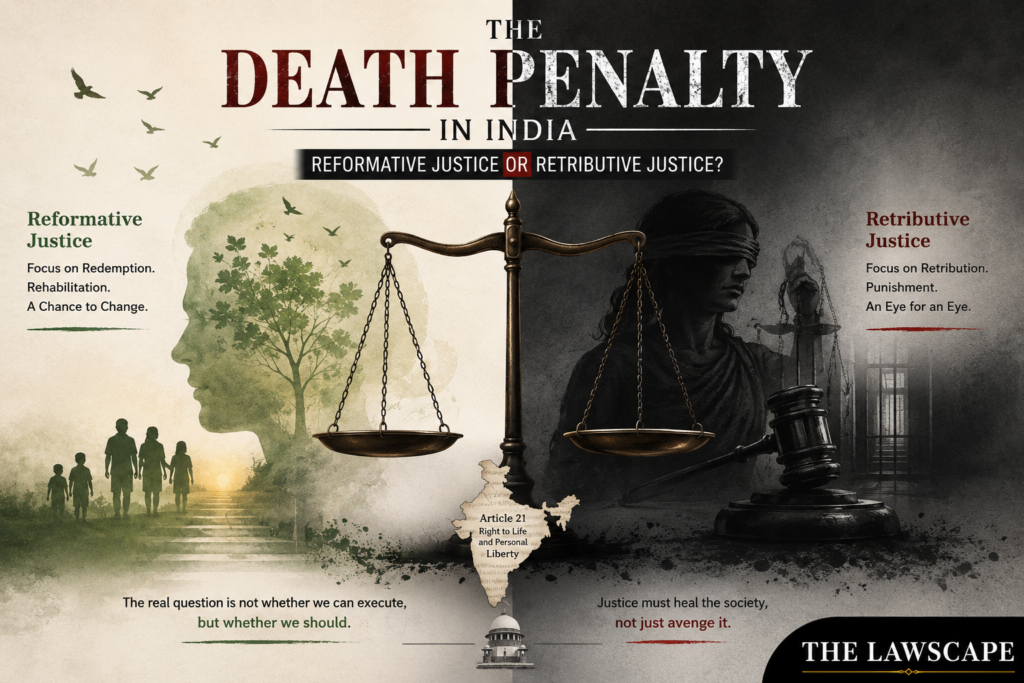
The conflict between reformative and retributive justice lies at the heart of the death penalty debate.
Retributive justice prioritises punishment and societal condemnation, whereas reformative justice prioritises rehabilitation and reintegration. Indian courts frequently oscillate between these competing approaches.
In cases involving terrorism, brutal murders, and aggravated sexual offences, courts have often invoked concepts such as societal outrage and collective conscience to justify capital punishment. Conversely, judicial decisions have also acknowledged mitigating factors including age, mental illness, socio-economic deprivation, and the possibility of reform.
This duality reflects an unresolved tension within Indian criminal jurisprudence.
The Constitution increasingly emphasises dignity, fairness, and substantive due process. Yet the death penalty continues to survive largely because of perceived demands for retribution in exceptional cases.
The growth of victim-centred justice has further complicated the debate. While families of victims may view capital punishment as essential for accountability and closure, constitutional adjudication cannot be guided solely by public anger or emotional retaliation. Criminal justice must remain consistent with constitutional morality and the rule of law.
Constitutional Validity of Capital Punishment
Article 21 of the Constitution guarantees that no person shall be deprived of life or personal liberty except according to procedure established by law.
Judicial interpretation has transformed Article 21 into a broad repository of substantive due process, dignity, fairness, and reasonableness.
In Jagmohan Singh, the Supreme Court upheld the death penalty on the basis that judicial sentencing procedures provided adequate safeguards.
Later, in Bachan Singh, the Court reaffirmed the constitutional validity of capital punishment while limiting its application to exceptional circumstances.
The constitutional validity of the death penalty is also influenced by Articles 14 and 19. Arbitrary sentencing violates equality before the law, while disproportionate punishment may offend constitutional fairness.
In Mithu v. State of Punjab, the Supreme Court struck down Section 303 of the Indian Penal Code, which mandated death sentences for life convicts convicted of murder. The Court held that mandatory capital punishment violated Articles 14 and 21 because it excluded consideration of mitigating circumstances and individualised sentencing.
This decision established that constitutional validity depends not merely upon legislative authorisation but also upon procedural fairness and judicial discretion.
The “Rarest of Rare” Doctrine
The “rarest of rare” doctrine evolved in Bachan Singh represents the judiciary’s attempt to reconcile capital punishment with constitutional limitations.
The Court held that the death penalty should be imposed only when life imprisonment is unquestionably inadequate.
This doctrine requires courts to balance aggravating and mitigating circumstances. Aggravating factors may include exceptional brutality, premeditation, and societal impact. Mitigating factors may include age, mental condition, socio-economic background, and the possibility of rehabilitation.
In Machhi Singh v. State of Punjab, the Supreme Court attempted to clarify the doctrine by identifying categories of cases that might justify capital punishment, including exceptionally brutal murders and offences that shock the collective conscience of society.
However, critics argue that concepts such as “collective conscience” lack precise constitutional meaning and permit subjective judicial interpretation. Similar cases often result in different sentencing outcomes, raising concerns regarding consistency and fairness.
Judicial Discretion and Sentencing Arbitrariness
One of the most significant criticisms of capital punishment concerns sentencing inconsistency.
The Supreme Court itself has acknowledged errors in death penalty adjudication. In several cases, death sentences have been commuted because courts failed to adequately consider mitigating circumstances or procedural safeguards.
The Death Penalty India Report published by Project 39A revealed that a substantial proportion of death row prisoners come from economically vulnerable and socially marginalised backgrounds.
Limited access to competent legal representation often affects sentencing outcomes and raises serious concerns regarding equality before the law.
If socio-economic disadvantage influences who receives a death sentence, the legitimacy of capital punishment becomes increasingly difficult to justify within a constitutional democracy.
Human Dignity and Constitutional Morality
Modern constitutionalism increasingly recognises dignity as a foundational constitutional value.
The Supreme Court has repeatedly affirmed that dignity forms an integral part of Article 21.
Execution extinguishes not only biological life but also the possibility of moral transformation, redemption, and rehabilitation. Critics argue that capital punishment treats individuals as irredeemable rather than as rights-bearing persons capable of change.
Constitutional morality requires institutions to uphold dignity, fairness, and liberty even in emotionally charged circumstances.
The principles of transformative constitutionalism further suggest that criminal justice should aim toward social reform rather than retributive violence. Viewed through this lens, capital punishment appears increasingly inconsistent with contemporary constitutional values.
Miscarriages of Justice, Delay, and Mental Health
The irreversible nature of the death penalty magnifies the consequences of judicial error.
Wrongful convictions, coerced confessions, inadequate investigations, and ineffective legal assistance create risks that cannot be corrected after execution.
The Supreme Court has recognised prolonged delay in deciding mercy petitions as a ground for commutation of death sentences. In Shatrughan Chauhan v. Union of India, the Court acknowledged the severe psychological trauma associated with prolonged confinement under sentence of death.
Mental illness among death row prisoners presents additional constitutional concerns. Executing individuals suffering from serious mental disorders is increasingly viewed as incompatible with contemporary standards of dignity and decency.
The possibility of irreversible miscarriage of justice fundamentally distinguishes capital punishment from all other forms of punishment.
Comparative and International Perspectives
Globally, there has been a significant movement toward abolition of the death penalty.
More than two-thirds of countries have abolished capital punishment either in law or practice. Nations such as the United Kingdom, France, Canada, and South Africa have rejected capital punishment on constitutional and human rights grounds.
In S v. Makwanyane, the Constitutional Court of South Africa held that the death penalty violated dignity, equality, and protection against cruel punishment.
By contrast, countries such as China, Iran, Saudi Arabia, and the United States continue to retain capital punishment, although even within these jurisdictions, concerns regarding arbitrariness and discrimination persist.
International human rights law increasingly favours abolition. Article 3 of the Universal Declaration of Human Rights recognises the right to life, while the International Covenant on Civil and Political Rights encourages progressive movement toward abolition.
Although India has not ratified the Second Optional Protocol to the ICCPR aimed at abolition, international human rights developments continue to influence constitutional interpretation and public discourse.
Capital Punishment under the Bharatiya Nyaya Sanhita, 2023
The Bharatiya Nyaya Sanhita, 2023, retains capital punishment for several offences, including murder, terrorism-related crimes, aggravated sexual offences against minors, and certain offences against the State.
Procedural safeguards continue under the Bharatiya Nagarik Suraksha Sanhita, 2023, including mandatory confirmation of death sentences by the High Court and the availability of mercy petitions under Articles 72 and 161 of the Constitution.
Despite these safeguards, concerns regarding arbitrariness, sentencing inconsistency, and prolonged delays remain unresolved.
Should Reformative Justice Prevail?
The central question is whether India’s constitutional democracy should continue to prioritise retribution in exceptional cases or move toward a fully reformative model of criminal justice.
Supporters of retention typically rely upon deterrence, victim justice, and societal protection. However, empirical evidence regarding deterrence remains uncertain.
Life imprisonment without remission may adequately protect society while avoiding the irreversible consequences of execution.
Reformative justice aligns more closely with constitutional morality because it preserves the possibility of rehabilitation and redemption. A constitutional democracy committed to dignity must recognise that even offenders retain fundamental human rights.
Furthermore, the unequal operation of capital punishment undermines its moral legitimacy. When socio-economic disadvantage influences sentencing outcomes, the death penalty ceases to function as a neutral instrument of justice.
The reformative approach does not diminish the seriousness of crime. Rather, it seeks accountability through methods consistent with constitutional values and human dignity.
Suggestions and Reforms
Several reforms may improve fairness within the existing framework:
- Comprehensive sentencing reforms should reduce arbitrariness in capital punishment cases.
- Clear statutory sentencing guidelines should replace vague standards.
- Psychological evaluation and socio-economic assessments should be mandatory before imposing death sentences.
- Mitigation investigations should become a formal component of sentencing proceedings.
- Legal aid mechanisms should be strengthened to ensure effective representation for economically disadvantaged accused persons.
- Mercy petitions should be decided within fixed timelines to prevent prolonged psychological suffering.
Ultimately, India should seriously reconsider the continued retention of capital punishment in light of evolving constitutional morality and international human rights standards.
Conclusion
The debate surrounding the death penalty in India reflects a deeper constitutional conflict between retributive justice and reformative constitutionalism.
Although Indian law formally retains capital punishment, judicial doctrine has steadily narrowed its application through constitutional safeguards and procedural limitations.
The “rarest of rare” doctrine sought to reconcile capital punishment with Article 21, yet practical implementation continues to reveal arbitrariness, socio-economic bias, and inconsistency in sentencing. The irreversible nature of execution, combined with the possibility of judicial error, fundamentally challenges the legitimacy of capital punishment within a constitutional democracy committed to dignity and fairness.
India’s constitutional jurisprudence has progressively expanded the meaning of life and liberty under Article 21 to include dignity, fairness, and substantive due process. These evolving constitutional values increasingly favour rehabilitation over retribution.
While societal outrage and victim concerns cannot be ignored, constitutional morality requires the State to rise above vengeance and uphold humane principles even in cases involving grave offences.
Consequently, although India continues to retain the death penalty in law, its constitutional trajectory appears more closely aligned with reformative justice than with retributive criminal jurisprudence. The continued existence of capital punishment, therefore, represents not merely a legal anomaly but an unresolved constitutional contradiction within India’s evolving democratic framework.
Disclaimer: The views expressed in this article are those of the author and do not necessarily reflect the views of The Lawscape.
The Lawscape — clear, practical legal insight for students and future lawyers.