
Balancing Speed and Justice: Fast Track Courts for Crimes Against Women—A Blessing or a Burden?
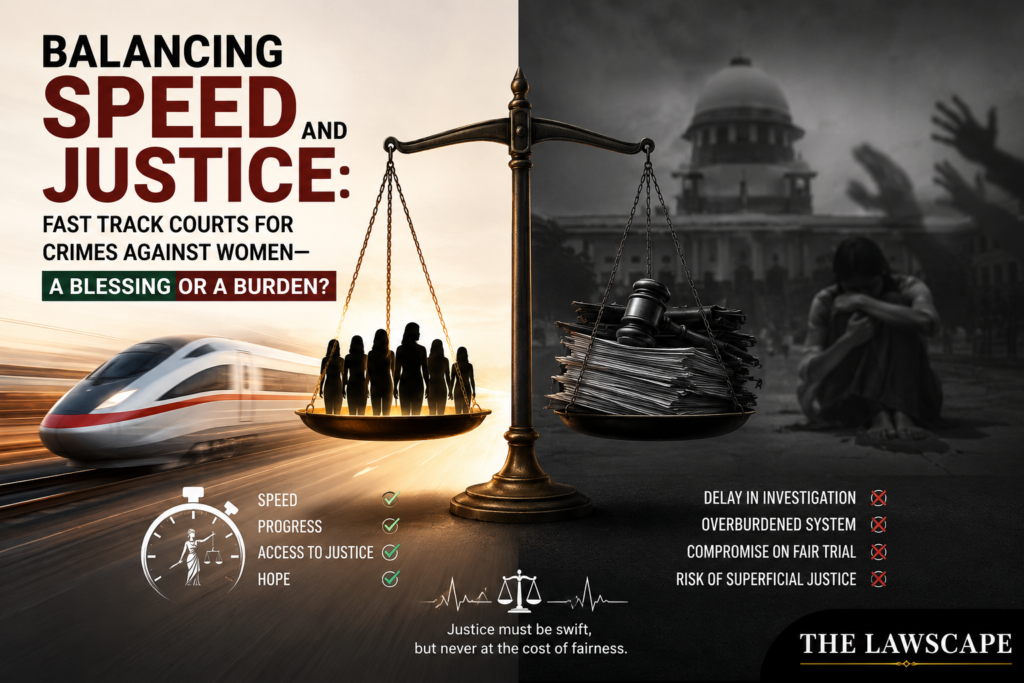
Author: Vaishnavi Sunkari
Student, PG COLLEGE OF LAW HYDERABAD
———————————————————————————-
💡 3 Quick Takeaways
- Fast Track Courts (FTCs) were established to reduce judicial delays and uphold the constitutional right to a speedy trial, particularly in cases involving vulnerable victims.
- Fast Track Special Courts (FTSCs) handling crimes against women and children have improved case disposal rates and reduced victim trauma caused by prolonged litigation.
- Despite their benefits, concerns remain regarding procedural fairness, inadequate investigation, limited judicial discretion, and the risk of hurried or unjust outcomes.
Abstract
The right to a speedy trial is a core constitutional principle recognised under Indian constitutional jurisprudence. However, this right often intersects with another equally important principle: the right to a fair and just hearing. This article examines the role and effectiveness of Fast Track Courts (FTCs), a specialised judicial mechanism introduced to ensure timely justice while reducing judicial pendency.
The article evaluates whether Fast Track Courts are a blessing to the Indian legal system by reducing case backlogs and ensuring swift justice, or whether the pressure to achieve speedy disposal results in rushed proceedings, perverse judgments, and incomplete justice. While these courts have contributed significantly to reducing pendency, concerns remain regarding procedural fairness and the quality of adjudication.
Particular attention is given to offences against women and children, where prolonged litigation often aggravates trauma and delays meaningful justice. The article argues that while Fast Track Courts are an indispensable component of judicial reform, their success ultimately depends upon adequate infrastructure, skilled judicial personnel, and strict adherence to due process.
Keywords: Fast Track Courts, Speedy Trial, Judicial Pendency, POCSO, Sexual Offences, Perverse Judgments, Judicial Backlogs, Article 21, Due Process, Gender Justice
Introduction
The Constitution of India plays a central role in protecting the rights and liberties of individuals while ensuring access to justice. Articles 14, 19, and 21 collectively reinforce the principles of fairness, equality, and procedural justice.
Although the Constitution does not expressly mention the right to a speedy trial, the Supreme Court has consistently recognised it as an integral component of Article 21, which guarantees the right to life and personal liberty. The administration of justice requires that legal proceedings be conducted fairly and concluded within a reasonable period.
The often-quoted maxim, “Justice delayed is justice denied,” reflects the reality that excessive delays can undermine the legitimacy and effectiveness of the justice delivery system. This concern becomes particularly significant in cases involving serious crimes against women, children, and senior citizens, where prolonged proceedings may result in continued trauma, weakened evidence, and diminished public confidence.
To address these challenges, Fast Track Courts were introduced as a specialised mechanism to expedite trials, reduce pendency, and prevent undue delays in the administration of justice.
Historical Evolution of Fast Track Courts
Fast Track Courts were first established in 2000 pursuant to the recommendations of the Eleventh Finance Commission. Their primary objective was to address the growing backlog of cases pending before district courts and High Courts across the country. Approximately 1,734 Fast Track Courts were established with financial support of ₹500 crore provided under the Commission’s recommendations.
Initially conceived as a temporary measure for five years, the scheme was subsequently extended under the Twelfth Finance Commission. These courts were staffed primarily through ad hoc judicial appointments intended to meet immediate institutional needs.
In 2011, however, the Union Government withdrew financial support for the Fast Track Court scheme. Several states nevertheless chose to continue operating these courts using their own resources.
The constitutional implications of this decision were considered in Brij Mohan Lal v. Union of India. While the Supreme Court declined to compel the Union Government to continue funding the scheme, it emphasised that the delivery of speedy justice remained a constitutional obligation of the State. The Court directed both the Union and State Governments to strengthen judicial infrastructure and increase judicial capacity to address delays effectively.
A significant turning point occurred following the 2012 Nirbhaya case, which triggered nationwide concern regarding crimes against women and deficiencies within the criminal justice system.
The Justice Verma Committee subsequently recommended several legal and institutional reforms, including the establishment of specialised courts to expedite cases involving sexual offences and crimes against women and children. These recommendations ultimately led to the creation of Fast Track Special Courts (FTSCs), specifically dedicated to rape cases and offences under the Protection of Children from Sexual Offences Act, 2012 (POCSO).
The Union Government later approved the continuation of these specialised courts through a centrally sponsored scheme, including hundreds of dedicated POCSO courts across the country.
Fast Track Courts and Crimes Against Women
Criminal trials involving offences against women frequently involve survivors who have experienced significant physical, emotional, and psychological trauma.
Cases involving rape, sexual assault, domestic violence, and offences under the POCSO Act often require victims to repeatedly revisit distressing experiences throughout lengthy legal proceedings. Delayed trials can therefore contribute to re-victimisation and increase the psychological burden on survivors.
Fast Track Special Courts seek to address these concerns by accelerating proceedings and ensuring timely disposal of cases.
An important advantage of expedited trials is the preservation of evidence. Delays often increase the risk of witness intimidation, hostile testimony, memory deterioration, and evidence tampering. Swift adjudication helps minimise these risks while strengthening the overall integrity of the trial process.
The effectiveness of criminal sanctions has traditionally been understood through three elements:
- Severity of punishment;
- Certainty of apprehension; and
- Speed of justice.
Fast Track Courts contribute directly to the third element by reducing the gap between offence and adjudication. The prospect of swift punishment may enhance deterrence and reduce opportunities for offenders to exploit procedural delays.
According to the article, Fast Track Special Courts have achieved notable disposal rates in POCSO cases while helping restore public confidence in the criminal justice system. Vulnerable Witness Deposition Centres (VWDCs) established under the FTSC framework have further strengthened victim protection by enabling testimony through audio-visual facilities, privacy screens, and secure environments that minimise confrontation with the accused.
These innovations aim to reduce secondary victimisation while facilitating more reliable witness testimony.
Judicial Support for Victim-Centred Procedures
The Supreme Court has consistently recognised the need for sensitivity in cases involving sexual offences.
State of Punjab v. Gurmit Singh (1996)
In this landmark case, the Court emphasised that trials involving sexual offences require a heightened degree of sensitivity and directed that such proceedings should ordinarily be conducted in camera to protect victims from unnecessary public exposure.
Sakshi v. Union of India (2004)
The Court further recognised the importance of creating a victim-friendly trial environment and endorsed the use of procedural safeguards such as screens and video-link facilities to prevent direct confrontation between survivors and accused persons during testimony.
These decisions continue to influence the functioning of Fast Track Special Courts and Vulnerable Witness Deposition Centres.
Why Fast Track Courts Are Considered a Blessing
Supporters of Fast Track Courts argue that they serve several important objectives.
Reduction of Judicial Pendency
Fast Track Courts significantly reduce case backlogs and contribute to the timely disposal of long-pending matters. By limiting unnecessary adjournments and delays, they promote greater efficiency within the judicial system.
Protection of Constitutional Rights
The right to a speedy trial forms an essential component of Article 21. Fast Track Courts help operationalise this constitutional guarantee by ensuring that justice is delivered within a reasonable timeframe.
Protection of Victims
Victims of serious crimes often experience prolonged emotional distress when proceedings continue for years. Expedited trials provide quicker legal closure and reduce opportunities for intimidation and re-traumatisation.
Deterrence
Swift adjudication sends a strong message that criminal conduct will result in timely legal consequences. This may contribute to deterrence, particularly in cases involving serious offences against women and children.
Enhanced Public Confidence
A justice system perceived as responsive and efficient is more likely to retain public trust. Fast Track Courts demonstrate institutional efforts to address delays and improve access to justice.
Why Fast Track Courts May Become a Burden
Despite their advantages, Fast Track Courts are not free from criticism.
Inadequate Examination of Witnesses
Pressure to dispose of cases quickly may result in insufficient examination and cross-examination of witnesses. Important inconsistencies or evidentiary issues may therefore remain unexplored.
Insufficient Investigation
Where investigations are incomplete or evidence collection is inadequate, accelerated proceedings may compromise the quality of adjudication rather than enhance justice.
Limited Judicial Discretion
Judges operating within disposal-oriented systems may face constraints in granting adjournments, ordering further investigation, or taking additional measures necessary to ensure fairness.
Risk of Miscarriage of Justice
The pursuit of speed should not undermine due process. Excessive emphasis on disposal statistics may increase the risk of erroneous findings and unjust outcomes.
Structural Challenges Beyond Courts
Judicial delay does not originate solely within courtrooms. Police investigations, forensic laboratories, prosecutorial delays, defence strategies, administrative inefficiencies, and judicial vacancies all contribute to case pendency.
Consequently, simply accelerating trials without addressing broader systemic issues may produce only partial solutions.
The article highlights concerns raised by legal experts who argue that Fast Track Courts sometimes prioritise speed over substantive justice. In this context, the observation that “hurried justice is buried justice” reflects fears that procedural shortcuts may undermine the fairness of proceedings.
Balancing Speed and Fairness
The challenge facing Fast Track Courts is not whether justice should be delivered quickly, but how speed can be reconciled with fairness.
The Supreme Court has repeatedly emphasised that expedited proceedings must remain consistent with due process and constitutional guarantees.
In Zahira Habibulla H. Sheikh v. State of Gujarat, the Court underscored the importance of maintaining fair trial standards even in complex and sensitive criminal cases. The decision serves as a reminder that efficiency cannot come at the expense of procedural justice.
The success of Fast Track Courts therefore depends not merely upon accelerated timelines but upon:
- Well-trained judges;
- Effective investigation mechanisms;
- Adequate infrastructure;
- Witness protection measures;
- Sufficient prosecutorial resources; and
- Strict adherence to due process.
Without these institutional safeguards, speed alone cannot ensure justice.
Conclusion
Fast Track Courts represent one of the most significant judicial reforms undertaken to address delays within the Indian legal system.
Particularly in cases involving crimes against women and children, these courts have provided a mechanism for reducing trauma, preserving evidence, and ensuring more timely access to justice. Their contribution to reducing judicial pendency and operationalising the constitutional right to a speedy trial is substantial.
However, the pursuit of speed must not overshadow the foundational principles of fairness, due process, and substantive justice. When courts operate without adequate resources, training, or procedural safeguards, the risk of incomplete investigations, inadequate hearings, and erroneous judgments increases significantly.
Fast Track Courts should therefore not be evaluated solely based on disposal statistics. Their true success lies in achieving an appropriate balance between efficiency and fairness.
When supported by robust infrastructure, skilled judicial officers, effective investigations, and victim-centred procedures, Fast Track Courts can function as a powerful instrument of justice. In such circumstances, they become not a burden upon the legal system, but a meaningful blessing for victims and society alike.
Disclaimer: The views expressed in this article are those of the author and do not necessarily reflect the views of The Lawscape.
The Lawscape — clear, practical legal insight for students and future lawyers.