
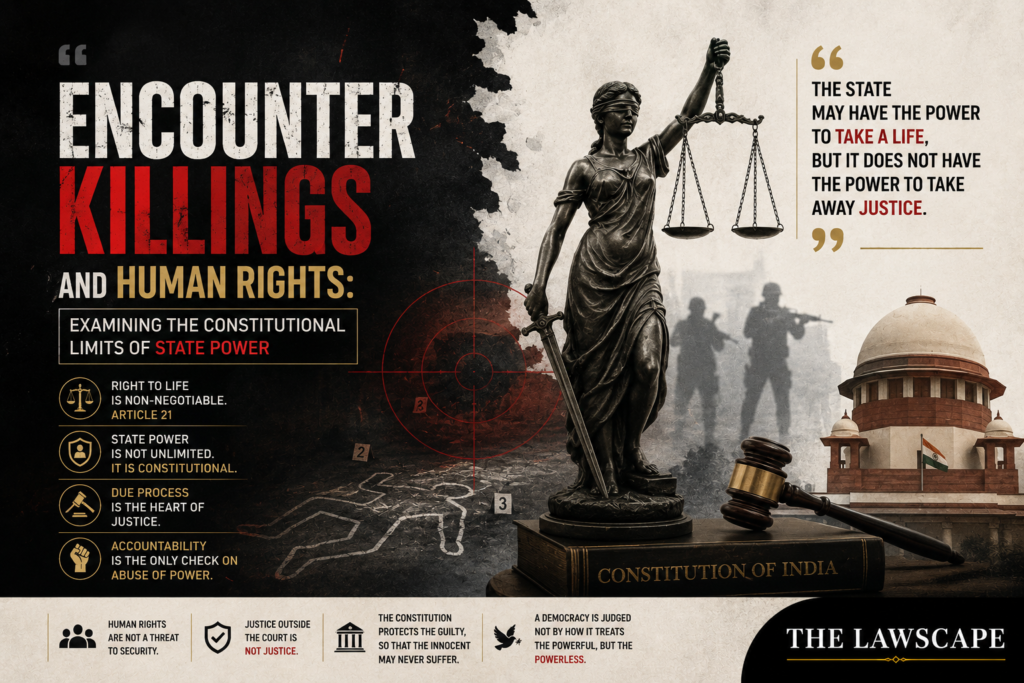
Encounter Killings and Human Rights: Examining the Constitutional Limits of State Power
Author: Hitesh Bhootra
Student, Aishwarya College of Education (Law)
———————————————————————————-
💡 3 Quick Takeaways
- Encounter killings present a direct conflict between demands for immediate justice and the constitutional guarantees of life, dignity, equality, and due process.
- Indian courts and human rights institutions have consistently held that extra-judicial killings cannot substitute lawful investigation, prosecution, and trial.
- Meaningful accountability requires independent investigations, stronger oversight mechanisms, police reforms, and a renewed commitment to the rule of law.
Abstract
Encounter killings continue to occupy a fiercely contested space within contemporary criminal justice discourse. While supporters often defend them as a swift response to dangerous criminality, terrorism, or public disorder, such killings raise profound constitutional and human rights concerns, particularly when lethal force is used outside the ordinary framework of judicial process.
In India, repeated allegations of fake encounters have exposed a persistent tension between public demands for immediate security and the constitutional guarantees of life, dignity, equality, and due process. This article examines encounter killings as both a legal and human rights issue, with particular emphasis on the Indian context.
The discussion explores the constitutional framework, international human rights standards, Supreme Court jurisprudence, the role of the National Human Rights Commission (NHRC), and the structural factors that contribute to impunity. The article argues that any legal system genuinely committed to the rule of law must reject encounter killings except in the narrowest circumstances involving genuine and proportionate self-defence. Even in such cases, independent investigation, accountability, and institutional reform remain essential whenever the State exercises lethal force.
Keywords: Encounter Killings, Extra-Judicial Executions, Human Rights, Article 21, Article 14, Rule of Law, Police Accountability, NHRC, Due Process
Introduction
Few issues illustrate the tension between public sentiment and constitutional discipline as sharply as encounter killings.
In popular discourse, police officers involved in encounter killings are often portrayed as efficient and decisive actors who achieve results where courts, prosecutors, and prisons are perceived to have failed. However, constitutional democracies are not judged by the speed with which punishment is imposed. Rather, they are evaluated on whether punishment is administered through lawful and accountable procedures.
Once the State begins taking lives outside the established framework of arrest, investigation, trial, and conviction, it risks moving beyond law enforcement and into the realm of executive punishment.
The debate surrounding encounter killings therefore extends far beyond questions of policing strategy. It concerns the fundamental nature of public authority. Can the executive effectively assume the role of judge and executioner in the name of efficiency? Can public approval legitimise violence that operates outside legal boundaries? Do human rights remain meaningful when the person killed is already socially condemned?
These questions are particularly significant in India, where allegations of fake encounters have repeatedly surfaced in conflict regions, metropolitan policing operations, and routine criminal investigations.
This article examines encounter killings within a broader legal framework. It distinguishes lawful use of force from extra-judicial executions, analyses constitutional and international protections for the right to life, reviews judicial and institutional responses, and explores the structural conditions that contribute to impunity. Ultimately, it argues that encounter killings are not isolated incidents but manifestations of deeper institutional weaknesses involving accountability, incentives, and commitment to due process.
Conceptual Framework: Encounter Killings and Extra-Judicial Executions
The term “encounter killing” has no formal statutory definition under Indian law.
Instead, it functions as a colloquial and administrative label used to describe deaths allegedly occurring during armed confrontations between law enforcement personnel and criminal suspects. Official narratives frequently characterise such incidents as unavoidable responses to immediate threats, often invoking concepts such as self-defence or force used while effecting arrest.
However, the apparent neutrality of the term may conceal circumstances that bear the characteristics of extra-legal, arbitrary, or summary executions.
International human rights law draws a clear distinction between lawful and unlawful State use of lethal force. The United Nations Basic Principles on the Use of Force and Firearms by Law Enforcement Officials permit intentional lethal force only where it is strictly unavoidable and necessary to protect life.
Similarly, the United Nations Principles on the Effective Prevention and Investigation of Extra-Legal, Arbitrary and Summary Executions require suspicious deaths involving State agents to be subject to independent investigation and accountability mechanisms.
The legal inquiry therefore extends beyond whether a death occurred during an alleged encounter. The crucial questions concern whether the use of force was necessary, proportionate, and subject to meaningful post-incident review.
The term “encounter killing” becomes particularly problematic when it functions as a rhetorical shield that diverts attention from possible antecedent illegality, including unlawful detention, fabricated evidence, torture, or pre-planned narratives of self-defence.
Consequently, legal analysis must move beyond labels and examine the factual circumstances, evidentiary reliability, and procedural safeguards surrounding each incident.
Constitutional Position in India
Article 21 and the Sanctity of Life
The constitutional analysis of encounter killings begins with Article 21 of the Constitution of India, which provides that no person shall be deprived of life or personal liberty except according to procedure established by law.
Judicial interpretation has transformed Article 21 from a procedural guarantee into a broader principle encompassing fairness, reasonableness, and substantive due process.
Consequently, when law enforcement agencies cause death outside the ordinary framework of arrest, investigation, and trial, such actions become constitutionally suspect unless they clearly fall within narrowly defined circumstances involving lawful self-defence or unavoidable protection of life.
Importantly, constitutional protection does not depend upon the social standing or perceived morality of the individual concerned. Constitutional rights belong equally to accused persons, convicted individuals, and socially marginalised groups.
Any contrary approach would permit certain categories of persons to be excluded from constitutional protection altogether.
Encounter killings therefore violate Article 21 not merely because they result in death, but because they involve the State assuming the authority to determine guilt and impose punishment without judicial process.
Article 14 and Equality Before Law
Encounter killings also implicate Article 14, which guarantees equality before the law and equal protection of the laws.
Where procedural safeguards are selectively denied to particular groups—especially individuals who are poor, marginalised, demonised, or politically inconvenient—a parallel system of punishment emerges outside the formal legal framework.
In such circumstances, some accused persons receive the benefit of due process while others are denied even the opportunity to defend themselves.
The constitutional injury is therefore both individual and structural. It concerns not only the deprivation of life but also the erosion of the principle that all persons stand equal before legal institutions.
The rule of law cannot coexist with a system in which executive discretion determines who is prosecuted and who is eliminated.
Judicial Response and Supreme Court Intervention
Judicial Condemnation of Fake Encounters
Indian courts have consistently rejected encounter killings as a legitimate substitute for criminal justice.
In Om Prakash v. State of Jharkhand, the Supreme Court strongly criticised “trigger-happy” policing and emphasised that fake encounters have no place within a constitutional democracy.
The Court reaffirmed that the responsibility of law enforcement agencies is to apprehend suspects and prosecute them according to law, not to execute them.
PUCL v. State of Maharashtra and the Sixteen Guidelines
The most significant judicial intervention came in People’s Union for Civil Liberties v. State of Maharashtra, where the Supreme Court formulated sixteen guidelines governing the investigation of police encounter deaths.
The case arose from allegations concerning numerous encounter killings in Mumbai and sought to establish a national accountability framework.
The guidelines require:
- Registration of an FIR in every encounter death;
- Independent investigation by a separate agency or police station;
- Magisterial inquiry;
- Prompt reporting to the NHRC or State Human Rights Commission;
- Proper post-mortem examination; and
- Compensation where unlawful force is established.
The Court further directed that officers involved in encounter incidents should not receive gallantry awards or promotions until the legality of their conduct has been independently verified.
The significance of PUCL lies not merely in the safeguards themselves but in the constitutional principle underlying them: whenever the State takes a life, legality cannot rest solely upon internal police narratives. Independent scrutiny becomes a constitutional necessity.
National Human Rights Commission and Oversight Mechanisms
The National Human Rights Commission has played an important role in standardising institutional responses to encounter deaths.
Beginning in 1997, the NHRC issued guidelines requiring prompt reporting of encounter deaths, magisterial inquiries, forensic examination, and proper post-mortem procedures.
Subsequent revisions strengthened reporting obligations and recognised that failure to disclose information may itself justify adverse inferences regarding concealment.
These measures represented a significant shift by treating encounter deaths not merely as police incidents but as potential human rights violations requiring independent scrutiny.
However, the NHRC’s role remains constrained by institutional limitations. The Commission functions primarily as an advisory body and lacks direct prosecutorial authority. Its effectiveness depends heavily upon cooperation from state agencies whose conduct may themselves be under examination.
This creates an accountability paradox: enforcement often depends upon the very institutions being scrutinised.
The problem is compounded by the incomplete implementation of police accountability reforms envisaged in Prakash Singh v. Union of India. Independent complaints authorities remain weak or absent in many jurisdictions, limiting effective oversight.
Structural Causes of Persistence and Impunity
Encounter killings persist not merely because of legal deficiencies but also because of institutional incentives.
In certain policing environments, extra-legal violence may be viewed as an efficient response to slow investigations, uncertain prosecutions, and low conviction rates. Under such circumstances, encounter killings may appear to offer an expedient shortcut to visible results.
Political signalling often reinforces this dynamic. Public endorsement of aggressive policing and rhetoric portraying due process as weakness may encourage officers to prioritise visible force over lawful restraint.
Media narratives celebrating so-called “encounter specialists” further blur the distinction between legal authority and public performance.
Institutional weaknesses also contribute to the problem. Chronic understaffing, inadequate training, limited forensic resources, weak supervision, and insufficient psychological support create environments in which unlawful shortcuts become attractive.
Consequently, encounter killings frequently reflect systemic conditions rather than isolated acts of individual misconduct.
Human Rights Consequences
The most immediate consequence of encounter killings is the irreversible deprivation of life without judicial determination.
However, the resulting human rights harm extends far beyond the deceased individual.
Families are frequently denied truth, participation, and effective remedies. Communities, particularly those already marginalised, may develop deep mistrust of law enforcement institutions and the broader justice system.
Encounter killings also damage constitutional institutions. They undermine confidence in courts by conveying the message that judicial processes may be bypassed when considered inconvenient.
Over time, they normalise the notion that certain lives are less deserving of legal protection and transform exceptional violence into an accepted policing practice.
The broader democratic implications are equally concerning. Once extra-legal violence is tolerated against individuals labelled as criminals or threats, similar reasoning may eventually be extended to dissidents, minorities, or political opponents.
The danger therefore lies not only in individual incidents but also in the gradual normalisation of executive violence unconstrained by law.
Reform Imperatives
Meaningful reform must begin with the principle that every death resulting from police action requires independent and credible scrutiny.
The safeguards developed by the Supreme Court and NHRC should be strengthened through statutory incorporation to ensure that compliance is not treated as discretionary.
Key reforms should include:
- Mandatory registration of FIRs in all encounter deaths;
- Independent investigative mechanisms;
- Preservation of forensic evidence;
- Participation of victims’ families in investigative processes;
- Strengthening of police accountability institutions;
- Full implementation of Prakash Singh reforms;
- Functional and independent complaints authorities; and
- Enhanced transparency and external oversight.
Equally important is addressing the social and political culture that celebrates encounter killings as a form of “instant justice.”
No legal reform can succeed if public discourse continues to reward extra-judicial violence. Sustainable change requires improvements in the efficiency, professionalism, and credibility of the criminal justice system itself so that public frustration does not translate into support for unlawful force.
Conclusion
Encounter killings represent one of the clearest points of conflict between demands for swift justice and the constitutional commitment to due process, equality, and human dignity.
While the State may legitimately use lethal force in narrowly defined circumstances of genuine self-defence, extra-judicial executions can never substitute lawful investigation, prosecution, and trial.
The repeated emergence of alleged fake encounters in India reveals deeper structural problems involving weak accountability mechanisms, political endorsement of aggressive policing, and inefficiencies within the criminal justice system.
Judicial safeguards, NHRC guidelines, and the constitutional protections embodied in Articles 14 and 21 collectively affirm a fundamental principle: the rule of law must prevail over executive violence.
A democratic society retains legitimacy only when State power operates within constitutional limits and remains subject to independent scrutiny and accountability.
Ultimately, encounter killings are not merely a policing issue. They constitute a constitutional challenge that tests whether a legal system remains committed to the principle that justice must be administered through law rather than through force.
Disclaimer: The views expressed in this article are those of the author and do not necessarily reflect the views of The Lawscape.
The Lawscape — clear, practical legal insight for students and future lawyers.