
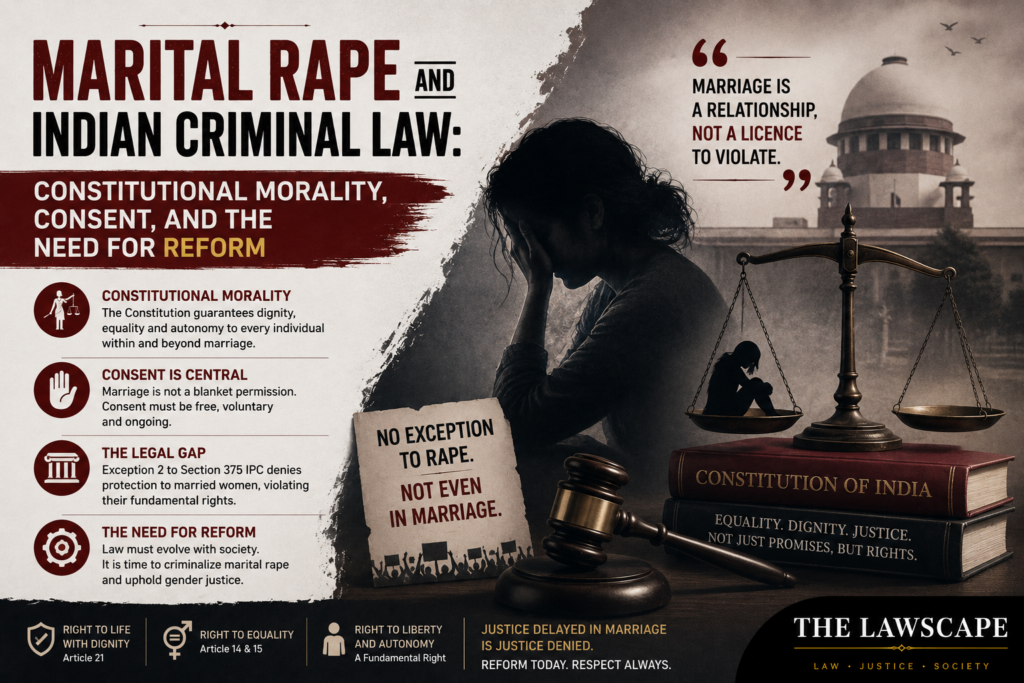
Marital Rape and Indian Criminal Law: Constitutional Morality, Consent, and the Need for Reform
Author: Aayushi Chaudhary
Student, Asian Law College, Noida Uttar Pradesh
—————————————————————————————-
💡 3 Quick Takeaways
- The marital rape exception in Indian criminal law is rooted in outdated common law assumptions that treat consent within marriage as irrevocable.
- The continued exclusion of marital rape from the scope of rape laws raises serious concerns under Articles 14, 15, and 21 of the Constitution of India.
- Criminalization of marital rape would strengthen constitutional values of dignity, autonomy, equality, and consent without undermining the institution of marriage.
Abstract
Marital rape remains one of the most debated and controversial issues in Indian criminal jurisprudence. Despite significant constitutional developments and growing recognition of women’s rights, Indian criminal law continues to provide immunity to husbands against prosecution for non-consensual sexual intercourse with their wives under certain circumstances. The marital rape exception reflects patriarchal assumptions rooted in outdated common law principles that viewed consent within marriage as irrevocable.
In modern constitutional democracies, however, bodily autonomy, dignity, privacy, and equality are recognised as fundamental rights belonging to every individual irrespective of marital status.
This article critically examines the concept of marital rape and its legal status in India. It analyses the historical development of the marital rape exception, its constitutional implications under Articles 14, 15, and 21 of the Constitution of India, significant judicial pronouncements, and comparative international approaches. The article further evaluates arguments both supporting and opposing criminalization and highlights the urgent need for legislative reform.
The article concludes that retaining marital rape immunity is inconsistent with constitutional morality, gender justice, and international human rights obligations. Criminalization of marital rape would not weaken the institution of marriage but would instead strengthen principles of consent, equality, dignity, and mutual respect within marital relationships.
Keywords: Marital Rape, Consent, Constitutional Morality, Criminal Law, Women’s Rights, Bodily Autonomy, Gender Justice
Introduction
Marriage has traditionally been regarded as a sacred social institution in India. Indian society places immense value upon marriage and often considers it the foundation of family life and social stability.
However, the sanctity attached to marriage cannot override the fundamental rights and dignity of an individual. The notion that a married woman loses control over her body upon entering marriage is inconsistent with constitutional values and contemporary human rights principles.
Marital rape refers to non-consensual sexual intercourse or sexual acts committed by a husband against his wife. Although rape is recognised as a serious criminal offence under Indian law, the law historically created an exception for husbands. Exception 2 to Section 375 of the Indian Penal Code provided that sexual intercourse by a man with his own wife, provided she was above a specified age, would not amount to rape.
This exception has long attracted criticism because it denies married women equal legal protection against sexual violence.
The issue of marital rape raises important constitutional and social questions concerning consent, autonomy, equality, dignity, and bodily integrity. It also reflects the tension between traditional societal norms and modern constitutional morality.
In recent years, increasing public awareness, feminist advocacy, and judicial scrutiny have intensified the debate regarding whether India should formally criminalize marital rape.
This article examines the legal and constitutional dimensions of marital rape and evaluates whether the continued existence of marital rape immunity can be justified within a democratic constitutional framework.
Meaning and Nature of Marital Rape
Marital rape refers to sexual intercourse or sexual acts committed by a husband against his wife without her free and voluntary consent.
The defining element of the offence is the absence of consent. Marriage cannot be treated as perpetual or irrevocable consent to sexual relations.
Marital rape may take several forms, including:
- Sexual intercourse through physical force or violence;
- Sexual acts committed through threats, intimidation, or coercion;
- Sexual intercourse without consent;
- Forced sexual acts during periods of separation; and
- Sexual conduct causing physical, emotional, or psychological harm.
The consequences of marital rape are often severe and long-lasting. Victims may suffer physical injuries, reproductive health complications, anxiety, depression, emotional trauma, and long-term psychological distress.
Because the abuse occurs within marriage, victims frequently face additional barriers including social stigma, economic dependence, fear of family breakdown, and lack of institutional support.
Unlike many other forms of sexual violence, marital rape often remains concealed because sexual relations within marriage are frequently viewed as private matters beyond public scrutiny. This culture of silence contributes significantly to underreporting and lack of accountability.
Historical Development of the Marital Rape Exception
The marital rape exception originated in English common law during the seventeenth century.
Sir Matthew Hale famously asserted that by entering into marriage, a woman gave irrevocable consent to sexual intercourse with her husband. According to this doctrine, a husband could not be guilty of raping his wife because marriage itself implied permanent consent.
This principle emerged from deeply patriarchal assumptions. Women were regarded as legally subordinate to men and often lacked an independent legal identity after marriage. The wife was frequently viewed as an extension of her husband’s legal personality.
These ideas were subsequently incorporated into colonial legal systems, including India’s criminal law framework. As a result, the Indian Penal Code, 1860 retained the marital rape exception under Section 375.
Although society, constitutional values, and legal understandings of individual rights have evolved substantially since the nineteenth century, the marital rape exception continued to remain part of Indian criminal law.
Modern constitutional democracies reject the assumption that marriage extinguishes personal autonomy. Consent is now understood as a continuing and voluntary agreement capable of being withdrawn at any time.
Consequently, the historical foundation of the marital rape exception appears increasingly incompatible with contemporary principles of equality, dignity, and bodily autonomy.
Legal Position of Marital Rape in India
Section 375 of the Indian Penal Code
Section 375 of the Indian Penal Code defined rape and recognised absence of consent as a central element of the offence.
However, Exception 2 to Section 375 stated:
“Sexual intercourse or sexual acts by a man with his own wife, the wife not being under fifteen years of age, is not rape.”
This provision effectively granted immunity to husbands from prosecution for rape committed against their wives.
Following the Nirbhaya incident, the Criminal Law (Amendment) Act, 2013 introduced significant reforms relating to sexual offences. Despite recommendations made by the Justice Verma Committee, Parliament chose not to criminalize marital rape.
Independent Thought v. Union of India
A significant development occurred in Independent Thought v. Union of India (2017), where the Supreme Court examined the inconsistency between child protection laws and the marital rape exception.
The Court held that sexual intercourse with a wife below eighteen years of age would amount to rape. It consequently read down Exception 2 and increased the age threshold from fifteen to eighteen years.
While the judgment recognised that child marriage could not justify sexual exploitation, it stopped short of completely abolishing marital rape immunity for adult wives.
Position under the Bharatiya Nyaya Sanhita, 2023
The Bharatiya Nyaya Sanhita, 2023 substantially retains the existing marital rape exception.
As a result, non-consensual sexual intercourse within marriage involving adult wives continues to remain outside the full scope of rape law.
Although women may seek remedies through domestic violence legislation and provisions relating to cruelty, such remedies do not fully recognise the gravity of sexual violence occurring within marriage.
Constitutional Dimensions of Marital Rape
Violation of Article 14: Right to Equality
Article 14 guarantees equality before the law and equal protection of the laws.
The marital rape exception creates a distinction between married and unmarried women regarding protection from sexual violence.
If a man engages in non-consensual sexual intercourse with an unmarried woman, the act constitutes rape. However, the same conduct against a married woman does not receive equivalent legal recognition solely because of her marital status.
Such classification lacks a convincing rational basis and undermines the principle of equal protection.
Marriage cannot reasonably serve as a ground for denying protection against sexual violence. The marital rape exception therefore raises serious concerns regarding constitutional equality.
Violation of Article 21: Right to Life and Personal Liberty
Article 21 protects life and personal liberty, including dignity, privacy, autonomy, and bodily integrity.
In Justice K.S. Puttaswamy v. Union of India (2017), the Supreme Court recognised privacy as a fundamental right and emphasised the importance of decisional autonomy and bodily integrity.
Similarly, in Suchita Srivastava v. Chandigarh Administration (2009), the Court recognised reproductive autonomy as an essential component of personal liberty.
Forced sexual intercourse within marriage directly interferes with bodily integrity and personal dignity.
The marital rape exception therefore appears inconsistent with constitutional protections safeguarding autonomy, privacy, and human dignity.
Violation of Article 15
Article 15 prohibits discrimination on the ground of sex.
The marital rape exception perpetuates patriarchal assumptions regarding the position of women within marriage and effectively denies married women protections available to unmarried women.
Such differential treatment undermines substantive gender equality and raises important questions regarding the compatibility of the exception with constitutional anti-discrimination principles.
Judicial Developments and Contemporary Debate
Delhi High Court Split Verdict
The constitutional validity of the marital rape exception received significant judicial attention in 2022 when the Delhi High Court delivered a split verdict on petitions challenging the provision.
Justice Rajiv Shakdher held that the exception violated Articles 14 and 21 and observed that marriage does not extinguish a woman’s right to consent.
Conversely, Justice C. Hari Shankar upheld the provision and expressed the view that the issue required legislative rather than judicial resolution.
Due to the split verdict, the matter remains subject to further consideration by the Supreme Court.
Expanding Recognition of Consent
Indian constitutional jurisprudence increasingly emphasises consent, dignity, privacy, and individual autonomy.
Judicial developments in areas involving reproductive rights, privacy, sexual autonomy, and personal liberty suggest an evolving constitutional framework that places increasing importance on individual choice and bodily integrity.
This evolution has intensified scrutiny of legal doctrines that continue to grant immunity for non-consensual sexual conduct within marriage.
Arguments in Favour of Criminalization
Protection of Bodily Autonomy
Every individual possesses the right to exercise control over their own body.
Marriage cannot extinguish the requirement of consent. Criminalization would recognise that consent remains necessary within marital relationships.
Constitutional Morality
Constitutional morality prioritises dignity, equality, liberty, and justice over patriarchal social traditions.
The marital rape exception conflicts with constitutional morality because it permits violations of bodily integrity under the protection of marital status.
Gender Justice and Equality
The exception reinforces gender inequality by denying married women protections available to others.
Criminalization would affirm that women remain independent rights-bearing individuals even after marriage.
International Human Rights Obligations
India is a signatory to international instruments such as the Convention on the Elimination of All Forms of Discrimination Against Women (CEDAW).
International human rights standards increasingly recognise marital rape as a form of violence against women and a violation of fundamental rights.
Numerous countries, including the United Kingdom, Canada, Australia, South Africa, and the United States, have criminalized marital rape.
Recognition of Domestic Violence
Marital rape constitutes a serious form of domestic violence.
Criminalization would provide victims with formal legal recognition and strengthen accountability mechanisms while encouraging reporting and awareness regarding women’s rights within marriage.
Arguments Against Criminalization
Possibility of Misuse
Opponents frequently argue that criminalization may result in false complaints and misuse of rape laws.
However, the possibility of misuse exists across many areas of criminal law. The mere possibility of false allegations cannot justify denying legal protection to genuine victims.
Judicial and investigative processes exist precisely to distinguish valid claims from unfounded accusations.
Preservation of Marriage
Another argument suggests that criminalization may destabilise marriage and increase marital conflict.
However, preserving marriage cannot come at the cost of constitutional rights and human dignity.
Healthy marriages are founded upon mutual respect, consent, and equality rather than coercion.
Evidentiary Difficulties
Critics also point to the evidentiary challenges associated with proving offences occurring within private spaces.
While such challenges are real, evidentiary difficulties exist in numerous criminal offences and do not justify complete legal immunity.
Cultural and Social Concerns
Some argue that sexual relations within marriage constitute private matters beyond legal regulation.
Yet privacy cannot be used as a shield for violence or abuse. The State retains a constitutional obligation to protect individuals from harm irrespective of where it occurs.
Comparative International Perspective
Several countries have abolished marital rape immunity and recognised that marriage does not imply permanent consent.
In the United Kingdom, the House of Lords in R v. R (1991) rejected the doctrine of irrevocable consent and held that a husband could be guilty of raping his wife.
Canada removed spousal immunity through legislative reform in 1983.
Similarly, Australia and South Africa recognise marital rape as a criminal offence.
These developments reflect a broader international movement towards protecting women’s autonomy, dignity, and equality within marriage.
India’s continued retention of marital rape immunity places it increasingly at odds with evolving international human rights standards and comparative constitutional practice.
Need for Legislative Reform
There is an urgent need for comprehensive legislative reform concerning marital rape in India.
Key reforms should include:
- Removal of the marital rape exception from criminal law;
- Explicit recognition of consent within marriage;
- Gender-sensitive investigation procedures;
- Victim support and counselling mechanisms;
- Public legal awareness programmes regarding bodily autonomy; and
- Appropriate procedural safeguards to prevent misuse.
Legislative reform must balance victim protection with fair trial guarantees. However, reform cannot be indefinitely postponed because of social resistance or political hesitation.
Indian constitutional jurisprudence has steadily evolved towards stronger recognition of dignity, equality, autonomy, and privacy. Criminal law must similarly evolve to reflect these constitutional commitments.
Conclusion
Marital rape constitutes a serious violation of bodily autonomy, dignity, and constitutional rights.
The continued existence of the marital rape exception reflects outdated patriarchal assumptions that are increasingly incompatible with contemporary constitutional values.
Marriage cannot be interpreted as irrevocable consent to sexual intercourse. Every individual, regardless of marital status, possesses the right to privacy, dignity, bodily integrity, and personal autonomy.
The Constitution guarantees equality and personal liberty to all citizens. Denying married women protection against sexual violence undermines these guarantees and perpetuates structural gender inequality.
Although concerns regarding misuse of law and evidentiary difficulties deserve consideration, they cannot justify blanket immunity for sexual violence within marriage. Legal systems are designed to evaluate evidence, protect procedural fairness, and ensure justice.
Recognising marital rape as an offence would not undermine the institution of marriage. Rather, it would strengthen the values of respect, consent, equality, and dignity that form the foundation of healthy marital relationships.
India has made significant progress in recognising women’s rights and constitutional freedoms. Criminalization of marital rape represents an important step towards achieving substantive equality, gender justice, and constitutional morality within a democratic society.
Disclaimer: The views expressed in this article are those of the author and do not necessarily reflect the views of The Lawscape.
The Lawscape — clear, practical legal insight for students and future lawyers.