
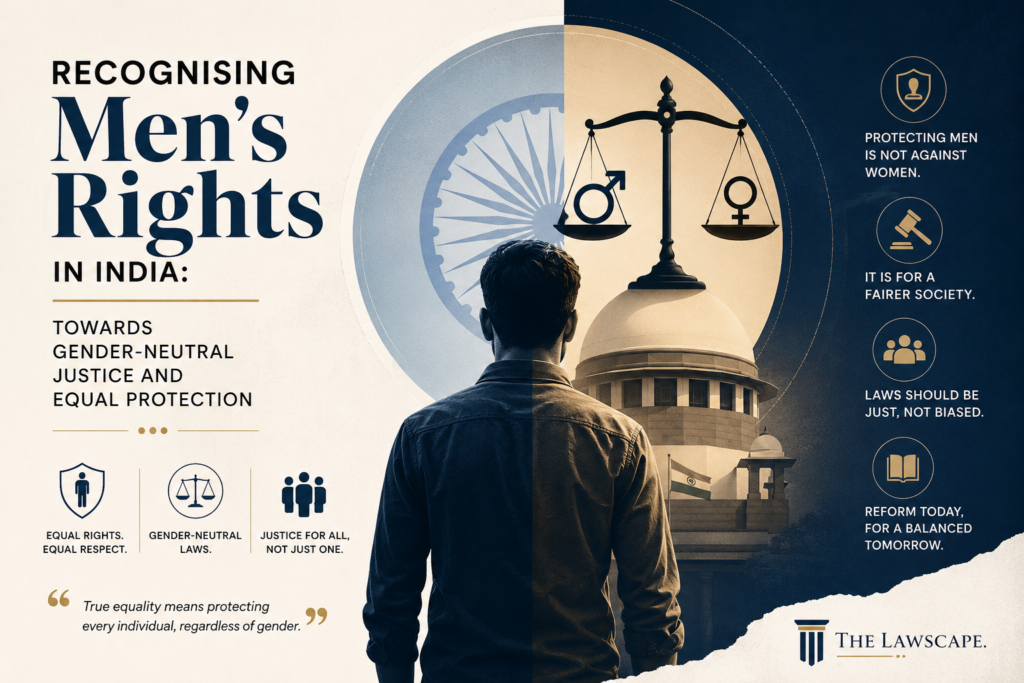
Recognising Men’s Rights in India: Towards Gender-Neutral Justice and Equal Protection
Author: Aditi Singh Parihar
Student, Shambhunath Institute of Law, Prayagraj
—————————————————————————————————–
💡 3 Quick Takeaways
- Constitutional guarantees of equality require legal systems to remain responsive to the rights and vulnerabilities of all individuals, irrespective of gender.
- Concerns regarding false accusations, mental health challenges, domestic abuse against men, and limited legal recognition of male victims have intensified debates surrounding gender-neutral laws.
- A balanced legal framework should strengthen protections for genuine victims while ensuring fairness, due process, and equal access to justice for everyone.
Abstract
India’s legal system has historically focused on protecting women and other vulnerable groups from discrimination, violence, and social exclusion. While these protections remain essential, concerns have increasingly been raised regarding the limited recognition of issues affecting men, including workplace harassment, mental health challenges, domestic abuse, false criminal accusations, and inadequate legal remedies in certain contexts.
This article examines the legal framework relating to men’s rights in India and evaluates the need for a more balanced approach to legal protection. Particular attention is given to concerns regarding misuse of certain legal provisions, the absence of gender-neutral protections in some statutes, and the broader social stereotypes that discourage recognition of male vulnerability.
The article further analyses constitutional principles of equality, dignity, and non-discrimination while exploring international human rights standards that advocate equal protection irrespective of gender. It argues that recognising men’s rights does not diminish women’s rights. Instead, a just legal system must remain committed to protecting every individual while ensuring fairness, accountability, and equal treatment before the law.
Keywords: Men’s Rights, False Accusations, Gender-Neutral Laws, Legal Bias, Gender Equality, Legal Reforms, Constitutional Rights
Introduction
India’s constitutional framework elevates equality and non-discrimination as fundamental rights guaranteed to all citizens. Articles 14, 15, and 21 of the Constitution collectively seek to ensure fairness, equality before the law, and protection of personal liberty.
Despite these constitutional commitments, debates continue regarding whether certain areas of Indian law adequately recognise the rights and vulnerabilities of men.
Over the past several decades, Indian legislation has increasingly adopted gender-specific protections in areas relating to domestic violence, sexual offences, matrimonial disputes, and workplace harassment. These legal measures were introduced to address historical discrimination and structural disadvantages faced by women.
However, concerns have emerged regarding instances where such laws are allegedly misused or where legal frameworks fail to recognise situations in which men may themselves become victims of harassment, abuse, violence, or false accusations.
The consequences of such allegations can be significant. Accusations relating to cruelty, dowry harassment, sexual offences, or domestic disputes may affect a person’s reputation, career, family relationships, and mental well-being even before legal proceedings reach a conclusion.
The discussion surrounding men’s rights should not be understood as opposition to women’s rights. Rather, it concerns the broader objective of ensuring that legal protections operate fairly and effectively for all individuals.
The Indian Men’s Rights Movement gained visibility during the late 1990s through the efforts of advocates and activists seeking greater recognition of legal issues affecting men. Their central argument has been that justice should not be viewed as a competition between genders but as a system committed to protecting everyone equally.
This article examines these concerns from a legal perspective and evaluates whether greater recognition of men’s rights is necessary within India’s constitutional framework.
Contemporary Issues Affecting Men
Discussions concerning men’s rights often focus on social expectations that portray men as emotionally resilient individuals who require little support or protection.
Such assumptions can discourage recognition of legitimate mental health concerns, emotional distress, and experiences of abuse.
According to data referenced by the author, men account for a substantial proportion of suicide deaths in India. Family disputes, marital conflicts, financial pressures, health concerns, and emotional distress are frequently identified as contributing factors.
Mental health challenges among men often remain underreported due to social expectations discouraging emotional expression and help-seeking behaviour.
The author argues that legal and social systems should pay greater attention to these issues, particularly where prolonged litigation, family disputes, or allegations contribute to psychological stress and social isolation.
False Allegations and Misuse of Legal Provisions
One of the central concerns raised within men’s rights discourse relates to allegations of misuse of certain criminal provisions.
Supporters of reform argue that while laws protecting women from cruelty, dowry harassment, and domestic abuse remain necessary, safeguards should also exist to prevent misuse and ensure procedural fairness.
Dara Laxmi Narayana v. State of Telangana
In Dara Laxmi Narayana v. State of Telangana (2024), the Supreme Court quashed criminal proceedings initiated under Section 498A of the Indian Penal Code (now Section 85 of the Bharatiya Nyaya Sanhita, 2023) and provisions of the Dowry Prohibition Act, 1961.
The Court observed that the allegations lacked specific instances of cruelty or dowry demands and emphasised that merely naming family members without supporting evidence could amount to an abuse of legal process.
The judgment highlighted the importance of ensuring that criminal proceedings are supported by specific and credible allegations rather than generalized accusations.
Sushil Kumar Sharma v. Union of India
In Sushil Kumar Sharma v. Union of India (2005), the Supreme Court recognised concerns regarding misuse of Section 498A and observed that abuse of legal provisions could undermine public confidence in the justice system.
Although the Court upheld the constitutional validity of the provision, it acknowledged that misuse required careful judicial attention.
Swapan Kumar Das v. State of West Bengal
Similarly, in Swapan Kumar Das v. State of West Bengal (2023), judicial observations highlighted the importance of preventing misuse of criminal law while simultaneously protecting genuine victims.
These decisions collectively reflect a judicial effort to balance victim protection with procedural fairness and due process.
Mental Health and Social Expectations
A recurring theme in discussions concerning men’s rights is the social expectation that men must remain emotionally strong regardless of personal circumstances.
Such stereotypes can discourage men from seeking psychological assistance, reporting abuse, or discussing emotional difficulties.
Mental health professionals increasingly emphasise that emotional vulnerability is not gender-specific. Anxiety, depression, trauma, and psychological distress affect individuals across all social groups.
The author argues that greater institutional support, counselling services, and public awareness programmes are necessary to address mental health challenges affecting men, particularly those involved in prolonged legal disputes or family conflicts.
Gender-Specific Laws and the Debate on Gender Neutrality
The author identifies several laws and legal provisions that primarily protect women, including:
- The Dowry Prohibition Act, 1961;
- The Protection of Women from Domestic Violence Act, 2005;
- The Sexual Harassment of Women at Workplace (Prevention, Prohibition and Redressal) Act, 2013; and
- Certain provisions of the Bharatiya Nyaya Sanhita, 2023 relating to offences against women.
The argument advanced is not that such protections should be removed, but rather that lawmakers should consider whether equivalent protections are necessary in circumstances where men may experience similar forms of harm.
The author questions whether offences such as stalking, voyeurism, workplace harassment, emotional abuse, or domestic violence should be recognised through more gender-neutral legal frameworks capable of protecting all victims regardless of gender.
Supporters of gender-neutral legislation argue that legal protection should be determined by the nature of the harm suffered rather than the gender of the victim.
This perspective has become increasingly prominent in international human rights discussions and comparative legal reform debates.
Sexual Abuse and Male Victimisation
Another issue highlighted by the author concerns the limited recognition of sexual abuse affecting boys and men.
Social stigma frequently discourages reporting of such incidents, contributing to underreporting and inadequate public awareness.
The author notes that several recent incidents involving abuse of male children have brought greater attention to the issue and challenged assumptions that sexual violence primarily affects women.
Recognition of male victimisation, according to the article, is necessary not only for individual justice but also for ensuring that legal and social support systems remain accessible to all victims of abuse.
Constitutional Perspective
The debate concerning men’s rights must ultimately be examined through the constitutional framework.
Article 14: Equality Before Law
Article 14 guarantees equality before the law and equal protection of the laws.
This principle requires legal classifications to be reasonable and consistent with constitutional objectives. Discussions concerning gender-neutral legislation frequently invoke Article 14 by arguing that legal protections should remain accessible to all individuals facing similar harms.
Article 15: Non-Discrimination
Article 15 prohibits discrimination on specified grounds while also permitting affirmative measures designed to protect disadvantaged groups.
The challenge lies in balancing protective legislation with broader commitments to equal treatment and fairness.
Article 21: Life and Personal Liberty
Article 21 protects dignity, liberty, mental well-being, and personal autonomy.
Concerns regarding mental health, social stigma, false accusations, and emotional distress are often framed within the broader constitutional commitment to protecting individual dignity and personal liberty.
The author argues that greater recognition of men’s rights would strengthen rather than weaken these constitutional values.
International Human Rights Perspective
International human rights instruments generally emphasise equality, dignity, and protection from discrimination regardless of gender.
The principle of equal protection requires legal systems to remain responsive to the experiences of all individuals while recognising the distinct vulnerabilities that different groups may face.
Several jurisdictions have gradually moved towards gender-neutral approaches in areas such as domestic violence, workplace harassment, and sexual offences while maintaining specialised protections where necessary.
These developments have influenced contemporary discussions regarding the future direction of legal reform in India.
Policy Suggestions and Recommendations
The author proposes several reforms aimed at strengthening recognition of men’s rights while maintaining existing protections for women.
Legal Awareness Initiatives
Educational institutions and public authorities should conduct awareness programmes concerning constitutional rights, legal protections, and available remedies for all individuals irrespective of gender.
Legal Aid and Mental Health Support
Specialised legal aid services and counselling mechanisms should be available for individuals facing false accusations, prolonged litigation, or significant emotional distress.
Mental health awareness programmes should be expanded to encourage help-seeking behaviour and reduce social stigma.
Balanced Recognition of Victimhood
Public discourse should recognise that both men and women may experience discrimination, abuse, harassment, or violence.
A victim-centred approach should focus on the nature of the harm rather than assumptions based solely on gender.
Child Custody Reform
The author advocates greater emphasis on shared parental involvement following divorce, with decisions guided by the welfare of the child while ensuring meaningful parental access wherever appropriate.
National Men’s Commission
The article proposes the establishment of a National Men’s Commission to provide legal assistance, counselling, advocacy, and support services for men facing legal or social difficulties.
Conclusion
The discussion surrounding men’s rights reflects broader questions concerning equality, fairness, and the role of law in protecting all individuals.
While Indian law has rightly developed significant protections for women in response to historical discrimination and violence, concerns continue to be raised regarding areas where men’s vulnerabilities remain insufficiently recognised.
Issues relating to mental health, false accusations, domestic abuse, workplace harassment, and access to legal remedies warrant serious examination within a constitutional framework committed to equality and dignity.
Recognising men’s rights should not be viewed as diminishing protections available to women. Rather, it represents an effort to ensure that justice remains accessible to all individuals irrespective of gender.
A balanced legal system must protect genuine victims, prevent misuse of legal provisions, uphold due process, and remain responsive to evolving social realities.
Ultimately, the pursuit of equality requires moving beyond stereotypes and recognising that fairness, dignity, and legal protection are rights that belong to every individual. Strengthening these principles will contribute to a more inclusive and just society consistent with constitutional values and the rule of law.
Disclaimer: The views expressed in this article are those of the author and do not necessarily reflect the views of The Lawscape.
The Lawscape — clear, practical legal insight for students and future lawyers.