
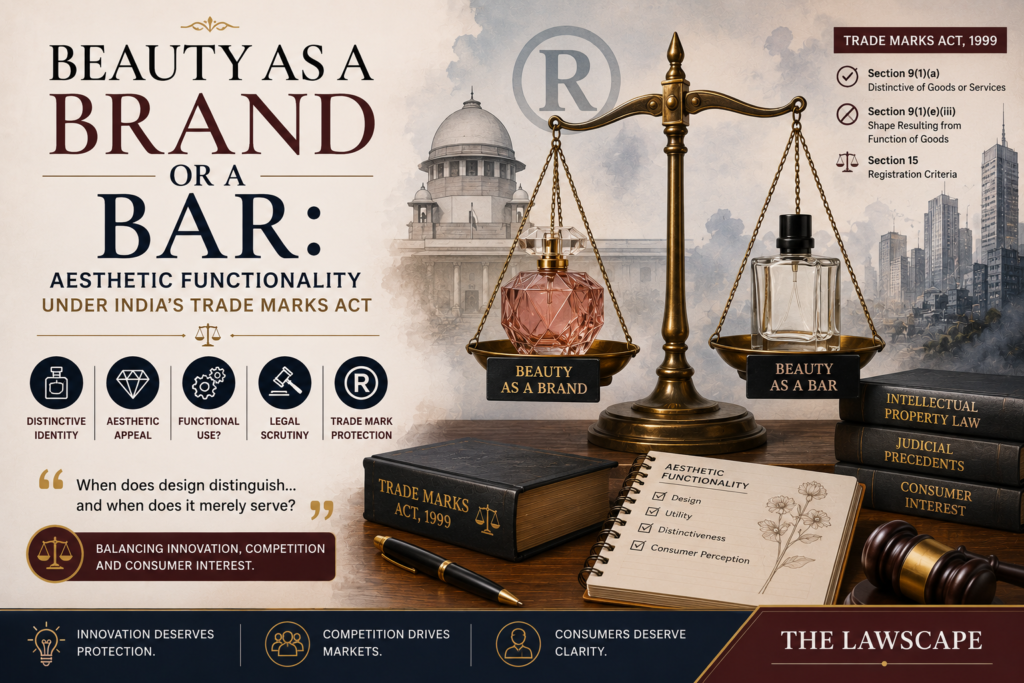
Beauty as a Brand or a Bar: Aesthetic Functionality under India’s Trade Marks Act
Author: Sakshi Shukla
Student, Manipal University Jaipur, Jaipur
————————————————————————–
💡 3 Quick Takeaways
- Indian trademark law lacks a clear doctrine of aesthetic functionality, creating uncertainty in protecting non-traditional trademarks.
- Section 9(3)(c) of the Trade Marks Act, 1999 addresses only shape marks and fails to adequately regulate colours, patterns, textures, and other aesthetic features.
- Legislative reform and judicial recognition of aesthetic functionality are necessary to prevent perpetual monopolies over commercially desirable product aesthetics.
Introduction
In 1993, Christian Louboutin famously used red nail polish to paint the sole of a shoe prototype, creating what would later become one of the most litigated trademarks in the world. The iconic red sole serves not only as a powerful branding device but also as an aesthetically desirable feature that competing luxury footwear designers may wish to use for purely artistic and commercial reasons.
This raises a fundamental question: should trademark law permit a business to obtain potentially perpetual exclusivity over an aesthetically appealing feature of a product?
Unlike patents and design rights, which provide protection for limited periods, trademark rights can theoretically endure indefinitely. Consequently, granting trademark protection to product aesthetics may create long-term monopolies over commercially valuable design elements. In jurisdictions such as the United States and the European Union, the doctrine of aesthetic functionality acts as an important safeguard by preventing trademark protection where exclusive rights would place competitors at a significant disadvantage unrelated to brand reputation.
Indian trademark law has yet to confront this issue directly.
The Trade Marks Act, 1999 addresses the matter only indirectly through Section 9(3)(c), which prohibits registration of shapes that provide substantial value to goods. While this provision reflects an important policy concern, it suffers from significant limitations. It applies exclusively to shape marks and offers no meaningful guidance regarding colours, textures, patterns, or other aesthetic elements that increasingly function as brand identifiers in modern markets.
This article examines the concept of aesthetic functionality, identifies deficiencies in the Indian statutory framework, analyses judicial treatment of aesthetic marks, and proposes reforms necessary to align Indian trademark law with contemporary commercial realities.
Understanding the Aesthetic Functionality Doctrine
The functionality doctrine represents one of the most important limitations on trademark protection. Its purpose is to prevent trademark law from becoming a perpetual substitute for patent or design protection while ensuring that trademarks remain primarily indicators of commercial origin.
The traditional application of functionality concerns technical functionality. Product features that are essential to the use, purpose, or operation of an article cannot be monopolised through trademark registration. Examples include the design of mechanical components or product shapes necessary for achieving a technical result.
Aesthetic functionality presents a more complex challenge.
The doctrine applies where an aesthetic feature is itself competitively necessary within a particular market. In such situations, granting exclusive rights over that feature would place competitors at a significant disadvantage unrelated to brand identity.
The doctrine was articulated by the United States Supreme Court in Qualitex Co. v. Jacobson Products Co. (1995), where the Court observed that trademark protection should not extend to features whose exclusive use would impose a significant non-reputation-related disadvantage on competitors.
The principle was further clarified in TrafFix Devices Inc. v. Marketing Displays Inc. (2001), which emphasised that features serving important functions beyond source identification should remain available for competitive use.
The critical distinction is therefore between aesthetic features that communicate source and those that are commercially necessary irrespective of source.
This distinction becomes particularly significant in industries such as fashion, luxury goods, jewellery, and consumer design, where aesthetic appeal often constitutes a primary factor influencing purchasing decisions.
India’s Statutory Framework: Strengths and Gaps
The Trade Marks Act, 1999 adopts a broad definition of “mark,” encompassing shapes, packaging, colours, and other non-traditional identifiers. The Act therefore appears capable of accommodating a wide range of aesthetic trademarks.
Section 9(3) imposes three important restrictions on the registration of shape marks. Registration is prohibited where a mark consists exclusively of:
- The shape resulting from the nature of the goods themselves;
- The shape necessary to obtain a technical result; or
- The shape that gives substantial value to the goods.
Among these provisions, Section 9(3)(c) comes closest to embodying an aesthetic functionality doctrine. However, the provision suffers from several structural limitations.
Most significantly, the expression “substantial value” remains undefined. Indian courts have not developed a consistent test to determine whether a product’s shape contributes substantial value. It remains unclear whether the inquiry should focus on consumer motivation, market pricing, commercial desirability, or some combination of these factors.
This ambiguity creates uncertainty both for applicants and for trademark examiners.
A more fundamental problem lies in the narrow drafting of the provision itself. Section 9(3)(c) applies only to shapes. It does not extend to colours, textures, patterns, product configurations, or combinations of aesthetic elements.
This limitation is particularly problematic because contemporary branding increasingly relies upon non-traditional marks. Colour marks, sound marks, three-dimensional marks, and other unconventional identifiers are now common features of modern trademark practice.
The Trade Marks Rules, 2017 recognise this reality by facilitating registration procedures for non-traditional marks. However, the substantive restrictions concerning aesthetic functionality remain confined to shape marks alone.
The result is an inconsistent legislative framework that recognises a broad spectrum of aesthetic trademarks while providing functionality safeguards for only one category.
Judicial Treatment of Aesthetic Marks in India
Indian courts have considered various disputes involving shape marks and product aesthetics, but they have not developed a coherent doctrine of aesthetic functionality.
Instead, judicial analysis has generally focused on distinctiveness, consumer confusion, and acquired secondary meaning while paying limited attention to the broader competitive implications of granting exclusive rights over aesthetic features.
In Gorbatschow Wodka KG v. John Distilleries Ltd. (2011), the Bombay High Court protected the distinctive shape of a vodka bottle on the basis of source identification and consumer recognition. While the decision addressed distinctiveness, it did not consider whether the bottle design possessed competitive aesthetic significance within the premium spirits industry.
Similarly, in KnitPro International v. Examiner of Trade Marks (2022), the Delhi High Court emphasised the importance of acquired distinctiveness for shape marks. Although the Court correctly focused on secondary meaning, it did not engage with questions of aesthetic functionality or competitive necessity.
The issue emerged more prominently in the Crocs litigation, where questions arose regarding the overlap between design protection and trademark protection. However, even in this context, courts did not comprehensively address whether granting trademark exclusivity over the product’s design would hinder legitimate competition.
The most significant omission appears in relation to colour marks.
In Christian Louboutin SAS v. Pawan Kumar & Ors. (2017), the Delhi High Court recognised and enforced protection for Louboutin’s red sole trademark. The Court analysed distinctiveness and consumer confusion but did not examine whether exclusive rights over a colour used in luxury footwear might affect competition within the broader market.
Consequently, Indian jurisprudence continues to lack a developed framework for evaluating the competitive implications of aesthetic trademarks.
Comparative Perspectives: The United States and the European Union
The United States possesses the most sophisticated body of jurisprudence concerning aesthetic functionality.
The decisions in Qualitex and TrafFix establish a framework that focuses on whether exclusive rights would create a significant competitive disadvantage unrelated to brand reputation. Importantly, this analysis extends beyond shape marks and applies equally to colours, textures, and other aesthetic features.
The Second Circuit’s decision in Christian Louboutin SAS v. Yves Saint Laurent America Inc. (2012) illustrates this nuanced approach. The Court held that Louboutin’s red sole was protectable when used in contrast with the remainder of the shoe because the contrast functioned as a source identifier. However, the Court declined to extend protection to entirely red shoes, recognising that doing so would improperly restrict competitors.
The European Union adopts a somewhat different but equally structured approach.
Article 7(1)(e)(iii) of the European Union Trade Mark Regulation excludes registration of shapes that provide substantial value to goods. European courts have interpreted this provision by examining whether aesthetic characteristics significantly influence consumer purchasing decisions.
Cases such as Lego Juris A/S v. OHIM and Henkel KGaA v. OHIM demonstrate a willingness to consider the commercial significance of aesthetic features and their impact on competition.
Both jurisdictions therefore provide analytical tools for distinguishing between source-identifying features and competitively essential aesthetics.
India currently lacks an equivalent framework.
Industry Implications
The absence of a clear aesthetic functionality doctrine has practical consequences across multiple industries.
In the fashion sector, courts often struggle to distinguish between distinctive branding elements and aesthetic features that competitors legitimately require. Without a coherent framework, trademark law risks granting excessive protection over design elements that should remain available for industry-wide use.
The jewellery industry presents similar concerns. Traditional motifs such as paisleys, lotus designs, and temple-inspired patterns possess deep cultural significance and often predate modern branding efforts. Overly broad trademark protection could permit commercial entities to claim exclusivity over design features that belong to a shared cultural heritage.
Consumer electronics and industrial design offer another illustration. Minimalist aesthetics, clean lines, matte finishes, and specific design proportions have become central features of contemporary product design. Granting exclusive rights over such elements could distort competition by preventing rivals from participating effectively in the marketplace.
These concerns demonstrate why aesthetic functionality serves an important role in preserving competitive balance.
Reform Imperatives
Meaningful reform is required at both judicial and legislative levels.
Indian courts should begin by adopting a structured two-stage analysis inspired by comparative jurisprudence.
First, courts should determine whether the aesthetic feature is competitively essential within the relevant market. The inquiry should focus on whether competitors would suffer a significant disadvantage unrelated to the trademark owner’s reputation if exclusive rights were granted.
Second, courts should assess whether the source-identification benefits of trademark protection outweigh any anti-competitive consequences.
Such an approach could be implemented through purposive interpretation of existing statutory provisions.
Legislatively, Section 9(3) should be amended to expand its scope beyond shapes. The provision should expressly apply to shapes, colours, patterns, textures, and combinations thereof.
Additionally, the Act should incorporate a statutory definition of “substantial value” based upon consumer motivation and competitive necessity. Such clarification would provide greater certainty for courts, applicants, and trademark examiners.
The Intellectual Property India Registry should also issue examination guidelines concerning aesthetic functionality, similar to the practice adopted by the European Union Intellectual Property Office. These guidelines would promote consistency and reduce uncertainty in trademark examination.
Conclusion
The doctrine of aesthetic functionality addresses a fundamental tension within trademark law: balancing the protection of brand identity against the need to preserve access to commercially desirable product aesthetics.
Although Section 9(3)(c) of the Trade Marks Act, 1999 reflects an awareness of this tension, its limited focus on shape marks, its undefined “substantial value” standard, and the absence of a coherent analytical framework have produced significant doctrinal uncertainty.
As India’s fashion, jewellery, luxury goods, and technology sectors continue to expand, disputes involving aesthetic trademarks will inevitably become more frequent and more complex.
The Indian equivalent of the Louboutin controversy has not yet fully emerged. However, when courts are eventually required to determine whether colours, textures, patterns, or other aesthetic features are competitively essential, existing legal frameworks may prove inadequate.
The need for proactive judicial development and legislative reform is therefore both evident and urgent. A well-defined doctrine of aesthetic functionality would preserve competition, enhance legal certainty, and ensure that trademark protection remains faithful to its fundamental purpose: identifying source rather than monopolising beauty itself.
Disclaimer: The views expressed in this article are those of the author and do not necessarily reflect the views of The Lawscape.
The Lawscape — clear, practical legal insight for students and future lawyers.