
Deepfake Crimes and Indian Law: Is the Legal System Ready?
Author: Shriya V.S.
Student, Mar Gregosios college of Law, Thiruvananthapuram
————————————————————————————————————————
💡 3 Quick Takeaways
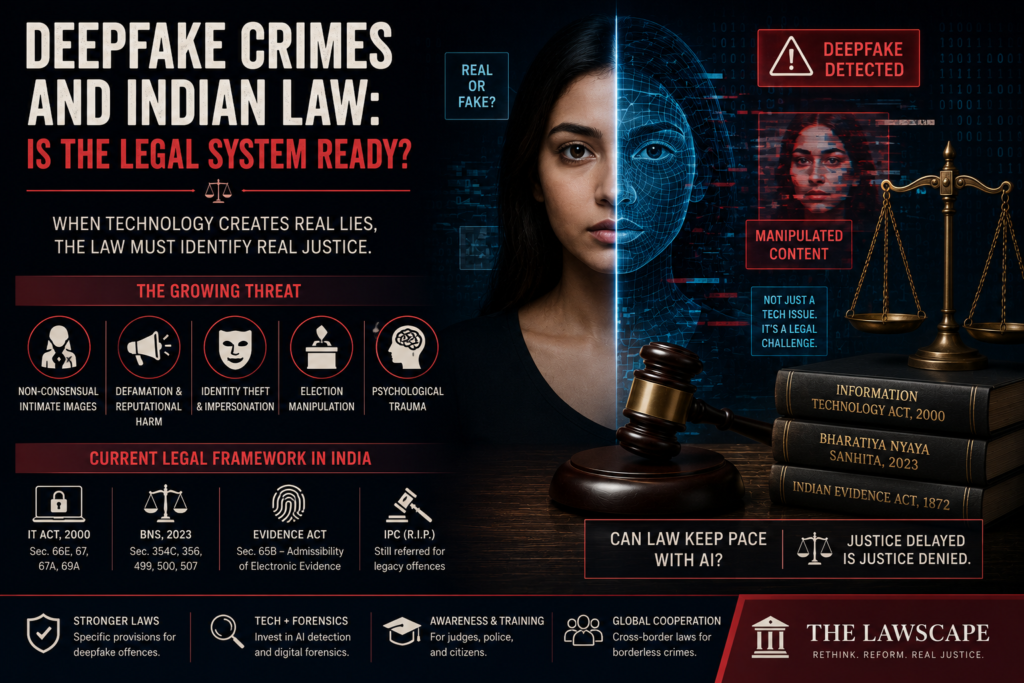
- Deepfake technology poses serious threats to privacy, reputation, democratic processes, and digital security.
- Existing Indian laws address certain deepfake-related harms, but there is no dedicated legal framework specifically regulating deepfakes.
- India requires comprehensive legislation, stronger cyber governance, and ethical AI regulation to effectively address emerging deepfake crimes.
Introduction
Deepfake technology is one of the most significant developments in artificial intelligence and digital media. The term “deepfake” combines the concepts of deep learning and fabricated content, referring to AI-generated or AI-manipulated images, videos, and audio recordings that appear authentic despite being entirely fabricated or significantly altered.
Modern deepfake systems rely on advanced machine learning models, including Generative Adversarial Networks (GANs), to simulate facial expressions, speech patterns, and voice modulation. These technologies enable users to superimpose an individual’s face onto another person’s body, generate realistic synthetic videos, and create convincing voice clones capable of imitating speech with remarkable accuracy.
As deepfake technology becomes increasingly accessible, the ability to distinguish authentic content from manipulated content becomes progressively more difficult. Consequently, deepfakes present serious risks not only to individuals but also to broader social, political, and legal systems.
The growing use of deepfake technology has generated concerns in several areas, including:
- Political misinformation and disinformation campaigns;
- Cyber fraud and identity theft;
- Reputational harm and character assassination;
- Non-consensual pornography;
- Financial fraud through voice replication;
- Manipulation of digital evidence; and
- Dissemination of misleading content through social media platforms.
These developments raise an important question: is the Indian legal system adequately prepared to address deepfake-related crimes?
Categories of Deepfake Crimes
Deepfake Video
Deepfake videos are among the most common forms of synthetic media manipulation. Artificial intelligence can generate or alter video content to make it appear that an individual said or did something that never occurred.
Such videos may depict public figures delivering fabricated speeches, participating in events that never happened, or engaging in conduct that is entirely fictional. The resulting content can cause significant reputational, political, and social harm.
Deepfake Audio
Deepfake audio technology uses artificial intelligence to replicate a person’s voice, including speech patterns, pitch, tone, and vocal characteristics.
These systems can generate entirely fabricated conversations or statements that the individual never made. As voice cloning technology becomes more sophisticated, distinguishing authentic recordings from manipulated content becomes increasingly difficult.
The technology has already been linked to financial fraud, impersonation schemes, and social engineering attacks.
Deepfake Images
Artificial intelligence can also generate or manipulate photographs by placing an individual’s likeness into fabricated scenarios.
These images may portray individuals in circumstances that never occurred or create entirely synthetic visual representations. Such content can be used for harassment, misinformation, blackmail, or reputational attacks.
Deepfakes in Politics
The political use of deepfake technology presents one of the most significant threats to democratic systems.
Manipulated videos, images, and audio recordings can be deployed to influence public opinion, damage political reputations, and disseminate false information during elections. Such practices risk undermining public trust in institutions and creating widespread confusion regarding the authenticity of digital content.
Constitutional Dimensions of Deepfake Crimes
The rise of deepfake technology raises important constitutional concerns involving privacy, dignity, autonomy, freedom of expression, and digital rights.
Article 21: Privacy, Dignity, and Personal Liberty
Article 21 of the Constitution guarantees the right to life and personal liberty. Through judicial interpretation, the Supreme Court has expanded this protection to include privacy, dignity, autonomy, and control over personal identity.
Deepfake technology directly threatens these constitutional values. The unauthorised use of an individual’s image, voice, or identity can significantly impair personal autonomy and violate privacy rights.
The Supreme Court’s landmark decision in Justice K.S. Puttaswamy v. Union of India recognised privacy as a fundamental right and emphasised the central importance of dignity and autonomy in the digital age. The judgment provides a constitutional foundation for addressing harms caused by deepfake pornography, AI-generated impersonation, and manipulated digital content.
Article 19: Freedom of Speech and Expression
Article 19(1)(a) guarantees freedom of speech and expression. However, this right is not absolute and remains subject to reasonable restrictions under Article 19(2).
Regulating deepfake technology therefore requires balancing competing constitutional interests. Excessive regulation may restrict legitimate artistic expression, satire, journalism, and technological innovation. Conversely, insufficient regulation may expose society to misinformation, cybercrime, and severe privacy violations.
This tension represents one of the most significant constitutional challenges in developing a legal framework for deepfake regulation.
Ramifications of Deepfake Technology
Deepfake Crimes and Their Social Impact
Deepfake technology has transformed the landscape of cybercrime. Its misuse affects not only individuals but also businesses, government institutions, and democratic processes.
The widespread availability of synthetic media tools increases opportunities for fraud, deception, and digital manipulation on an unprecedented scale.
Identity Theft and Impersonation
One of the most concerning applications of deepfake technology involves identity theft.
Criminals can use AI-generated audio and video to impersonate individuals for fraudulent purposes, including obtaining financial benefits, authorising transactions, or deceiving victims into transferring funds.
Such activities can result in financial loss, reputational damage, and erosion of trust in digital communication systems.
Online Harassment and Non-Consensual Pornography
Deepfake pornography has emerged as a particularly harmful use of synthetic media technology.
Victims—most often women—may find their images digitally manipulated and inserted into explicit content without consent. Such conduct violates privacy, dignity, and personal autonomy while inflicting severe emotional and psychological harm.
The consequences often extend beyond digital spaces, affecting victims’ personal relationships, professional opportunities, and mental health.
Political Misinformation and Democratic Harm
Deepfakes pose a serious threat to democratic institutions and electoral processes.
Manipulated content can influence public opinion, spread misinformation, and undermine confidence in political leaders and public institutions. Given India’s vast digital population and extensive social media usage, the potential impact of politically motivated deepfakes is particularly significant.
The erosion of public trust in authentic information may ultimately weaken democratic discourse itself.
Existing Legal Framework Governing Deepfakes in India
India currently lacks legislation specifically dedicated to regulating deepfake technology. Nevertheless, several existing statutes address related conduct involving impersonation, fraud, obscenity, defamation, and misinformation.
Information Technology Act, 2000
The Information Technology Act, 2000 remains India’s primary legislation dealing with cybercrime.
Section 66C: Identity Theft
Section 66C criminalises the fraudulent or dishonest use of another person’s electronic signature, password, or unique identification features.
Deepfake content involving unauthorised identity impersonation may attract liability under this provision.
Section 66D: Cheating by Personation
Section 66D penalises impersonation using computer resources or communication devices for the purpose of cheating or obtaining unlawful benefits.
Deepfake-generated impersonation schemes may fall within the scope of this provision.
Sections 67 and 67A: Obscene and Sexually Explicit Content
These provisions regulate the publication and transmission of obscene and sexually explicit material in electronic form.
Deepfake pornography and sexually manipulated content may be prosecuted under these sections.
While these provisions provide certain remedies, the Information Technology Act was enacted before the emergence of sophisticated AI-generated media and therefore contains no direct references to deepfake technology.
Bharatiya Nyaya Sanhita, 2023
The Bharatiya Nyaya Sanhita (BNS), 2023 also contains provisions that may apply to deepfake-related offences.
Section 111: Organised Crime
Where deepfakes form part of organised cybercrime operations, extortion schemes, or coordinated fraud networks, liability may arise under provisions relating to organised crime.
Section 353: Public Mischief
The dissemination of false information or manipulated media causing public alarm, panic, or misinformation may attract liability under this provision.
Section 356: Defamation
Deepfake audio, video, and image content intended to harm a person’s reputation may constitute defamation.
Section 351: Criminal Intimidation
Where deepfakes are used to threaten, coerce, or intimidate individuals, criminal intimidation provisions may become applicable.
Sections 336–338: Forgery
The creation or manipulation of electronic records through deepfake technology for fraudulent purposes may amount to forgery under the BNS.
Although these provisions provide some protection, they remain indirect responses to deepfake harms rather than a dedicated regulatory framework.
Landmark Judicial Decisions
Justice K.S. Puttaswamy v. Union of India
The Supreme Court’s decision in Justice K.S. Puttaswamy v. Union of India represents one of the most significant constitutional judgments concerning privacy in India.
The Court recognised privacy as a fundamental right under Article 21 and emphasised the importance of dignity, autonomy, and informational self-determination.
These principles are highly relevant to deepfake-related harms, which frequently involve unauthorised use of personal identity and intrusion into private life.
Shreya Singhal v. Union of India
In Shreya Singhal v. Union of India, the Supreme Court struck down Section 66A of the Information Technology Act as unconstitutional.
The Court held that vague restrictions on online speech could produce a chilling effect on freedom of expression. Importantly, the judgment affirmed that speech on the internet enjoys the same constitutional protection as speech in other forms.
This decision remains significant when considering future regulation of deepfakes, as lawmakers must ensure that regulatory measures remain compatible with constitutional free speech guarantees.
R. Rajagopal v. State of Tamil Nadu
In R. Rajagopal v. State of Tamil Nadu, commonly known as the Auto Shankar case, the Supreme Court recognised the “right to be let alone” as an aspect of the right to privacy.
The Court held that individuals possess a right to protect matters relating to their personal lives from unauthorised publication.
This principle is particularly relevant in cases involving deepfake content that intrudes upon private life, personal relationships, family matters, or individual identity.
Challenges in Regulating Deepfakes
Despite existing legal protections, significant challenges remain.
First, deepfakes are often difficult to detect. Rapid advances in artificial intelligence make synthetic content increasingly realistic, complicating both investigation and prosecution.
Second, existing laws primarily address the consequences of deepfake misuse rather than the technology itself. This reactive approach may prove inadequate as AI systems become more sophisticated.
Third, deepfake content frequently crosses jurisdictional boundaries, creating challenges for enforcement and international cooperation.
Finally, regulators must carefully balance innovation and constitutional freedoms against the need to protect individuals from harm.
Conclusion
Deepfake technology represents one of the most significant challenges of the digital age. While artificial intelligence offers remarkable opportunities for innovation, creativity, and communication, its misuse has generated new forms of cybercrime, misinformation, privacy violations, and reputational harm.
The consequences extend beyond individual victims. Deepfakes threaten democratic institutions, public trust, digital security, and the integrity of information ecosystems.
Although existing laws such as the Information Technology Act, 2000 and the Bharatiya Nyaya Sanhita, 2023 provide certain legal remedies, India currently lacks a comprehensive legislative framework specifically designed to regulate deepfake technology. Judicial decisions such as Justice K.S. Puttaswamy v. Union of India, Shreya Singhal v. Union of India, and R. Rajagopal v. State of Tamil Nadu offer important constitutional guidance, but significant regulatory gaps remain.
As artificial intelligence continues to evolve at an unprecedented pace, legal systems must adapt accordingly. Effective responses to deepfake crimes require specialised legislation, stronger cyber governance mechanisms, improved digital literacy, enhanced detection technologies, and ethical frameworks governing artificial intelligence.
In the emerging era of synthetic media, protecting truth, privacy, dignity, and democratic integrity is no longer merely a policy objective—it has become an essential requirement of modern justice.
Disclaimer: The views expressed in this article are those of the author and do not necessarily reflect the views of The Lawscape.
The Lawscape — clear, practical legal insight for students and future lawyers.