
Human Trafficking: A Criminological and Penological Analysis of Modern Slavery
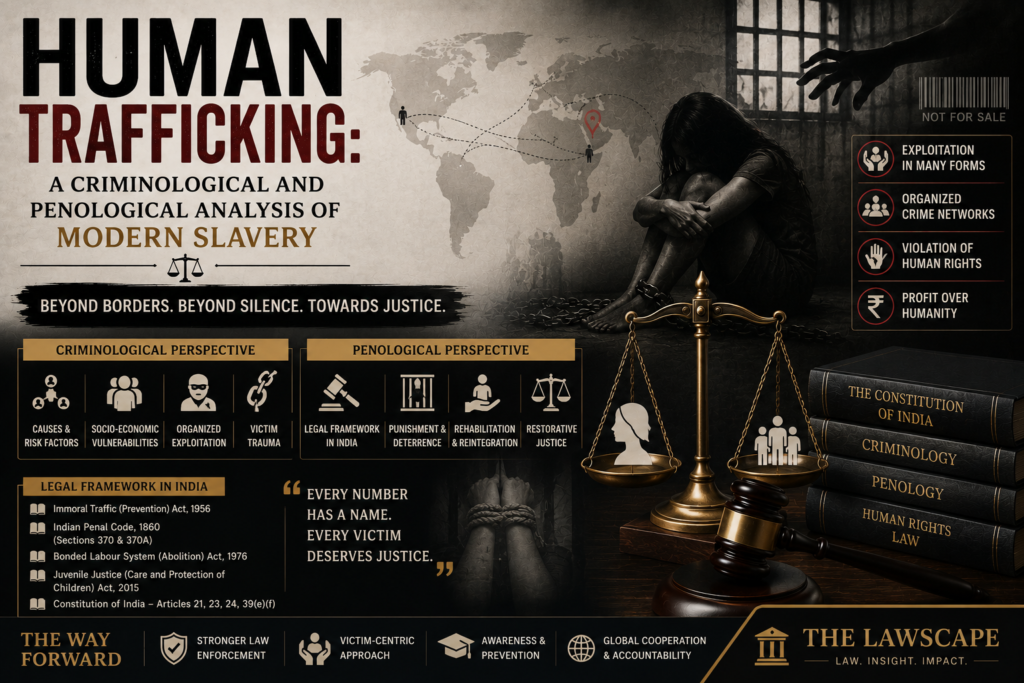
Author: Ashika D
Student, Government Law College, Chengalpattu
—————————————————————————————-
💡 3 Quick Takeaways
- Human trafficking is a complex form of organized crime rooted in poverty, inequality, gender discrimination, and institutional weaknesses.
- Criminological theories such as strain theory, differential association theory, social disorganization theory, organized crime theory, and feminist criminology provide valuable insights into the causes and persistence of trafficking.
- Effective anti-trafficking measures require a balanced approach combining criminal punishment, victim rehabilitation, social welfare, and institutional accountability.
Introduction
Human trafficking is among the gravest forms of organized crime in the contemporary world and is frequently described as a modern form of slavery. It involves the recruitment, transportation, transfer, harbouring, or receipt of persons through coercion, deception, abuse of power, fraud, or exploitation for purposes such as forced labour, sexual exploitation, bonded labour, domestic servitude, child exploitation, and organ trafficking.
The internationally accepted definition of trafficking is contained in the Palermo Protocol under the United Nations Convention against Transnational Organized Crime. Human trafficking constitutes a direct assault on human dignity, bodily autonomy, liberty, and fundamental rights. It is not merely a criminal law issue but also a social, economic, political, and human rights concern.
The persistence of trafficking is closely linked to poverty, unemployment, migration, gender inequality, organized crime, corruption, weak governance structures, and social vulnerability. Globalization, technological advancement, and increasing cross-border mobility have further enabled trafficking networks to expand their operations and exploit vulnerable populations.
In India, trafficking manifests in various forms, including bonded labour, child labour, domestic servitude, forced prostitution, and exploitative labour migration. Constitutional protections under Articles 21, 23, and 24 safeguard individuals against exploitation, while statutory frameworks criminalise trafficking and related offences.
From a criminological perspective, trafficking must be understood as a product of broader structural and institutional conditions rather than merely individual criminal conduct. From a penological perspective, the focus extends beyond punishment to include rehabilitation, victim protection, prevention, and restorative justice.
Nature and Characteristics of Human Trafficking
Human trafficking consists of three essential components:
- The Act – recruitment, transportation, transfer, harbouring, or receipt of persons;
- The Means – force, coercion, deception, fraud, abuse of power, or exploitation of vulnerability; and
- The Purpose – exploitation for financial or other benefits.
These elements form the foundation of international legal recognition of trafficking.
Trafficking is rarely committed by isolated offenders. Instead, it is generally carried out through organized networks involving recruiters, transporters, intermediaries, financiers, and exploiters operating in a coordinated manner. These networks function with secrecy, division of labour, and sophisticated planning to maximise profits.
A defining feature of trafficking is its focus on vulnerable populations. Victims are often drawn from economically disadvantaged and socially marginalised communities lacking access to education, healthcare, employment opportunities, and institutional support. Women, children, migrants, refugees, and other vulnerable groups are disproportionately affected.
The increasing transnational nature of trafficking has further complicated enforcement efforts. Weak border controls, corruption, political instability, technological advancements, and global migration patterns facilitate trafficking operations across national boundaries.
Given its complexity, trafficking cannot be adequately understood solely through traditional criminal law frameworks. It requires an interdisciplinary approach integrating legal, sociological, economic, and criminological perspectives.
Human Trafficking as Organized Crime
Human trafficking is widely recognised as a form of transnational organized crime.
Organized crime scholars describe such criminal enterprises as structured and continuous operations designed to generate profit through coordinated illegal activity. Human trafficking networks closely resemble other organized criminal enterprises such as narcotics trafficking and arms smuggling.
These networks typically operate through hierarchical structures comprising:
- Recruiters;
- Transporters;
- Middlemen;
- Financiers; and
- Exploiters.
Trafficking organizations rely on forged documentation, illegal migration routes, money laundering mechanisms, digital communication tools, corruption, and transnational networks to sustain their activities and evade detection.
Modern technology has significantly enhanced the reach of trafficking organizations. Social media platforms, online advertisements, encrypted communication systems, and digital payment methods provide traffickers with new opportunities to recruit victims and conceal their operations.
International organisations such as the United Nations Office on Drugs and Crime (UNODC) and INTERPOL have consistently emphasised the need for intelligence sharing, cross-border cooperation, financial investigations, and coordinated enforcement strategies to combat trafficking effectively.
The organized nature of trafficking demonstrates that legal responses must target not only individual offenders but also the broader criminal structures that facilitate exploitation.
Characteristics of Organized Crime Associated with Human Trafficking
Trafficking-related criminal organizations exhibit several distinguishing characteristics:
- Cross-border and transnational operations;
- Profit-oriented objectives;
- Structured hierarchies and specialised roles;
- Division of labour among participants;
- Continuous and long-term criminal activity;
- Use of advanced technology;
- Operational secrecy;
- Institutional and criminal collaboration;
- Digital communication networks;
- Territorial influence;
- Adaptability to legal and technological changes; and
- Reliance on corruption and illicit financial systems.
These characteristics make trafficking networks particularly difficult to investigate and dismantle.
Consequently, anti-trafficking strategies must focus on disrupting entire criminal ecosystems rather than merely prosecuting individual participants.
Feminist Criminology and Gender-Based Exploitation
Feminist criminology offers a critical perspective on trafficking by examining the relationship between gender inequality, patriarchy, and exploitation.
Unlike traditional criminological approaches, feminist criminology emphasises how social and legal institutions may reinforce unequal power structures that disproportionately affect women and girls.
Women and girls frequently experience heightened vulnerability due to:
- Economic dependence;
- Limited educational opportunities;
- Restricted access to employment;
- Unequal property rights;
- Domestic violence;
- Early marriage; and
- Social exclusion.
Traffickers often exploit these vulnerabilities through false promises of employment, marriage, education, or improved living conditions.
From a feminist perspective, trafficking represents not only criminal conduct but also a manifestation of broader patterns of gender-based violence and structural inequality.
This approach advocates for gender-sensitive interventions focused on:
- Women’s empowerment;
- Educational access;
- Economic independence;
- Legal protection;
- Healthcare access; and
- Equal opportunities.
Long-term prevention therefore requires both legal reform and broader social transformation aimed at achieving substantive gender equality.
The Sociological School of Criminology and Human Trafficking
The sociological school of criminology views criminal behaviour as a product of social structures and environmental conditions rather than solely individual characteristics.
One of the most influential explanations is Robert Merton’s Strain Theory, which argues that crime may arise when individuals are unable to achieve socially valued goals through legitimate means.
Applied to trafficking, this theory highlights how economic inequality, poverty, unemployment, and social exclusion create pressures that may encourage criminal activity.
Traffickers may pursue financial success through illegal means, while economically vulnerable individuals become susceptible to exploitation because they lack access to legitimate opportunities.
In many developing regions, migration motivated by economic necessity further increases vulnerability to trafficking schemes disguised as employment opportunities.
Accordingly, effective anti-trafficking measures must address broader social conditions through:
- Poverty alleviation;
- Employment generation;
- Educational access;
- Social welfare programmes; and
- Community development initiatives.
Differential Association Theory and Trafficking Networks
Edwin Sutherland’s Differential Association Theory explains criminal behaviour as learned through interaction with others.
According to this theory, individuals acquire criminal values, techniques, and motivations through close association with criminal groups.
Human trafficking networks provide a clear example of this process.
Participants learn methods of recruitment, transportation, intimidation, concealment, and exploitation through continued interaction with other members of criminal organizations. Over time, criminal behaviour becomes normalised and reinforced within these networks.
This perspective underscores the importance of disrupting criminal associations, dismantling organized networks, and preventing the transmission of criminal knowledge through effective law enforcement and community intervention.
Social Disorganization Theory and Vulnerable Communities
Shaw and McKay’s Social Disorganization Theory links criminal activity to weakened social institutions and community instability.
Communities characterised by poverty, unemployment, migration, poor education, weak governance, and family breakdown often experience diminished social control and increased vulnerability to crime.
Traffickers frequently target such communities by exploiting the absence of strong social support systems and offering deceptive opportunities relating to employment, migration, or financial assistance.
This theory suggests that trafficking prevention requires strengthening local institutions, improving governance, expanding educational opportunities, and fostering community resilience.
Community development and social cohesion play a vital role in reducing vulnerability to exploitation.
The Penological Perspective: Punishment and Rehabilitation
Penology focuses on punishment, correction, and rehabilitation within the criminal justice system.
From a penological perspective, severe punishment for traffickers serves important deterrent and incapacitative functions. Strong sanctions can disrupt trafficking networks and reduce the profitability of exploitation.
However, contemporary penological thought also recognises that victims of trafficking require protection rather than criminalisation.
Victims frequently suffer:
- Physical abuse;
- Psychological trauma;
- Social stigma;
- Economic deprivation; and
- Long-term emotional harm.
Accordingly, effective responses must include comprehensive rehabilitation measures such as:
- Safe shelter;
- Medical treatment;
- Psychological counselling;
- Legal assistance;
- Educational opportunities;
- Vocational training;
- Employment support; and
- Social reintegration programmes.
Restorative approaches emphasise healing, empowerment, and recovery rather than focusing exclusively on offender punishment.
A purely punitive strategy is insufficient because trafficking is deeply connected to social vulnerabilities that often persist even after rescue and rehabilitation.
Constitutional and Legal Framework in India
The Indian Constitution provides significant safeguards against trafficking and exploitation.
Constitutional Protections
Article 21 guarantees the right to life and personal liberty and protects human dignity.
Article 23 expressly prohibits trafficking in human beings, forced labour, and begar.
Article 24 prohibits the employment of children in hazardous occupations.
Together, these provisions establish a constitutional foundation for combating trafficking and protecting vulnerable persons.
Statutory Framework
India has enacted several laws addressing trafficking and related forms of exploitation.
These include:
- Bharatiya Nyaya Sanhita, 2023;
- Immoral Traffic (Prevention) Act, 1956;
- Bonded Labour System (Abolition) Act, 1976;
- Juvenile Justice (Care and Protection of Children) Act, 2015;
- Protection of Children from Sexual Offences Act, 2012; and
- Child labour legislation and other labour protection statutes.
India is also bound by international commitments under the Palermo Protocol and related anti-trafficking frameworks.
Despite this comprehensive legal framework, challenges remain in implementation due to corruption, weak enforcement mechanisms, lack of awareness, and institutional limitations.
Landmark Judicial Decisions
Indian courts have played a significant role in strengthening anti-trafficking jurisprudence.
Vishal Jeet v. Union of India
The Supreme Court recognised trafficking and child prostitution as serious violations of fundamental rights and directed the establishment of rehabilitation measures and stronger enforcement mechanisms.
Gaurav Jain v. Union of India
The Court emphasised the protection, education, rehabilitation, and social integration of children of sex workers.
People’s Union for Democratic Rights v. Union of India
The Supreme Court adopted an expansive interpretation of forced labour, recognising that economic compulsion and exploitative wages may amount to coercive labour practices.
Bandhua Mukti Morcha v. Union of India
The Court declared bonded labour incompatible with Articles 21 and 23 and emphasised the State’s obligation to identify, release, and rehabilitate bonded labourers.
Rantsev v. Cyprus and Russia
This landmark international decision recognised trafficking as a contemporary form of slavery and affirmed the positive obligations of states to prevent trafficking, protect victims, and conduct effective investigations.
Collectively, these decisions have strengthened the human rights dimension of anti-trafficking law and reinforced state responsibility in protecting vulnerable populations.
Critical Evaluation
Criminological and penological perspectives provide valuable insights into trafficking but also possess certain limitations.
No single theory fully explains the complexity of trafficking.
The sociological approach effectively highlights structural inequalities but may not adequately explain the operational dynamics of organized criminal networks.
Differential Association Theory explains how criminal behaviour is learned but pays limited attention to broader economic and institutional factors.
Social Disorganization Theory focuses on community vulnerability but may overlook transnational dimensions of trafficking.
Similarly, organized crime theories emphasise criminal networks and profitability while sometimes giving insufficient attention to victims’ lived experiences.
Feminist criminology contributes important insights regarding gender inequality but may not fully capture the experiences of male victims and other forms of exploitation.
From a penological standpoint, excessive reliance on punishment risks neglecting the social conditions that contribute to trafficking and re-trafficking.
Furthermore, practical challenges such as corruption, inadequate victim identification, weak rehabilitation systems, limited public awareness, and technological advancements continue to undermine anti-trafficking efforts.
These realities demonstrate the need for an integrated and multidisciplinary response.
Conclusion
Human trafficking is a multifaceted phenomenon that cannot be understood solely through conventional criminal law frameworks. Criminological and penological perspectives provide important tools for understanding its causes, mechanisms, and consequences.
The sociological school highlights poverty, inequality, and social vulnerability. Differential Association Theory explains the transmission of criminal behaviour through organized networks. Social Disorganization Theory demonstrates how weakened communities become susceptible to exploitation. Organized crime perspectives reveal the sophisticated and profit-driven nature of trafficking enterprises. Feminist criminology exposes the role of gender inequality and patriarchal structures in facilitating exploitation.
While punishment remains an essential component of anti-trafficking efforts, it is insufficient on its own. Effective responses must also prioritise rehabilitation, social reintegration, education, healthcare, legal assistance, and economic empowerment for victims.
India’s constitutional protections, statutory framework, and judicial interventions have strengthened safeguards against trafficking. However, sustainable progress requires continued legal reform, stronger enforcement, social welfare initiatives, international cooperation, and victim-centred policies.
Ultimately, human trafficking is not merely a criminal justice issue but a profound human rights challenge affecting dignity, freedom, equality, and social justice. Addressing it effectively requires coordinated efforts from governments, legal institutions, communities, civil society organisations, and international bodies committed to eliminating exploitation and protecting human dignity.
Disclaimer: The views expressed in this article are those of the author and do not necessarily reflect the views of The Lawscape.
The Lawscape — clear, practical legal insight for students and future lawyers.