
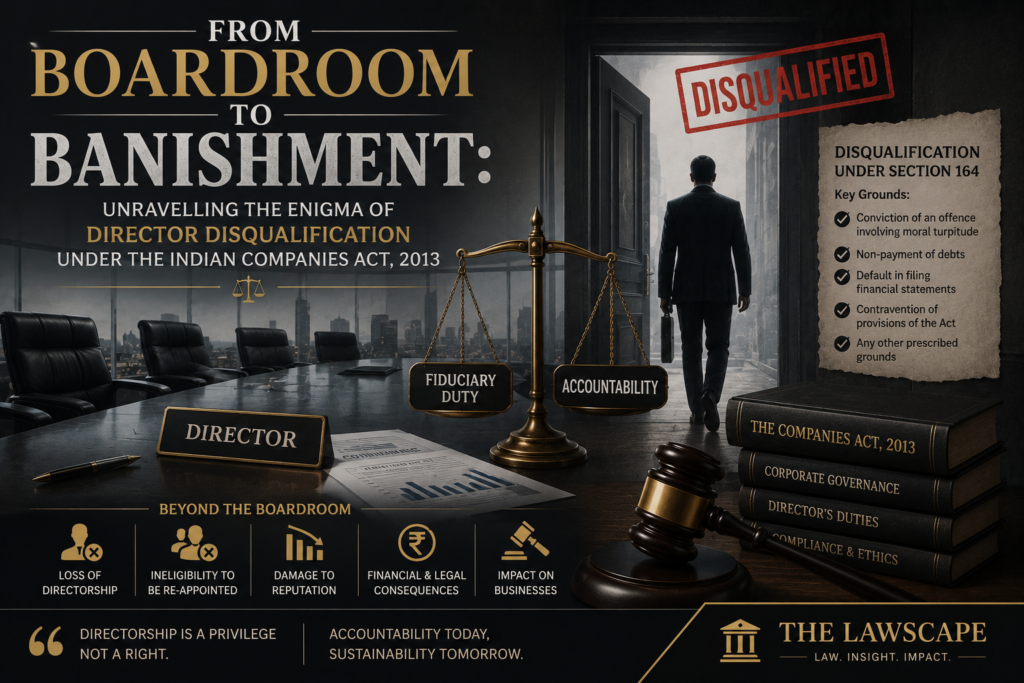
From Boardroom to Banishment: Unravelling the Enigma of Director Disqualification under the Indian Companies Act, 2013
Author: Sanika Dehury
Student, National Law University, Odisha, city- Cuttack
—————————————————————————————————–
💡 3 Quick Takeaways
- Sections 164 and 167 of the Companies Act, 2013 establish the framework governing director disqualification and vacation of office in India.
- Director disqualification serves as an important mechanism for ensuring corporate accountability, transparency, and regulatory compliance.
- Despite recent reforms, significant challenges remain regarding interpretation, remedies for wrongly disqualified directors, and the interaction between Sections 164 and 167.
Introduction
Directors occupy a central position in corporate governance. Although a company enjoys a separate legal personality, its affairs are managed through directors who make strategic decisions, oversee operations, and ensure compliance with legal obligations. As agents of the company, directors play a crucial role in protecting the interests of shareholders and stakeholders while maintaining corporate integrity.
Given the significance of their responsibilities, directors may be disqualified where they engage in fraud, criminal conduct, financial mismanagement, or serious violations of statutory obligations. Director disqualification serves not only as a punitive measure but also as a mechanism for promoting accountability, transparency, and ethical corporate leadership.
Section 164 of the Companies Act, 2013 prescribes various grounds on which a person may be disqualified from acting as a director. Disqualification often carries serious consequences, including reputational harm and restrictions on holding directorial positions for specified periods.
The broader objective of these provisions is to deter misconduct, strengthen investor confidence, and ensure compliance with corporate governance standards. By preventing unsuitable individuals from managing corporate affairs, the law seeks to safeguard the interests of shareholders, creditors, and the public.
Director disqualification therefore represents an essential component of modern corporate governance and a significant tool for maintaining integrity within the corporate sector.
Statutory Basis for Director Disqualification
The Companies Act, 2013 provides two principal categories of director disqualification.
Failure to File Financial Statements and Annual Returns
A director may be disqualified if the company fails to file financial statements or annual returns for three consecutive financial years.
The rationale behind this provision is to ensure compliance with statutory reporting obligations and maintain transparency in corporate operations.
Default in Financial Obligations
Disqualification may also arise where a company fails to:
- Repay deposits;
- Pay interest on deposits;
- Redeem debentures;
- Pay interest on debentures; or
- Distribute declared dividends,
for a continuous period of one year or more.
Under Section 164(2) of the Companies Act, 2013, directors associated with such defaulting companies become ineligible for reappointment and are prohibited from being appointed as directors in any other company for a period of five years.
These provisions aim to ensure that directors actively monitor compliance and fulfil their financial responsibilities towards stakeholders.
Grounds for Disqualification under Section 164
The Companies Act does not prescribe specific educational or professional qualifications for appointment as a director. However, Section 164 establishes various grounds on which a person may be disqualified.
Objectives of Director Disqualification
The disqualification framework seeks to achieve several important objectives:
- Protection of investors and stakeholders;
- Promotion of financial accountability;
- Enforcement of regulatory compliance;
- Prevention of corporate misconduct; and
- Strengthening of corporate governance standards.
Disqualification Based on Personal Conduct
Section 164(1) disqualifies individuals who fall within specified categories, including:
- Persons declared to be of unsound mind by a competent court;
- Undischarged insolvents;
- Persons whose insolvency applications remain pending;
- Individuals convicted of offences resulting in imprisonment of six months or more, where five years have not elapsed since completion of the sentence;
- Persons convicted of offences punishable with imprisonment of seven years or more;
- Individuals disqualified by orders of courts or tribunals;
- Persons who fail to pay calls on shares within six months of the due date;
- Persons convicted under Section 188 relating to related-party transactions within the preceding five years;
- Individuals failing to comply with statutory requirements relating to Director Identification Numbers (DINs); and
- Persons exceeding the statutory limit on the number of directorships permitted under Section 165.
These grounds seek to ensure that directors possess financial integrity, legal competence, and the ability to discharge their responsibilities responsibly.
Disqualification Arising from Corporate Defaults
Section 164(2) addresses situations where disqualification results from non-compliance by the company itself.
Directors may be disqualified where:
- The company fails to file annual returns or financial statements for three consecutive years; or
- The company defaults in repayment of deposits, redemption of debentures, payment of interest, or payment of declared dividends for a continuous period of one year or more.
Upon disqualification, directors become ineligible for reappointment to the defaulting company or appointment to any other company for five years.
The provision reflects the principle that directors bear collective responsibility for ensuring statutory compliance and financial discipline within the company.
Removal by Ordinary Resolution
While disqualification concerns statutory ineligibility, removal from office may occur through separate mechanisms under the Companies Act.
Section 169 permits shareholders to remove a director through an ordinary resolution, subject to compliance with prescribed procedures.
Directors may also face removal where they fail to disclose interests as required under Section 184(2), engage in misconduct, or otherwise breach statutory obligations.
The process generally requires:
- Notice to shareholders;
- A properly convened general meeting;
- An opportunity for the concerned director to present a defence; and
- Compliance with statutory and procedural requirements.
These safeguards ensure procedural fairness while preserving shareholder control over corporate management.
Special Notice Requirements
Under Section 115 of the Companies Act, 2013 and Rule 23 of the Companies (Management and Administration) Rules, 2014, removal of a director requires a special notice.
A member possessing:
- At least one percent of voting power; or
- Shares having a paid-up value of not less than five lakh rupees,
may propose a resolution for the removal of a director by giving at least fourteen days’ notice.
The notice should clearly specify the grounds for the proposed removal.
The company is required to furnish a copy of the notice to the concerned director and provide an opportunity to be heard before any resolution is considered.
The importance of proper notice was emphasised in Queen Kuries & Loans (P.) Ltd. v. Sheena Jose, where the court held that grounds for removal must be clearly specified.
Disqualification Relating to Share Qualification and Board Composition
The Companies Act also imposes requirements concerning board composition and corporate governance.
Section 149 mandates a minimum number of directors for certain classes of companies and requires at least one director to satisfy the residency requirement in India.
In certain circumstances, a director may become ineligible due to:
- Failure to acquire required qualification shares;
- Disposal of qualification shares where such holding is mandatory;
- Violation of provisions contained in the Articles of Association; or
- Non-compliance with statutory requirements governing board composition.
These provisions are intended to ensure proper governance structures and adherence to corporate regulations.
Consequences of Director Disqualification
The consequences of disqualification are significant.
A disqualified director:
- Cannot be reappointed to the same company;
- Cannot be appointed as a director in any other company;
- Remains ineligible for a period of five years; and
- May suffer substantial reputational damage.
The Ministry of Corporate Affairs has increasingly enforced these provisions and has periodically published lists of disqualified directors.
Consequently, corporate compliance has become an important priority for boards seeking to avoid statutory disqualification.
Remedies Available to Disqualified Directors
Directors facing disqualification may seek legal remedies through various mechanisms.
Appeal Against Disqualification
Affected directors may challenge disqualification orders before competent courts and seek interim relief while disputes are adjudicated.
Appointment of Temporary Directors
Companies may appoint temporary directors possessing valid Director Identification Numbers (DINs) and Digital Signature Certificates (DSCs) to facilitate compliance and regularise corporate affairs.
Proceedings Before the NCLT
Where a company has been struck off for non-compliance, restoration proceedings may be initiated before the National Company Law Tribunal (NCLT).
Successful restoration may assist directors in resolving issues arising from disqualification and reactivating corporate operations.
Applicability of Sections 164 and 167 to LLPs
The question of extending director disqualification provisions to Limited Liability Partnerships (LLPs) has received considerable attention.
The relevant committee examining the issue recommended that amendments relating to Sections 164 and 167 should also apply to LLPs through notifications issued under Section 67 of the LLP Act, 2008.
The recommendations included:
- Extension of grace periods for newly appointed directors;
- Exemptions for nominee directors appointed by SEBI-registered debenture trustees; and
- Harmonisation of governance standards between companies and LLPs.
The committee also noted the absence of effective remedies for directors whose names are wrongly removed from official records, often forcing affected individuals to seek relief through writ petitions.
Shortcomings in Section 164
Several concerns have been raised regarding the operation of Section 164.
Historically, Section 274(1)(g) of the Companies Act, 1956 applied primarily to public companies, whereas Section 164(2) of the Companies Act, 2013 expanded the scope of disqualification provisions.
Despite this broader framework, uncertainties continue regarding:
- The treatment of private companies;
- Interpretation of statutory defaults;
- Availability of remedies for affected directors; and
- Consistency in enforcement.
These concerns have generated considerable litigation and debate within corporate law circles.
Conflict Between Sections 164 and 167
One of the most debated issues concerns the interaction between Sections 164 and 167.
Section 164 deals with disqualification, while Section 167 governs vacation of office.
The distinction becomes particularly important because:
- Section 164(1) concerns personal disqualifications such as insolvency, mental incapacity, or criminal conviction;
- Section 164(2) concerns corporate defaults attributable to the company.
Courts have grappled with whether disqualification under Section 164(2) should automatically trigger vacation of office under Section 167.
The issue has generated conflicting interpretations and remains an important area of corporate governance jurisprudence.
Recent amendments introducing Section 167(3) attempt to address governance concerns by enabling the appointment of replacement directors where all directors vacate office simultaneously.
Judicial Decisions on Director Disqualification
Bushell v. Faith (1970)
In Bushell v. Faith, a dispute arose among shareholders of a private company regarding the removal of a director.
The company’s articles granted enhanced voting rights to a director whose removal was proposed. The House of Lords upheld the validity of the provision, recognising that weighted voting rights could legitimately protect directors in closely held companies.
The decision remains significant in demonstrating how corporate constitutions may influence the removal process.
Tarlok Chand Khanna v. Raj Kumar Kapoor (1983)
This dispute concerned share transfers, corporate control, and allegations of oppression and mismanagement.
The court examined the validity of certain share allotments and transfers and ultimately concluded that the disputed allotment lacked proper board approval.
The court further held that the petitioners failed to establish entitlement to relief under the relevant provisions of the Companies Act.
The decision illustrates the importance of procedural compliance in corporate governance matters.
Reform Proposals
Several reforms have been proposed to improve the operation of director disqualification provisions.
Clarification of Section 167
It has been suggested that vacation of office under Section 167 should apply only to personal disqualifications under Section 164(1) rather than corporate defaults under Section 164(2).
Such clarification would reduce uncertainty and improve consistency in interpretation.
Extension of Grace Periods
The Companies (Amendment) Act, 2017 introduced a six-month period within which newly appointed directors may rectify corporate defaults.
It has been proposed that this period be extended to two years, providing directors with a realistic opportunity to restore compliance.
Protection for Nominee Directors
Recommendations have also been made to exempt nominee directors appointed by SEBI-registered debenture trustees from certain disqualifications arising under Section 164(2).
Such reforms would recognise the distinct role performed by nominee directors and prevent undue hardship.
Conclusion
The Companies Act, 2013 establishes a comprehensive framework governing the appointment, disqualification, removal, and accountability of directors. Sections 164 and 167 serve as critical tools for promoting corporate transparency, compliance, and responsible governance.
By prescribing eligibility standards and imposing consequences for misconduct and non-compliance, the Act seeks to protect shareholders, creditors, and other stakeholders while strengthening confidence in corporate institutions.
Recent amendments have improved the statutory framework by providing additional safeguards for newly appointed directors and recognising the unique position of nominee directors. The extension of certain provisions to LLPs further reflects the evolving nature of corporate regulation in India.
Nevertheless, significant challenges remain. The absence of effective remedies for wrongly disqualified directors, ambiguities surrounding the interaction of Sections 164 and 167, and continuing interpretative disputes highlight the need for further reform.
As corporate governance standards continue to evolve, sustained legislative refinement and judicial oversight will remain essential to ensuring that director disqualification provisions effectively balance accountability, fairness, and efficient corporate administration.
Disclaimer: The views expressed in this article are those of the author and do not necessarily reflect the views of The Lawscape.
The Lawscape — clear, practical legal insight for students and future lawyers.