
Rights of LGBTQ+ Communities Under Indian Law: Equality Beyond Identity
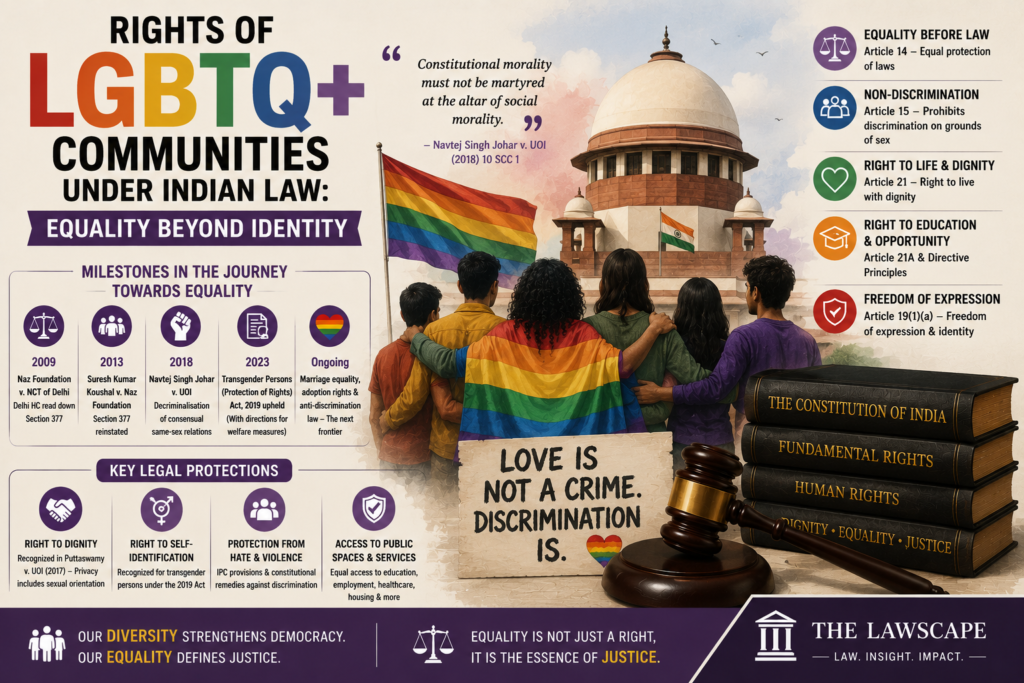
Author: Divyanshi Shakya
Student, Shri Ramswaroop Memorial University
————————————————————————————-
💡 3 Quick Takeaways
- The Indian Constitution guarantees equality, dignity, privacy, and freedom of expression to LGBTQ+ individuals through Articles 14, 15, 19(1)(a), and 21.
- Landmark judgments such as NALSA v. Union of India and Navtej Singh Johar v. Union of India transformed the legal landscape by recognizing gender identity and decriminalizing consensual same-sex relations.
- Despite constitutional progress, LGBTQ+ communities continue to face social stigma, workplace discrimination, mental health challenges, and limited recognition of several civil rights.
Introduction
“The family, marriage, procreation and sexual orientation are all integral to dignity of an individual.”
— Dr. D.Y. Chandrachud, Former Chief Justice of India
Equality, freedom, and dignity are among the most fundamental constitutional values guaranteed to every individual in India. A democratic society can progress only when all individuals enjoy equal rights, equal protection under the law, and the freedom to live with dignity. Recognition of LGBTQ+ rights is therefore not merely a legal necessity but also a moral imperative consistent with constitutional principles of inclusion and equality.
The term LGBTQIA+—commonly referred to as LGBTQ+—encompasses a broad spectrum of sexual orientations and gender identities. Understanding these identities is essential to appreciating the legal and social challenges faced by the community.
- Lesbian refers to a woman who is emotionally, romantically, or physically attracted to another woman.
- Gay generally refers to a man who is emotionally, romantically, or physically attracted to another man.
- Bisexual describes individuals who experience attraction to more than one gender.
- Transgender is an umbrella term for individuals whose gender identity differs from the sex assigned to them at birth.
- Queer or Questioning refers to individuals who do not identify within conventional categories of sexuality or gender, or who are exploring their identity.
- Intersex describes individuals born with biological characteristics that do not fit typical definitions of male or female bodies.
- Asexual refers to individuals who experience little or no sexual attraction.
- Non-binary individuals do not identify exclusively as male or female and may use terms such as genderfluid, genderqueer, or bigender to describe their identity.
- The symbol “+” acknowledges identities and orientations that may not be fully represented by the listed categories.
This article examines the constitutional protections available to LGBTQ+ communities in India, traces the historical development of LGBTQ+ rights, analyses landmark judicial decisions, and highlights continuing challenges that prevent the full realization of equality and dignity.
LGBTQ+ Inclusion and Democratic Society
The relationship between democracy and LGBTQ+ rights is deeply interconnected. Democratic societies thrive on inclusivity, participation, and the recognition of human dignity. Throughout history, LGBTQ+ individuals have contributed significantly to art, literature, music, culture, politics, and social reform.
Writers such as James Baldwin and Virginia Woolf, musicians such as Freddie Mercury, and modern advocates including Laverne Cox have enriched public discourse through their work and advocacy. Political leaders and activists have also played important roles in advancing equality and challenging discrimination.
Across the world, organizations such as UHAI and ILGA-Europe have worked to strengthen civil society, protect human rights, and promote democratic accountability. In India, organizations such as Sappho for Equality and the Sahodaran Community Oriented Health Development Society have focused on awareness, advocacy, healthcare access, and the protection of LGBTQ+ rights.
The work of such organizations demonstrates that democratic governance requires the inclusion of all individuals regardless of gender identity or sexual orientation. Exclusion weakens social cohesion, whereas inclusion strengthens democracy by ensuring equal participation in public life.
Historical Background
Contrary to popular misconceptions, diverse sexual orientations and gender identities are not foreign concepts imposed upon Indian society. Historical evidence demonstrates that such identities have existed in the Indian subcontinent for centuries.
Ancient Indian literature contains numerous references to gender diversity and same-sex relationships. Texts such as the Rig Veda, Kamasutra, Ramayana, and Mahabharata contain narratives and depictions that reflect a more nuanced understanding of sexuality and gender.
The story of Shikhandi in the Mahabharata is frequently cited as an early example of gender transition and transgender identity. Similarly, the concept of Ardhanarishvara symbolically represents the union of masculine and feminine energies, reflecting a broader philosophical acceptance of gender plurality.
Historical references are also found in Islamic and Mughal literature. The memoir Baburnama records Emperor Babur’s attraction toward a young man, while Sufi traditions often celebrated relationships that transcended conventional categories of gender and sexuality.
Architectural evidence further supports this historical reality. The temples of Khajuraho and the Sun Temple at Konark contain sculptures depicting diverse sexual expressions, including same-sex intimacy.
The legal marginalization of LGBTQ+ identities largely emerged during British colonial rule. Victorian moral standards were imposed upon Indian society through colonial legislation, most notably Section 377 of the Indian Penal Code, 1860.
Section 377 and the Criminalization of Homosexuality
Section 377 of the Indian Penal Code criminalized “carnal intercourse against the order of nature” and became the primary legal instrument used to stigmatize and criminalize same-sex relationships.
For more than 150 years, the provision contributed to discrimination, social exclusion, harassment, blackmail, and criminal prosecution of LGBTQ+ individuals. Its impact extended far beyond formal criminal law and influenced public attitudes toward sexual minorities.
The modern legal challenge to Section 377 began when the Naz Foundation filed a Public Interest Litigation questioning its constitutional validity.
In 2009, the Delhi High Court delivered a landmark judgment holding that consensual same-sex relations between adults could not be criminalized. The Court found that Section 377 violated constitutional guarantees of equality, dignity, and non-discrimination.
However, in Suresh Kumar Koushal v. Naz Foundation, the Supreme Court reversed the Delhi High Court’s decision and reinstated criminalization.
The setback was temporary.
In Navtej Singh Johar v. Union of India, a Constitution Bench of the Supreme Court unanimously held that Section 377 was unconstitutional to the extent that it criminalized consensual same-sex relations between adults. The Court recognized that sexual orientation is an inherent aspect of identity and that discrimination based on sexual orientation violates constitutional guarantees of equality and dignity.
The judgment emphasized that constitutional morality must prevail over social morality and affirmed that LGBTQ+ individuals are entitled to the same constitutional protections as all other citizens.
Justice Indu Malhotra’s observation that “history owes an apology” to LGBTQ+ persons remains one of the most powerful acknowledgments of the historical injustice faced by the community.
The NALSA Judgment and Recognition of Gender Identity
Another transformative development occurred in National Legal Services Authority (NALSA) v. Union of India.
The central issue before the Court was whether individuals who did not identify within the male-female binary could be legally recognized as a third gender.
The Supreme Court answered this question affirmatively and recognized transgender persons as a distinct legal category entitled to constitutional protection.
The Court held that:
- Every individual has the right to self-identify their gender.
- Gender identity forms an integral component of personal autonomy and dignity.
- Transgender persons are entitled to all fundamental rights guaranteed by the Constitution.
- Medical examinations or biological tests cannot be imposed as prerequisites for gender recognition.
The judgment marked a significant shift from biological determinism toward recognition of self-perceived gender identity.
Constitutional Rights of LGBTQ+ Communities
Article 14: Equality Before Law
Article 14 guarantees equality before the law and equal protection of the laws.
The Supreme Court has consistently held that these protections apply equally to LGBTQ+ individuals. Discrimination based on sexual orientation or gender identity violates the constitutional principle of equality.
Articles 15 and 16: Protection Against Discrimination
Articles 15 and 16 prohibit discrimination on grounds of sex.
Judicial interpretation has expanded the understanding of “sex” to include gender identity and sexual orientation. Consequently, discrimination against transgender persons and LGBTQ+ individuals falls within the scope of constitutional protection.
Article 19(1)(a): Freedom of Expression
Gender identity and self-expression are protected forms of expression under Article 19(1)(a).
The freedom to express one’s identity through appearance, conduct, speech, and personal choices forms an essential component of constitutional liberty.
Article 21: Life, Liberty, and Dignity
Article 21 has emerged as the most significant constitutional safeguard for LGBTQ+ rights.
The Supreme Court has interpreted the right to life to include dignity, privacy, autonomy, and personal liberty. Gender identity and sexual orientation are now recognized as integral aspects of an individual’s dignity and selfhood.
Collectively, these constitutional provisions establish a framework that protects LGBTQ+ persons from discrimination and affirms their equal citizenship.
The Transgender Persons (Protection of Rights) Act, 2019
The Transgender Persons (Protection of Rights) Act, 2019 was enacted to protect transgender individuals from discrimination in employment, education, healthcare, housing, and access to public services.
The legislation also established the National Council for Transgender Persons to advise governments, monitor implementation, and promote awareness regarding transgender rights.
However, the Act has attracted criticism from activists and scholars.
Key concerns include:
- The requirement of official certification processes for recognition of gender identity.
- Inadequate protections against discrimination.
- The absence of provisions relating to reservations, scholarships, and educational reforms.
- Concerns regarding unequal punishment standards for offences committed against transgender persons.
These criticisms highlight the continuing gap between constitutional ideals and legislative implementation.
Continuing Challenges
Despite significant legal progress, LGBTQ+ communities continue to face numerous challenges.
Social Stigma
Deep-rooted prejudices continue to portray queer identities as unnatural or socially unacceptable. Such attitudes contribute to exclusion, hostility, and discrimination.
Digital Harassment
Social media platforms have become sites of harassment, hate speech, bullying, doxxing, and targeted abuse directed at LGBTQ+ individuals.
Family and Social Pressures
Many LGBTQ+ persons experience rejection from family members due to concerns regarding social status, cultural expectations, or religious beliefs.
Workplace Discrimination
Discrimination frequently manifests during recruitment, promotions, workplace interactions, and career advancement opportunities.
Many LGBTQ+ individuals report:
- Unequal hiring practices;
- Exclusion from workplace activities;
- Verbal harassment and inappropriate comments;
- Pressure to conceal their identities; and
- Limited professional growth opportunities.
Mental Health Concerns
Persistent discrimination often contributes to:
- Depression;
- Anxiety;
- Low self-esteem;
- Social isolation; and
- Emotional distress.
The lack of adequate support systems further compounds these challenges.
Although legal recognition has improved significantly, social acceptance continues to lag behind.
Conclusion
The recognition of LGBTQ+ rights in India represents one of the most significant developments in contemporary constitutional jurisprudence. The judgments in NALSA and Navtej Singh Johar not only recognized gender identity and decriminalized consensual same-sex relations but also established broader constitutional principles concerning dignity, equality, privacy, and autonomy.
These decisions have laid the foundation for future recognition of civil rights relating to marriage, adoption, surrogacy, inheritance, and protection against discrimination.
However, constitutional recognition alone is insufficient. Social stigma, workplace discrimination, inadequate legal protections, and continuing exclusion demonstrate that much work remains to be done.
A truly democratic society cannot flourish unless every individual, irrespective of sexual orientation or gender identity, enjoys equal respect, equal opportunities, and equal protection under the law. Legal reforms, public awareness, and social acceptance must therefore advance together to ensure that LGBTQ+ persons can live with dignity, freedom, and equality.
Homosexuality and gender diversity should not be viewed as foreign concepts but as realities deeply embedded within India’s own historical and cultural traditions. The future of LGBTQ+ rights in India depends upon translating constitutional promises into lived realities for all.
Disclaimer: The views expressed in this article are those of the author and do not necessarily reflect the views of The Lawscape.
The Lawscape — clear, practical legal insight for students and future lawyers.