
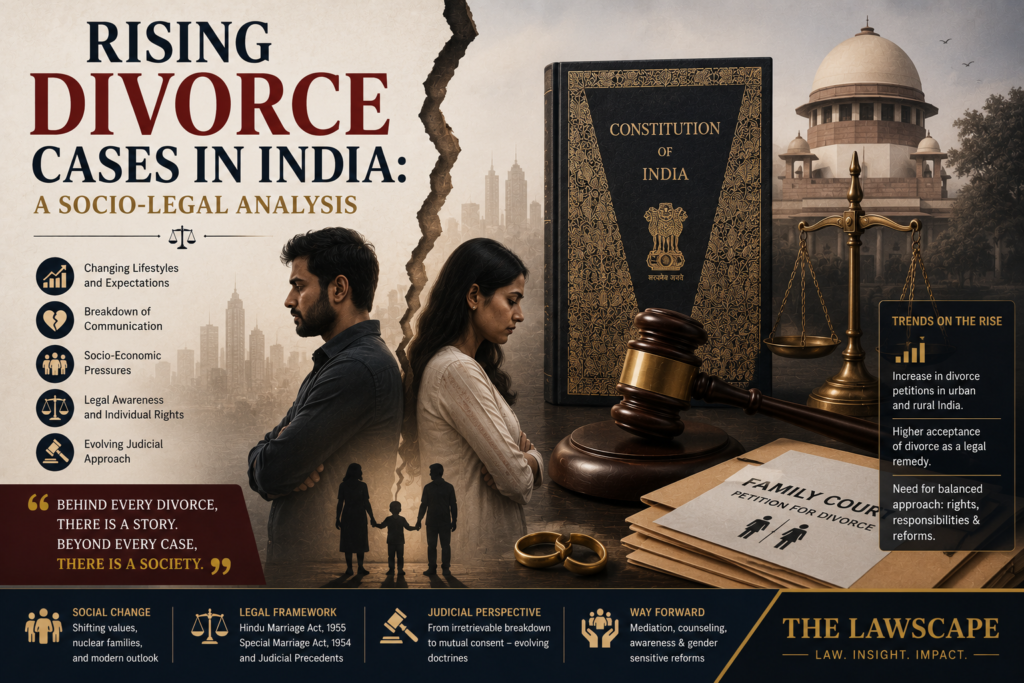
Rising Divorce Cases in India: A Socio-Legal Analysis
Author: Devangana Mahesh
Student, Mar Gregorios College of Law, Thiruvananthapuram
———————————————————————————————————-
💡 3 Quick Takeaways
- Rising divorce rates in India reflect changing social attitudes, increased individual autonomy, and evolving expectations from marriage.
- Economic independence, urbanization, technological influence, and changing gender roles have significantly contributed to the growth of matrimonial disputes.
- Legal reforms, mediation mechanisms, and family courts play a crucial role in balancing personal liberty with the preservation of family stability.
Introduction
Marriage in India has traditionally been regarded not merely as a contractual relationship but as a sacred institution deeply rooted in religion, culture, and social norms. Divorce, by contrast, was historically discouraged and often viewed with social disapproval regardless of the circumstances leading to marital breakdown.
Over the years, however, changing social attitudes and growing recognition of individual autonomy have led to the acceptance of divorce as a legitimate legal remedy for ending unhappy or dysfunctional marriages. Divorce refers to the legal dissolution of marriage by a competent court. While it was once heavily stigmatized, increasing awareness of individual rights, emotional well-being, and personal dignity has transformed public perceptions regarding marital dissolution.
The rise in divorce cases across India is frequently attributed to factors such as changing social attitudes, economic independence, higher educational attainment, growing awareness among women, and evolving expectations from marital relationships. Various reports indicate that metropolitan cities, particularly Delhi and other major urban centres, have witnessed significant increases in divorce petitions.
This article examines the multidimensional causes behind rising divorce rates in India and critically analyses the legal and societal responses to this emerging phenomenon.
Legal Framework Governing Divorce in India
Marriage and divorce in India are regulated through personal laws applicable to different religious communities.
Hindu Marriage Act, 1955
The Hindu Marriage Act, 1955 governs Hindus, Buddhists, Jains, and Sikhs. Section 13 of the Act provides several grounds for divorce, including:
- Adultery;
- Cruelty;
- Desertion;
- Conversion;
- Mental disorder;
- Venereal disease;
- Renunciation; and
- Presumption of death.
The Act also recognizes divorce by mutual consent under Section 13B, reflecting increasing acceptance of individual choice and consensual dissolution of marriage.
Muslim Personal Law
Under Muslim personal law, marriage is regarded as a civil contract and may be dissolved through various methods such as Talaq, Khula, Mubarat, or judicial divorce.
The Dissolution of Muslim Marriages Act, 1939 provides statutory grounds enabling Muslim women to seek divorce. A major development occurred in Shayara Bano v. Union of India, where the Supreme Court declared the practice of instant triple talaq unconstitutional. Parliament subsequently enacted the Muslim Women (Protection of Rights on Marriage) Act, 2019.
Indian Divorce Act and Parsi Marriage Laws
The Indian Divorce Act governs Christians, while separate legislation regulates Parsi marriages and divorces. Amendments over time have introduced greater equality between men and women concerning matrimonial remedies.
Special Marriage Act, 1954
The Special Marriage Act facilitates civil marriages irrespective of religion and provides legal remedies for divorce. It is commonly used for interfaith and inter-caste marriages.
Causes Behind Rising Divorce Cases in India
Although matrimonial laws provide specific legal grounds for divorce, broader social and economic developments have significantly contributed to the rising number of divorce cases.
Urbanization and Modernization
Urbanization and modernization have transformed traditional family structures and marital expectations.
Exposure to global cultures, changing lifestyles, and increasing mobility have encouraged individuals to prioritize emotional compatibility, personal growth, and professional aspirations. Contemporary marriages often involve expectations that differ substantially from traditional models of marital relationships.
In metropolitan areas, these changing expectations frequently contribute to marital conflicts and eventual separation.
Economic Independence of Women
One of the most significant contributors to rising divorce rates is the growing economic independence of women.
Historically, financial dependence compelled many women to remain in abusive or unhappy marriages. Increased access to education, employment opportunities, and financial resources has enabled women to make independent decisions regarding their personal lives.
Economic empowerment allows women to challenge domestic abuse, dowry-related harassment, and unequal treatment within marriage.
The Supreme Court’s observations in Shayara Bano v. Union of India further reinforced principles of dignity and equality within matrimonial relationships.
Changing Social Attitudes
Social perceptions regarding divorce have changed considerably, particularly among younger generations.
Divorce no longer carries the same degree of stigma in many urban settings as it once did. Families are increasingly supportive of separation in situations involving incompatibility, emotional distress, or abusive relationships.
The growing emphasis on personal happiness and mental well-being has contributed to greater acceptance of divorce as a legitimate solution to marital conflict.
Domestic Violence and Cruelty
Domestic violence remains one of the most significant causes of matrimonial disputes.
Physical abuse, emotional cruelty, verbal harassment, marital misconduct, and dowry-related violence often compel individuals to seek legal separation.
In V. Bhagat v. D. Bhagat, the Supreme Court held that mental cruelty includes conduct causing such mental pain and suffering that continued cohabitation becomes impossible.
This judicial recognition has broadened the understanding of cruelty within matrimonial law and facilitated access to legal remedies.
Technological and Social Media Influence
Technology and social media have substantially altered interpersonal relationships.
Excessive digital engagement may contribute to communication breakdowns, mistrust, emotional distance, and allegations of infidelity. Online interactions and virtual relationships have increasingly become sources of matrimonial disputes.
Additionally, constant exposure to idealized lifestyles on social media platforms may create unrealistic expectations regarding marriage and relationships.
Changing Gender Roles and Equality Aspirations
Traditional marital arrangements often assigned domestic responsibilities to women and economic responsibilities to men.
Modern marriages increasingly challenge these assumptions. Women now actively participate in professional and public life, while expectations regarding household responsibilities and decision-making have evolved.
Conflicts sometimes arise when spouses hold differing views regarding gender roles, equality, and family responsibilities.
Social Consequences of Rising Divorce Rates
Impact on Children
Divorce can have significant emotional, psychological, and social consequences for children.
Parental separation may lead to:
- Anxiety;
- Emotional insecurity;
- Academic difficulties; and
- Psychological distress.
The extent of the impact often depends upon the nature of parental relationships and post-divorce arrangements.
Economic Consequences
Divorce may result in financial instability, particularly for women and children.
Issues relating to:
- Maintenance;
- Alimony;
- Child custody; and
- Property division
often become contentious and require judicial intervention.
Indian courts have increasingly emphasized the importance of fair financial support and maintenance arrangements.
Psychological Impact
Marital breakdown frequently results in emotional stress, depression, anxiety, and psychological trauma.
At the same time, some individuals may experience emotional relief, personal freedom, and improved well-being after leaving dysfunctional relationships.
Transformation of Family Structures
The rise in divorce rates reflects broader changes in Indian family structures and social values.
While some critics view increasing divorces as evidence of weakening family values, others interpret them as indicators of growing awareness regarding personal dignity, equality, and human rights.
Landmark Judicial Decisions
Shayara Bano v. Union of India
In this landmark case, a Constitution Bench of the Supreme Court declared instant triple talaq unconstitutional.
The Court emphasized constitutional morality, gender justice, and women’s dignity while holding the practice violative of fundamental rights.
Naveen Kohli v. Neelu Kohli
The Supreme Court recognized the concept of irretrievable breakdown of marriage and recommended legislative reform permitting divorce where relationships have become completely unworkable.
The Court observed that forcing parties to remain in emotionally dead marriages serves little social purpose.
Samar Ghosh v. Jaya Ghosh
This decision elaborated the concept of mental cruelty and provided guidelines for determining cruelty in matrimonial disputes.
The Court recognized that emotional neglect, humiliation, denial of companionship, and sustained abusive conduct may constitute mental cruelty.
Joseph Shine v. Union of India
The Supreme Court struck down Section 497 of the Indian Penal Code, thereby decriminalizing adultery.
Although adultery remains a civil ground for divorce, the judgment emphasized autonomy, privacy, and gender equality.
Amardeep Singh v. Harveen Kaur
The Supreme Court held that the six-month cooling-off period under Section 13B of the Hindu Marriage Act may be waived in appropriate cases.
The judgment facilitated quicker resolution of mutual-consent divorce proceedings and reduced unnecessary prolongation of litigation.
Role of Family Courts and Mediation
The Family Courts Act established specialized courts for resolving matrimonial disputes through less adversarial and more sensitive mechanisms.
Family Courts aim to provide:
- Speedier justice;
- Conciliatory dispute resolution;
- Reduced procedural complexity; and
- Greater sensitivity to family dynamics.
Mediation has emerged as an effective tool for resolving matrimonial conflicts. Courts frequently encourage mediation to facilitate reconciliation or amicable settlement where possible.
Alternative dispute resolution mechanisms reduce:
- Emotional stress;
- Litigation costs; and
- Prolonged legal proceedings.
Counselling services and psychological support systems further strengthen the effectiveness of family courts in addressing matrimonial disputes.
Challenges Within the Existing Legal System
Delay in Matrimonial Proceedings
Indian courts continue to face significant backlogs in matrimonial litigation.
Prolonged proceedings often increase emotional distress and financial burdens for the parties involved.
Allegations of Misuse
Certain matrimonial laws, particularly anti-dowry provisions, have occasionally been criticized for alleged misuse.
Courts have therefore sought to balance protection for genuine victims with safeguards against arbitrary prosecution.
Absence of Irretrievable Breakdown as a Statutory Ground
Although the Supreme Court has repeatedly recommended legislative recognition of irretrievable breakdown of marriage as an independent ground for divorce, no comprehensive statutory amendment has yet been enacted.
As a result, many marriages continue to exist legally despite complete emotional and practical breakdown.
Social Stigma in Rural Areas
While urban attitudes toward divorce have become increasingly liberal, divorced individuals—particularly women—continue to face social stigma in rural and conservative communities.
Economic dependency, social pressure, and limited awareness often discourage individuals from seeking legal remedies.
Suggestions and Legal Reforms
Recognition of Irretrievable Breakdown of Marriage
One of the most significant reforms proposed by courts and legal scholars is the statutory recognition of irretrievable breakdown of marriage as an independent ground for divorce.
Such recognition would reduce unnecessary litigation and allow courts to address cases where reconciliation is clearly impossible.
Speedier Matrimonial Justice
Procedural reforms are necessary to reduce delays in matrimonial litigation.
Faster adjudication can help minimize emotional and financial hardships experienced by litigants.
Strengthening Counselling and Mediation
Professional counselling and mediation services should be strengthened within family courts.
These mechanisms can assist couples in understanding whether conflicts are temporary or indicative of permanent marital breakdown.
Pre-marital counselling and relationship education may also help individuals develop realistic expectations and conflict-resolution skills.
Gender-Sensitive and Child-Centred Approach
Future reforms should prioritize both gender equality and child welfare.
Maintenance, custody, and visitation decisions should reflect contemporary realities while ensuring that the best interests of children remain paramount.
Conclusion
The rise in divorce cases in India represents a significant social transformation reflecting evolving attitudes toward marriage, gender equality, personal liberty, and emotional well-being.
Economic independence of women, urbanization, modernization, technological influences, changing social attitudes, and increased legal awareness have collectively contributed to growing rates of marital dissolution. Simultaneously, Indian courts and legislatures have expanded protections relating to equality, dignity, autonomy, and human rights within matrimonial relationships.
Although rising divorce rates may raise concerns regarding family stability, they also indicate growing awareness of individual rights and freedom from abusive or incompatible relationships. Divorce should therefore not be viewed solely as a social failure but also as an important legal remedy available in appropriate circumstances.
The challenge before Indian society lies in balancing the preservation of family values with the protection of personal dignity and constitutional freedoms. Effective mediation, counselling, judicial reforms, and social awareness can contribute to a more humane, balanced, and rights-oriented matrimonial justice system.
Disclaimer: The views expressed in this article are those of the author and do not necessarily reflect the views of The Lawscape.
The Lawscape — clear, practical legal insight for students and future lawyers.