
India’s Digital Personal Data Protection Framework: Implementation Challenges in the Wake of the 2025 Developments
Author: Ayushi Rathore
Student, acropolis institue of law indore
———————————————————————————————-
💡 3 Quick Takeaways
- The Digital Personal Data Protection Act, 2023 represents India’s first comprehensive framework for regulating digital personal data and protecting informational privacy.
- Despite its progressive objectives, implementation in 2025 faces significant challenges relating to regulatory capacity, compliance costs, cybersecurity preparedness, digital literacy, and government exemptions.
- The long-term success of the framework depends upon effective enforcement, institutional independence, public awareness, and technological resilience.
Introduction
India is undergoing a rapid digital transformation that has fundamentally altered the way individuals communicate, conduct financial transactions, access public services, and participate in economic activity. The widespread adoption of digital payment systems, e-commerce platforms, social media applications, cloud-based services, and government-led digital initiatives has led to an unprecedented increase in the collection, storage, and processing of personal data.
While this transformation has contributed significantly to economic growth and digital inclusion, it has also generated serious concerns regarding privacy, data misuse, cyberattacks, unauthorized data sharing, and large-scale breaches of personal information. In recent years, several incidents involving data leaks and questionable data-processing practices have intensified concerns regarding informational privacy and accountability within India’s expanding digital ecosystem.
A major constitutional foundation for data protection emerged through Justice K.S. Puttaswamy v. Union of India, where the Supreme Court recognized privacy as a fundamental right under Article 21 of the Constitution. The judgment highlighted the importance of informational privacy and established the need for a comprehensive legal framework regulating the collection and use of personal data.
In response to these developments, Parliament enacted the Digital Personal Data Protection Act, 2023 (DPDP Act). The legislation seeks to regulate the processing of digital personal data, strengthen privacy protections, and establish a structured framework for data governance.
Although the enactment of the DPDP Act represents a significant milestone in India’s digital legal landscape, its implementation in 2025 continues to face numerous legal, institutional, and practical challenges. These concerns raise important questions regarding regulatory preparedness, compliance obligations, cybersecurity enforcement, and the effective protection of privacy rights in an increasingly data-driven society.
Evolution of Data Protection in India
Before the enactment of the DPDP Act, India lacked a comprehensive and dedicated data protection statute.
While certain provisions under the Information Technology Act, 2000 and related rules addressed aspects of data security and sensitive personal information, these measures were often criticized for being fragmented and inadequate in addressing the complexities of modern digital ecosystems.
The rapid expansion of digital commerce, artificial intelligence, cloud computing, and platform-based services highlighted the limitations of existing legal frameworks. Consequently, the demand for a dedicated data protection regime became increasingly urgent.
The constitutional recognition of privacy in Justice K.S. Puttaswamy v. Union of India transformed the discourse surrounding digital rights in India. The Supreme Court held that privacy forms an essential component of personal liberty, dignity, and autonomy under Article 21.
The DPDP Act may therefore be viewed as a legislative response to the constitutional principles articulated in Puttaswamy. The framework attempts to balance the legitimate use of data for governance, administration, and economic development with the protection of individual privacy rights.
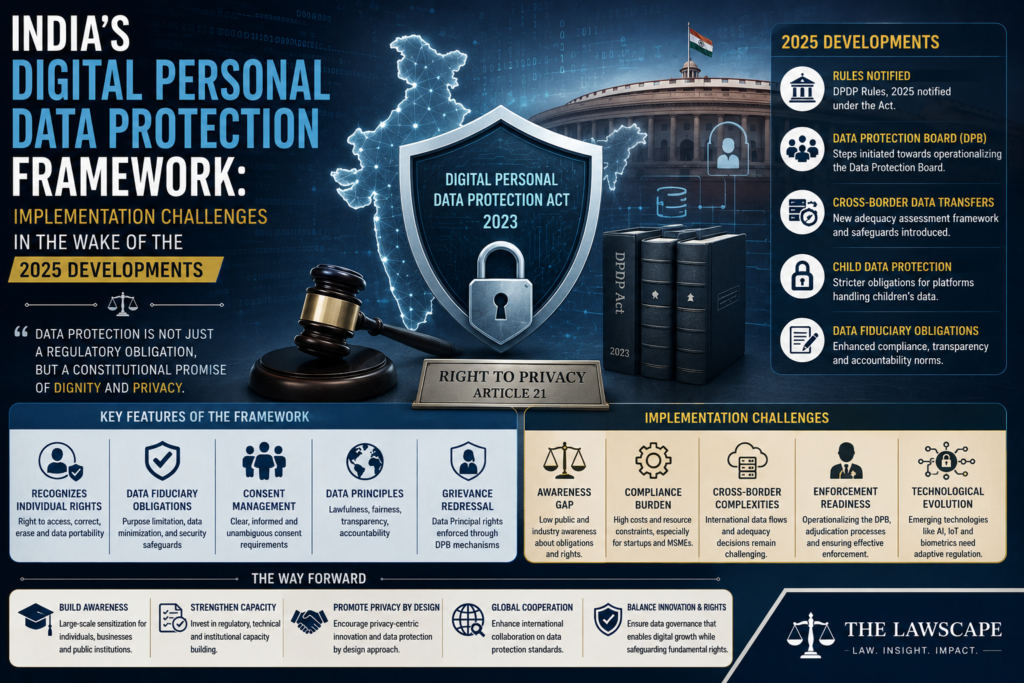
Key Features of the DPDP Framework
One of the central pillars of the DPDP Act is its consent-based approach to data processing.
The Act requires Data Fiduciaries to obtain consent before processing personal data and seeks to enhance user autonomy by granting Data Principals several important rights.
These include:
- The right to access personal information;
- The right to seek correction of inaccurate data;
- The right to grievance redressal; and
- The right to erasure of personal data in specified circumstances.
These provisions are intended to provide individuals with greater control over their digital identities and strengthen accountability within the data-processing ecosystem.
In principle, the framework aligns India with several internationally recognized privacy standards and reflects a broader commitment to digital trust and responsible data governance.
Institutional and Regulatory Challenges
Despite its progressive objectives, one of the most significant implementation challenges concerns regulatory preparedness.
No data protection regime can function effectively without robust enforcement institutions. Although the DPDP Act contemplates the establishment of a Data Protection Board, questions remain regarding its independence, procedural framework, enforcement powers, and operational capacity.
At present, concerns persist regarding:
- The handling of complaints;
- Enforcement of penalties;
- Development of compliance standards; and
- Consistency of regulatory oversight.
The effectiveness of the framework will depend substantially upon the institutional capacity of regulatory authorities to monitor compliance and respond effectively to violations.
Without a strong enforcement infrastructure, privacy protections risk remaining largely aspirational rather than practical.
Compliance Burden on Businesses
Another major challenge relates to the compliance obligations imposed upon businesses.
Large technology companies generally possess the financial and technical resources necessary to establish sophisticated data governance systems, employ compliance officers, and conduct periodic cybersecurity audits.
However, the situation differs significantly for small businesses and start-ups.
Compliance often requires substantial expenditure on:
- Legal consultation;
- Technical infrastructure;
- Cybersecurity systems;
- Staff training; and
- Internal governance mechanisms.
For emerging enterprises operating with limited resources, these requirements may create significant financial pressures.
Given India’s rapidly growing start-up ecosystem, concerns have emerged that extensive compliance obligations could discourage innovation and create competitive disadvantages for smaller firms relative to larger corporations.
Achieving an appropriate balance between privacy protection and ease of doing business therefore remains a critical policy challenge.
The Problem of Meaningful Consent
The DPDP framework places considerable emphasis on consent as the basis for lawful processing of personal data.
However, questions remain regarding whether user consent in digital environments is genuinely informed and meaningful.
In practice, many individuals routinely accept privacy policies and terms of service without reading or fully understanding them. Lengthy documents, complex legal language, and limited awareness regarding privacy rights often result in consent becoming a procedural formality rather than an informed decision.
This challenge is particularly significant in a country where digital literacy levels vary considerably across regions and socio-economic groups.
Consequently, although the framework formally recognizes user choice, its practical effectiveness may be limited unless individuals possess adequate awareness of their rights and the implications of consent.
Meaningful privacy protection therefore requires not only legal rights but also widespread public education and digital literacy initiatives.
Cybersecurity and Data Breach Risks
The effectiveness of any data protection regime is closely linked to cybersecurity preparedness.
India has witnessed a significant increase in:
- Cyberattacks;
- Phishing incidents;
- Ransomware attacks; and
- Large-scale data breaches.
Several organizations, including financial institutions and digital service providers, have experienced incidents involving unauthorized disclosure of personal information.
In such circumstances, legal obligations alone may be insufficient to ensure effective protection of personal data.
Robust cybersecurity requires:
- Strong technical safeguards;
- Advanced security infrastructure;
- Regular security audits;
- Incident response mechanisms; and
- Continuous monitoring systems.
Without adequate technological preparedness, enforcement of privacy rights may remain largely symbolic.
The relationship between cybersecurity and data protection therefore highlights the need for an integrated approach to digital governance.
Cross-Border Data Transfers
Cross-border transfer of personal data presents another significant implementation challenge.
Many multinational corporations process and store the data of Indian users on servers located outside India. This raises complex questions concerning:
- Jurisdiction;
- Regulatory oversight;
- Enforcement mechanisms; and
- Data sovereignty.
Critics have argued that the absence of strict localization requirements may expose Indian citizens’ data to foreign surveillance or misuse.
Conversely, excessively restrictive localization measures may adversely affect international trade, foreign investment, and digital commerce.
India therefore faces the difficult task of balancing economic interests with concerns relating to informational sovereignty and privacy protection.
The regulation of cross-border data flows will remain a critical area of debate as the digital economy continues to expand.
Government Exemptions and Privacy Concerns
One of the most debated aspects of the DPDP framework concerns exemptions available to government agencies.
Certain provisions permit the government to exempt specified agencies from the application of the Act on grounds such as:
- National security;
- Public order; and
- Prevention and investigation of offences.
While national security undoubtedly constitutes a legitimate governmental objective, critics have expressed concerns regarding the breadth of these exemptions.
Broad exemption powers may potentially weaken privacy protections and create risks of excessive surveillance or inadequate accountability.
The concerns are particularly significant in light of the principles established in Puttaswamy, where the Supreme Court emphasized that restrictions on privacy must satisfy requirements of legality, necessity, and proportionality.
The challenge therefore lies in ensuring that national security objectives are pursued without undermining constitutional safeguards relating to privacy and personal liberty.
Comparative Perspective: Lessons from the GDPR
India’s data protection framework is frequently compared with the European Union’s General Data Protection Regulation (GDPR), which is widely regarded as one of the most comprehensive privacy regimes globally.
The GDPR provides:
- Detailed transparency obligations;
- Extensive user rights;
- Independent supervisory authorities; and
- Strong enforcement mechanisms.
Compared to the GDPR, the Indian framework adopts a more flexible and business-friendly approach aimed at balancing privacy protection with economic growth and digital innovation.
This flexibility may support entrepreneurship and digital development. However, critics argue that a less stringent regulatory approach could weaken privacy protections if not accompanied by effective enforcement mechanisms.
The comparison highlights the continuing challenge of balancing regulatory effectiveness with economic competitiveness.
Supporting Legal Authorities
The constitutional foundation of India’s data protection regime remains Justice K.S. Puttaswamy v. Union of India, where the Supreme Court recognized privacy as a fundamental right protected under Article 21.
The DPDP Act, 2023 serves as the principal legislative framework governing digital personal data and establishing obligations relating to consent-based processing.
The recommendations of the Justice B.N. Srikrishna Committee also played a significant role in shaping contemporary debates concerning privacy, innovation, and data governance.
Comparative analysis with international frameworks such as the GDPR further informs discussions regarding user rights, transparency obligations, and enforcement standards.
Collectively, these legal and policy developments have shaped India’s evolving approach to digital privacy regulation.
Conclusion
The Digital Personal Data Protection Act, 2023 represents a significant milestone in India’s journey toward establishing a modern data governance framework. By introducing a consent-based model for processing personal data, the legislation seeks to strengthen privacy protections, promote accountability, and enhance trust within the digital ecosystem.
Nevertheless, the implementation of the framework in 2025 continues to encounter substantial legal, institutional, and technological challenges. Concerns regarding regulatory readiness, compliance costs, cybersecurity vulnerabilities, digital literacy, cross-border data transfers, and governmental exemptions raise important questions regarding the practical effectiveness of the regime.
While the Act establishes a strong legal foundation, its long-term success will depend upon:
- Transparent enforcement mechanisms;
- Institutional independence;
- Public awareness and digital literacy;
- Robust cybersecurity infrastructure; and
- Effective regulatory oversight.
Ultimately, India’s challenge lies in ensuring that the constitutional promise of informational privacy coexists with innovation, economic development, and national security within an increasingly interconnected digital economy.
The effectiveness of the DPDP framework will determine whether India succeeds in creating a secure, rights-oriented, and accountable digital environment capable of protecting individual privacy while supporting continued technological progress.
Disclaimer: The views expressed in this article are those of the author and do not necessarily reflect the views of The Lawscape.
The Lawscape — clear, practical legal insight for students and future lawyers.