
The Impact of Artificial Intelligence on the Legal System: Innovation, Efficiency, and Constitutional Challenges
Author: Nandani Singh
Student, LLOYD LAW COLLEGE, GREATER NOIDA
Co-Author: Shivam Kumar
Student, Lloyd law college
——————————————————————————————
💡 3 Quick Takeaways
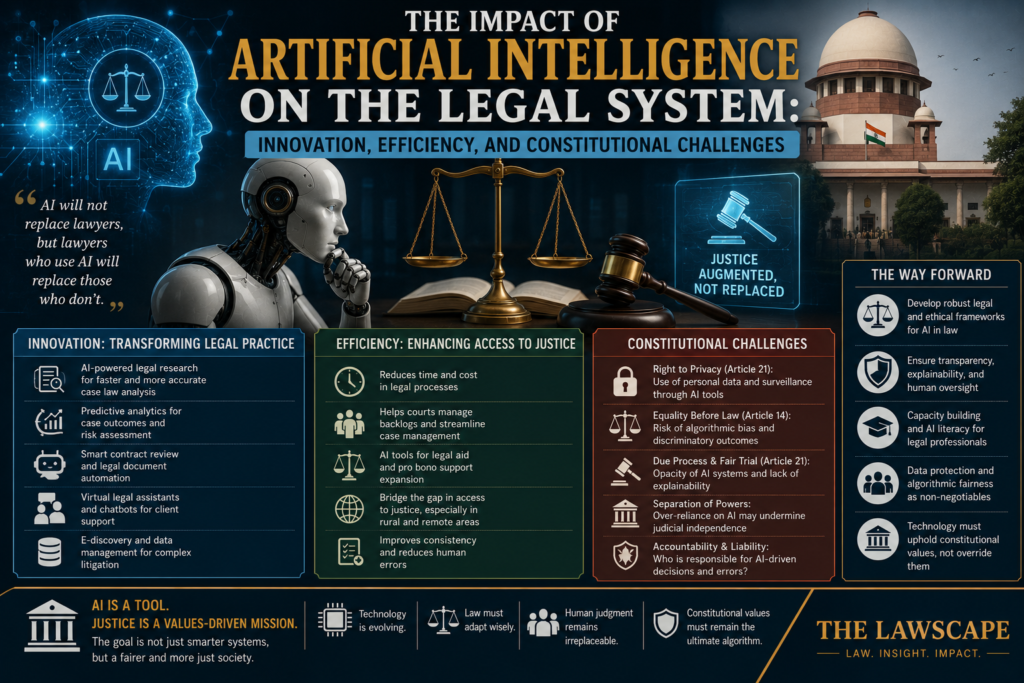
- Artificial Intelligence is transforming legal research, drafting, judicial administration, and access to justice by improving efficiency and reducing costs.
- The growing use of AI in legal systems raises significant concerns regarding privacy, accountability, transparency, algorithmic bias, and procedural fairness.
- AI should function as an assistive tool within the justice system rather than a replacement for human judgment, constitutional interpretation, and ethical decision-making.
Introduction
Artificial Intelligence (AI) is among the most transformative technologies of the twenty-first century, reshaping industries across healthcare, finance, education, governance, transportation, and law. The legal profession, traditionally dependent upon human reasoning, legal interpretation, advocacy, and extensive research, is undergoing a significant technological transition as AI-based systems become increasingly integrated into legal processes.
AI refers to the capability of computer systems to perform tasks that ordinarily require human intelligence, including reasoning, learning, language comprehension, and decision-making. Within the legal profession, AI technologies are now used for legal research, document review, contract analysis, predictive analytics, compliance monitoring, and court administration. Advanced legal technology platforms can process thousands of statutes, judicial decisions, and legal documents within seconds, substantially reducing the time and effort associated with traditional legal work.
The rapid digitization of India’s legal system has further accelerated the adoption of technology. E-courts, virtual hearings, AI-assisted translation tools, electronic filing systems, and digital case management platforms have become increasingly common. The COVID-19 pandemic significantly intensified this trend by demonstrating the necessity of technology-driven justice delivery during periods of disruption.
Despite its advantages, the integration of AI into legal systems raises complex constitutional, legal, and ethical concerns. Questions relating to privacy, algorithmic bias, accountability, transparency, procedural fairness, and employment displacement challenge traditional understandings of justice and the rule of law.
This article examines the impact of AI on legal systems, with particular reference to India and comparative international developments. It evaluates the role of AI in legal research, judicial administration, legal education, and access to justice while analysing the constitutional and ethical implications arising from its increasing use. The article ultimately argues that AI should serve as an assistive mechanism rather than a substitute for the human foundations of justice.
Evolution of AI in the Legal Sector
Historically, legal practice relied heavily on manual research, physical documentation, legal interpretation, and human judgment. Lawyers devoted substantial time to reviewing statutes, analysing precedents, preparing case files, drafting agreements, and advising clients.
Technological advancements gradually introduced digital databases, document management systems, and online legal research tools. Artificial Intelligence represents the next stage of this evolution.
Modern AI systems utilize machine learning and natural language processing to analyse legal data, generate research outputs, and assist legal professionals in performing various tasks. These systems can:
- Conduct legal research;
- Draft contracts and legal documents;
- Analyse agreements;
- Assess legal risks;
- Monitor compliance obligations; and
- Predict potential litigation outcomes.
As law firms increasingly rely on AI-powered platforms for due diligence and legal analytics, courts across the world have also begun incorporating technological solutions into their operations.
In India, initiatives such as the Supreme Court Vidhik Anuvaad Software (SUVAS) have been introduced to facilitate the translation of legal documents into different languages and improve accessibility within the judicial process.
Despite these developments, AI remains a supplementary tool. Legal decisions ultimately require human reasoning, ethical evaluation, constitutional interpretation, and contextual understanding. Technology may enhance efficiency, but it cannot replace the human dimensions of justice.
Artificial Intelligence in Legal Research and Legal Drafting
One of the most significant applications of AI within the legal profession is in legal research and drafting.
AI-powered legal databases enable lawyers, researchers, and judges to identify relevant precedents and statutory provisions with unprecedented speed and accuracy. This has substantially reduced the costs and time traditionally associated with legal research.
Similarly, AI-assisted drafting tools are increasingly used for preparing:
- Contracts;
- Legal notices;
- Petitions;
- Compliance documents; and
- Commercial agreements.
These systems help identify inconsistencies, reduce drafting errors, and improve overall efficiency.
Predictive analytics has emerged as another important area of application. By analysing patterns within judicial decisions and litigation outcomes, AI systems can assist lawyers in assessing litigation risks and developing legal strategies.
However, predictive analytics remains controversial.
Judicial decisions cannot be reduced to statistical patterns alone. Every legal dispute involves unique factual circumstances requiring judicial discretion, constitutional interpretation, and ethical reasoning. Consequently, predictive tools should be viewed as aids rather than substitutes for legal judgment.
The constitutional dimension of AI-assisted legal processes becomes particularly relevant in light of the Supreme Court’s decision in Justice K.S. Puttaswamy v. Union of India, where the Court recognized privacy as a fundamental right under Article 21 of the Constitution. The handling of sensitive legal and personal data by AI systems therefore requires robust safeguards to protect informational privacy.
Judicial Administration and Technological Transformation
Artificial Intelligence has also influenced judicial administration through technological innovations designed to improve efficiency and accessibility.
AI-supported systems are increasingly used for:
- Digital case management;
- Scheduling and listing of cases;
- Court record transcription;
- Virtual hearings;
- Electronic filing; and
- Administrative workflow management.
The Indian judiciary has adopted various technological initiatives aimed at reducing case backlogs and enhancing access to justice, particularly for individuals residing in remote or underserved regions.
Virtual courts and electronic filing systems have simplified procedural requirements and improved the accessibility of judicial services.
Nevertheless, concerns arise when AI begins to influence judicial decision-making.
Algorithms cannot replicate human empathy, contextual awareness, ethical reasoning, or constitutional interpretation. Judicial decisions often involve complex considerations that extend beyond factual analysis and require balancing competing rights, social realities, and constitutional values.
The Supreme Court’s decision in Maneka Gandhi v. Union of India emphasized that fairness, reasonableness, and due process form essential components of Article 21. Any technological system influencing legal decisions must therefore remain consistent with principles of natural justice and procedural fairness.
A further challenge concerns algorithmic opacity.
Many AI systems function as “black boxes,” making it difficult to understand how conclusions are generated. Such opacity raises important questions regarding transparency, accountability, and public trust within the justice system.
Legal and Ethical Issues Associated with AI
Algorithmic Bias
One of the most significant concerns associated with AI is algorithmic bias.
AI systems learn from existing datasets. If those datasets reflect historical discrimination or social inequalities, the resulting outputs may reproduce or reinforce those biases.
Discriminatory outcomes generated by automated systems may undermine constitutional guarantees of equality and non-discrimination under Articles 14 and 15 of the Constitution.
Ensuring fairness within AI systems therefore requires careful scrutiny of training data, algorithmic design, and implementation practices.
Privacy and Data Protection
AI systems rely upon large volumes of personal and legal information to function effectively.
The collection, storage, and processing of such information create concerns regarding surveillance, confidentiality, and misuse of sensitive data.
India’s Digital Personal Data Protection Act, 2023 represents a significant step toward regulating the processing of digital personal data and strengthening privacy protections. The legislation establishes obligations for governments, businesses, and individuals involved in data processing and contributes to the development of a more structured framework for digital governance.
Employment Displacement
The growing use of AI technologies may significantly affect employment patterns within the legal profession.
Tasks traditionally performed by junior lawyers, legal assistants, and support staff—such as document review, contract analysis, and routine legal research—are increasingly being automated.
While AI may create new professional opportunities, concerns remain regarding job displacement and the future structure of legal employment.
Accountability and Liability
Another major concern relates to responsibility for AI-generated errors.
Where AI systems provide inaccurate legal advice, generate discriminatory outcomes, or contribute to procedural mistakes, questions arise regarding legal liability.
Uncertainty persists regarding whether responsibility should rest with developers, legal practitioners, institutions, or users. The absence of comprehensive regulatory frameworks governing AI accountability continues to create significant legal challenges.
Artificial Intelligence and Access to Justice
Artificial Intelligence has the potential to significantly improve access to justice.
AI-based legal assistance systems can provide individuals with information regarding their rights, legal procedures, and available remedies at relatively low cost. Such tools may be particularly valuable for individuals who cannot afford traditional legal services.
In the Indian context, AI-assisted legal aid initiatives align with the objectives of Article 39A, which seeks to ensure equal justice and free legal aid.
AI can further enhance access to justice through:
- Online dispute resolution mechanisms;
- Automated legal information services;
- Legal chatbots;
- Document assistance tools; and
- Digital legal aid platforms.
These innovations may reduce procedural barriers and increase the accessibility of legal services.
However, technological solutions alone cannot guarantee equal access to justice.
Economic disparities, digital illiteracy, inadequate infrastructure, and limited technological awareness continue to prevent many individuals from benefiting fully from such innovations.
Consequently, technological progress must be accompanied by investments in public awareness, digital literacy, and infrastructure development.
Global Regulation of Artificial Intelligence
Governments and international organizations across the world are increasingly developing regulatory frameworks governing AI technologies.
The European Union has adopted the Artificial Intelligence Act, which emphasizes transparency, accountability, risk assessment, and human oversight in the development and deployment of AI systems.
In the United States, regulation remains more fragmented and is often implemented through sector-specific measures and judicial oversight.
International organizations such as UNESCO and the World Intellectual Property Organization (WIPO) have also emphasized the importance of ethical AI governance, international cooperation, and responsible technological development.
India presently lacks a comprehensive statutory framework specifically regulating AI. Nevertheless, ongoing policy discussions concerning responsible AI, digital governance, and technological accountability indicate growing recognition of the challenges associated with emerging technologies.
Constitutional Implications of AI in the Legal System
The increasing integration of AI into legal systems raises important constitutional questions.
Equality and Non-Discrimination
Algorithmic bias may result in discriminatory outcomes that undermine constitutional guarantees under Articles 14 and 15.
Ensuring fairness within AI systems therefore becomes a constitutional imperative.
Privacy
The processing of personal and legal information by AI systems directly implicates the fundamental right to privacy recognized in Puttaswamy.
Strong safeguards are necessary to prevent misuse and unauthorized access to sensitive information.
Due Process and Fairness
Article 21 requires that legal procedures remain fair, reasonable, and just.
Excessive reliance upon opaque algorithms may undermine procedural fairness and weaken public confidence in legal institutions.
Accountability
Constitutional governance requires that public authority remain accountable.
Where AI systems influence legal outcomes, clear accountability mechanisms must exist to ensure transparency and legal responsibility.
These constitutional concerns highlight the need for careful regulation and human oversight within AI-assisted legal processes.
Conclusion
Artificial Intelligence is transforming legal systems by improving efficiency, enhancing legal research, streamlining administrative processes, and expanding access to legal services.
Its benefits include faster legal research, improved case management, reduced operational costs, and greater accessibility of justice mechanisms. However, the increasing integration of AI into legal systems also raises significant concerns regarding privacy, transparency, accountability, algorithmic bias, procedural fairness, and employment displacement.
Justice cannot be reduced to automated decision-making.
The legal system is fundamentally rooted in human reasoning, ethical judgment, empathy, constitutional interpretation, and contextual understanding. While AI can support legal professionals and improve institutional efficiency, it cannot replace judges, lawyers, or the human values that underpin the administration of justice.
The future of AI within the legal system therefore depends upon achieving an appropriate balance between technological innovation and constitutional governance. Effective regulatory frameworks, robust privacy protections, accountability mechanisms, transparency standards, and human oversight will be essential to ensuring that AI strengthens rather than undermines the rule of law.
Ultimately, AI should be viewed as an instrument that assists the delivery of justice while remaining subordinate to the constitutional principles, democratic values, and human judgment upon which the legal system is built.
Disclaimer: The views expressed in this article are those of the author and do not necessarily reflect the views of The Lawscape.
The Lawscape — clear, practical legal insight for students and future lawyers.