
The Basic Structure Doctrine: Shield of Democracy or Judicial Supremacy?
Author: Avni Sood
Student, Army Institute of Law, Mohali, Sec 68
——————————————————————————————————
💡 3 Quick Takeaways
- The Basic Structure Doctrine limits Parliament’s amending power by preventing alterations that destroy the Constitution’s fundamental identity.
- The doctrine has played a crucial role in safeguarding democracy, judicial review, secularism, federalism, and constitutional supremacy during periods of political crisis.
- Despite its constitutional significance, the doctrine continues to attract criticism for its lack of explicit textual basis and its perceived expansion of judicial authority.
Introduction
One of the most enduring questions in constitutional law concerns the scope of Parliament’s power to amend the Constitution. Can an elected majority alter every constitutional principle, including democracy, judicial independence, and fundamental rights? More fundamentally, can a Constitution legally authorize its own destruction?
These questions lie at the heart of the Basic Structure Doctrine, one of the most significant developments in modern Indian constitutional law. The doctrine seeks to reconcile constitutional flexibility with the preservation of constitutional identity. It represents a judicial response to the challenge of balancing democratic governance with constitutional limitations on power.
India’s constitutional framework is founded upon constitutional supremacy, the rule of law, separation of powers, and the protection of fundamental rights. At the same time, Article 368 grants Parliament the authority to amend the Constitution to ensure that it remains responsive to changing social, political, and economic realities.
This duality raises an important constitutional concern: does Parliament possess unlimited authority to alter every aspect of the constitutional framework?
The origins of this debate can be traced to the post-independence period, when Parliament enacted land reform measures and other socio-economic legislation that affected constitutionally protected rights. Repeated attempts to overcome adverse judicial decisions through constitutional amendments generated concerns that unlimited amendment powers could eventually undermine the Constitution’s core values.
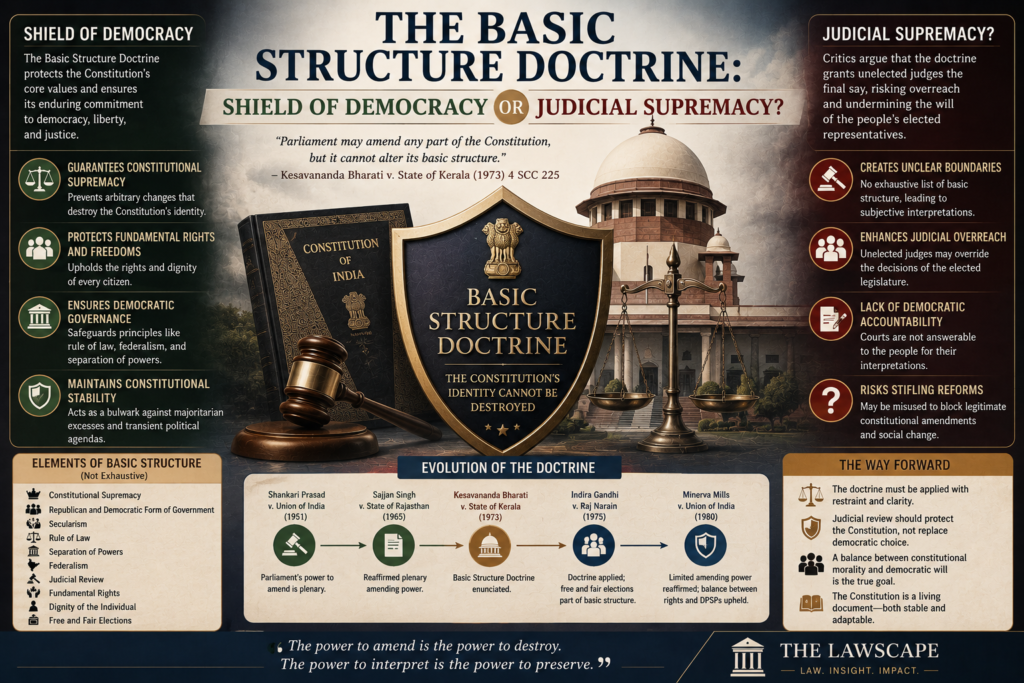
The Supreme Court’s decision in Kesavananda Bharati v. State of Kerala sought to address this tension by holding that Parliament could amend the Constitution but could not alter its “basic structure.” The doctrine has since become a central feature of Indian constitutionalism.
Supporters regard it as the ultimate safeguard against authoritarianism and constitutional destruction. Critics, however, argue that it grants excessive authority to unelected judges and weakens democratic decision-making.
This article examines the historical development, constitutional significance, and continuing controversy surrounding the Basic Structure Doctrine while evaluating whether it functions primarily as a shield of democracy or as an instrument of judicial supremacy.
Historical Evolution of the Doctrine
The origins of the Basic Structure Doctrine lie in the constitutional conflict between Parliament and the Judiciary regarding the scope of Parliament’s amending powers.
Soon after independence, Parliament introduced agrarian reform legislation intended to address social and economic inequalities. These measures were frequently challenged before the courts on the ground that they violated fundamental rights, particularly the right to property.
Shankari Prasad v. Union of India
The first major constitutional challenge arose in Shankari Prasad v. Union of India.
The Supreme Court upheld Parliament’s authority to amend fundamental rights and held that constitutional amendments were not “law” within the meaning of Article 13. Consequently, amendments could not be invalidated merely because they affected fundamental rights.
Sajjan Singh v. State of Rajasthan
A similar position was adopted in Sajjan Singh v. State of Rajasthan.
However, significant concerns emerged in the dissenting opinions of Justice Hidayatullah and Justice Mudholkar, who questioned whether Parliament’s amending power should remain entirely unrestricted and suggested that certain constitutional principles might be beyond amendment.
I.C. Golaknath v. State of Punjab
A major constitutional shift occurred in I.C. Golaknath v. State of Punjab.
The Supreme Court reversed its earlier position and held that Parliament could not amend fundamental rights. The Court characterized these rights as transcendental and beyond legislative interference.
The decision intensified the constitutional conflict between Parliament and the Judiciary. Parliament responded by enacting the Twenty-Fourth Constitutional Amendment, expressly reaffirming its authority to amend any provision of the Constitution.
This confrontation ultimately culminated in the landmark Kesavananda Bharati decision.
The Kesavananda Bharati Judgment
The judgment in Kesavananda Bharati v. State of Kerala remains one of the most important constitutional decisions in Indian legal history.
The case was heard by a thirteen-judge bench, the largest bench ever constituted by the Supreme Court. The central question before the Court was whether Parliament possessed unlimited authority under Article 368 to amend every aspect of the Constitution, including its fundamental principles and institutional framework.
By a narrow majority of seven to six, the Court held that Parliament could amend any provision of the Constitution but could not alter or destroy its “basic structure.”
The judgment represented a constitutional compromise between parliamentary power and constitutional supremacy.
Importantly, the Court declined to provide an exhaustive definition of the doctrine. Nevertheless, various judges identified several foundational principles that formed part of the Constitution’s basic structure, including:
- Constitutional supremacy;
- Rule of law;
- Judicial review;
- Democracy;
- Secularism; and
- Separation of powers.
The significance of the judgment extends beyond merely limiting amendment powers. It established the principle that the Constitution possesses a permanent constitutional identity that cannot be destroyed through amendment.
According to the Court, constitutional amendment cannot become a mechanism for constitutional self-destruction.
The doctrine therefore ensures that Parliament remains empowered to amend the Constitution in response to evolving circumstances while preventing it from abolishing the constitutional framework from which its authority itself derives.
Essential Features of the Basic Structure
The Supreme Court intentionally refrained from creating a rigid list of principles constituting the basic structure. Instead, the doctrine has evolved incrementally through judicial interpretation.
Several constitutional principles have consistently been recognized as forming part of the basic structure.
Constitutional Supremacy
The Constitution remains the highest legal authority in India.
Parliament derives its authority from the Constitution and therefore cannot destroy the source of its own powers.
Rule of Law
The rule of law ensures that governmental power remains subject to legal limitations.
Arbitrary governance is incompatible with constitutional democracy and constitutional accountability.
Judicial Review
Judicial review enables courts to examine the constitutional validity of legislative and executive actions.
Without judicial review, constitutional limitations would become ineffective because there would be no institution capable of enforcing them.
Democracy
Democracy forms the foundation of the constitutional system.
Free and fair elections, representative government, and political accountability have repeatedly been recognized as essential constitutional principles.
Secularism
The Constitution requires the State to maintain neutrality toward all religions and protect religious freedom equally.
Secularism therefore functions as a foundational element of constitutional equality and social harmony.
Federalism
Federalism preserves the balance of power between the Union and the States.
This division of authority prevents excessive concentration of power and reflects India’s diverse political and cultural character.
Separation of Powers
The Legislature, Executive, and Judiciary must function within their respective constitutional spheres.
Institutional independence and mutual accountability are therefore essential to maintaining constitutional balance.
Collectively, these principles preserve the Constitution’s identity and continuity.
Expansion of the Doctrine Through Judicial Decisions
Following Kesavananda Bharati, the Basic Structure Doctrine evolved through a series of landmark constitutional decisions.
Indira Nehru Gandhi v. Raj Narain
In Indira Nehru Gandhi v. Raj Narain, the Supreme Court held that free and fair elections form part of the Constitution’s basic structure.
The decision, delivered during the Emergency period, reinforced democratic legitimacy and constitutional accountability.
Minerva Mills v. Union of India
In Minerva Mills v. Union of India, the Court reaffirmed that Parliament’s amending power is itself limited.
The Court held that Parliament could not transform a limited power into an unlimited one, thereby strengthening the constitutional foundations of the doctrine.
S.R. Bommai v. Union of India
The Supreme Court recognized secularism as a basic feature of the Constitution in S.R. Bommai v. Union of India.
The judgment emphasized that religious neutrality forms an essential constitutional obligation.
I.R. Coelho v. State of Tamil Nadu
In I.R. Coelho v. State of Tamil Nadu, the Court extended judicial review to laws placed in the Ninth Schedule.
The Court held that even Ninth Schedule legislation could be reviewed if it violated the Constitution’s basic structure.
The NJAC Case
The doctrine assumed renewed significance in Supreme Court Advocates-on-Record Association v. Union of India.
The Supreme Court invalidated the National Judicial Appointments Commission (NJAC) Amendment on the ground that judicial independence forms part of the Constitution’s basic structure.
The judgment generated substantial debate, with critics accusing the Judiciary of protecting its institutional interests and supporters arguing that judicial independence is indispensable to constitutional governance.
These decisions demonstrate the doctrine’s evolution from a limitation on amendment powers into a broader constitutional philosophy dedicated to preserving constitutional integrity.
The Doctrine as a Shield of Democracy
Supporters frequently describe the Basic Structure Doctrine as one of the strongest safeguards of constitutional democracy in India.
Its primary function is to prevent constitutional destruction through apparently lawful constitutional amendments.
Without substantive limits on amendment powers, a temporary parliamentary majority could potentially:
- Abolish elections;
- Eliminate judicial review;
- Dismantle federalism; or
- Curtail fundamental freedoms.
Constitutional democracies require more than electoral majorities. They also require institutional safeguards capable of preventing the concentration of power.
The doctrine’s significance became particularly evident during the Emergency period between 1975 and 1977.
The Forty-Second Constitutional Amendment sought to expand parliamentary supremacy and significantly restrict judicial review. In Minerva Mills, the Supreme Court invoked the Basic Structure Doctrine to invalidate portions of the amendment and reaffirmed that limited amending power itself forms part of the Constitution’s basic structure.
The decision demonstrated the doctrine’s role as a safeguard against authoritarian constitutionalism.
The doctrine also serves to protect minority rights and constitutional morality. Democratic governments may occasionally pursue measures that undermine equality, institutional independence, or civil liberties. Judicial review under the Basic Structure Doctrine therefore functions as a check against majoritarian excesses.
From this perspective, the doctrine is viewed not as an obstacle to democracy but as a mechanism necessary for its preservation.
Criticism: Judicial Supremacy and Democratic Concerns
Despite its constitutional significance, the Basic Structure Doctrine remains highly controversial.
One of the principal criticisms concerns its lack of textual foundation.
The phrase “basic structure” does not appear anywhere in the Constitution. Critics therefore argue that the judiciary created a constitutional limitation without explicit constitutional authorization.
Concerns also arise regarding democratic legitimacy.
Parliament consists of elected representatives accountable to the electorate, whereas judges are unelected constitutional functionaries. Granting judges the authority to invalidate constitutional amendments passed by elected representatives appears, according to critics, inconsistent with democratic principles.
Another criticism relates to conceptual uncertainty.
The Supreme Court has never produced an exhaustive list of elements constituting the basic structure. This flexibility provides judges with considerable interpretative discretion and may result in uncertainty regarding the doctrine’s future application.
Some scholars further contend that the doctrine effectively places the Judiciary above Parliament by allowing courts to determine the permissible boundaries of constitutional change.
According to this view, constitutional evolution should occur primarily through democratic deliberation and legislative action rather than judicial innovation.
These criticisms continue to fuel significant constitutional debate.
Balancing Democracy and Constitutionalism
The debate surrounding the Basic Structure Doctrine ultimately reflects a broader tension between democracy and constitutionalism.
Democracy is founded upon majority rule and political representation. Constitutionalism, however, requires limits on governmental power to preserve liberty, institutional balance, and minority rights.
The Basic Structure Doctrine attempts to reconcile these competing principles by allowing constitutional amendments while protecting the Constitution’s foundational values.
Unlike the United Kingdom, India does not follow a model of unrestricted parliamentary sovereignty.
India adopted a written Constitution founded upon constitutional supremacy. Parliament derives its authority from the Constitution and therefore cannot destroy the constitutional order from which that authority originates.
Comparative constitutional experience demonstrates that substantive limits on constitutional amendments are not unique to India.
For example, the German Constitution expressly protects certain foundational principles, including human dignity and democratic federalism, from amendment.
At the same time, courts must exercise constitutional restraint when applying the doctrine. Excessive judicial intervention may undermine democratic accountability and disrupt institutional balance.
The continuing challenge therefore lies in preserving an appropriate equilibrium between constitutional protection and democratic governance.
Conclusion
The Basic Structure Doctrine remains one of the most influential principles in Indian constitutional law.
Developed in response to concerns regarding unlimited amendment powers, the doctrine protects the Constitution’s essential identity from destruction through constitutional amendment.
Although critics argue that the doctrine lacks an explicit textual basis and grants excessive authority to judges, its role in preserving constitutional democracy cannot be overlooked. Over the decades, it has safeguarded judicial independence, constitutional supremacy, democracy, secularism, federalism, and the rule of law during periods of constitutional uncertainty and political conflict.
The debate between parliamentary authority and judicial review is likely to continue. Nevertheless, constitutional democracy requires more than temporary political majorities. It requires enduring constitutional principles capable of limiting governmental power and preserving institutional integrity.
The Basic Structure Doctrine, therefore, represents not merely a judicial innovation but a constitutional safeguard. By preventing constitutional destruction through lawful means, it continues to function as a critical mechanism for protecting Indian democracy while simultaneously reminding the Judiciary of the importance of constitutional restraint.
Ultimately, the doctrine reflects a fundamental constitutional truth: the Constitution is not simply a political document subject to unrestricted alteration. It is a constitutional charter founded upon enduring values that cannot be sacrificed even in the name of democratic power.
Disclaimer: The views expressed in this article are those of the author and do not necessarily reflect the views of The Lawscape.
The Lawscape — clear, practical legal insight for students and future lawyers.