
Passive Euthanasia in India: Constitutional Recognition, Judicial Evolution, and Contemporary Challenges
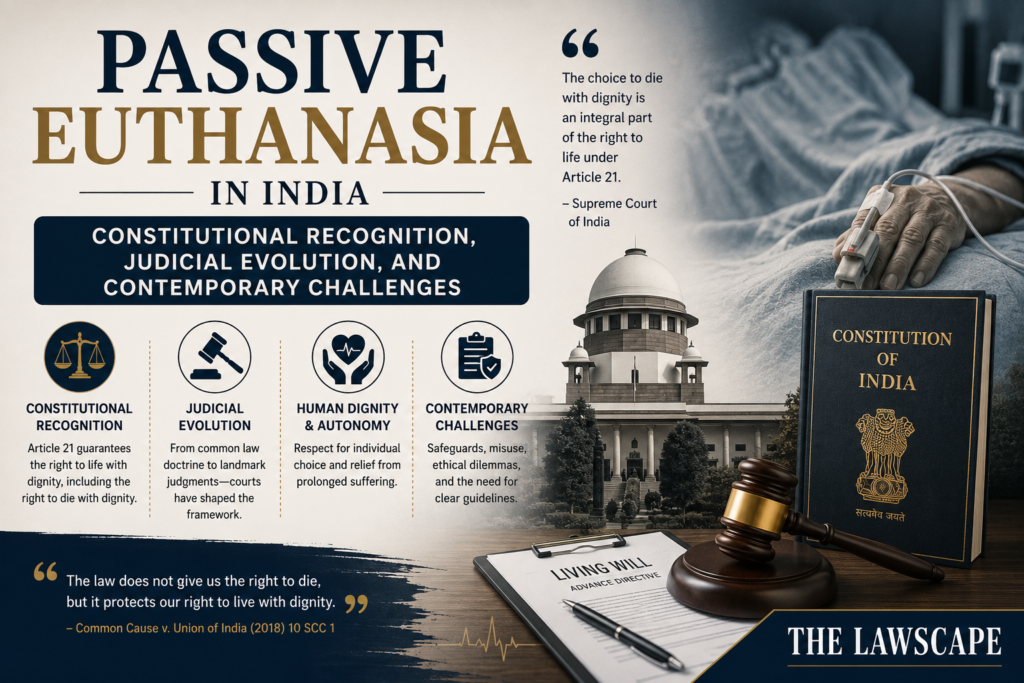
Author: Jyothika K G
Student, Mar Gregorios College of Law, Thiruvananthapuram
————————————————————————————————————————-
💡 3 Quick Takeaways
- Passive euthanasia is legally recognized in India through judicial decisions and is closely linked to the constitutional guarantee of dignity under Article 21.
- Landmark decisions such as Gian Kaur v. State of Punjab, Aruna Ramachandra Shanbaug v. Union of India, and Common Cause v. Union of India have shaped the legal framework governing passive euthanasia and living wills.
- Despite judicial recognition, the absence of comprehensive legislation continues to create concerns regarding implementation, safeguards, and potential misuse.
Introduction
Passive euthanasia is one of the most debated and sensitive issues in contemporary constitutional and medical jurisprudence. The concept concerns the withdrawal or withholding of life-sustaining medical treatment from terminally ill or permanently unconscious patients, allowing death to occur naturally rather than through continued artificial intervention.
In India, discussions surrounding euthanasia are closely connected with Article 21 of the Constitution, which guarantees the right to life and personal liberty. Over the years, judicial interpretation of Article 21 has expanded beyond mere physical existence to include dignity, autonomy, privacy, and personal choice. Consequently, questions relating to end-of-life decisions have increasingly been examined through the lens of constitutional rights and human dignity.
The legal position on passive euthanasia has evolved gradually through a series of landmark judgments. Decisions such as Gian Kaur v. State of Punjab, Aruna Ramachandra Shanbaug v. Union of India, and Common Cause v. Union of India have significantly influenced the recognition of passive euthanasia and the concept of living wills within Indian law.
More recently, the Supreme Court’s decision in Harish Rana v. Union of India marked a significant development by permitting the withdrawal of life support in a prolonged vegetative-state case, applying principles previously established by the Court.
This article examines the meaning and classification of euthanasia, its constitutional dimensions, the recommendations of the Law Commission of India, the judicial evolution of passive euthanasia, and the continuing challenges associated with its implementation in India.
Understanding Euthanasia
Meaning of Euthanasia
The term “euthanasia” originates from the Greek expression meaning “good death.”
Generally, euthanasia refers to the intentional allowing or causing of death in cases involving irreversible illness, severe suffering, or permanent incapacity. The objective is to relieve pain and permit a dignified end to life.
The concept is often described as “mercy killing” because it is associated with compassion toward individuals experiencing prolonged suffering with little or no possibility of recovery.
Historically, the term was used by Francis Bacon to describe a peaceful and painless death, emphasizing the physician’s responsibility to alleviate suffering where possible.
Classification of Euthanasia
Euthanasia may be classified into different categories based on the method employed and the presence or absence of consent.
Active Euthanasia
Active euthanasia involves a positive act intended to cause death.
Examples include administering a lethal injection or providing a substance designed to end life immediately.
In Aruna Ramachandra Shanbaug v. Union of India, the Supreme Court distinguished active euthanasia from passive euthanasia and clarified their legal implications.
Under the Bharatiya Nyaya Sanhita, 2023, active euthanasia continues to be treated as a criminal offence.
Passive Euthanasia
Passive euthanasia involves the withdrawal or withholding of life-sustaining treatment rather than the administration of a lethal substance.
Examples include:
- Disconnecting ventilatory support;
- Discontinuing life-support systems;
- Stopping artificial nutrition in appropriate circumstances; and
- Withholding further medical interventions where recovery is impossible.
Unlike active euthanasia, passive euthanasia permits death to occur naturally by discontinuing artificial medical support.
The Supreme Court recognized passive euthanasia in Aruna Ramachandra Shanbaug v. Union of India and subsequently refined the legal framework through later decisions.
Voluntary Euthanasia
Voluntary euthanasia occurs when a competent patient knowingly and voluntarily consents to the decision.
Involuntary Euthanasia
Involuntary euthanasia involves ending a person’s life without consent and is generally regarded as unlawful and ethically unacceptable.
The 196th Law Commission Report
An important contribution to the euthanasia debate emerged through the 196th Report of the Law Commission of India titled Medical Treatment to Terminally Ill Patients (Protection of Patients and Medical Practitioners).
The report was prepared following the Supreme Court’s decision in Gian Kaur v. State of Punjab.
The Law Commission recommended the enactment of legislation designed to regulate medical decisions concerning terminally ill patients while providing legal protection to both patients and medical practitioners.
Among its notable recommendations were:
- Recognition of a competent patient’s right to refuse medical treatment;
- Protection for doctors acting in accordance with lawful medical decisions;
- Judicial oversight through High Courts in appropriate cases; and
- Reliance upon expert medical opinion before withdrawing life-sustaining treatment.
The proposed framework introduced important concepts such as:
Best Interest
The “best interest” principle required consideration of:
- Medical factors;
- Ethical concerns;
- Social circumstances; and
- Emotional well-being.
Informed Decision
An informed decision required that a mentally competent patient understand:
- The nature of the illness;
- Available treatment options;
- Risks involved; and
- Consequences of refusing treatment.
These concepts later influenced judicial discussions concerning passive euthanasia and end-of-life autonomy.
Constitutional Dimensions of Passive Euthanasia
Article 21 of the Constitution provides that no person shall be deprived of life or personal liberty except according to procedure established by law.
Judicial interpretation has significantly expanded the meaning of this provision.
The Supreme Court has repeatedly emphasized that the right to life includes:
- Human dignity;
- Privacy;
- Personal autonomy;
- Bodily integrity; and
- Freedom of choice.
The debate surrounding euthanasia emerged from the broader question of whether the right to life also includes a corresponding right to die.
P. Rathinam v. Union of India
In P. Rathinam v. Union of India, the Supreme Court examined the constitutional validity of Section 309 of the Indian Penal Code, which criminalized attempts to commit suicide.
The Court held that the provision was unconstitutional and observed that the right to life included a right not to continue living under certain circumstances.
The judgment generated substantial debate concerning the relationship between life, liberty, and personal autonomy.
Gian Kaur v. State of Punjab
The position adopted in P. Rathinam was subsequently reconsidered in Gian Kaur v. State of Punjab.
The Supreme Court held that Article 21 does not include a general right to die.
The Court distinguished between:
- The natural process of dying with dignity; and
- The unnatural termination of life through suicide.
While rejecting the existence of a broad constitutional right to die, the Court recognized that dignity remains relevant during the process of natural death.
This observation later became foundational for the recognition of passive euthanasia.
Judicial Recognition of Passive Euthanasia
Aruna Ramachandra Shanbaug v. Union of India
The modern legal framework governing passive euthanasia originated in Aruna Ramachandra Shanbaug v. Union of India.
Aruna Shanbaug, a nurse at KEM Hospital in Mumbai, remained in a vegetative state for decades following a brutal assault.
A petition was filed seeking permission for passive euthanasia.
After reviewing medical evidence, the Supreme Court declined the request because Aruna was not considered brain dead and continued to receive nutrition and care through natural means.
However, the Court used the opportunity to recognize passive euthanasia in principle and establish procedural safeguards.
The guidelines required:
- Judicial supervision;
- Medical expert evaluation; and
- Consideration of the views of family members and caregivers.
These guidelines remained operative until legislative action or further judicial clarification.
Living Wills and Common Cause v. Union of India
A major development occurred through the Supreme Court’s decision in Common Cause v. Union of India.
The Court formally recognized:
- Passive euthanasia; and
- Advance Medical Directives, commonly known as Living Wills.
What Is a Living Will?
A Living Will is a legal document through which an individual expresses a preference regarding medical treatment in circumstances where they become incapable of communicating decisions.
Such directives enable individuals to indicate whether life-support measures should continue in situations involving terminal illness or irreversible incapacity.
Safeguards Established by the Court
To ensure that Living Wills are implemented responsibly, the Court prescribed procedural safeguards requiring:
- Medical evaluation by expert committees;
- Independent review mechanisms;
- Administrative oversight; and
- Verification of the patient’s condition before withdrawal of treatment.
The judgment significantly strengthened the constitutional foundation of the right to die with dignity.
The Harish Rana Case: A Significant Development
A major milestone occurred in Harish Rana v. Union of India.
Harish Rana, a young engineering student, suffered severe injuries after a fall and remained in a permanent vegetative state for more than thirteen years.
His survival depended entirely upon Clinically Assisted Nutrition and Hydration (CANH).
His parents approached the Supreme Court seeking permission to withdraw life-sustaining treatment.
Supreme Court’s Decision
The Court held that CANH constitutes medical treatment and may be discontinued where it no longer serves a meaningful therapeutic purpose.
Importantly, the Court expanded upon the principles laid down in Common Cause by emphasizing that decisions concerning passive euthanasia should consider:
- Medical futility;
- Human dignity;
- Personal identity; and
- The patient’s overall suffering.
Because Harish had not executed a Living Will, the Court applied the doctrine of substituted judgment to determine what he would likely have chosen.
The Court considered evidence suggesting that he had been an active and independent individual and concluded that indefinite artificial maintenance of life could undermine his dignity.
Rather than ordering immediate withdrawal of support, the Court directed that Harish be transferred to a palliative care facility to ensure comfort and dignity.
Following the completion of all required procedures, life support was withdrawn in accordance with judicial authorization.
The decision represents a significant development in the practical implementation of passive euthanasia principles within the Indian legal system.
Concerns and Challenges Associated with Passive Euthanasia
Despite judicial recognition, passive euthanasia remains controversial.
Potential for Misuse
Critics argue that decisions concerning withdrawal of treatment could be influenced by:
- Financial interests;
- Property disputes;
- Inheritance conflicts; or
- Caregiving burdens.
This concern is particularly relevant where vulnerable patients cannot express their wishes.
Moral and Religious Objections
Many religious and cultural traditions regard human life as inherently sacred.
Consequently, withdrawal of life-support measures may be viewed as inconsistent with deeply held ethical and spiritual beliefs.
Medical Miscalculation
Medical prognoses are not infallible.
An incorrect diagnosis concerning irreversibility or recovery prospects could result in irreversible consequences.
Emotional Pressure
Terminally ill patients may experience feelings of guilt or perceive themselves as burdens upon family members.
Such psychological pressures may affect decision-making.
Absence of Comprehensive Legislation
India continues to rely primarily upon judicial decisions rather than a dedicated statutory framework governing passive euthanasia.
The absence of detailed legislation creates uncertainty regarding:
- Procedures;
- Oversight mechanisms;
- Accountability standards; and
- Uniform implementation.
Conclusion
Passive euthanasia occupies a significant place within India’s evolving constitutional and medical jurisprudence.
Through decisions such as Gian Kaur v. State of Punjab, Aruna Ramachandra Shanbaug v. Union of India, and Common Cause v. Union of India, the Supreme Court progressively recognized that the dignity protected by Article 21 extends to the final stages of human life.
The recognition of Living Wills and the legal acceptance of passive euthanasia reflect the Court’s effort to balance individual autonomy, human dignity, and medical realities.
The decision in Harish Rana v. Union of India further demonstrates the practical application of these principles and marks an important milestone in the development of end-of-life jurisprudence in India.
Nevertheless, passive euthanasia continues to present significant ethical, legal, and procedural challenges. Concerns regarding misuse, medical uncertainty, moral objections, and institutional safeguards remain unresolved.
Given the increasing importance of end-of-life decision-making, there is a compelling need for comprehensive legislation that provides clear procedures, effective safeguards, and uniform standards. Such a framework would promote legal certainty while ensuring that the constitutional commitment to dignity, autonomy, and humane treatment remains protected.
Disclaimer: The views expressed in this article are those of the author and do not necessarily reflect the views of The Lawscape.
The Lawscape — clear, practical legal insight for students and future lawyers.