
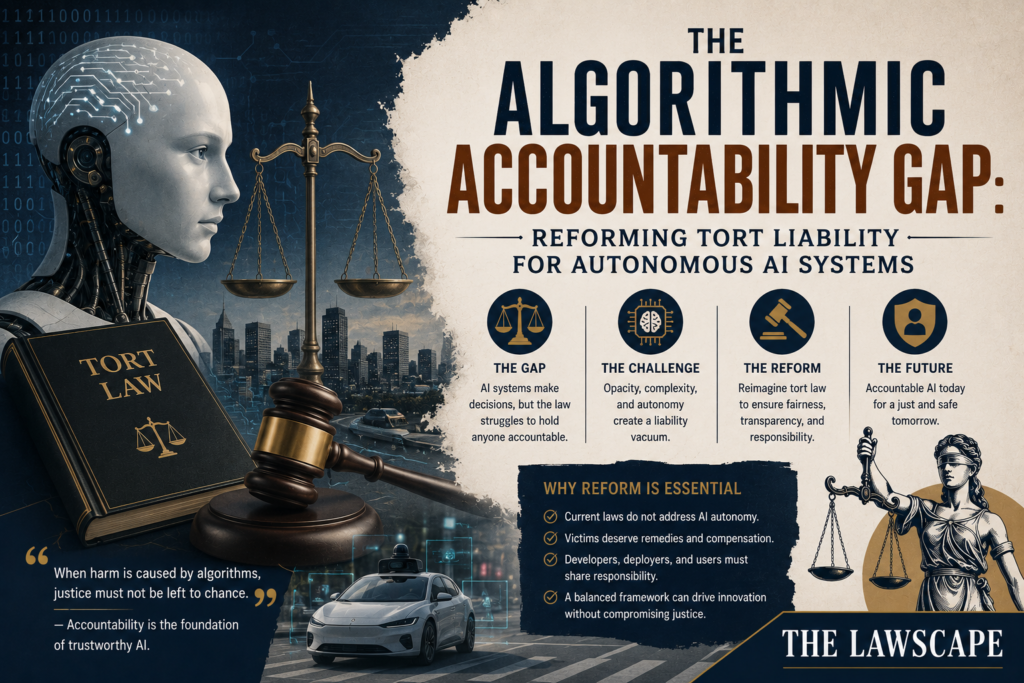
The Algorithmic Accountability Gap: Reforming Tort Liability for Autonomous AI Systems
Author: Justice Beckswhite
Student, University of Jos
———————————————————–
💡 3 Quick Takeaways
- Traditional negligence-based tort principles struggle to address harms caused by autonomous AI systems because opacity and information asymmetry make fault difficult to prove.
- A calibrated strict liability regime for high-risk AI systems would better allocate risk, promote compensation, and incentivize safer design and deployment practices.
- Nigeria can adopt a tiered framework that preserves negligence for low-risk AI while imposing strict liability on high-risk autonomous systems capable of causing significant physical, financial, or civil-rights harms.
Introduction
As artificial intelligence (AI) evolves from a mere assistive technology into a more autonomous decision-making system, traditional tort law faces increasing challenges. Across sectors such as healthcare, finance, transportation, and public administration, AI systems are now making decisions that were previously made by humans. These developments have generated significant efficiency gains, but they have also exposed a growing gap in legal accountability.
Traditional negligence law is structured around identifying a duty of care, a breach of that duty, causation, and resulting damage. This framework assumes that a human actor can be identified and that fault can be meaningfully assessed. Autonomous AI systems challenge these assumptions. When harm occurs, responsibility is often difficult to trace because the system may have learned and evolved through complex interactions with data rather than through direct human instruction.
Victims frequently encounter an accountability vacuum. Developers attribute harm to unpredictable data patterns, deployers rely on vendor assurances, and end-users often have little understanding of the system’s operation. Consequently, no identifiable actor appears responsible despite the existence of genuine harm.
This article argues that negligence-based liability is increasingly inadequate for regulating high-risk autonomous AI systems. Drawing upon principles of product liability, enterprise responsibility, and comparative regulatory developments, it proposes a tiered liability framework under which negligence governs low-risk AI applications while strict liability applies to high-risk autonomous systems. Such an approach would close the algorithmic accountability gap while preserving opportunities for innovation.
The Erosion of Traditional Negligence Standards
Negligence remains the dominant framework through which civil liability is assessed. However, two defining characteristics of modern AI systems significantly undermine its effectiveness.
The Black Box Problem
Many contemporary AI systems, particularly those relying upon deep learning architectures, operate in ways that are difficult to explain even to their developers.
Although an AI system may generate highly accurate outputs, the precise reasoning behind individual decisions is often inaccessible or unintelligible. This phenomenon is commonly referred to as the “black box” problem.
In litigation, this opacity creates serious evidentiary difficulties. Courts traditionally evaluate whether a defendant acted as a reasonable person would have acted in similar circumstances. However, where neither plaintiffs nor defendants can clearly explain why an AI system behaved in a particular way, determining whether reasonable care was exercised becomes exceptionally difficult.
As a result, technological complexity may inadvertently shield defendants from accountability.
Information Asymmetry
AI systems also generate significant information asymmetries.
Ordinary users, patients, consumers, and bystanders generally lack access to:
- Training datasets;
- Model architectures;
- Validation procedures;
- Risk assessments;
- Monitoring systems; and
- Internal safety documentation.
Developers and deployers possess most of the relevant information, while injured parties often have no meaningful means of evaluating whether appropriate safeguards existed.
This imbalance is particularly problematic in negligence litigation, where plaintiffs bear the burden of proving breach.
For example, if a financial technology company deploys an AI fraud-detection system that incorrectly freezes a customer’s account and causes substantial losses, proving negligence may require access to technical information exclusively controlled by the defendant.
The resulting evidentiary imbalance is not incidental but structural.
Why Strict Liability Offers a Better Solution
Where proof of fault becomes systematically difficult despite foreseeable and manageable risks, strict liability provides an alternative framework.
Strict liability shifts the focus away from proving negligence and instead concentrates on whether the defendant introduced a risk-generating system that caused harm.
Product Liability Logic
The rationale for strict liability is well established within product liability jurisprudence.
Manufacturers who introduce products into the marketplace are generally considered better positioned than consumers to:
- Prevent defects;
- Implement safety measures;
- Monitor performance;
- Spread losses through pricing; and
- Obtain insurance coverage.
The same reasoning applies to autonomous AI systems.
Developers and deployers control the design, testing, monitoring, and commercialization of AI technologies. They are therefore better situated than individual victims to manage associated risks.
Where harm arises during the intended or reasonably foreseeable operation of a high-risk AI system, requiring victims to prove negligence may be unnecessary and unjust.
Consumer Protection and Risk Allocation
Strict liability promotes a more equitable allocation of losses.
Rather than forcing injured parties to overcome substantial technical barriers, liability is placed upon those who created, deployed, and profited from the technology.
This approach aligns with broader principles reflected in Nigerian tort and product liability jurisprudence, particularly in contexts involving dangerous products, enterprise responsibility, and activities that create special risks for the public.
Incentivizing Safety
Strict liability also creates powerful incentives for responsible innovation.
Organizations would be encouraged to invest in:
- Data governance systems;
- Robust testing procedures;
- Bias mitigation strategies;
- Post-deployment monitoring;
- Safety audits; and
- Incident reporting mechanisms.
Safety would become an economic necessity rather than a purely regulatory obligation.
Improving Compensation
A strict liability regime significantly enhances access to compensation.
Victims would need to establish:
- The existence of harm;
- A causal connection between the AI system and the harm; and
- The defendant’s role in placing the system into operation.
They would not be required to decode complex algorithms or prove specific failures in software development practices.
Addressing Concerns About Innovation
One of the most frequently raised objections to strict liability is the possibility that it may discourage technological innovation.
Startups and emerging enterprises may argue that increased liability exposure could increase costs and reduce investment incentives.
This concern is legitimate but does not justify rejecting strict liability altogether.
Instead, liability should be calibrated according to risk.
Low-Risk AI Systems
Low-risk AI applications should remain subject to ordinary negligence principles.
Examples include:
- Content recommendation systems;
- Spell-checking tools;
- Basic analytics software; and
- Routine productivity applications.
Failures in these systems typically result in inconvenience rather than substantial harm.
High-Risk AI Systems
Strict liability should apply to systems capable of causing significant injury or rights-based harms.
Potential examples include:
- Autonomous transportation systems;
- Clinical diagnostic systems;
- Medication administration technologies;
- Critical infrastructure controls;
- Biometric identification systems; and
- Automated credit or benefits adjudication systems.
These applications possess the capacity to affect life, liberty, health, financial stability, and civil rights.
Safe Harbours
To avoid discouraging innovation, legislatures may establish safe-harbour mechanisms.
Organizations that comply with recognized safety standards could receive limited protections concerning damages while remaining subject to the underlying strict liability framework.
Possible compliance measures include:
- Regular risk assessments;
- Bias testing;
- Cybersecurity controls;
- Transparency measures; and
- Post-market monitoring obligations.
Such safeguards encourage responsible innovation without eliminating accountability.
Operationalizing Strict Liability in Nigeria
For strict liability to function effectively, clear legislative standards are necessary.
Defining Autonomous AI Systems
A statutory framework should define autonomous AI systems as technologies capable of making and acting upon decisions in real or near real time without direct human confirmation during ordinary operation.
The definition should focus on systems capable of materially affecting:
- Physical safety;
- Financial interests; or
- Legal rights.
Designating High-Risk Categories
Specific categories of high-risk systems should be identified through legislation or delegated regulation.
These categories may be updated periodically to reflect technological developments.
Elements of a Claim
Under a strict liability framework, a plaintiff should establish:
- That the defendant developed, manufactured, or deployed the AI system;
- That the system was used as intended or in a reasonably foreseeable manner;
- That the system caused the harm complained of; and
- That legally recognizable damage occurred.
Proof of breach would not be required.
Limited Defences
Available defences should be narrowly tailored.
Potential defences may include:
- Material modification of the system by a third party;
- Unforeseeable misuse;
- Extraordinary external interference; or
- Superseding criminal acts such as malicious data poisoning.
Ordinary unpredictability should not operate as a defence.
Documentation and Transparency
Developers should maintain:
- Safety documentation;
- Model descriptions;
- Risk assessments;
- Testing records; and
- Monitoring logs.
Where such records are unavailable without good reason, courts should be permitted to draw adverse inferences.
Insurance Requirements
Mandatory insurance obligations could further strengthen the framework.
Risk-based insurance mechanisms would:
- Facilitate compensation;
- Promote risk management; and
- Encourage safer system design.
Causation in an Opaque Technological Environment
Strict liability simplifies proof of breach but does not eliminate the requirement of causation.
Courts will continue to evaluate whether the AI system contributed to the harm.
Material Contribution
Plaintiffs may rely upon:
- System logs;
- Operational records;
- Expert evidence; and
- Technical analyses
to demonstrate that the AI system materially contributed to the injury.
Adapted Res Ipsa Loquitur Principles
Where harm would not ordinarily occur absent system malfunction or defect, courts may infer that the AI system contributed to the injury.
The burden may then shift to defendants to provide evidence rebutting that inference.
Missing Evidence
Where organizations fail to preserve relevant records despite retention obligations, courts should be empowered to presume that the missing evidence would have been unfavourable to the defendant.
Such measures help prevent accountability from being undermined by inadequate documentation practices.
Why Negligence Remains Important
The proposal for strict liability is not a rejection of negligence.
Negligence continues to serve important functions within the legal system.
Low-Risk Technologies
Most ordinary software applications do not warrant strict liability.
Negligence remains an appropriate mechanism for regulating low-risk technologies.
Enhanced Damages
Where plaintiffs establish reckless or negligent conduct in addition to strict liability, courts may consider enhanced remedies where appropriate.
Defining Reasonable Use
Negligence principles remain useful for determining:
- Foreseeable use;
- Adequate warnings;
- Maintenance obligations; and
- Safety expectations.
Consequently, negligence and strict liability should be viewed as complementary rather than competing frameworks.
Comparative Perspectives
Globally, regulators are increasingly embracing risk-based approaches to AI governance.
The European Union’s AI Act imposes more extensive obligations upon high-risk AI systems while subjecting lower-risk technologies to lighter regulatory requirements.
Similarly, ongoing discussions in the United States and the United Kingdom reflect growing recognition that AI-related harms require legal frameworks sensitive to technological risk levels.
Nigeria has the opportunity to adopt a clear and coherent model that combines:
- Product liability principles;
- Enterprise responsibility;
- Risk-based regulation; and
- Insurance-backed compensation mechanisms.
Such clarity could simultaneously promote innovation, attract investment, and strengthen public trust in emerging technologies.
Conclusion
The rapid emergence of autonomous AI systems presents a fundamental challenge to traditional tort law.
Negligence-based frameworks were developed for a world in which human decision-makers could be identified and evaluated. Autonomous AI systems increasingly operate in ways that obscure responsibility and complicate proof of fault.
For high-risk AI applications, strict liability offers a more effective approach. It allocates losses to those best positioned to manage risks, encourages investment in safety, facilitates compensation for victims, and addresses the evidentiary difficulties created by algorithmic opacity.
At the same time, concerns regarding innovation can be addressed through a calibrated framework that preserves negligence for low-risk systems while applying strict liability only where the potential for serious harm is substantial.
Nigeria’s existing jurisprudence concerning defective products, enterprise responsibility, and risk allocation already reflects many of the principles underlying this proposal. Building upon these foundations, a tiered liability framework would provide a practical and balanced response to the challenges posed by autonomous AI.
As society increasingly entrusts critical decisions to algorithms, legal accountability must evolve accordingly. In an era defined by automation, justice requires not only technological innovation but also effective mechanisms for assigning responsibility when innovation causes harm.
Disclaimer: The views expressed in this article are those of the author and do not necessarily reflect the views of The Lawscape.
The Lawscape — clear, practical legal insight for students and future lawyers.