
Uniform Civil Code in India: A Constitutional Necessity or a Challenge to India’s Diversity?
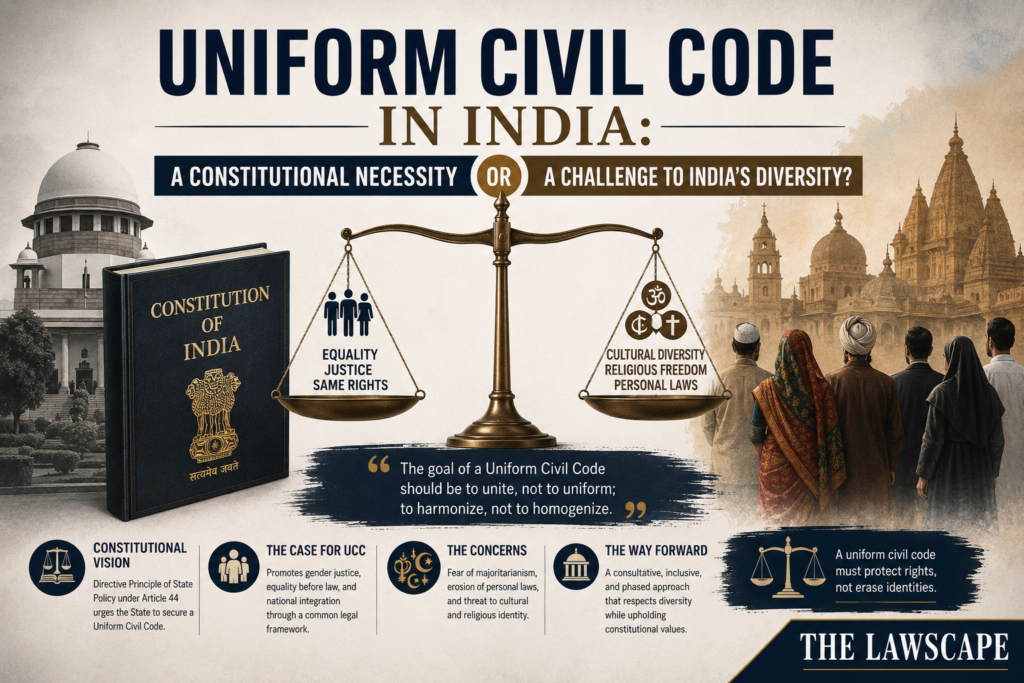
Author: Sanskriti Mishra
Student, NIMS School of Law, NIMS University, Jaipur
———————————————————————————————————
💡 3 Quick Takeaways
- The Uniform Civil Code (UCC) seeks to establish a common set of civil laws for all citizens and is rooted in Article 44 of the Constitution.
- Supporters view the UCC as a means to promote equality, gender justice, and national integration, while critics fear it may undermine cultural diversity and religious freedom.
- The constitutional challenge lies not in choosing between equality and diversity, but in reconciling both within India’s pluralistic democratic framework.
Introduction
The debate surrounding the Uniform Civil Code (UCC) remains one of the most contested issues in Indian constitutional discourse. Supporters argue that a common civil code is necessary to advance equality, gender justice, and national integration. Critics, however, contend that such a measure may threaten India’s pluralistic identity and interfere with constitutionally protected religious freedoms.
India is a culturally diverse nation where personal laws governing marriage, divorce, inheritance, adoption, and succession differ across religious communities. While criminal law applies uniformly to all citizens, personal laws continue to be regulated by religion-specific legal frameworks. The idea of a Uniform Civil Code seeks to replace these diverse personal laws with a common set of civil rules applicable to all citizens irrespective of religion.
The constitutional basis for the UCC is found in Article 44 of the Constitution, which directs the State to endeavour to secure a Uniform Civil Code throughout the territory of India. At the same time, the Constitution guarantees freedom of religion and cultural autonomy through Articles 25, 26, and 29. The resulting tension between constitutional equality and cultural diversity lies at the heart of the UCC debate.
Recent developments, particularly the implementation of a Uniform Civil Code framework in Uttarakhand, have reignited public and political discussions regarding India’s readiness for a unified civil law regime. While some view the move as a step toward greater equality and legal consistency, others fear it may adversely affect minority rights and cultural identities.
This article examines the historical foundations of personal laws in India, the constitutional framework surrounding the UCC, judicial interpretations, arguments both supporting and opposing its implementation, and the practical challenges associated with legal uniformity in a diverse society.
Historical Background of Personal Laws in India
The origins of India’s contemporary personal law system can largely be traced to the colonial period.
During British rule, criminal laws were standardized across territories, but matters concerning family relations and religion were generally left to be governed by community-specific personal laws. The colonial administration largely avoided interference in religious and family matters in order to prevent social unrest and religious resistance. As a result, distinct legal systems developed for Hindus, Muslims, Christians, Parsis, and other communities in areas such as marriage, inheritance, guardianship, and succession.
Following independence, the Indian government undertook significant reforms of Hindu personal laws through the Hindu Code Bills of the 1950s. These reforms modernized laws relating to marriage, inheritance, adoption, and guardianship. However, comparable reforms were not introduced across all personal law systems.
This uneven approach contributed to demands for a Uniform Civil Code. Many believed that a secular republic should ultimately move toward a common legal framework applicable to all citizens rather than maintaining separate personal laws based on religion.
At the same time, minority communities expressed concerns that a uniform code could undermine religious identity and cultural autonomy. These concerns significantly influenced the Constituent Assembly’s decision to place the Uniform Civil Code within the Directive Principles of State Policy rather than among the enforceable Fundamental Rights.
Constitutional Framework and the UCC Debate
The constitutional debate surrounding the Uniform Civil Code primarily concerns the relationship between Directive Principles of State Policy and Fundamental Rights.
Article 44 and the Directive Principles
Article 44 provides that:
“The State shall endeavour to secure for the citizens a uniform civil code throughout the territory of India.”
Although Directive Principles are not enforceable in courts, they serve as important constitutional goals intended to guide legislative and policy development.
Supporters of the UCC argue that Article 44 reflects the constitutional vision of legal uniformity and equal citizenship.
Fundamental Rights and Cultural Diversity
In contrast, Articles 25 and 26 guarantee freedom of religion and the right to manage religious affairs, while Article 29 protects the cultural and educational rights of minorities.
Critics argue that any attempt to impose a common civil framework must account for these constitutional protections.
The debate therefore raises a fundamental question: should personal laws be regarded as religious practices deserving constitutional protection, or as secular legal arrangements that may legitimately be reformed by the State?
Equality and Constitutional Morality
Supporters frequently invoke Article 14, which guarantees equality before the law.
They argue that separate personal laws sometimes result in unequal treatment, particularly in matters involving:
- Inheritance;
- Divorce;
- Maintenance;
- Guardianship; and
- Property rights.
From this perspective, a Uniform Civil Code would promote substantive equality and strengthen constitutional morality.
However, opponents contend that equality does not necessarily require complete uniformity. India’s constitutional framework accommodates diversity in language, culture, customs, and tribal traditions. Legal pluralism, therefore, need not be viewed as inherently inconsistent with constitutional values.
Judicial Approach Towards the Uniform Civil Code
The Indian judiciary has repeatedly addressed the issue of personal law reform and the desirability of a Uniform Civil Code.
Mohd. Ahmed Khan v. Shah Bano Begum
One of the most significant decisions in this area was Mohd. Ahmed Khan v. Shah Bano Begum.
The Supreme Court granted maintenance rights to a divorced Muslim woman under Section 125 of the Criminal Procedure Code and observed that a Uniform Civil Code could help promote national integration by reducing contradictions arising from diverse personal law systems.
The decision generated considerable political controversy and eventually led to the enactment of the Muslim Women (Protection of Rights on Divorce) Act, 1986.
Sarla Mudgal v. Union of India
In Sarla Mudgal v. Union of India, the Supreme Court examined situations where Hindu men converted to Islam solely for the purpose of contracting second marriages without dissolving existing marriages.
The Court criticized such misuse of personal laws and once again emphasized the desirability of a Uniform Civil Code.
Shayara Bano v. Union of India
In Shayara Bano v. Union of India, the Supreme Court declared the practice of instant triple talaq unconstitutional.
The judgment strengthened arguments favouring reform of personal laws to ensure compliance with constitutional principles of equality and gender justice.
Despite repeatedly encouraging reform, the judiciary has consistently recognized that implementation of the Uniform Civil Code remains a matter for legislative action and public consensus rather than judicial imposition.
Arguments Supporting the Uniform Civil Code
Equality Before Law
One of the strongest arguments in favour of the UCC is that legal rights should not vary based on religious affiliation.
Supporters argue that all citizens should receive equal legal protection regardless of community membership. Since personal laws often prescribe different rules governing family matters, a common legal framework would better realize the constitutional guarantees contained in Articles 14 and 15.
Gender Justice
Advocates of the UCC frequently emphasize its potential contribution to gender equality.
Certain personal law provisions relating to inheritance, maintenance, divorce, and succession have historically been criticized for disadvantaging women.
The decisions in Shah Bano and Shayara Bano are often cited as examples demonstrating the need to align personal laws with constitutional values of dignity and equality.
Supporters argue that constitutional rights should not be compromised merely because discriminatory practices are embedded within religious or customary traditions.
National Integration
Another argument is that a common civil framework may strengthen national integration.
Separate personal laws can create legal fragmentation and reinforce social divisions. A unified legal structure may promote a stronger sense of common citizenship by emphasizing constitutional identity over communal distinctions.
Simplification of Laws
India’s personal law system is often viewed as complex and fragmented.
Different legal regimes governing similar issues can create confusion and complicate dispute resolution. A Uniform Civil Code could simplify administration and improve consistency in the application of civil laws.
Arguments Against the Uniform Civil Code
Threat to Cultural Diversity
Opposition to the UCC is largely rooted in concerns regarding cultural autonomy.
Personal laws are deeply intertwined with religious beliefs, customs, traditions, and community identity. Many minority communities fear that a uniform code could ultimately reflect the practices of the majority rather than a genuinely neutral framework.
Religious Freedom
Critics argue that personal laws form an important part of religious practice protected under Article 25 of the Constitution.
Excessive state intervention in family and personal matters may therefore undermine constitutionally protected freedoms relating to religion and cultural identity.
This concern is particularly significant in a society where religious practices often overlap with social and familial customs.
Political Misuse
Another criticism concerns the political nature of the UCC debate.
Many observers argue that discussions surrounding the Uniform Civil Code are frequently influenced by electoral considerations rather than genuine commitment to legal reform.
As a result, certain communities view the issue with suspicion and question the motivations underlying calls for implementation.
Uniformity Does Not Necessarily Ensure Justice
Opponents further contend that legal uniformity does not automatically produce substantive equality.
India’s social structure is characterized by immense diversity, including distinct regional, tribal, and customary practices. A single legal framework may not adequately accommodate these differences.
The Law Commission of India, in its 2018 Consultation Paper on Family Law Reform, concluded that a Uniform Civil Code was neither necessary nor desirable at that stage. Instead, it recommended targeted reforms aimed at eliminating discriminatory practices within existing personal law systems.
Recent Developments and Practical Concerns
The implementation of the Uniform Civil Code framework in Uttarakhand has revived national discussion regarding its feasibility and implications.
Supporters view the initiative as a significant step toward constitutional equality and legal uniformity. Critics, however, have raised concerns regarding implementation, privacy, and state regulation of personal relationships.
Particular attention has been directed toward provisions concerning the registration of live-in relationships. Some legal scholars have argued that excessive state involvement in personal relationships may affect individual autonomy and privacy.
Questions also remain regarding the application of a uniform code to India’s diverse tribal communities, regional customs, and traditional practices.
The debate has therefore moved beyond theoretical constitutional discussions and entered the realm of active governance and legislative experimentation.
Critical Analysis
The Uniform Civil Code debate is frequently portrayed as a conflict between constitutional morality and traditional personal laws.
Such a characterization oversimplifies the issue.
There is little doubt that personal laws should evolve where they conflict with constitutional values of dignity, equality, and justice. Constitutional rights cannot be subordinated indefinitely to discriminatory practices merely because they are socially accepted.
At the same time, reform within a culturally diverse society cannot succeed if it is perceived as coercive or insensitive to community identities.
India’s constitutional democracy derives much of its strength from its pluralistic character. Consequently, legal reform must seek to reconcile equality with cultural autonomy rather than treating them as mutually exclusive values.
A gradual reform-oriented approach may therefore be more practical than an immediately imposed uniform framework. Progressive reform of personal laws, combined with broader public consultation and consensus-building, may facilitate constitutional transformation while preserving social trust.
Ultimately, the legitimacy of any legal reform depends not only upon constitutional justification but also upon public confidence in its fairness and inclusiveness.
Conclusion
The Uniform Civil Code remains one of the most complex constitutional questions confronting contemporary India.
The debate engages multiple constitutional principles simultaneously, including equality, secularism, religious freedom, gender justice, and cultural autonomy. Supporters view the UCC as a necessary step toward equal citizenship, legal consistency, and protection of women’s rights. Opponents fear that it may undermine India’s cultural diversity and minority protections.
Both concerns derive legitimacy from constitutional values.
India undoubtedly requires continuous legal reform to ensure that constitutional rights are not compromised by discriminatory practices. However, such reform must also respect the pluralistic foundations of Indian democracy.
The objective of constitutional governance should not merely be legal uniformity. Rather, it should be the preservation of dignity, equality, inclusiveness, and justice within a diverse constitutional framework.
The future of the Uniform Civil Code should therefore be guided by dialogue, gradual reform, constitutional principles, and broad public participation rather than political expediency alone.
Ultimately, the debate is not about choosing between equality and diversity. It is about ensuring that both values coexist harmoniously within India’s constitutional order.
Disclaimer: The views expressed in this article are those of the author and do not necessarily reflect the views of The Lawscape.
The Lawscape — clear, practical legal insight for students and future lawyers.