
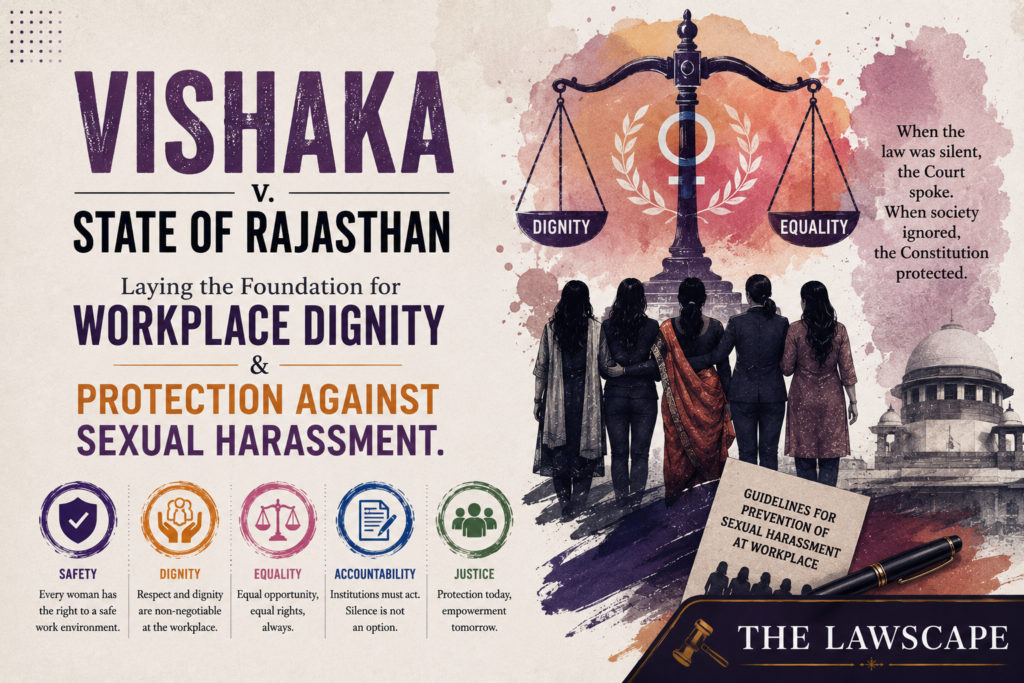
Vishaka v. State of Rajasthan: Laying the Foundation for Workplace Dignity and Protection Against Sexual Harassment
Author: Anjel Shristi Minz
Student, Viniba Bhave University, University Law College, Hazaribagh, Jharkhand
💡 3 Quick Takeaways
1. Vishaka v. State of Rajasthan recognised sexual harassment at the workplace as a violation of women’s fundamental rights under Articles 14, 15, 19(1)(g), and 21 of the Constitution.
2. In the absence of a specific statutory framework, the Supreme Court framed the Vishaka Guidelines to prevent and redress workplace sexual harassment.
3. The judgment became the foundation for the Sexual Harassment of Women at Workplace (Prevention, Prohibition and Redressal) Act, 2013, and remains a landmark in gender justice jurisprudence.
Introduction
Vishaka v. State of Rajasthan is a landmark judgment in Indian constitutional and gender justice jurisprudence. The decision is widely regarded as a turning point in the legal recognition of workplace sexual harassment as a violation of women’s fundamental rights. The case emerged from the brutal gang rape of Bhanwari Devi, a grassroots-level social worker in Rajasthan, and exposed the absence of an effective legal mechanism to protect women from sexual harassment and gender-based violence in workplaces.
In response to this legislative vacuum, the Supreme Court of India stepped in and laid down the celebrated Vishaka Guidelines, which were to operate as binding law until Parliament enacted specific legislation. The case is therefore significant not only because it acknowledged workplace sexual harassment as a constitutional issue, but also because it demonstrated the Court’s proactive role in protecting women’s rights through judicial innovation.
Case Details
Case: Vishaka & Ors. v. State of Rajasthan & Ors.
Citation: (1997) Supreme Court 3011
Court: Supreme Court of India
Bench: Justice J.S. Verma, Justice Sujata V. Manohar, and Justice B.N. Kirpal
Date of Judgment: 13 August 1997
Parties: Petitioners – Vishaka & Ors.; Respondents – State of Rajasthan & Ors.
Facts of the Case
The writ petition in Vishaka v. State of Rajasthan was filed under Article 32 of the Constitution as a class action by certain social activists and non-governmental organisations. The immediate cause behind the petition was the horrifying incident involving Bhanwari Devi, a woman employed under the Women’s Development Programme initiated by the Government of Rajasthan.
Bhanwari Devi belonged to Bhateri village in Rajasthan and worked as a grassroots social worker. Her role involved spreading awareness against harmful social practices such as child marriage and promoting gender equality in her rural community. In 1992, while attempting to prevent the marriage of a one-year-old girl from a dominant Gurjar family, she faced severe hostility and resistance from the local community. As a consequence, she was ostracised, financially boycotted, and publicly humiliated.
Subsequently, on 22 September 1992, she was allegedly gang-raped by five men from the Gujjar community. The aftermath of the incident revealed a deeply insensitive and negligent institutional response. The police delayed the investigation, her medical examination was conducted after more than fifty hours, and important findings were omitted from the medical report. Despite the gravity of the offence, the trial court acquitted all the accused on the ground of lack of evidence and procedural technicalities. Bhanwari Devi did not receive justice from the Rajasthan High Court either, and the accused were allowed to go free.
The verdict was widely condemned as a gross miscarriage of justice. It also exposed the inadequacy of the existing legal framework in addressing sexual harassment and violence against women. This led several women’s groups, NGOs, social activists, and legal professionals to approach the Supreme Court under the collective platform of Vishaka. They filed a Public Interest Litigation under Article 32, seeking the enforcement of women’s fundamental rights in the workplace.
The petitioners brought to the attention of the Supreme Court the absence of domestic law dealing specifically with workplace sexual harassment and sought effective measures to address the issue. They invoked Articles 14, 15, 19(1)(g), and 21 of the Constitution, arguing that women were entitled to a workplace free from sexual harassment, discrimination, and threats to dignity and life.
Issues Arising
The principal issue before the Court was the existence of a legislative vacuum in relation to workplace sexual harassment and the health and safety of women at work. The case raised the broader constitutional concern of whether women’s equality and dignity could be meaningfully protected in the absence of a specific legal framework.
The three-judge Bench identified the following constitutional questions:
- Whether the non-enactment of a law concerning sexual harassment at the workplace amounted to an infringement of the fundamental rights of women guaranteed under Articles 14, 15, 19(1)(g), and 21 of the Constitution of India.
- Whether the Supreme Court had the jurisdiction under Article 32 of the Constitution to issue binding guidelines on sexual harassment pending the enactment of legislation by Parliament.
- Whether international conventions such as the Convention on the Elimination of All Forms of Discrimination Against Women (CEDAW), ratified by India, could be incorporated into Indian law in the absence of domestic legislation.
Arguments of the Parties
Appellants – Vishaka & Ors.
The petitioners contended that sexual harassment of women at the workplace violated the fundamental rights guaranteed under Articles 14, 15, 19(1)(g), and 21 of the Constitution. They argued that the absence of a legal framework ensuring a safe working environment for women exposed a serious lacuna in the law. This lack of protection not only made workplaces unsafe but also hindered women from pursuing employment and living a meaningful life with dignity.
The petitioners urged the Court to frame guidelines for the prevention of sexual harassment at workplaces. They further argued that India, having ratified the Convention on the Elimination of All Forms of Discrimination Against Women (CEDAW), was under an obligation to adopt legal and institutional measures to eliminate gender discrimination and workplace sexual harassment.
The petitioners also emphasised that Bhanwari Devi was not an isolated victim. Many women suffered similar abuse but refrained from complaining because of fear, stigma, and social pressure. Reliance was placed on international principles and comparative jurisprudence to support the proposition that where there is a lacuna in domestic law, courts may draw upon international conventions so long as they are not inconsistent with fundamental rights under Part III of the Constitution. The petitioners therefore sought judicial intervention to safeguard women’s rights and secure a safer work environment.
Respondents – State of Rajasthan
Interestingly, the learned Solicitor General appearing for the respondents, with their consent, supported the petitioners’ case. The respondents assisted the Court in exploring effective measures to curb workplace sexual harassment and in structuring a set of preventive guidelines. The Court was also assisted by Fali S. Nariman as amicus curiae, along with Ms. Naina Kapur and Ms. Meenakshi.
The respondents suggested that States should include information in their reports regarding sexual harassment and the measures adopted to protect women from such acts and from other forms of violence occurring at workplaces.
Judgment
The Supreme Court delivered a historic judgment and laid down guidelines to be followed by employers and institutions in dealing with complaints of sexual harassment at the workplace. These came to be known as the Vishaka Guidelines. The Court made it clear that the guidelines would operate as binding law until suitable legislation was enacted by Parliament.
The Court held that sexual harassment at the workplace amounts to a violation of the fundamental rights of women under Articles 14, 15, 19(1)(g), and 21 of the Constitution. It recognised that the right to work with dignity, free from sexual harassment, is part of the constitutional guarantee of equality, non-discrimination, liberty, and life with dignity.
The Vishaka Guidelines filled the legislative vacuum and later formed the basis of the Sexual Harassment of Women at Workplace (Prevention, Prohibition and Redressal) Act, 2013.
Vishaka Guidelines
The Supreme Court laid down the following key guidelines:
- Duty of the Employer: Employers and heads of institutions have the primary responsibility to prevent sexual harassment and provide procedures for the resolution, settlement, or prosecution of such acts.
- Definition of Sexual Harassment: Sexual harassment includes unwelcome sexually determined behaviour such as physical contact and advances, demands or requests for sexual favours, sexually coloured remarks, showing pornography, and any other unwelcome physical, verbal, or non-verbal conduct of a sexual nature.
- Preventive Steps: Employers must take preventive measures to ensure a safe working environment and provide appropriate working conditions in respect of health, hygiene, and leisure.
- Criminal Proceedings: Where the conduct amounts to an offence under the Indian Penal Code, the employer must initiate appropriate action by making a complaint to the competent authority.
- Disciplinary Action: Rules and regulations governing employment in both public and private sectors must prohibit sexual harassment and prescribe suitable penalties for offenders.
- Complaints Mechanism: Every organisation must establish an effective and time-bound complaints mechanism for redressal.
- Complaints Committee: The complaints committee must be headed by a woman, and at least half of its members must be women. To ensure impartiality, it should also include a third-party member from an NGO or a body familiar with the issue of sexual harassment.
- Workers’ Initiative: Employees must be allowed to raise issues of sexual harassment in workers’ meetings and employer-employee forums.
- Awareness: Employers must create awareness of women’s rights by prominently displaying and circulating the guidelines.
- Third-Party Harassment: Where harassment is caused by a third party or outsider, the employer must assist the affected woman in terms of support and preventive action.
These judicial guidelines were subsequently codified in 2013 through the enactment of the Sexual Harassment of Women at Workplace (Prevention, Prohibition and Redressal) Act.
The Sexual Harassment at Workplace Act, 2013
The Sexual Harassment of Women at Workplace (Prevention, Prohibition and Redressal) Act, 2013 marked a major legal advancement, coming seventeen years after the Vishaka judgment. Commonly referred to as the POSH Act, its principal objective is to promote gender equality and ensure a safe working environment for women.
The Act provides a broader definition of an “aggrieved woman,” covering women of all ages and employment statuses. It applies to both organised and unorganised sectors and extends to a wide range of workplaces. The Act is rooted in the Vishaka Guidelines and gives statutory recognition to the principles evolved by the Supreme Court.
The legislation mandates that establishments employing ten or more persons must constitute an Internal Complaints Committee (ICC), headed by a senior woman employee and including an external member to ensure impartiality, along with other members. In workplaces with fewer than ten employees, or where the complaint is against the employer, a Local Complaints Committee (LCC) is to be constituted to ensure access to redressal, especially in the unorganised sector.
Conclusion / Observation
Sexual harassment of women at the workplace remains a serious concern in India. If strong and effective action is not taken, it directly affects women’s participation in the workforce and, consequently, the nation’s economic and social development. In Vishaka, the Supreme Court upheld the constitutional values of equality, liberty, and dignity, and acknowledged that women are entitled to work in an environment free from sexual harassment.
The Vishaka judgment was a pioneering intervention because, in the absence of legislation, the Court created a framework that recognised sexual harassment as a constitutional wrong and imposed duties on employers and institutions. It also inspired women to speak up against workplace abuse that had long been suffered in silence. Eventually, the Sexual Harassment of Women at Workplace (Prevention, Prohibition and Redressal) Act, 2013 was enacted and came into force on 23 April 2013 through its publication in the Gazette of India.
However, the enactment of legislation alone is not sufficient. Effective implementation at the grassroots level, especially in rural areas, remains essential. Awareness must be created not only among women employees but also among employers, institutions, and society at large. It should not be the duty of the government alone to address workplace sexual harassment; organisations and institutions must also adopt concrete strategies and preventive mechanisms to protect women employees.
The broader objective behind such protections is not merely compliance with the law, but the realisation of gender equality, dignity, and fairness in the workplace. Vishaka therefore remains a foundational judgment in Indian legal history, both for its immediate contribution to women’s workplace rights and for its long-term influence on the development of gender justice jurisprudence.
Disclaimer: The views expressed in this article are those of the author and do not necessarily reflect the views of The Lawscape.
The Lawscape — clear, practical legal insight for students and future lawyers.