
Navtej Singh Johar v. Union of India: Constitutional Morality, Dignity, and the Decriminalisation of Same-Sex Relations
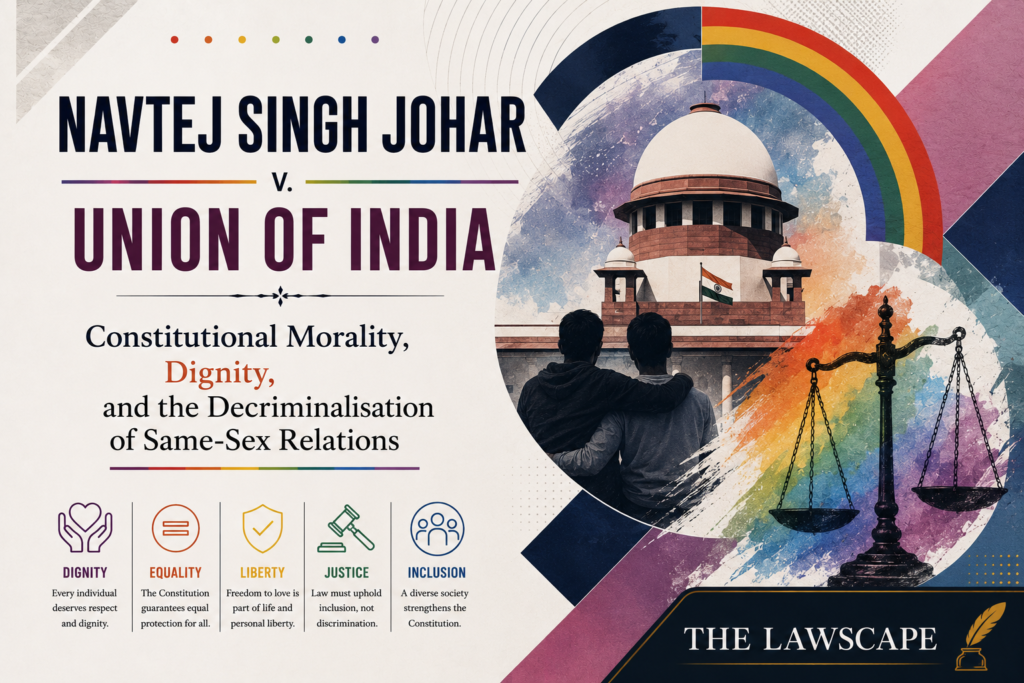
Author: Bhavya Suman
Student, Llyod law college
———————————————————–
💡 3 Quick Takeaways
1. Navtej Singh Johar v. Union of India partially struck down Section 377 of the Indian Penal Code by decriminalising consensual same-sex relations between adults in private.
2. The Supreme Court grounded its ruling in Articles 14, 15, 19, and 21, recognising dignity, privacy, autonomy, and equality as central constitutional protections for LGBTQ+ persons.
3. The judgment overruled Suresh Kumar Koushal v. Naz Foundation and became a foundational precedent for LGBTQ+ rights and transformative constitutionalism in India.
Introduction
Navtej Singh Johar v. Union of India (2018) is one of the most transformative constitutional judgments in Indian legal history. In this case, the Supreme Court examined the constitutional validity of Section 377 of the Indian Penal Code, a colonial-era provision that criminalised consensual homosexual relations between adults. The judgment marked a significant shift towards the protection of individual dignity, privacy, equality, and sexual autonomy under the Constitution of India.
This landmark judgment represents a defining moment in the evolution of LGBTQ+ rights in India. By decriminalising consensual sexual conduct among adults, including homosexual acts, the decision marked the emergence of a more inclusive interpretation of constitutional freedoms. It is considered a landmark step in recognising constitutional morality, transformative constitutionalism, and human dignity. The decision not only overruled the earlier judgment in Suresh Kumar Koushal v. Naz Foundation but also strengthened the jurisprudence relating to privacy and personal liberty developed in Justice K.S. Puttaswamy v. Union of India. The case therefore holds immense importance in the development of human rights and constitutional law in India.
Historical Background
Section 377 of the Indian Penal Code was a colonial-era provision that criminalised “carnal intercourse against the order of nature” and prescribed punishment for certain sexual acts. Historically, this provision was used not only against homosexual conduct but also extended to a wider range of acts, including anal and oral sex, even among opposite-sex couples. Despite its broad wording, the practical impact of Section 377 was felt most severely by sexual minorities, especially persons in same-sex relationships.
Earlier, the Delhi High Court in Naz Foundation v. Government of NCT of Delhi (2009) had declared Section 377 unconstitutional insofar as it criminalised consensual same-sex relations between adults. The High Court held that such criminalisation violated Articles 14, 15, and 21 of the Constitution and recognised the rights to dignity, privacy, and equality of homosexual individuals.
However, this decision was later overruled by the Supreme Court in Suresh Kumar Koushal v. Naz Foundation (2013). In that case, the Court observed that the LGBTQ+ community constituted only a small section of society and held that it was for the legislature to decide whether the law should be amended. The judgment was widely criticised by human rights activists, scholars, and constitutional experts for failing to adequately protect fundamental rights.
A major constitutional development took place in Justice K.S. Puttaswamy v. Union of India (2017), where the Supreme Court recognised the right to privacy as a fundamental right under Article 21 of the Constitution. The judgment also acknowledged that sexual orientation is an essential attribute of privacy, dignity, and individual autonomy. This created a strong constitutional foundation for reconsidering the validity of Section 377.
Against this background, several petitioners, including dancer Navtej Singh Johar, approached the Supreme Court challenging the constitutional validity of Section 377 insofar as it criminalised consensual sexual relationships between adults of the same sex.
The Petition and Petitioners
On 27 April 2016, five prominent citizens filed a writ petition before the Supreme Court of India challenging the validity of Section 377. The petitioners included Navtej Singh Johar, Sunil Mehra, Ritu Dalmia, Aman Nath, Keshav Suri, and Ayesha Kapur. They argued that Section 377, in its application to consensual sexual acts between adults, infringed the fundamental rights guaranteed under the Constitution of India. According to them, the criminalisation of same-sex intimacy was not merely a misinterpretation of societal morality but also a direct violation of personal liberty, dignity, and equality.
Facts of the Case
A writ petition was filed on 26 April 2016 by Navtej Singh Johar, a dancer from the LGBTQ+ community, along with other petitioners, challenging the constitutional validity of Section 377 of the IPC. The provision criminalised “carnal intercourse against the order of nature” and had historically been used to penalise consensual homosexual relationships between adults. The petitioners sought recognition of the “right to sexuality,” the “right to sexual autonomy,” and the “right to choose a sexual partner” as integral components of the right to life guaranteed under Article 21 of the Constitution. They also prayed that Section 377 be declared unconstitutional.
The challenge came after a long judicial history. In July 2009, the Delhi High Court in Naz Foundation v. Government of NCT of Delhi partially decriminalised consensual same-sex relations between adults. However, the Supreme Court reversed that position in Suresh Kumar Koushal v. Naz Foundation (2013), restoring the validity of Section 377. It was in this constitutional setting that the petitioners approached the Supreme Court under Article 32, contending that Section 377 violated Articles 14, 15, 19, and 21 of the Constitution.
Issues Before the Court
The principal issues before the Court were as follows:
- Whether Section 377 IPC, to the extent that it criminalised consensual sexual conduct between adults of the same sex in private, violated Articles 14, 15, 19, and 21 of the Constitution.
- Whether discrimination on the ground of sexual orientation is encompassed within the prohibition of discrimination on the ground of “sex” under Article 15.
- Whether the doctrine of constitutional morality required reading down or striking down Section 377.
- Whether the decision in Suresh Kumar Koushal v. Naz Foundation required reconsideration or continued to be good law.
Arguments of the Parties
Petitioners’ Arguments
The petitioners argued that sexual orientation is a natural and inherent aspect of an individual’s identity. Therefore, discrimination on the basis of sexual orientation violates the constitutional guarantees of equality under Articles 14 and 15. It was further contended that consensual adult intimacy in private lies at the core of autonomy, dignity, and privacy protected under Article 21, and that criminalising such conduct also has a chilling effect on free expression under Article 19(1)(a).
They also argued that the phrase “carnal intercourse against the order of nature” is manifestly arbitrary, vague, and capable of misuse. According to the petitioners, the criminalisation of same-sex relationships created social stigma, fear, discrimination, and barriers to healthcare for LGBTQ+ individuals, while simultaneously exposing them to harassment and abuse.
The petitioners further submitted that Suresh Kumar Koushal v. Naz Foundation was inconsistent with later constitutional developments, particularly NALSA v. Union of India and Justice K.S. Puttaswamy v. Union of India.
Respondent – Union of India
The Union Government did not strongly oppose the petition in relation to consensual sexual relations between adults in private and largely left the matter to the wisdom of the Supreme Court. At the same time, it submitted that if wider questions relating to civil rights and constitutional policy were to be considered, the Government should be permitted to file a detailed affidavit.
Certain intervenors, including religious and social organisations, opposed the decriminalisation of Section 377. They argued that the provision was necessary to preserve public morality and traditional social values. It was also contended that fundamental rights are subject to reasonable restrictions and that any change in the law should be made by Parliament rather than through judicial interpretation.
Court’s Reasoning and Analysis
The case was decided by a five-judge Constitution Bench, which adopted a transformative constitutional approach while examining the validity of Section 377. The Court observed that homosexuality and bisexuality are natural variations of human sexuality and that they should not be treated as disorders or abnormalities.
The Supreme Court held that Section 377 violated Article 14 because the provision was arbitrary and created unreasonable discrimination on the basis of sexual orientation. The Bench further interpreted the term “sex” under Article 15 broadly to include sexual orientation, thereby holding that discrimination against LGBTQ+ persons is constitutionally prohibited.
Relying on Justice K.S. Puttaswamy v. Union of India, the Court recognised that privacy, dignity, and personal autonomy are essential aspects of Article 21. Criminalisation of consensual same-sex relationships was therefore held to be unconstitutional. The Court also observed that Section 377 suppressed the ability of LGBTQ+ persons to express their identity, form relationships, and engage in intimacy, without satisfying any valid ground under Article 19(2).
Emphasising the principle of constitutional morality, the Court stated that constitutional rights cannot be denied merely because a section of society disapproves of a particular identity or lifestyle. The Bench overruled Suresh Kumar Koushal v. Naz Foundation and held that constitutional interpretation must protect minority rights and human dignity. At the same time, the Court clarified that Section 377 would continue to apply to non-consensual acts, acts involving minors, and bestiality.
Ratio Decidendi
The Supreme Court held that consensual sexual relationships between adults fall within the sphere of privacy, dignity, autonomy, and personal liberty protected under Articles 14, 15, 19, and 21 of the Constitution. It recognised that sexual orientation is an intrinsic part of identity and that discrimination on this basis is unconstitutional. The Court further held that constitutional morality must prevail over social or public morality. Consequently, Section 377 IPC was declared unconstitutional to the extent that it criminalised consensual same-sex relations between adults.
Judgment
The Supreme Court held that Section 377 IPC is unconstitutional insofar as it criminalised consensual sexual conduct between adults, irrespective of sexual orientation or gender. However, the provision remains valid for non-consensual acts, acts involving minors, and bestiality. The decision in Suresh Kumar Koushal v. Naz Foundation was overruled, and the petitions were allowed.
Implications
The judgment recognised LGBTQ+ persons as full and equal citizens entitled to the protection of Articles 14, 15, 19, and 21 of the Constitution. It prioritised constitutional morality over shifting public morality and significantly strengthened Indian jurisprudence on privacy, dignity, and anti-discrimination.
The Court also imposed a broader responsibility upon the State and society to eliminate stigma, ensure equal access to healthcare, and sensitise public institutions and officials towards the concerns of the LGBTQ+ community. Although the case did not directly adjudicate upon questions of marriage, inheritance, adoption, or succession, it laid a strong constitutional foundation for future claims concerning the civil rights of homosexual persons.
Critical Analysis
The decision in Navtej Singh Johar v. Union of India is widely regarded as one of the most progressive constitutional judgments delivered by the Supreme Court of India. It reaffirmed the principles of equality, dignity, privacy, and individual autonomy by recognising that sexual orientation is an intrinsic aspect of human identity. By striking down the discriminatory application of Section 377 IPC, the Court corrected a historical injustice faced by the LGBTQ+ community.
One of the greatest strengths of the judgment is its emphasis on constitutional morality over societal morality. The Court rightly held that fundamental rights cannot be denied merely because a particular group constitutes a minority or because its choices are not accepted by the majority. This approach significantly strengthens the protection of minority rights under the Constitution.
The judgment also reflects the influence of transformative constitutionalism. It interpreted the Constitution as a living document capable of responding to changing social realities and ensuring equal protection for all citizens. The decision further strengthened the jurisprudence developed in Justice K.S. Puttaswamy v. Union of India regarding privacy and personal liberty.
Although the judgment laid a strong constitutional foundation for future claims relating to marriage equality, adoption, inheritance, and succession rights of LGBTQ+ persons, these issues were not directly adjudicated upon by the Court. The decision was primarily confined to the decriminalisation of consensual same-sex relationships and the protection of dignity, privacy, and equality under the Constitution. Therefore, while the judgment marked a significant step towards LGBTQ+ rights, the realisation of several civil and family rights continues to depend upon future judicial interpretation and legislative reform.
Overall, the judgment represents a landmark advancement in constitutional law and human rights jurisprudence in India. It not only restored the dignity of LGBTQ+ individuals but also reaffirmed the Constitution’s commitment to equality, liberty, privacy, and inclusiveness.
Conclusion
Navtej Singh Johar v. Union of India (2018) is a landmark judgment in Indian constitutional jurisprudence that reaffirmed the values of equality, dignity, privacy, and individual autonomy. By partially striking down Section 377 IPC, the Supreme Court recognised that consensual same-sex relationships between adults are entitled to constitutional protection. The judgment corrected a longstanding historical injustice and strengthened the principles of constitutional morality and transformative constitutionalism.
Although it did not directly resolve issues relating to marriage, adoption, succession, or other civil rights of LGBTQ+ persons, it laid an important constitutional foundation for future developments in this area. The decision remains a significant milestone in the protection of human rights and the advancement of an inclusive and democratic society in India.
Disclaimer: The views expressed in this article are those of the author and do not necessarily reflect the views of The Lawscape.
The Lawscape — clear, practical legal insight for students and future lawyers.