
Carlill v. Carbolic Smoke Ball Co.: Unilateral Offers, Acceptance by Performance, and the Binding Force of Advertisements
Author: Amandeep Kaur
Student, University of Nicosia, Nicosia
————————————————————————————
💡 3 Quick Takeaways
1. Carlill v. Carbolic Smoke Ball Co. is a landmark contract law case establishing that an advertisement can amount to a binding unilateral offer when it contains a clear promise and demonstrates an intention to create legal relations.
2. The Court held that acceptance in a unilateral contract may take place through performance of the required conditions, without the need for prior communication of acceptance.
3. The judgment remains a foundational authority on offer, acceptance, intention to create legal relations, and consumer protection in contract law.
Introduction
Carlill v. Carbolic Smoke Ball Co. is one of the most important and frequently cited cases in contract law. It is a landmark authority on the concepts of offer, acceptance, intention to create legal relations, and unilateral contracts. The case clarified that a public advertisement may, in certain circumstances, constitute a legally binding offer rather than a mere invitation to treat.
The judgment remains highly relevant in modern contract law because it established principles that continue to govern reward offers, promotional schemes, and commercial advertisements. The decision also strengthened consumer protection by ensuring that businesses cannot escape liability after making clear and serious promises to the public. Owing to its lasting significance, the case is studied extensively by law students and practitioners across common law jurisdictions.
Facts of the Case
The Carbolic Smoke Ball Company manufactured a medicinal product known as the “Carbolic Smoke Ball.” During a widespread influenza epidemic in England, the company launched an advertising campaign claiming that the smoke ball could prevent influenza and other related illnesses.
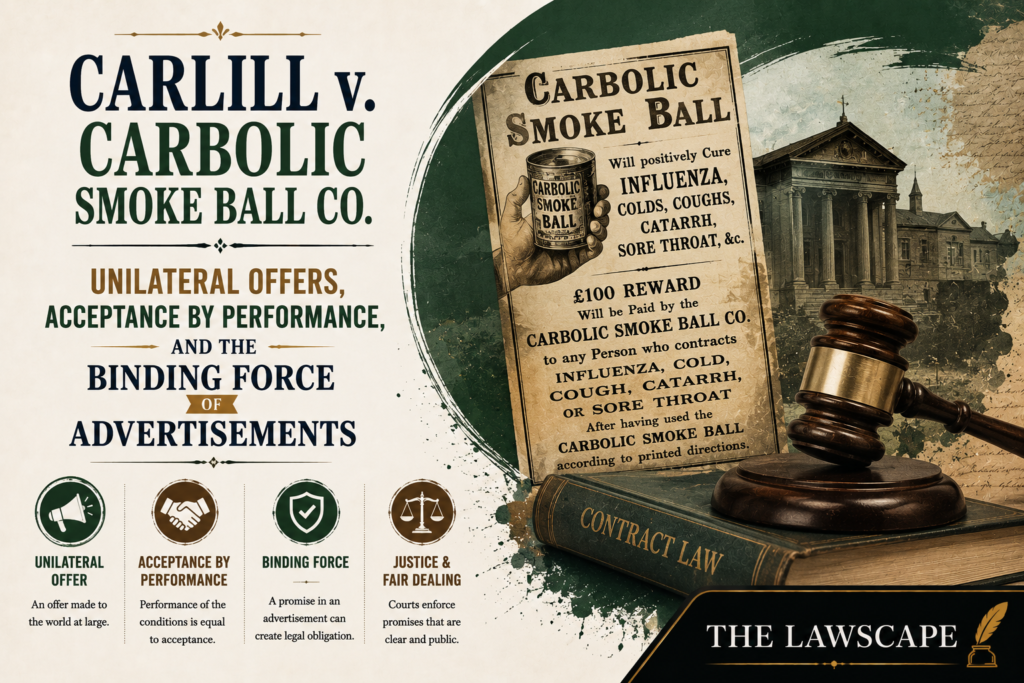
The company published an advertisement in newspapers stating that it would pay a reward of £100 to any person who contracted influenza after using the smoke ball according to the instructions provided. The advertisement further declared that £1,000 had been deposited in a bank to demonstrate the company’s sincerity and commitment to honouring the promise.
Mrs. Louisa Carlill purchased the smoke ball and used it exactly as prescribed by the company. Despite following all instructions, she contracted influenza. Consequently, she sought payment of the promised reward of £100.
The company refused to pay and argued that the advertisement was merely a marketing strategy intended to promote sales. According to the company, no legally enforceable contract existed between itself and Mrs. Carlill. As a result, Mrs. Carlill initiated legal proceedings to recover the promised reward.
Issues Before the Court
The Court was required to determine the following legal issues:
- Whether the advertisement constituted a valid offer capable of acceptance.
- Whether Mrs. Carlill accepted the offer by performing the conditions specified in the advertisement.
- Whether a legally enforceable contract existed between the parties.
- Whether communication of acceptance was necessary in the circumstances of the case.
- Whether the company’s promise was sufficiently certain to create legal obligations.
Arguments of the Parties
Arguments of the Appellant (Carbolic Smoke Ball Company)
The company argued that the advertisement was merely a sales promotion and not a contractual offer. It contended that the statement was intended to attract customers and should not be interpreted as creating legally binding obligations.
The company further argued that the advertisement was too vague and uncertain to constitute a valid offer. Since it was addressed to the general public, it could not amount to a specific contractual promise.
Another argument advanced by the company was that Mrs. Carlill had never communicated her acceptance of the offer. Under ordinary principles of contract law, acceptance must be communicated to the offeror before a binding agreement can arise. Since no such communication occurred, the company claimed that no contract had been formed.
The company also asserted that the promise was not intended to be taken seriously and should be regarded as advertising puffery rather than a genuine contractual commitment.
Arguments of the Respondent (Mrs. Carlill)
Mrs. Carlill argued that the advertisement contained a clear and definite promise to pay £100 to any person who fulfilled the stated conditions and nevertheless contracted influenza.
She emphasised that the company’s statement regarding the deposit of £1,000 in a bank demonstrated a serious intention to create legal relations. Such a deposit would have been unnecessary if the company merely intended to make an exaggerated advertising claim.
Mrs. Carlill further contended that she had accepted the offer by performing all the required conditions. She purchased the smoke ball, used it according to the instructions, and subsequently contracted influenza.
It was argued that because the offer was unilateral in nature, communication of acceptance was unnecessary. The offer itself contemplated acceptance through performance rather than prior notification.
Judgment
The Court of Appeal ruled in favour of Mrs. Carlill. It held that the advertisement constituted a valid unilateral offer made to the public. The language of the advertisement, combined with the deposit of £1,000, clearly demonstrated an intention on the part of the company to be legally bound by its promise.
The Court rejected the argument that the advertisement was mere sales puffery. Instead, it concluded that the promise was sufficiently specific and serious to create legal obligations.
The Court further held that Mrs. Carlill had accepted the offer by performing the conditions prescribed in the advertisement. Since the offer contemplated acceptance through conduct, communication of acceptance was not required. Accordingly, a valid contract existed between the parties, and Mrs. Carlill was entitled to recover the promised reward of £100.
Ratio Decidendi
The ratio decidendi of the case is that a unilateral offer made to the public can become legally binding when an individual performs the conditions specified in the offer.
The Court established that communication of acceptance is not necessary in unilateral contracts where the offeror has indicated that performance of the required act constitutes acceptance. In such cases, completion of the prescribed conditions is sufficient to form a contract.
The Court also clarified that advertisements may amount to contractual offers when they contain clear promises and demonstrate an intention to create legal relations. The deposit of £1,000 by the company served as strong evidence that the promise was genuine and intended to be legally enforceable.
Therefore, the case established important principles concerning unilateral contracts, offer and acceptance, and intention to create legal relations.
Critical Analysis
The decision in Carlill v. Carbolic Smoke Ball Co. is widely regarded as one of the most significant judgments in contract law. The ruling successfully balanced the interests of commercial enterprises with the need to protect consumers from misleading representations.
One of the greatest strengths of the judgment is its recognition of unilateral contracts. The Court acknowledged that certain offers are intended to be accepted through performance rather than communication. This practical approach reflects commercial reality and ensures that contractual principles remain flexible enough to accommodate different types of transactions.
The judgment also strengthened consumer protection. The company made a public promise to encourage consumers to purchase its product. If the Court had allowed the company to avoid liability, businesses could have made extravagant promises without any legal consequences. By enforcing the promise, the Court ensured that companies remain accountable for representations made to the public.
Another important contribution of the case is its clarification of the concept of intention to create legal relations. The Court did not rely solely on the wording of the advertisement. Instead, it considered the surrounding circumstances, particularly the deposit of £1,000, which demonstrated that the company intended its promise to be taken seriously. This approach continues to influence modern courts when determining whether a statement is legally binding.
The decision also promotes fairness and justice. Mrs. Carlill relied upon the company’s promise and acted according to its instructions. It would have been unjust to permit the company to benefit from increased sales while avoiding its contractual obligations.
However, certain criticisms may be made. Some legal scholars argue that advertisements are generally invitations to treat rather than offers. Expanding contractual liability in relation to advertisements may expose businesses to numerous claims. Nevertheless, the Court carefully limited its reasoning to the exceptional facts of the case. The explicit promise and the bank deposit distinguished this advertisement from ordinary commercial promotions.
From a practical perspective, the case remains highly relevant today. Modern businesses frequently use advertisements, promotional offers, and reward schemes to attract consumers. The principles established in Carlill continue to guide courts in determining whether such statements create legally enforceable obligations.
The case therefore serves as an important reminder that commercial entities must exercise caution when making promises to the public. Clear promises intended to induce action may result in binding legal obligations.
Conclusion
Carlill v. Carbolic Smoke Ball Co. remains a cornerstone of contract law and one of the most influential cases concerning contract formation. The judgment established that a valid offer can be made to the public at large and that acceptance may occur through performance of the prescribed conditions. It also reinforced the principle that serious commercial promises may give rise to enforceable legal obligations.
The Court’s decision promoted consumer protection, commercial accountability, and fairness in contractual dealings. By holding the company responsible for its promise, the Court ensured that businesses cannot make serious representations to the public and subsequently deny responsibility for them.
From an academic perspective, the case provides valuable insight into the principles of offer, acceptance, unilateral contracts, and intention to create legal relations. These principles continue to form the foundation of modern contract law and remain relevant in contemporary commercial transactions.
In my opinion, the judgment was both legally sound and socially beneficial. It protected the reasonable expectations of consumers while ensuring that businesses act responsibly when making public promises. The case therefore continues to be an essential authority in the study and application of contract law and remains highly relevant even in the modern commercial world.
Disclaimer: The views expressed in this article are those of the author and do not necessarily reflect the views of The Lawscape.
The Lawscape — clear, practical legal insight for students and future lawyers.