
Kesavananda Bharati v. State of Kerala: The Basic Structure Doctrine and the Limits of Constitutional Amendment
Author: Natasha Nayak
Student, KIIT School Of Law, Bhubaneswar
——————————————————————————————
💡 3 Quick Takeaways
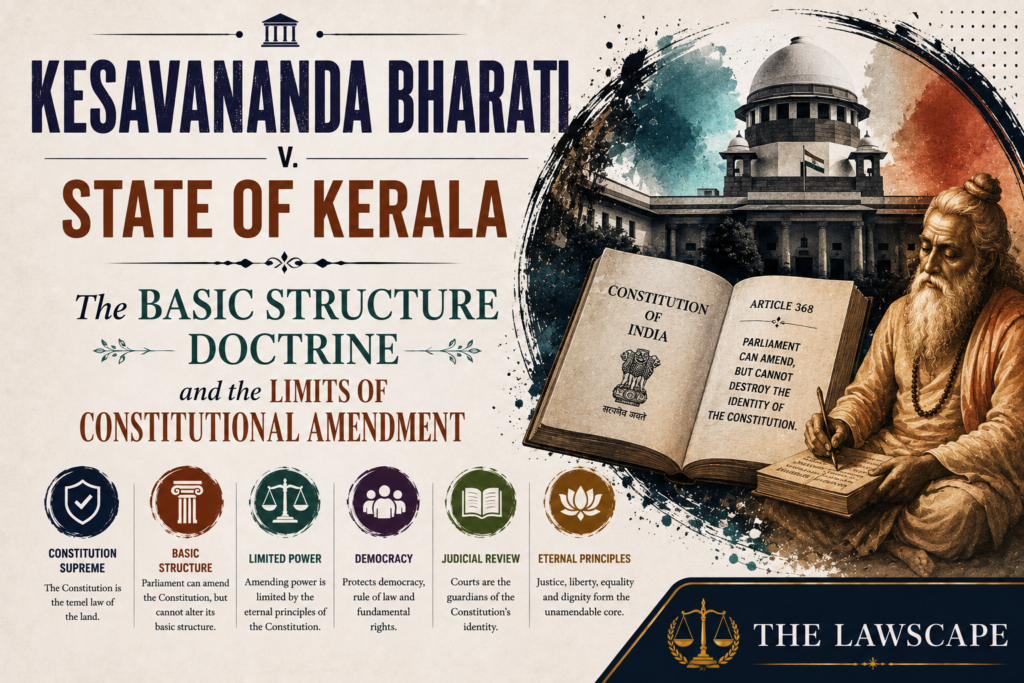
1. Kesavananda Bharati v. State of Kerala is the landmark judgment in which the Supreme Court evolved the Basic Structure Doctrine to limit Parliament’s amending power under Article 368.
2. The Court held that although Parliament has wide powers to amend the Constitution, it cannot alter or destroy its essential features or identity.
3. The judgment permanently reshaped Indian constitutional law by balancing parliamentary power with constitutional supremacy and judicial review.
Introduction
The decision rendered in Kesavananda Bharati v. State of Kerala constitutes one of the most significant constitutional pronouncements in Indian legal history. The judgment fundamentally altered the understanding of constitutional amendment powers under Article 368 of the Constitution and introduced the Basic Structure Doctrine, which continues to govern the constitutional framework of India. The case emerged from a conflict between Parliament’s assertion of unlimited amending power and the judiciary’s role as the guardian of constitutional supremacy.
By evolving the doctrine that Parliament cannot alter the “basic structure” of the Constitution, the Supreme Court attempted to reconcile democratic governance with constitutional limitations. The judgment assumes exceptional constitutional importance because it established that while Parliament possesses wide powers to amend the Constitution, such power is not absolute or destructive in nature. The decision therefore represents a balance between parliamentary sovereignty and constitutional supremacy.
Facts of the Case
His Holiness Kesavananda Bharati, the head of the Edneer Mutt in Kerala, challenged the constitutional validity of the Kerala Land Reforms Act, 1963, as amended by subsequent legislation. The petitioner contended that the land reform measures violated his fundamental rights guaranteed under Articles 14, 19(1)(f), 25, 26, and 31 of the Constitution.
During the pendency of the proceedings, Parliament enacted the Twenty-fourth, Twenty-fifth, and Twenty-ninth Constitutional Amendments with the objective of expanding Parliament’s amending authority and insulating land reform legislation from judicial review. The constitutional validity of these amendments was therefore challenged before a thirteen-judge Constitution Bench, the largest bench ever constituted by the Supreme Court of India. The principal issue before the Court concerned the scope of Parliament’s amending power under Article 368 and whether Parliament could amend every provision of the Constitution, including Fundamental Rights, without limitation.
Issues Before the Court
The principal issues before the Court were as follows:
- Whether Parliament possesses unlimited power to amend the Constitution under Article 368.
- Whether Fundamental Rights can be amended or abrogated by constitutional amendment.
- Whether the Twenty-fourth, Twenty-fifth, and Twenty-ninth Constitutional Amendments were constitutionally valid.
- Whether there exist implied limitations upon Parliament’s amending power.
Judicial Reasoning and Interpretation
The judgment was delivered by a narrow majority of 7:6. The Court held that Parliament possesses extensive powers to amend the Constitution; however, such powers cannot be exercised in a manner that destroys or alters the “basic structure” or essential features of the Constitution.
The majority rejected the earlier reasoning adopted in Golak Nath v. State of Punjab, which had held that Fundamental Rights were entirely beyond Parliament’s amending authority. Instead, the Court adopted a middle path by recognising Parliament’s power to amend Fundamental Rights while simultaneously imposing substantive limitations upon such amendments.
The Court interpreted Article 368 not merely as a procedural provision but as a source of constituent power. Nevertheless, the majority observed that the constituent power under Article 368 remains limited by the inherent identity of the Constitution itself. The Constitution was not viewed as an ordinary legal document subject to complete political alteration; rather, it was regarded as a foundational charter embodying enduring constitutional principles.
Chief Justice S.M. Sikri reasoned that certain essential features of the Constitution cannot be abrogated because the Constitution derives its legitimacy from those foundational principles. Several judges identified features such as the supremacy of the Constitution, the republican and democratic form of government, secularism, separation of powers, and federalism as elements of the Constitution’s basic structure.
Justice H.R. Khanna’s opinion assumed decisive importance. He held that Parliament’s amending power is broad but not unlimited, and that the Constitution cannot be altered in a manner that changes its fundamental identity. His interpretation became the controlling principle of the majority judgment.
The Court also examined the Twenty-fifth Amendment and partially invalidated the second part of Article 31C, which excluded judicial review entirely. The judges held that judicial review forms an essential constitutional mechanism for maintaining constitutional supremacy and preventing arbitrary state action.
Principles Evolved in the Judgment
Basic Structure Doctrine
The most important principle evolved in the case was the Basic Structure Doctrine. The doctrine establishes that Parliament cannot amend the Constitution in a manner that destroys its essential framework or identity. Although the Court did not provide an exhaustive list of basic features, it recognised several principles as integral to the constitutional order.
Limited Amending Power
The judgment clarified that Parliament’s constituent power differs from ordinary legislative power, yet remains limited in character. The Court rejected the argument that constitutional amendments are beyond judicial scrutiny. This interpretation preserved constitutional continuity while preventing authoritarian constitutional alteration.
Constitutional Supremacy
The Court reaffirmed that the Constitution remains supreme and that all organs of the State derive authority from it. The judgment rejected the Diceyan conception of absolute parliamentary sovereignty and instead affirmed constitutional supremacy. Parliament was therefore held incapable of exercising unlimited sovereignty similar to the British Parliament.
Judicial Review as a Constitutional Safeguard
The decision reinforced judicial review as an indispensable constitutional mechanism. The Court recognised that without judicial review, constitutional limitations upon State power would become illusory.
Critical Analysis
The judgment reflects a sophisticated attempt to balance democratic will with constitutional restraint. The Court recognised that a written Constitution must possess certain inviolable features to preserve its identity. In doing so, the Supreme Court transformed itself into the ultimate interpreter and protector of constitutional morality.
The reasoning of the majority has been praised for preventing majoritarian excesses and safeguarding democratic institutions. By limiting Parliament’s amending power, the Court ensured that transient political majorities could not dismantle constitutional guarantees or alter the democratic framework of governance.
However, the judgment has also attracted criticism. Critics argue that the Basic Structure Doctrine lacks textual foundation within the Constitution and represents an instance of judicial overreach. Since the Constitution does not expressly mention implied limitations upon Article 368, opponents contend that the doctrine grants excessive discretionary power to the judiciary.
Despite these criticisms, the doctrine has acquired consistent judicial acceptance and has subsequently been reaffirmed in numerous constitutional decisions. The absence of an exhaustive definition of “basic structure” has also allowed constitutional interpretation to remain flexible and adaptive to changing political and social conditions. The decision is frequently examined as an example of the judiciary’s role in constitutional evolution and law-making through interpretation. Comparative constitutional scholarship has likewise recognised similarities between the Basic Structure Doctrine and theories concerning unconstitutional constitutional amendments developed in other jurisdictions.
Impact of the Judgment
The impact of Kesavananda Bharati upon Indian constitutional law has been profound and enduring. The judgment permanently altered the balance between Parliament and the judiciary by ensuring that constitutional amendments remain subject to judicial scrutiny. The doctrine subsequently played a decisive role during the constitutional crisis of the Emergency period. In Indira Nehru Gandhi v. Raj Narain, the Supreme Court relied upon the Basic Structure Doctrine to invalidate provisions that undermined free and fair elections. Similarly, in Minerva Mills v. Union of India, the Court reaffirmed that limited amending power itself forms part of the Constitution’s basic structure.
The judgment has also significantly influenced comparative constitutional jurisprudence. The doctrine was subsequently expanded in I.R. Coelho v. State of Tamil Nadu, where the Supreme Court held that legislation placed in the Ninth Schedule remains subject to Basic Structure review. Most importantly, the doctrine has functioned as a constitutional safeguard against authoritarianism. It has preserved institutional accountability, protected civil liberties, and ensured that constitutional democracy in India remains governed by enduring constitutional values rather than temporary political interests.
Conclusion
Kesavananda Bharati v. State of Kerala remains a constitutional watershed in Indian legal history. Through the evolution of the Basic Structure Doctrine, the Supreme Court succeeded in reconciling constitutional flexibility with constitutional permanence. The judgment preserved Parliament’s authority to amend the Constitution while simultaneously preventing the destruction of its essential identity.
The case continues to occupy a central position in constitutional jurisprudence because it established that constitutional supremacy prevails over parliamentary supremacy. By recognising implied limitations upon amending power, the Court strengthened democratic governance, judicial independence, and the rule of law. The doctrine evolved in this case has subsequently become the cornerstone of Indian constitutional interpretation and continues to shape the relationship between constitutional authority and democratic power.
Disclaimer: The views expressed in this article are those of the author and do not necessarily reflect the views of The Lawscape.
The Lawscape — clear, practical legal insight for students and future lawyers.