
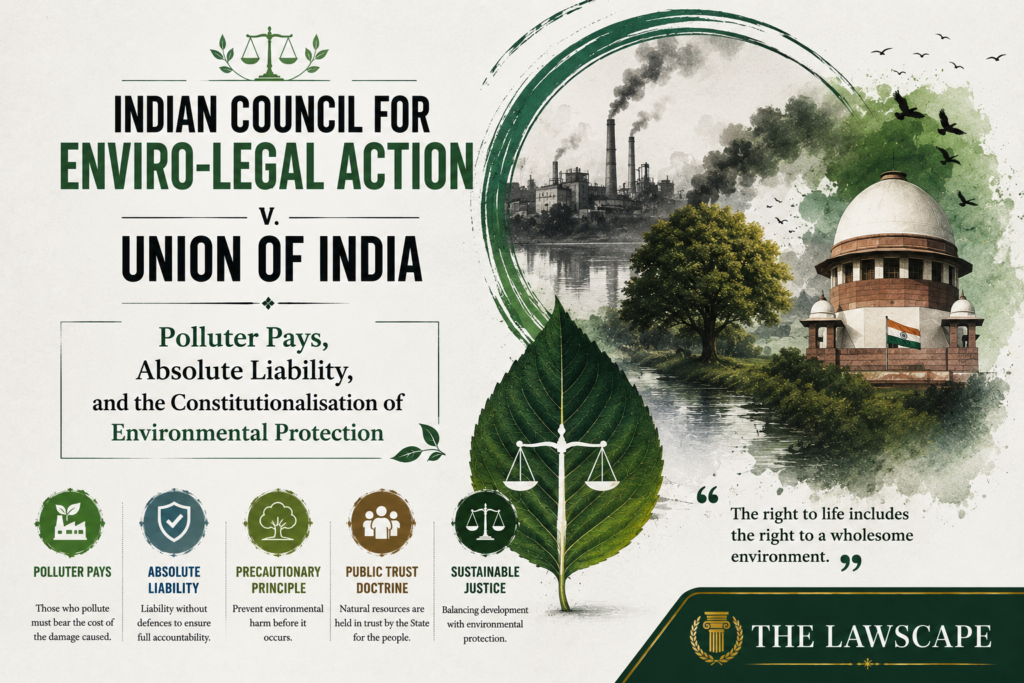
Indian Council for Enviro-Legal Action v. Union of India: Polluter Pays, Absolute Liability, and the Constitutionalisation of Environmental Protection
Author: Aayushi Chaudhary
Student, Asian Law College, Noida
—————————————————————
💡 3 Quick Takeaways
1. Indian Council for Enviro-Legal Action v. Union of India is a landmark environmental law judgment in which the Supreme Court firmly applied the Polluter Pays Principle and absolute liability against hazardous industries.
2. The case expanded Article 21 by recognising that the right to life includes the right to a clean and healthy environment.
3. The judgment strengthened environmental accountability in India by linking industrial pollution, constitutional rights, and restorative justice.
Abstract
Environmental protection has emerged as one of the most significant concerns in the modern legal system. One of its principal causes is the growth of pollution arising from human settlements and the pursuit of individual and industrial interests. This case concerns severe environmental pollution caused by industrial units in Bichhri village, Udaipur District, Rajasthan, where the normal lives of people and cattle were affected, resulting in disease, ecological degradation, and serious harm to the villagers.
The Indian Council for Enviro-Legal Action, an environmental organisation, filed a writ petition before the Supreme Court in response to this environmental disaster. The case addressed the liability of chemical industries responsible for extensive environmental degradation and public health harm. The Supreme Court decisively enforced the Polluter Pays Principle and imposed liability on industries to remediate environmental damage and compensate those affected. By linking ecological protection to Article 21 and recognising the right to a clean and healthy environment as intrinsic to the right to life, the judgment became a cornerstone of Indian environmental law and significantly shaped the balance between industrial development, justice, and sustainability.
Introduction
The rapid pace of industrialisation in India has significantly contributed to economic development, but it has simultaneously resulted in serious environmental degradation, posing a direct threat to human health and ecological balance. Increasing instances of industrial pollution, particularly in rural and semi-urban areas, exposed the inefficiency of regulatory mechanisms and highlighted the urgent need for judicial intervention to safeguard environmental rights. In response to such challenges, the Indian legal system has developed a robust environmental framework through a combination of statutory provisions and judicial innovation. While legislations such as the Environment (Protection) Act, 1986 provide the foundational legal structure, it is the judiciary that has actively shaped environmental jurisprudence by introducing and enforcing key principles through Public Interest Litigation.
This judicial activism has ensured that environmental concerns are addressed not merely as policy issues but as enforceable legal rights. The case of Indian Council for Enviro-Legal Action v. Union of India (1996) emerges as a landmark judgment within this context. The case arose from environmental destruction caused by hazardous chemical industries in Bichhri village, Rajasthan, and provided the Supreme Court with an opportunity to address industrial accountability. In doing so, the Court firmly established the Polluter Pays Principle, which mandates that the polluting entity must bear the cost of environmental damage, and reinforced the doctrine of absolute liability, which imposes strict responsibility on industries engaged in inherently dangerous activities without exceptions.
From a constitutional perspective, this case represents a significant expansion of the scope of Article 21, as the Supreme Court recognised that the right to life includes the right to live in a clean and pollution-free environment. Furthermore, it aligns with the broader constitutional directives under Article 48A, which requires the State to protect and improve the environment, and Article 51A(g), which imposes a fundamental duty on citizens to protect the natural environment. The impact of this judgment extends far beyond the immediate dispute, as it strengthened environmental governance, reinforced the role of Public Interest Litigation as an instrument of social justice, and laid down a strong precedent for holding industries accountable. It continues to serve as a cornerstone of Indian environmental law.
Facts
The case arose out of the environmental conditions in Bichhri village, located in Udaipur district, Rajasthan. Several industrial units were operating in the village, all controlled by the same individuals and situated within the same industrial complex. These units began manufacturing chemicals, including oleum and “H” acid. The fourth respondent, Hindustan Agro Chemicals Limited, began manufacturing oleum in 1987, while the fifth respondent, Silver Chemicals, and the eighth respondent, Jyoti Chemicals, manufactured “H” acid along with certain other products.
These industries had neither obtained the necessary clearances, consents, and licences, nor installed any equipment for the treatment of highly toxic effluents discharged by them. The toxic waste generated by these industries percolated deep into the soil, polluting the groundwater and rendering it unfit for human and agricultural use. The pollution spread disease, death, and severe ecological damage across the village. The gravity of the situation was such that the District Magistrate had to impose Section 144 of the Code of Criminal Procedure in the area due to unrest among villagers.
Although some of the industries claimed to have ceased manufacturing “H” acid by January 1989, the harmful consequences of their activities persisted in the form of toxic sludge and long-term environmental contamination. In these circumstances, the Indian Council for Enviro-Legal Action filed a writ petition before the Supreme Court of India. The Court issued notice to the Union of India, the Government of Rajasthan, the Rajasthan Pollution Control Board, and the respondent industries. It also directed the National Environmental Engineering Research Institute (NEERI) to conduct a study of the situation in Bichhri village and submit a report. NEERI’s findings revealed the existence of massive quantities of toxic sludge, including large quantities stored in pits, confirming the scale of the environmental damage.
Issues
The principal issues before the Court were as follows:
- Whether the respondent industries were liable for the environmental damage caused in Bichhri village due to the discharge of hazardous substances.
- Whether the doctrine of absolute liability was applicable to industries engaged in hazardous and inherently dangerous activities.
- Whether the Polluter Pays Principle could be invoked to compel the respondent industries to bear the cost of environmental restoration and compensation.
- Whether the acts of the respondent industries had resulted in a violation of the fundamental right to life under Article 21 of the Constitution of India.
Arguments of the Parties
Petitioner’s Side
The petitioner, through a Public Interest Litigation, contended that the respondent industries were directly responsible for causing severe environmental damage in Bichhri village by discharging untreated and hazardous chemical waste into the surrounding land and water sources. It was argued that these activities contaminated the soil and groundwater, made water unfit for consumption, and adversely affected agriculture and public health.
The petitioner further submitted that the respondent industries were engaged in the production of hazardous substances and were operating without proper safeguards and in clear violation of environmental norms. Despite being aware of the harmful consequences of their actions, they continued to discharge toxic effluents, thereby causing long-term ecological damage. According to the petitioner, this established negligence as well as a complete disregard for environmental protection.
It was also argued that such pollution amounted to a violation of the fundamental right to life under Article 21 of the Constitution, since the right to life includes the right to live in a clean and healthy environment. The pollution directly affected the health and livelihood of the local population, thereby infringing their basic human rights.
The petitioner strongly relied upon the doctrine of absolute liability, contending that industries engaged in hazardous and inherently dangerous activities must be held strictly liable for any harm caused, irrespective of negligence or intention. Since the respondent industries dealt with toxic chemicals, they could not escape liability for the damage caused to the environment. The petitioner also invoked the Polluter Pays Principle, arguing that the industries must bear the cost of environmental restoration and compensate the affected villagers. Judicial intervention was therefore necessary to ensure accountability and the effective enforcement of environmental law.
Respondent’s Side
The respondent industries contended that they should not be held solely responsible for the environmental damage in Bichhri village. It was argued that not all industries contributed equally to the pollution and that fixing complete liability upon them would be unjust. Some of the industries also submitted that they had already ceased operations and therefore should not be held liable for ongoing environmental harm.
The respondents further argued that certain units had taken steps to comply with environmental regulations and had either obtained or were in the process of obtaining necessary permissions. According to them, any violation was not intentional but resulted from a lack of proper guidance and regulatory clarity.
They also submitted that responsibility for environmental protection does not rest solely upon industries, but also upon government authorities responsible for monitoring and enforcing environmental laws. The respondents emphasised that the failure of regulatory bodies to supervise industrial activities contributed significantly to the situation. With respect to the doctrine of absolute liability, they argued that imposing such liability without considering the specific facts of each industry would be unfair and that liability should instead be determined on a case-by-case basis. They similarly challenged the application of the Polluter Pays Principle, contending that any financial burden should be proportionate to the extent of pollution caused by each unit. The respondents also denied that their actions directly violated Article 21, arguing that no clear causal link had been established between their activities and the alleged harm suffered by villagers.
Judgment of the Case
The Supreme Court of India delivered its judgment on 11 August 1996. After considering the facts of the case and the reports submitted by the Rajasthan Pollution Control Board and NEERI, the Court decisively upheld the Polluter Pays Principle as a fundamental aspect of Indian environmental law. It held the respondent industries liable to bear the cost of restoring the damaged environment. The Court further directed that in the event of failure to pay, the amount could be recovered from the movable and immovable assets of the respondent industries.
The Rajasthan Pollution Control Board was directed to seal all factories, units, and plants of the respondent industries in Bichhri village that had violated environmental law. The Court emphasised that the respondents had produced toxic effluents without obtaining the requisite clearances, consents, or licences, and had failed to install appropriate treatment equipment. The environmental harm caused by them was described as grave and far-reaching.
The industries were directed to pay compensation for remedial measures to restore the environment in Bichhri village under the supervision of the Ministry of Environment and Forests. The Court also made broader observations regarding environmental governance, stating that chemical industries should be permitted to operate only after all environmental aspects are carefully considered and that their functioning should be closely monitored to ensure that they do not pollute surrounding areas. The Court noted that many such industries were water-intensive and suggested that the advisability of permitting them in arid areas should also be examined.
Importantly, the Court highlighted the need for specialised environmental adjudicatory mechanisms. It observed that environmental matters often do not receive the sustained attention they deserve in ordinary courts because of workload and procedural delays, and therefore suggested the creation of environmental courts to deal exclusively with such matters. The Court also encouraged the Central Government to strengthen environmental protection machinery at both the Centre and State levels.
Finally, the Court recognised the public-spirited role played by the petitioner organisation and awarded costs in its favour for pursuing the litigation over a long period in the public interest.
Critical Analysis
The judgment in Indian Council for Enviro-Legal Action is widely regarded as a milestone in Indian environmental law. It marks a pivotal moment in environmental jurisprudence by reinforcing that Article 21 includes the right to a clean and healthy environment. This expansive interpretation has played a central role in the development of environmental rights in India.
A critical appreciation of the case must examine not only its doctrinal innovations but also its practical limitations in ensuring environmental justice. One of the most commendable aspects of the judgment is its strong endorsement of the Polluter Pays Principle and its emphasis on restorative justice. The principle requires polluters not merely to compensate victims, but also to bear the cost of restoring environmental damage. By doing so, the Court transformed environmental harm from a regulatory issue into a constitutional and financial obligation.
The judgment also reflects the influence of international environmental principles, particularly those associated with the Rio Declaration on Environment and Development. By invoking the Polluter Pays Principle and the Precautionary Principle, the Court integrated international environmental norms into Indian constitutional jurisprudence. This judicial move bridged the gap between the Directive Principles of State Policy under Article 48A and the fundamental duties under Article 51A(g), ensuring that both the State and citizens share responsibility for ecological preservation.
At the same time, the case highlights the limitations of judicial activism. While the Court laid down strong principles and imposed liability, the actual implementation of environmental orders often remains weak. This reveals the broader challenge of translating judicial declarations and international commitments into practical domestic compliance. In that sense, the judgment is both a milestone in environmental jurisprudence and a reminder of the persistent enforcement deficit in India’s environmental governance.
The case is also important because it operationalised the doctrine of absolute liability against hazardous industries, building upon the principle evolved in M.C. Mehta v. Union of India (Oleum Gas Leak Case). Unlike the traditional English rule of strict liability under Rylands v. Fletcher, which allows certain exceptions, the Indian doctrine of absolute liability removes such exceptions and imposes complete responsibility upon hazardous industries for the harm they cause. This marks a distinctively Indian approach to environmental liability, one that prioritises public safety and ecological protection over industrial defences.
Another notable contribution of the case lies in its institutional implications. The Court’s suggestion that specialised environmental courts or tribunals should be established to deal with complex ecological disputes later influenced institutional developments in Indian environmental governance. It contributed to the movement towards specialised environmental adjudication, eventually culminating in bodies such as the National Green Tribunal.
The broader ripple effect of the judgment can be seen in later environmental decisions where principles such as Polluter Pays, Precautionary Principle, and sustainable development became central to judicial reasoning. In simple terms, the case transformed environmental protection from a matter of policy into a legal and constitutional mandate, ensuring that both industries and the State are accountable for safeguarding ecological balance.
Conclusion
Indian Council for Enviro-Legal Action v. Union of India (1996) is a landmark judgment that significantly strengthened environmental jurisprudence in India. The Supreme Court decisively held that industries engaged in hazardous and inherently dangerous activities are absolutely liable for any harm caused, without exceptions. By enforcing the doctrine of absolute liability, the Court moved beyond traditional principles of liability and ensured stricter industrial accountability.
Further, the application of the Polluter Pays Principle marked an important step in ensuring that environmental damage is not treated merely as a regulatory issue but as a financial and legal responsibility of the polluter. The Court made it clear that industries must bear the full cost of environmental restoration and compensate affected individuals.
The judgment also expanded the scope of Article 21 by affirming that the right to life includes the right to a clean, safe, and pollution-free environment. It highlighted the importance of judicial intervention through Public Interest Litigation in situations where administrative authorities fail to act effectively.
Overall, the case not only provided justice to the victims of Bichhri village but also set a strong precedent for future environmental cases, promoting sustainable development, corporate accountability, and stricter enforcement of environmental laws in India.
Disclaimer: The views expressed in this article are those of the author and do not necessarily reflect the views of The Lawscape.
The Lawscape — clear, practical legal insight for students and future lawyers.