
Vishaka v. State of Rajasthan: Judicial Recognition of Workplace Sexual Harassment as a Constitutional Wrong
Author: Aditi Singh Parihar
Student, Shambhunath Institute of Law, Prayagraj
————————————————————————————–
💡 3 Quick Takeaways
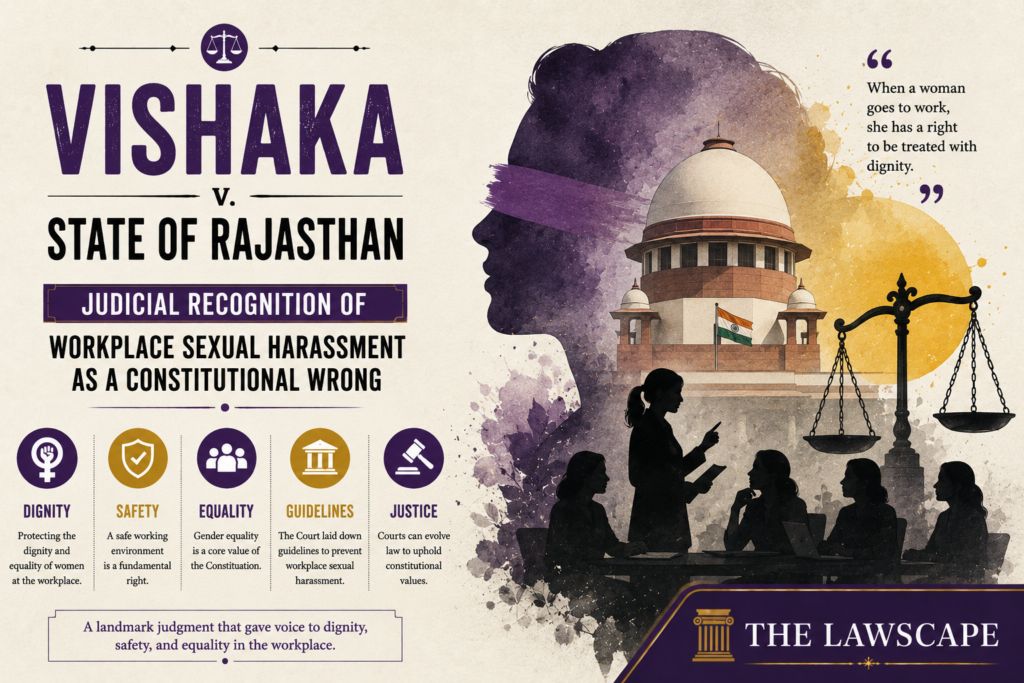
1. Vishaka v. State of Rajasthan recognised workplace sexual harassment as a violation of women’s fundamental rights under Articles 14, 15, 19, and 21 of the Constitution.
2. In the absence of legislation, the Supreme Court framed the Vishaka Guidelines to prevent and redress sexual harassment at the workplace.
3. The judgment became the foundation for the Sexual Harassment of Women at Workplace (Prevention, Prohibition and Redressal) Act, 2013, and remains a landmark in women’s rights jurisprudence.
Introduction
The judgment in Vishaka v. State of Rajasthan is one of the most progressive and enduring decisions delivered by the Supreme Court of India. The case played a crucial role in securing the protection of women’s rights at the workplace. Prior to this decision, India had no specific law addressing sexual harassment at the workplace. As a result, women who faced such conduct were left without an effective legal remedy, and such incidents were often treated as private matters rather than as violations of women’s rights.
Through this judgment, the Supreme Court recognised sexual harassment not merely as an infringement of women’s rights, but as a serious violation of fundamental and constitutional rights under Articles 14, 15, 19, and 21 of the Constitution of India. The Court further affirmed that all women have the right to equality, safety, and dignity at the workplace.
The case arose from the unfortunate incident involving Bhanwari Devi, a social worker from Rajasthan, who was gang-raped for attempting to prevent a child marriage in her village. In the absence of legislative protection, the Supreme Court laid down a set of guidelines—now known as the Vishaka Guidelines—which later informed the enactment of the Sexual Harassment of Women at Workplace (Prevention, Prohibition and Redressal) Act, 2013. The judgment thus stands as a landmark in the constitutional protection of women’s rights.
Facts of the Case
Bhanwari Devi was a woman from Bhateri, Rajasthan, who worked under the Women’s Development Project (WDP) of the Government of Rajasthan. She was employed as a “Saathi,” meaning a friend, and her role involved spreading awareness regarding social issues such as child marriage, gender equality, and women’s welfare. She had earlier taken up an issue of rape and received support from the village community. However, when she began educating villagers about the illegality of child marriage, the same support disappeared despite the fact that the villagers were aware that child marriage was unlawful.
In the meantime, the family of Ram Karan Gurjar planned to conduct the child marriage of his one-year-old daughter. Bhanwari Devi, acting in her capacity as a social worker, sought to stop the marriage with the assistance of the Sub-Divisional Officer and the Deputy Superintendent of Police. Despite these efforts, the marriage was solemnised the next day and no effective police action was taken.
Thereafter, Ram Karan Gurjar, along with Ram Sukh Gujjar, Gyarsa Gujjar, Badri Gujjar, and Shravan Sharma, attacked Bhanwari Devi’s husband and brutally gang-raped her. The police initially refused to register her complaint, which delayed the investigation. When she attempted to seek justice, she was heavily criticised and pressured to abandon the matter. Although she ultimately succeeded in filing a complaint, the medical examination was delayed by fifty hours, and the report failed to record the commission of rape, mentioning only the age of the victim.
Bhanwari Devi and her husband later approached the trial court in Rajasthan. However, owing to lack of evidence and several procedural failures, all the accused were acquitted. The trial court even questioned why Bhanwari Devi’s husband had not helped her or called for assistance at the time of the incident. The struggle for justice nevertheless continued, and several women’s organisations and activists began supporting her cause. Dissatisfied with the decision of the trial court, a women’s rights group known as “Vishaka” filed a Public Interest Litigation seeking protection and rights for women at the workplace.
Issues Raised Before the Court
The Supreme Court considered several important issues, including:
- Whether sexual harassment of women at the workplace amounts to a violation of fundamental and constitutional rights, particularly Articles 14, 19, and 21.
- Whether the judiciary can step in to create protective guidelines and mechanisms in the absence of explicit parliamentary legislation dealing with workplace sexual harassment.
- Whether employers and the State bear a constitutional duty to proactively prevent sexual harassment and provide safe working conditions.
- Whether the Court could apply international law in the absence of adequate measures under existing domestic law.
These issues were of immense significance because, at that time, Indian law did not contain any clear provisions specifically dealing with the protection of women from sexual harassment at the workplace.
Petitioners’ Arguments
The petitioners strongly argued that sexual harassment at the workplace is not merely a social wrong but a direct violation of the fundamental rights guaranteed by the Constitution. They submitted that women cannot truly enjoy their right to equality in workplaces where the environment is unsafe and hostile. It was argued that the law must treat all citizens equally; however, women continued to face discrimination and unequal treatment in employment settings.
The petitioners contended that women are frequently subjected to unwelcome physical contact, humiliation, and other forms of harassment, which deprive them of equal opportunities and respect in the workplace. They further relied on Article 15, which prohibits discrimination on grounds of sex, and argued that women should not be treated differently merely because they are women. According to the petitioners, sexual harassment at the workplace constitutes a form of discrimination specifically targeted at women and therefore directly undermines constitutional guarantees.
It was also argued that the legal system contained a serious loophole in failing to ensure a safe workplace environment, which is a basic human right of every woman. The petitioners emphasised that there were no specific laws or legislative measures to protect women from workplace sexual harassment and that this legal vacuum made women feel unsafe and vulnerable in their professional spaces. They therefore urged the Court to step in and protect women through judicial guidelines so that such violations would not continue unchecked.
Respondents’ Arguments
The respondents argued that the Indian legal system already contained several laws aimed at protecting women. They referred to provisions of the Indian Penal Code dealing with assault, criminal force, and related offences, and contended that these existing provisions were sufficient to safeguard women’s rights. They therefore submitted that there was no need for the Court to frame separate guidelines.
The respondents further relied on the doctrine of separation of powers, arguing that law-making is the function of Parliament, while the judiciary is only responsible for interpreting laws. According to them, it would be inappropriate for the Court to formulate guidelines in the absence of legislation.
They also contended that not every workplace is unsafe or inappropriate and that some incidents may arise out of personal misunderstandings, which would not necessarily amount to a violation of fundamental rights. At the same time, the respondents also suggested that States should include in their reports information regarding sexual harassment and the measures adopted to protect women from such acts and from other forms of workplace violence.
Judgment
The Supreme Court held that sexual harassment at the workplace constitutes a clear violation of fundamental and constitutional rights. The Court recognised that all women have a fundamental right to work in an environment free from fear, discrimination, and harassment. It further observed that gender equality necessarily includes protection against sexual harassment at the workplace.
The Court held that workplace sexual harassment also violates the right to practise any profession or to carry on any occupation, trade, or business under Article 19(1)(g) of the Constitution. In the absence of any specific domestic legislation on the subject, the Court relied upon Article 141 and laid down a set of binding norms to govern workplace sexual harassment. These came to be known as the Vishaka Guidelines and were to operate as law until suitable legislation was enacted by Parliament.
The Court’s intervention thus filled a major legislative vacuum and provided an enforceable framework for the protection of women at the workplace. These guidelines eventually formed the basis of the Sexual Harassment of Women at Workplace (Prevention, Prohibition and Redressal) Act, 2013.
Vishaka Guidelines
The Supreme Court framed the Vishaka Guidelines to prevent and redress workplace sexual harassment. The guidelines included the following key principles:
- Employers and other responsible persons must take steps to prevent sexual harassment and provide procedures for conciliation, prosecution, and other necessary action.
- Preventive measures must be taken to avoid such incidents, and these duties apply to both public and private employers.
- Sexual harassment was defined to include physical contact, demands for sexual favours, showing pornography, sexually coloured remarks, and unwelcome physical, verbal, or non-verbal sexual conduct.
- There must be a robust mechanism or body to deal with complaints of sexual harassment.
- Appropriate conditions of work, including health and safety measures, must be ensured so that women are not exposed to unsafe workplace environments.
- Employers must take appropriate action by filing complaints under the relevant provisions of the Indian Penal Code and must ensure that victims are not discriminated against during the pendency of proceedings.
- Employers must initiate disciplinary proceedings where such conduct amounts to misconduct during employment.
- Every organisation should create an effective mechanism for the redressal of complaints.
- A complaints committee must be constituted, headed by a woman, and should report annually to the government.
- Employees should be permitted to raise issues of sexual harassment during employer-employee meetings.
- Awareness regarding women’s rights and the guidelines should be widely disseminated.
- A third party such as an NGO or institution should be involved in the complaints mechanism to reduce pressure from senior officials.
- Where the act of sexual harassment is committed by a third party who is not part of the organisation, the employer must take all necessary steps to assist the victim.
These guidelines were of immense significance and were later transformed into statutory law through the Sexual Harassment of Women at Workplace (Prevention, Prohibition and Redressal) Act, 2013.
Critical Analysis
The judgment in Vishaka v. State of Rajasthan is rightly regarded as one of the most important decisions in Indian legal history for the protection of women’s rights. The case significantly expanded the scope of fundamental rights under the Constitution of India. One of its most important contributions was the recognition that sexual harassment at the workplace is not merely a personal or moral wrong, but a serious social and legal wrong that directly affects women’s constitutional rights.
Another important aspect of the judgment is the Court’s reliance on international law, particularly CEDAW and related international principles, in order to fill the legislative vacuum that existed in India at the time. The decision therefore represents an important example of judicial creativity in the service of constitutional justice.
The Vishaka Guidelines themselves can be regarded as the ratio and most enduring contribution of the case. They transformed the legal understanding of workplace sexual harassment and laid the foundation for a structured mechanism to protect women in employment spaces. Despite criticism that the Court stepped into the legislative domain, the judgment remains revolutionary in ensuring protection and recognition of the issue. It also bound all courts in India until Parliament enacted the 2013 legislation.
Ultimately, the decision was a foundational step towards the enactment of the Sexual Harassment of Women at Workplace (Prevention, Prohibition and Redressal) Act, 2013 and continues to be a core authority in the field of women’s rights and workplace dignity.
Conclusion
The judgment in Vishaka v. State of Rajasthan is a landmark decision that transformed India’s approach to the protection of women’s rights at the workplace. The Supreme Court recognised sexual harassment as a violation of women’s fundamental rights to equality, dignity, liberty, and safe working conditions. The case also highlighted the importance of international human rights principles in constitutional adjudication.
Most importantly, the judgment laid the groundwork for the enactment of the Sexual Harassment of Women at Workplace (Prevention, Prohibition and Redressal) Act, 2013, thereby ensuring a formal legal framework for justice, fairness, equality, liberty, and dignity regardless of gender. For these reasons, Vishaka remains one of the most significant decisions in the history of Indian constitutional and gender justice jurisprudence.
Disclaimer: The views expressed in this article are those of the author and do not necessarily reflect the views of The Lawscape.
The Lawscape — clear, practical legal insight for students and future lawyers.