
S.R. Bommai v. Union of India: Federalism, Secularism, and the Constitutional Limits of Article 356
Author: Sanvi Oli
Student, IMS Unison University, Dehradun
———————————————————————————
💡 3 Quick Takeaways
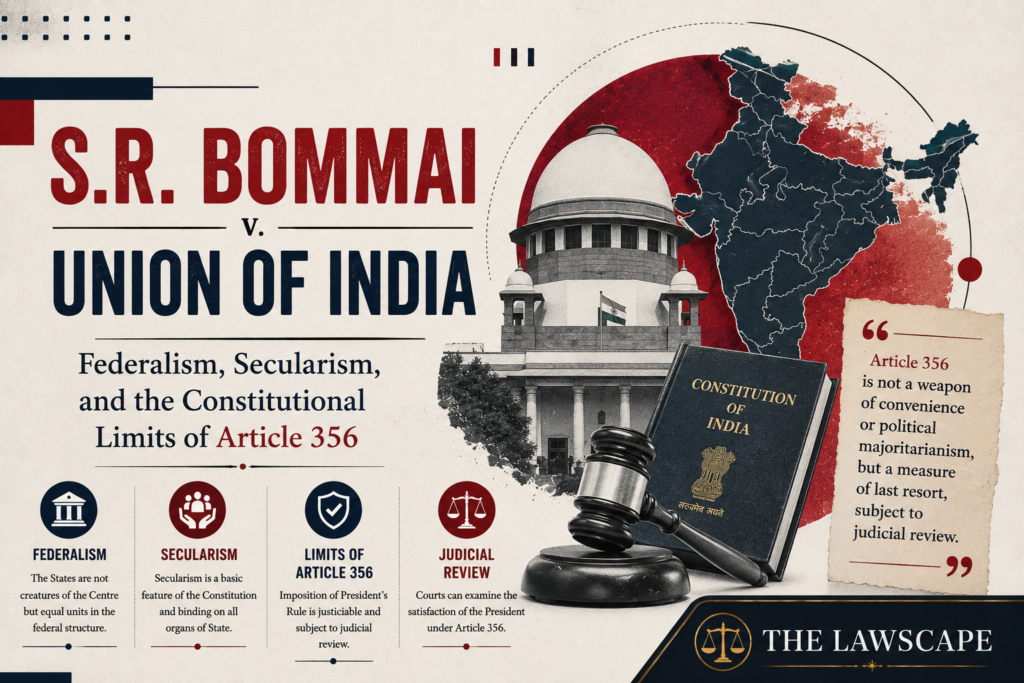
1. S.R. Bommai v. Union of India transformed the constitutional understanding of Article 356 by subjecting Presidential Proclamations to judicial review and limiting the arbitrary use of President’s Rule.
2. The Supreme Court recognised federalism and secularism as basic features of the Constitution, thereby strengthening India’s constitutional structure against partisan misuse of emergency powers.
3. The judgment established the floor test as the proper method of determining legislative majority and reinforced the role of Parliament and the judiciary in checking executive excess.
Introduction
Among the landmark constitutional pronouncements in post-independence India, few carry the doctrinal and institutional significance of S.R. Bommai v. Union of India. Delivered by a nine-judge Constitution Bench in 1994, the judgment addressed one of the most contentious and politically charged provisions of the Constitution of India—Article 356, which empowers the Union to impose President’s Rule in a State upon the breakdown of constitutional machinery. For decades preceding this ruling, Article 356 had been invoked with troubling frequency and often for partisan political ends rather than genuine constitutional necessity.
The case arose against the turbulent political backdrop of the late 1980s, when President’s Rule was imposed in Karnataka, and later in several other States, under circumstances widely perceived as arbitrary. S.R. Bommai, then the Chief Minister of Karnataka, challenged the constitutional validity of the Proclamation. What began as a dispute concerning the dismissal of a single State government ultimately developed into a sweeping constitutional inquiry involving federalism, secularism, judicial review, and the very character of Indian democracy.
The judgment fundamentally reoriented the relationship between the Centre and the States, imposed meaningful constitutional limits on executive discretion, and elevated both federalism and secularism to the status of basic features of the Constitution. Its reasoning draws upon foundational principles of democratic governance and continues to shape Indian constitutional law to this day.
Facts of the Case
S.R. Bommai was the Chief Minister of Karnataka and headed a Janata Dal government. In April 1989, the Governor of Karnataka submitted a report to the President stating that the Bommai government had lost its majority in the State Legislative Assembly due to defections. On the basis of this report, the President issued a Proclamation under Article 356(1), dismissing the Bommai ministry and dissolving the State Legislature. Significantly, Bommai was not given an opportunity to prove his majority on the floor of the House before this drastic step was taken.
Bommai challenged the constitutionality of the Proclamation before the Karnataka High Court, but his petition was dismissed. He then appealed to the Supreme Court. By the time the matter reached the apex court, similar challenges had also been filed regarding the imposition of President’s Rule in Nagaland, Meghalaya, Himachal Pradesh, Rajasthan, Madhya Pradesh, and other States, many of which had been dismissed after a change in the Central Government. Recognising the broader constitutional significance of these disputes, the Supreme Court consolidated the matters and referred them to a nine-judge Constitution Bench.
This clustering of cases enabled the Court to deliver a comprehensive ruling on the constitutional architecture governing Centre-State relations, executive power, and the role of the judiciary in matters traditionally treated as non-justiciable acts of State.
Issues Raised
The constitutional bench was called upon to decide several interrelated questions:
- Whether a Presidential Proclamation under Article 356 is subject to judicial review, and if so, to what extent.
- Whether the dissolution of a State Legislature consequent upon a Presidential Proclamation can take effect before Parliamentary approval is obtained under Article 356(3).
- Whether federalism constitutes a basic feature of the Indian Constitution that cannot be abrogated even through the mechanism of Article 356.
- Whether secularism is a basic feature of the Constitution, and whether conduct of a State government contrary to secular values can legitimately justify a Proclamation under Article 356.
- What remedies are available if a Presidential Proclamation is found to be unconstitutional.
Analysis
A. Judicial Review of Presidential Proclamation
One of the most consequential holdings of the judgment concerns the justiciability of a Proclamation issued under Article 356. Prior to Bommai, the dominant judicial understanding—traceable to State of Rajasthan v. Union of India (1977)—was that Presidential Proclamations under Article 356 were essentially political acts falling within the executive domain and were therefore largely immune from judicial scrutiny. The Bommai Bench decisively departed from this approach.
The Court held that although the President’s satisfaction under Article 356(1) is subjective in nature, it must be based upon relevant material. A Proclamation may therefore be challenged on the ground that it was issued without any relevant factual basis, or that the material placed before the President was extraneous, irrelevant, or constitutionally insufficient to justify such a drastic step. This framework, drawing from the Wednesbury principle of administrative law, introduced meaningful judicial oversight without allowing courts to simply substitute their own political judgment for that of the executive.
This holding represents a major doctrinal achievement. The Court balanced institutional respect for executive discretion with the need to preserve constitutional accountability. By requiring that the President’s satisfaction be supported by germane material, the judgment substantially curtailed the possibility of politically motivated misuse of Article 356.
B. The Floor Test Imperative
A central defect in the Karnataka episode, as well as in several other instances of President’s Rule, was the dismissal of elected governments without first allowing them an opportunity to prove their majority on the floor of the Assembly. The Court unanimously held that the question of whether a government enjoys majority support is inherently a matter to be tested in the Legislature through a floor test. A Governor’s subjective assessment of the political situation, however sincerely formed, cannot replace the constitutional mechanism of legislative confidence.
This ruling drew upon the democratic principle that elected representatives must be allowed to express their confidence or lack of confidence in the executive within the House itself. Denying such an opportunity offends not only procedural fairness but also the very structure of parliamentary democracy. The Court’s insistence on the floor test thus became one of the most important constitutional safeguards against arbitrary dismissals of State governments.
C. Federalism as a Basic Feature
Perhaps the most enduring contribution of Bommai is its recognition of federalism as a basic feature of the Constitution. The Court extended the logic of the Basic Structure Doctrine laid down in Kesavananda Bharati v. State of Kerala by holding that the constitutional distribution of power between the Centre and the States forms part of the indestructible core of the Constitution.
The Court did not deny that Article 356 may be invoked in genuine cases of constitutional breakdown. However, it made clear that such intervention must remain exceptional and narrowly tailored. Article 356 cannot be used as an instrument to systematically undermine the autonomous constitutional sphere reserved for the States. In the Court’s formulation, Article 356 is a safety valve, not a tool of political homogenisation.
This recognition of federalism as part of the Constitution’s basic structure is particularly significant in the Indian context. Although India is often described as having a quasi-federal structure, with a strong Centre, Bommai gave substantive constitutional protection to the federal principle by ensuring that the States are not reduced to administrative units of the Union through the arbitrary use of emergency powers.
D. Secularism as a Constitutional Pillar
The judgment also addressed the constitutional significance of secularism. The Court held that secularism is a basic feature of the Constitution and is inseparable from its democratic and republican framework. It further observed that if a State government acts in a manner contrary to secular constitutional values—such as by aligning itself with a religious agenda or facilitating communal violence—such conduct may legitimately justify the invocation of Article 356.
This aspect of the judgment assumed immediate relevance in the aftermath of the demolition of the Babri Masjid and the dismissal of certain BJP-led State governments. The Court’s reasoning gave constitutional legitimacy to central intervention where a State government fundamentally violates secular norms, while simultaneously cautioning that secularism must not be invoked as a pretext for partisan political action.
Critics have noted that this aspect of the judgment may invite subjective application, as determining whether a government has violated secular norms can itself involve political judgment. Even so, the Court’s recognition of secularism as a constitutional basic feature remains one of the most important elements of the ruling.
E. Parliamentary Approval and Legislative Dissolution
Another significant ruling concerned the procedural safeguard under Article 356(3), which requires that a Presidential Proclamation be approved by both Houses of Parliament within two months. The Court held that the dissolution of a State Legislature cannot take effect before such Parliamentary approval is obtained. Until then, the Legislature may only be kept in suspended animation.
This interpretation prevents the executive from presenting Parliament with a fait accompli and preserves the supervisory role of Parliament in relation to the exercise of emergency powers. The Court further held that if Parliament withholds approval, the dismissed government and dissolved legislature must be restored.
F. Critical Assessment
The Bommai judgment deserves considerable appreciation as a work of constitutional reasoning. By reading Article 356 in light of the Constitution’s overall federal design, rather than in isolation, the Court produced a judgment of enduring institutional value. It resisted political expediency and instead reaffirmed foundational constitutional commitments.
At the same time, certain limitations may be acknowledged. The nine judges delivered six separate concurring opinions, and while this reflects the depth of engagement with the constitutional questions involved, it also makes it somewhat difficult to extract a single unified ratio on every point. Further, although the standards for judicial review represented a significant advance over earlier doctrine, they remain relatively deferential to executive satisfaction. Questions concerning the quality and sufficiency of material required to justify a Proclamation have not always been answered with perfect clarity.
Conclusion
S.R. Bommai v. Union of India stands as a constitutional landmark not merely because of the specific rules it established regarding Article 356, but because of what it represents as an exercise in constitutional jurisprudence. The judgment demonstrated that no constitutional provision—however broad its language—can be permitted to override the foundational principles upon which the Constitution rests. Article 356 had, for decades, operated as an unchecked instrument of political power. Bommai drew a constitutional line and held that democracy cannot survive without meaningful constraints on executive intervention.
By elevating federalism and secularism to the status of basic features of the Constitution, the Court laid down principles that extend well beyond Article 356. The judgment affirmed that the Constitution is not merely a charter of governmental powers, but a framework built upon enduring commitments to pluralism, decentralisation, constitutional accountability, and the rule of law.
In practice, Bommai had a significant deterrent effect. The use of President’s Rule declined markedly after the decision, and both Governors and the Union Government became more cautious in invoking Article 356. The floor test requirement also emerged as a widely accepted constitutional norm.
Ultimately, Bommai illustrates the vital role of an independent judiciary in preserving constitutional governance against political encroachment. It remains one of the most important authorities in Indian constitutional law on the questions of power, accountability, federalism, and the foundations of democratic government.
Disclaimer: The views expressed in this article are those of the author and do not necessarily reflect the views of The Lawscape.
The Lawscape — clear, practical legal insight for students and future lawyers.