
Hostile Takeovers in India: Balancing Corporate Control and Shareholder Rights
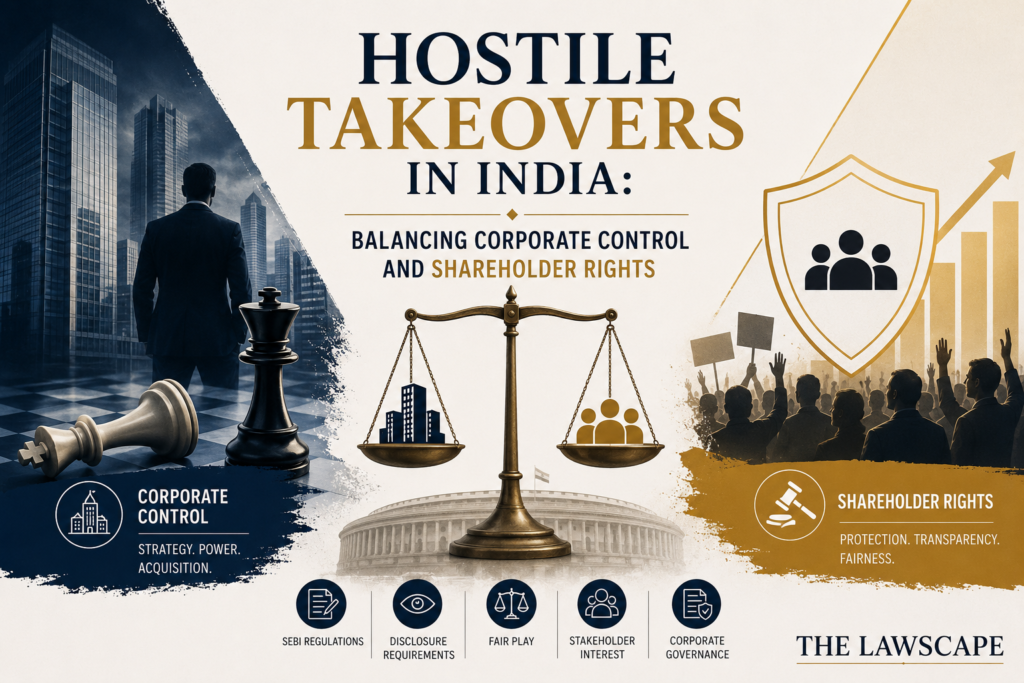
Author: Aafreen Kamil
Student, Andaman Law College, Sri Vijaya Puram
———————————————————————————————————
💡 3 Quick Takeaways
1. Hostile takeovers remain uncommon in India due to promoter-driven ownership structures, regulatory safeguards, and market realities.
2. The SEBI Takeover Regulations, 2011 provide the principal legal framework governing substantial acquisitions and mandatory open offers.
3. Landmark acquisitions such as L&T–Mindtree and Adani–NDTV demonstrate that shareholder rights ultimately prevail over managerial resistance.
Hostile takeovers have increasingly become a subject of discussion in corporate governance, particularly as India’s capital markets continue to mature. Consider a mid-sized Indian toy company, XYZ, known for its eco-friendly and child-safe toys with a significant public following. The company discovers that its biggest rival has quietly acquired 24.9% of its shares—dangerously close to the 25% threshold prescribed under the SEBI (Substantial Acquisition of Shares and Takeovers) Regulations, 2011, which would trigger a mandatory open offer. The immediate question that arises is: how can the company prevent a hostile takeover?
Before examining the available remedies, it is essential to understand the meaning of a hostile takeover. A hostile takeover refers to an acquisition in which the acquiring company gains control of the target company without the consent of its management or board of directors. This distinguishes it from a friendly takeover, which proceeds with the approval and cooperation of the target company’s leadership.
The defining characteristic of a hostile takeover is therefore the absence of managerial consent. Although instances of hostile takeovers have been relatively limited in India, notable examples include Larsen & Toubro’s acquisition of Mindtree Limited and the Adani Group’s acquisition of NDTV.
It is equally important to recognise that hostile takeovers are not inherently detrimental. Their consequences depend largely upon the surrounding circumstances and the manner in which they are executed. This article examines the concept of hostile takeovers, the regulatory framework governing them in India, their implications, relevant case studies, shareholder dynamics, and the strategies employed by both acquiring and target companies. The objective is to assess whether India’s existing legal and market infrastructure is sufficiently equipped to address the challenges posed by hostile takeovers.
Legal Framework Governing Hostile Takeovers in India
The legal framework governing hostile takeovers in India is comparatively conservative when contrasted with jurisdictions that experience a more active mergers and acquisitions market. Indian legislation does not specifically define “hostile takeover.” Instead, acquisitions are governed through securities regulations, company law, competition law, and foreign investment regulations.
SEBI (Substantial Acquisition of Shares and Takeovers) Regulations, 2011
The SEBI Takeover Regulations prescribe the thresholds and procedures governing acquisitions of substantial shareholding in listed companies. Under Regulation 3(1), an acquirer who, together with persons acting in concert, acquires 25% or more of the voting rights in a target company must make a public announcement offering to acquire at least an additional 26% of the company’s shares through an open offer.
Companies Act, 2013
Although the Companies Act, 2013 does not expressly refer to hostile takeovers, it regulates several consequential corporate actions following an acquisition, including alteration of the Articles of Association, appointment and removal of directors, and convening shareholders’ meetings.
FEMA and Foreign Direct Investment Regulations
Where the acquirer is a foreign entity, the Foreign Exchange Management Act, 1999 and the Consolidated FDI Policy issued by the Department for Promotion of Industry and Internal Trade (DPIIT) regulate the permissibility and conditions governing such acquisitions.
Reasons Behind Hostile Takeovers
The motivations behind hostile takeovers vary and are not necessarily adverse.
Asset Maximisation
A target company may possess valuable but underutilised assets. The acquiring company may believe that improved management can unlock the true value of these assets.
Poor Management
Inefficient management may encourage an acquirer to seek control on the assumption that better leadership would improve corporate performance and enhance shareholder value.
Empire Building
Certain acquisitions are motivated primarily by managerial ambitions to expand corporate influence and market dominance rather than by sound commercial considerations.
Strategies Employed in Hostile Takeovers
Distinct strategies are adopted by both acquiring companies and target companies.
Strategies Used by Acquirers
Open Offer
The open offer remains the most common mechanism for hostile acquisitions. The acquirer publicly offers to purchase shares from existing shareholders at a premium above the prevailing market price without obtaining the board’s approval. The objective is to secure effective voting control. Under the SEBI Takeover Regulations, crossing the 25% threshold triggers a mandatory open offer for an additional 26% shareholding.
Bear Hug Letter
Under this approach, the acquiring company privately offers to purchase the target company at a substantial premium. If the offer is rejected, it may subsequently be made public, thereby placing considerable pressure on the target company’s board, particularly where shareholders perceive the offer to be financially attractive.
Strategies Used by Target Companies
Poison Pill
The poison pill is among the most recognised takeover defence mechanisms internationally. Existing shareholders are granted rights to purchase additional shares at discounted prices, thereby diluting the hostile acquirer’s ownership and increasing acquisition costs. However, this strategy has limited practical application in India because Indian company law and the SEBI Regulations do not permit discriminatory issuance of discounted shares solely to frustrate hostile acquisitions.
White Knight
Under the white knight strategy, the target company identifies a friendly acquirer willing to purchase the company on more favourable terms than those offered by the hostile bidder. This enables the target company to avoid acquisition by an undesirable purchaser.
Challenges Faced in India
Hostile takeovers remain relatively rare in India due to a combination of structural, regulatory, and cultural factors.
Family-Controlled Companies
A significant proportion of Indian companies continue to be promoter or family controlled. Concentrated shareholding leaves relatively few shares available for acquisition through the open market.
SEBI Takeover Regulations
The mandatory open offer requirement substantially increases the financial commitment required for a successful hostile acquisition, often making such transactions commercially expensive.
Cultural Resistance
India’s corporate landscape is characterised by long-standing relationships among promoters, institutional investors, financiers, and business groups. These relationships frequently operate as an informal defence against hostile acquisitions by limiting institutional support for outside acquirers.
Additional challenges include the possibility of overpayment, procedural delays, and defensive strategies such as the white knight mechanism.
Supporting Case Studies
Larsen & Toubro’s Acquisition of Mindtree Limited (2019)
Holding approximately US$2 billion in surplus cash and constrained from undertaking a share buyback, Larsen & Toubro identified the information technology sector as a strategic investment opportunity. It implemented a three-stage acquisition strategy involving the purchase of V.G. Siddhartha’s stake, subsequent open market acquisitions, and finally an open offer to public shareholders at ₹980 per share. The acquisition proceeded despite strong resistance from Mindtree’s founders and promoters.
Adani Group’s Acquisition of NDTV
The acquisition began with the purchase of Vishvapradhan Commercial Private Limited (VCPL), which held warrants convertible into a 29.18% stake in NDTV’s promoter company. This was followed by an open offer through which the Adani Group increased its shareholding before the founders, Prannoy Roy and Radhika Roy, sold most of their remaining shares, resulting in Adani obtaining majority control. The acquisition generated considerable debate regarding media independence in India.
Both transactions offer important lessons for Indian companies. The Mindtree acquisition demonstrates that emotional resistance cannot override shareholder rights when a determined acquirer follows the legal process. The NDTV acquisition illustrates how historic financial arrangements may eventually facilitate a change in corporate control. Collectively, these examples underscore the importance of prudent financial planning, effective shareholder engagement, and careful corporate governance.
Should India Reform Its Takeover Defences?
India presently offers fewer takeover defence mechanisms than jurisdictions such as the United States, where techniques including poison pills have received judicial recognition. Nevertheless, simply transplanting foreign defence mechanisms into the Indian regulatory framework may not be appropriate.
Instead, India requires a balanced regulatory approach that affords promoters a meaningful opportunity to present their position while preserving the primacy of shareholder decision-making. Future reforms should account not only for numerical thresholds but also for the cultural, reputational, and institutional context in which Indian companies operate. At the same time, such reforms should avoid protecting inefficient management or frustrating legitimate market discipline.
Conclusion
Hostile takeovers should not be underestimated. They possess the capacity to transform corporate control rapidly, as demonstrated by the Mindtree and NDTV acquisitions. These cases remind Indian companies that financial prudence, transparent management, and active shareholder engagement are not merely desirable corporate practices but essential safeguards against unwanted acquisitions.
Beyond technical legal considerations, companies also embody years of vision, trust, and commitment invested by founders, employees, customers, and communities. As mergers and acquisitions continue to evolve within India, an appropriate balance must be maintained between safeguarding legitimate promoter interests and respecting shareholder rights. Ultimately, adaptation, sound governance, and preservation of shareholder confidence remain among the most effective defences in an environment where change can arrive unexpectedly.
Disclaimer: The views expressed in this article are those of the author and do not necessarily reflect the views of The Lawscape.
The Lawscape — clear, practical legal insight for students and future lawyers.