
Child Protection Beyond Formalism: A Critical Commentary on Independent Thought v. Union of India (2017)
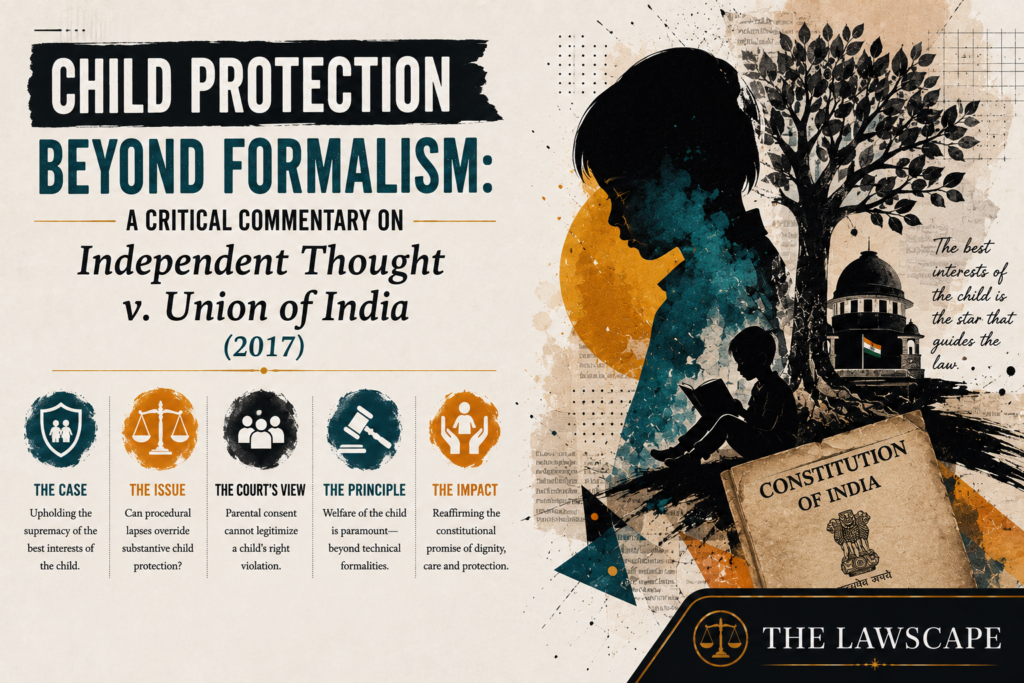
Author: Sanskriti Mishra
Student, NIMS School of Law, NIMS University, Jaipur
———————————————————————————-
💡 3 Quick Takeaways
1. Independent Thought v. Union of India removed the marital rape exception for wives between fifteen and eighteen years of age by reading down Exception 2 to Section 375 IPC.
2. The Supreme Court harmonised the IPC with child protection statutes such as POCSO and the Prohibition of Child Marriage Act, placing dignity, bodily integrity, and the best interests of the child at the centre of its reasoning.
3. While the judgment strengthened protection for minor girls within marriage, it left unresolved larger questions concerning the continuing legal recognition of child marriage, adolescent autonomy, and legislative inconsistency.
Introduction
The decision of the Supreme Court in Independent Thought v. Union of India marks one of the most significant judicial interventions in India’s child protection jurisprudence. The case emerged from a longstanding inconsistency within the legal framework governing children, marriage, and sexual offences. While various statutes, including the Protection of Children from Sexual Offences Act, 2012 (POCSO) and the Prohibition of Child Marriage Act, 2006 (PCMA), recognised eighteen years as the threshold of childhood, Exception 2 to Section 375 of the Indian Penal Code created an anomaly by permitting sexual intercourse between a husband and his wife if the wife was above fifteen years of age. Consequently, conduct that would constitute rape outside marriage was legally immunised within a marital relationship involving a minor wife.
The case raised questions that extended beyond technical statutory interpretation. It required the Court to consider whether the legal system could genuinely claim to protect children while simultaneously allowing an exception that effectively validated sexual intercourse with married girls between fifteen and eighteen years of age. The judgment was therefore central to determining how child rights, constitutional values, and legislative policy could be reconciled in a coherent legal framework. The Court had to decide whether the exception truly protected children or instead undermined the very purpose of child protection laws. In that sense, both child rights and constitutional morality lay at the heart of the decision.
The Supreme Court did not merely look at the text of the law in isolation. Instead, it attempted to harmonise statutes that were operating in contradiction with one another. The decision is a clear victory for child rights, but it also exposes persistent tensions within Indian family law and the broader legal framework governing children. What makes the case particularly important is not only what the Supreme Court was able to achieve, but also what it left unresolved. The judgment therefore stands as both a landmark for child rights and a reminder that the legal architecture surrounding childhood and marriage in India remains incomplete.
Background and Facts
The petitioner, Independent Thought, a non-governmental organisation working in the field of child rights, challenged the constitutional validity of Exception 2 to Section 375 of the Indian Penal Code. At the time, the provision stated that sexual intercourse by a man with his wife would not amount to rape if the wife was not under fifteen years of age. This effectively created a legal distinction between married and unmarried girls in the age group of fifteen to eighteen years.
The challenge was founded on the argument that this exception was directly inconsistent with contemporary child protection legislation. Under POCSO, every person below eighteen years of age is treated as a child, and sexual activity with a child constitutes an offence irrespective of consent. Similarly, the Prohibition of Child Marriage Act sought to regulate and discourage child marriage. Yet the IPC continued to preserve a marital exception that significantly weakened the protection offered by these statutes.
The petitioner contended that this distinction was arbitrary, discriminatory, and contrary to constitutional guarantees of equality and dignity. At its core, the case asked whether the law could continue to preserve a separate rule for married girls when the broader legal framework increasingly recognised children as rights-bearing individuals entitled to bodily autonomy and protection from sexual exploitation.
Issues Before the Court
The Supreme Court was primarily required to determine:
- Whether Exception 2 to Section 375 IPC was inconsistent with constitutional principles and child protection legislation.
- Whether sexual intercourse with a wife between fifteen and eighteen years of age could continue to enjoy immunity from prosecution.
- Whether the provision could be interpreted in a manner consistent with the POCSO Act and the Prohibition of Child Marriage Act.
The Judgment and Ratio Decidendi
The Supreme Court adopted a purposive interpretive approach rather than striking down the provision in its entirety. It held that sexual intercourse with a wife below eighteen years of age would constitute rape for the purposes of criminal law and consequently read down Exception 2 to Section 375 IPC. The Court observed that retaining the age threshold of fifteen years would create an irreconcilable conflict between the IPC and child protection legislation. A girl below eighteen could not simultaneously be treated as a child under POCSO and yet be considered capable of lawful marital intercourse under the IPC. Such a contradiction, the Court held, would defeat the legislative objective underlying child welfare statutes.
A particularly significant feature of the judgment was the Court’s reliance on constitutional principles of dignity, bodily integrity, and the best interests of the child. The decision recognised that child marriage often operates within structures of social and economic vulnerability, and that the law must be interpreted in a way that advances rather than weakens child protection. The Court therefore made it clear that if a girl is below eighteen years of age, the fact of marriage cannot be used to justify sexual intercourse that would otherwise amount to rape. In this way, the welfare of children was placed at the centre of the interpretive exercise, and child protection law was read in a manner that furthered constitutional values and safeguarded the well-being of minor girls.
Critical Analysis
The judgment deserves considerable praise for confronting a contradiction that had persisted within Indian law for decades. Prior to this decision, a married girl between fifteen and eighteen years of age occupied a legally anomalous position. She was recognised as a child under child protection statutes, yet was simultaneously denied the protection available to unmarried girls. By eliminating this distinction, the Court reinforced the principle that marriage cannot dilute the fundamental rights of children.
One of the most compelling aspects of the judgment is its rejection of formalistic reasoning. Rather than treating the IPC in isolation, the Court interpreted the provision within the broader legislative framework. This reflects a recognition that child rights legislation cannot function effectively if criminal law itself creates exceptions that undermine its objectives. The decision therefore strengthened doctrinal coherence within Indian child protection jurisprudence.
The judgment is also notable for its engagement with constitutional morality. Historically, legal responses to child marriage were often shaped by social practices and cultural accommodation. The Court consciously moved away from this tradition by emphasising constitutional commitments over social acceptance. In doing so, it reaffirmed that the legitimacy of legal rules must be evaluated against constitutional values rather than historical practices alone.
However, despite these achievements, the decision remains incomplete in several respects. The most significant limitation lies in the Court’s decision to address the consequences of child marriage without directly confronting the institution itself. While sexual intercourse with a wife below eighteen years was criminalised, child marriages were not rendered automatically void. As a result, the legal system continues to recognise the existence of child marriages in certain circumstances while simultaneously criminalising one of the most significant consequences arising from those marriages.
This creates a serious conceptual difficulty. If the law accepts that a person below eighteen years of age is not mature enough to consent to sexual activity, it becomes difficult to justify why the law still permits the continuance of child marriage. The judgment resolves one contradiction, but leaves another intact. The law continues to recognise child marriage in limited ways, even though it also proceeds on the basis that those below eighteen lack the maturity to make decisions of this kind.
A second concern relates to enforcement. Judicial pronouncements alone cannot transform deeply entrenched social realities. Child marriage in India is frequently linked to poverty, gender inequality, lack of education, and social custom. Criminalisation addresses the legal dimension of the problem, but it does not by itself remedy the structural conditions that enable child marriage to persist. Consequently, the practical impact of the judgment depends heavily upon institutional capacity and wider social reform beyond the courtroom.
The decision also raises broader questions about the relationship between child protection and adolescent autonomy. Although the case primarily concerned child marriage, it forms part of a wider jurisprudential debate regarding the legal treatment of individuals between fifteen and eighteen years of age. Courts increasingly encounter cases involving adolescent relationships that do not fit neatly into traditional categories of exploitation. While the judgment adopts a strongly protective approach, it offers limited guidance on how the law should navigate the evolving capacities of adolescents while still maintaining safeguards against abuse.
Another notable feature of the case is its reliance on judicial interpretation rather than legislative amendment. The Court harmonised conflicting statutes through interpretation, but the very existence of such inconsistencies points to shortcomings in legislative coordination. Questions concerning the age of consent, child marriage, and child protection ought ideally to be addressed through a coherent statutory framework rather than through piecemeal judicial intervention.
Nevertheless, these criticisms should not obscure the transformative significance of the judgment. The decision marks an important shift away from viewing child marriage as a matter of private family relations and toward recognising it as a question of rights and constitutional protection. By centring the welfare and dignity of the child, the Court reoriented the legal discourse surrounding marriage and childhood.
Conclusion
Independent Thought v. Union of India stands as a landmark judgment in India’s evolving child rights jurisprudence. The Supreme Court successfully removed a statutory inconsistency that undermined the protection afforded to minor girls and reinforced the principle that marriage cannot extinguish the rights of children.
Yet the decision is best understood not as the culmination of reform, but as an important stage in an ongoing process. While it strengthened protection against sexual exploitation within child marriages, it left unresolved broader tensions concerning the legal status of child marriage, adolescent autonomy, and legislative coherence. Its enduring significance lies in demonstrating that child protection cannot be achieved merely through formal legal categories; it requires a legal framework that consistently prioritises dignity, equality, and the best interests of the child. In that sense, Independent Thought is both a landmark achievement and a reminder that the project of child rights reform in India remains unfinished.
Disclaimer: The views expressed in this article are those of the author and do not necessarily reflect the views of The Lawscape.
The Lawscape — clear, practical legal insight for students and future lawyers.