
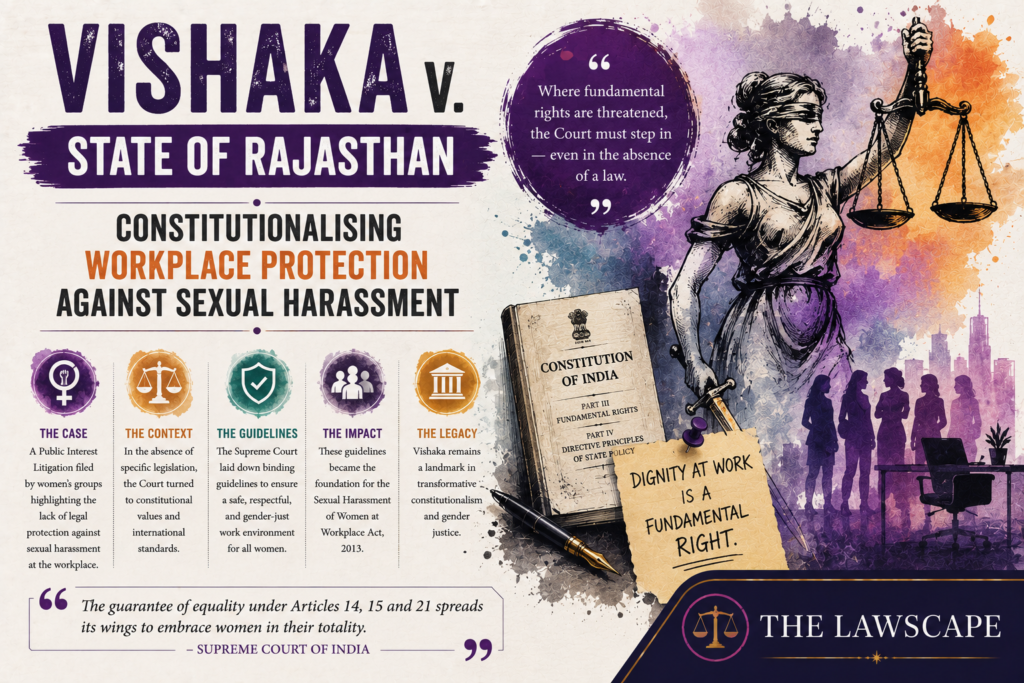
Vishaka v. State of Rajasthan: Constitutionalising Workplace Protection Against Sexual Harassment
Author: SHRIYA VS
Student, Mar Gregosios college of Law, Thiruvananthapuram
————————————————————————————————-
💡 3 Quick Takeaways
- Vishaka v. State of Rajasthan recognised workplace sexual harassment as a violation of women’s fundamental rights under Articles 14, 15, 19(1)(g), and 21 of the Constitution of India.
- In the absence of specific legislation, the Supreme Court framed the Vishaka Guidelines to provide immediate protection against sexual harassment at the workplace.
- The judgment laid the foundation for the Sexual Harassment of Women at Workplace (Prevention, Prohibition and Redressal) Act, 2013, and remains a landmark in Indian constitutional and gender justice jurisprudence.
Introduction
In the modern era, women have become an essential component of the workforce and have made an immense contribution to the economic, social, and professional development of society. However, despite significant advancement in employment, education, and public life, women continue to face discrimination, exploitation, and harassment in the workplace. Sexual harassment at the workplace not only violates the dignity and autonomy of women but also affects the constitutional rights guaranteed under the Indian Constitution, particularly the rights to equality, freedom, life, and personal liberty under Articles 14, 15, 19, and 21. It also denies women a safe and secure working environment.
Before 1997, there was no specific law or remedy in India to address workplace sexual harassment. Affected women could only seek recourse under provisions of the Indian Penal Code, 1860, such as Sections 354 and 509, which were inadequate to effectively deal with sexual harassment in the work environment. The issue remained unresolved even as the participation of women in the workforce continued to grow. Sexual harassment made working in organisations humiliating, unsafe, hostile, and degrading for women, thereby compromising their dignity, self-confidence, and economic independence.
Against this backdrop, the landmark case of Vishaka v. State of Rajasthan came before the Supreme Court. The case arose from the gang rape of Bhanwari Devi, a social worker in Rajasthan, while she was attempting to prevent child marriage in her village. The incident exposed the complete lack of legal protection available to working women and prompted several women’s rights organisations to approach the Supreme Court through a Public Interest Litigation. By treating sexual harassment as a violation of fundamental human rights, the Court laid down the now-famous Vishaka Guidelines to protect women against workplace sexual harassment.
Facts of the Case
The genesis of this case lies in the tragic experience of Bhanwari Devi, who worked as a social worker under the Women’s Development Programme of the Government of Rajasthan. Her role involved creating awareness regarding women’s welfare, gender equality, women’s education, and the eradication of social evils such as child marriage.
In 1992, Bhanwari Devi attempted to prevent the marriage of a one-year-old child belonging to an influential family in the village of Dhakoor Gujjar. Her intervention was treated as interference in social customs and a breach of local social etiquette, despite the fact that child marriage was illegal. In response, the child’s family subjected Bhanwari Devi and her family to threats and social boycott.
As an act of revenge, Bhanwari Devi was subsequently gang-raped in the presence of her husband. Following the assault, she was subjected to severe neglect by state authorities. Her medical examination was delayed, the police registered the FIR only a day after she approached them, and even then she was made to undergo humiliation in the process. Although an FIR was eventually lodged, institutional negligence and delay in investigation weakened the collection of evidence and compromised the prosecution.
The trial court acquitted the accused on the ground of insufficient evidence. The incident highlighted the inadequacy of the existing legal framework in dealing with sexual harassment and violence against working women. Consequently, a Public Interest Litigation was filed, resulting in the landmark judgment of Vishaka v. State of Rajasthan, in which the Supreme Court laid down the Vishaka Guidelines and mandated employers to take necessary steps to prevent sexual harassment at the workplace.
Issues Raised
The principal issues before the Court were as follows:
- Whether the decision of the trial court and the failure of the legal system violated Bhanwari Devi’s fundamental rights under Articles 14, 15, 19(1)(g), and 21 of the Constitution of India.
- Whether the Court could rely on international law in the absence of specific domestic legislation dealing with workplace sexual harassment.
- Whether employers bear responsibility where sexual harassment is committed by or against their employees in the course of employment.
Arguments of the Parties
Arguments of the Petitioner
A writ petition was filed before the Supreme Court under Article 32 of the Constitution of India by several women’s rights organisations, social activists, and non-governmental organisations, collectively referred to as the petitioner, namely Vishaka. The petitioner brought to the Court’s notice that the gang rape of Bhanwari Devi was not merely an isolated criminal incident but a reflection of the broader insecurity, vulnerability, and discrimination faced by women in workplaces across India. It was argued that in the absence of any specific legislation addressing sexual harassment at the workplace, women remained vulnerable to exploitation.
The petitioner contended that workplace sexual harassment violates Articles 14, 15, 19(1)(g), and 21 of the Constitution. It was argued that a woman subjected to sexual harassment is denied equality before the law under Article 14, suffers discrimination on the basis of sex contrary to Article 15, and faces an unlawful restriction on her right to carry on a profession under Article 19(1)(g). Such conduct also infringes her right to live with dignity and personal liberty under Article 21.
With respect to international law, the petitioners argued that in the absence of domestic legislation, the Supreme Court could rely upon international conventions and human rights instruments to interpret constitutional guarantees. In particular, they relied upon the Convention on the Elimination of All Forms of Discrimination Against Women (CEDAW), which had been ratified by India. According to the petitioners, obligations undertaken by India at the international level should guide constitutional interpretation where there is no inconsistency with domestic law. Since CEDAW imposes a duty upon the State to secure equality and protection for women, it was argued that the Court should draw upon it in framing protections against workplace sexual harassment.
The petitioners further submitted that employers and institutions bear both a moral and legal duty to provide women with a safe and secure workplace. Merely having penal provisions for assault or rape was not sufficient to address the broader problem of sexual harassment at work. It was therefore necessary to create institutional mechanisms to prevent, detect, and redress complaints. The petitioners requested the Court to impose obligations on employers to establish complaints mechanisms, conduct sensitisation programmes, ensure confidentiality, provide prompt redress, and protect employees from victimisation, until appropriate legislation was enacted by Parliament.
Arguments of the Respondents
The respondents, including the State of Rajasthan and the Union of India, acknowledged the seriousness of the issues raised and accepted the need for effective measures to protect women from sexual harassment and gender-based discrimination. At the same time, they highlighted constitutional and institutional concerns relating to the separation of powers and the role of the judiciary.
On the first issue, the respondents argued that constitutional protections already existed in the form of Articles 14, 15, 19(1)(g), and 21, and that penal provisions dealing with offences against women, such as outraging modesty, rape, and assault, were already available. They submitted that while there was some degree of legal protection in theory, there was admittedly no specific law dealing with workplace sexual harassment. This gap, they accepted, required to be filled through further legislation.
Regarding judicial intervention in the absence of legislation, the respondents contended that law-making ordinarily falls within the domain of the legislature. Parliament and the State Legislatures are the bodies responsible for enacting laws governing employment relations and workplace conduct. However, they also conceded that in the absence of a legislative framework, and where the protection of fundamental rights is at stake, judicial directions may be necessary as an interim measure. The Union of India, through the Solicitor General, broadly supported the issuance of interim directions by the Court until legislation was enacted.
On the issue of international conventions, the respondents submitted that international treaties are not automatically enforceable in India unless incorporated through domestic legislation. However, they accepted that international human rights standards may be used as interpretative tools where domestic law is silent and there is no conflict with constitutional provisions. They therefore did not object to the Court drawing upon CEDAW and similar instruments to strengthen the protection of women’s rights.
Finally, on employer responsibility, the respondents admitted that employers owe a duty of care to employees and should make reasonable efforts to ensure a safe workplace. They accepted that organisations should put in place grievance redressal systems, disciplinary procedures, and preventive mechanisms to address sexual harassment. Although they argued that the precise scope of such duties may best be determined legislatively, they supported interim judicial directions requiring institutional accountability and complaint mechanisms.
Judgment
The Supreme Court of India held that sexual harassment at the workplace amounts to a violation of the fundamental rights guaranteed under Articles 14, 15, 19(1)(g), and 21 of the Constitution. The Court observed that every woman is entitled to work in an environment free from discrimination, intimidation, and sexual harassment.
In reaching this conclusion, the Court recognised that, at the relevant time, there was no statutory law in India specifically dealing with sexual harassment at the workplace. To fill this legal vacuum, the Court invoked constitutional guarantees as well as international conventions, particularly CEDAW.
The Supreme Court accordingly framed the Vishaka Guidelines, which were to operate as law until Parliament enacted suitable legislation. The Court defined sexual harassment broadly to include unwelcome physical contact, demands or requests for sexual favours, sexually coloured remarks, showing pornography, and any verbal, non-verbal, or physical conduct of a sexual nature that creates a hostile work environment.
Under these guidelines, employers were required to take preventive and prohibitory measures against sexual harassment by creating awareness, ensuring a safe work environment, and establishing an effective complaints mechanism. Every workplace was required to set up a Complaints Committee headed by a woman and involving a third-party member to ensure impartiality.
The Court further directed employers to take prompt action on complaints, initiate disciplinary proceedings where necessary, assist victims in pursuing criminal remedies, and ensure that complainants were not subjected to victimisation or retaliation. It also stressed the importance of employee awareness, participation, and the involvement of external bodies where necessary.
By issuing these directions, the Supreme Court filled a significant legislative gap and provided immediate protection to women in workplaces throughout India. The Vishaka Guidelines remained in force until the enactment of the Sexual Harassment of Women at Workplace (Prevention, Prohibition and Redressal) Act, 2013.
The judgment is rightly regarded as a landmark in Indian constitutional jurisprudence because it recognised workplace sexual harassment as a violation of fundamental rights and laid the foundation for modern workplace gender justice law in India.
Critical Analysis
The judgment in Vishaka v. State of Rajasthan is widely regarded as a path-breaking decision that transformed the legal landscape relating to women’s rights and workplace protection in India. It marked a significant judicial development by recognising that sexual harassment at the workplace is not merely a private grievance between an employee and an employer, but a constitutional issue involving the dignity, equality, and liberty of women.
By linking workplace harassment to Articles 14, 15, 19(1)(g), and 21, the Court gave real and practical meaning to constitutional guarantees of equality, non-discrimination, freedom of profession, and dignity. The decision made clear that the right to work in a safe environment is inseparable from the right to live with dignity.
One of the most important contributions of the judgment was the Court’s reliance on international human rights instruments, especially CEDAW, in the absence of domestic legislation. Through this approach, the Court was able to bridge a serious legislative vacuum and provide immediate protection to working women. The Vishaka Guidelines imposed concrete obligations upon employers to prevent and redress sexual harassment and thereby created a framework of accountability that had previously been absent.
Although some critics viewed the judgment as an instance of judicial activism, such intervention was necessary in the circumstances. The absence of legislation could not be allowed to operate as a justification for denying women protection against violations of their fundamental rights. In that sense, the decision reflects a purposive and rights-oriented approach to constitutional adjudication.
Conclusion
Vishaka v. State of Rajasthan brought the issue of workplace sexual harassment in India into constitutional focus and fundamentally altered the legal response to it. Through the Vishaka Guidelines, the Supreme Court identified and addressed a serious legislative gap while reinforcing women’s constitutional rights to equality, dignity, security, and equal opportunity in the workplace.
The case also laid the foundation for the enactment of the Sexual Harassment of Women at Workplace (Prevention, Prohibition and Redressal) Act, 2013. However, the effectiveness of legal reform ultimately depends on implementation. The existence of statutory protections is meaningful only when supported by strong institutional mechanisms, awareness, and enforcement.
India’s social and economic progress depends significantly on women’s full and equal participation in the workforce. That participation cannot be meaningful unless women are guaranteed a workplace free from sexual harassment, intimidation, and discrimination.
Disclaimer: The views expressed in this article are those of the author and do not necessarily reflect the views of The Lawscape.
The Lawscape — clear, practical legal insight for students and future lawyers.