
Dobbs v. Jackson Women’s Health Organization: Reconsidering Constitutional Protection of Abortion Rights in the United States
Author: AYUSHI RATHORE
Student,acropolis institue of law indore
—————————————————————————
💡 3 Quick Takeaways
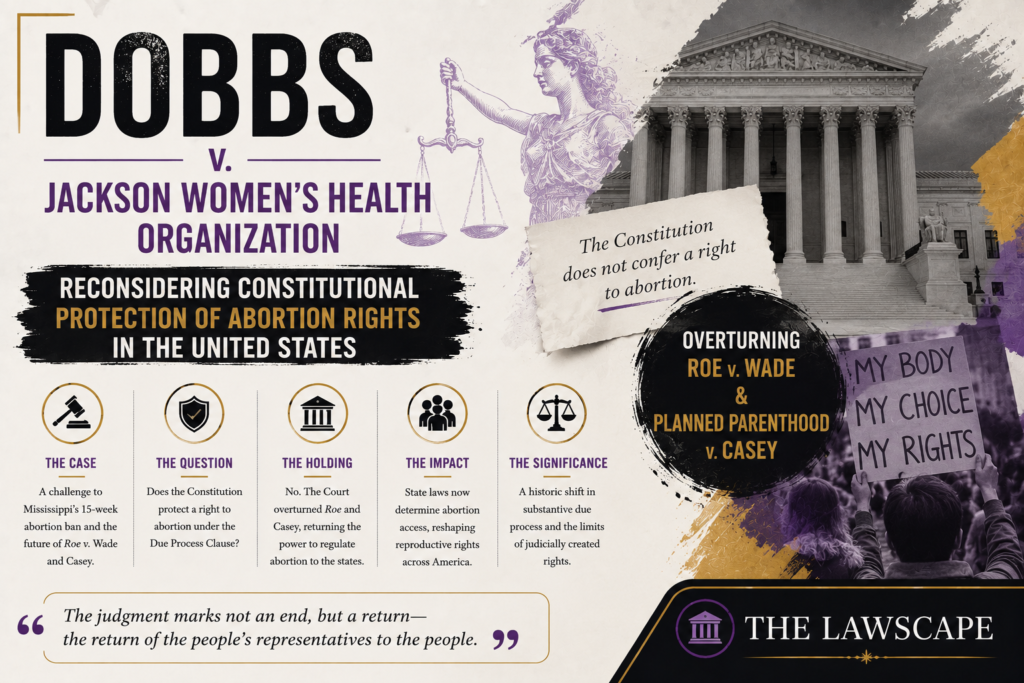
- Dobbs v. Jackson Women’s Health Organization overturned Roe v. Wade and Planned Parenthood v. Casey, ending federal constitutional protection for abortion rights in the United States.
- The Supreme Court held that abortion is not a fundamental right protected under the Fourteenth Amendment because it is not deeply rooted in the nation’s history and tradition.
- The judgment reignited debates on stare decisis, federalism, privacy, and the future of substantive due process rights.
Introduction
The decision in Dobbs v. Jackson Women’s Health Organization represents one of the most significant constitutional developments in contemporary American jurisprudence. Delivered by the United States Supreme Court in 2022, the judgment overturned nearly five decades of precedent established by Roe v. Wade and reaffirmed by Planned Parenthood v. Casey. By doing so, the Court removed federal constitutional protection for abortion rights and transferred regulatory authority to individual states.
The case emerged from a challenge to Mississippi’s Gestational Age Act, which prohibited most abortions after fifteen weeks of pregnancy. The legislation directly conflicted with the viability framework developed under Roe and Casey. The Supreme Court’s review of the law therefore raised fundamental questions concerning privacy, liberty, substantive due process, judicial precedent, and constitutional interpretation.
The judgment attracted widespread attention because of its implications for reproductive rights and the doctrine of stare decisis. While supporters regarded the decision as a restoration of democratic decision-making, critics viewed it as a setback for women’s autonomy and constitutional protections. The case continues to influence debates concerning constitutional rights, judicial power, and federalism in the United States.
Facts of the Case
In 2018, the State of Mississippi enacted the Gestational Age Act, prohibiting abortions after fifteen weeks of pregnancy except in cases of medical emergency or severe foetal abnormality. The legislation was enacted despite existing Supreme Court precedents recognising a woman’s constitutional right to obtain an abortion before foetal viability.
Jackson Women’s Health Organization, the only licensed abortion clinic in Mississippi, challenged the law in federal court. The clinic argued that the statute violated rights protected under the Fourteenth Amendment and was inconsistent with the standards established in Roe v. Wade and Planned Parenthood v. Casey.
The United States District Court struck down the law, holding that states could not prohibit abortions prior to viability. The Fifth Circuit Court of Appeals affirmed the decision. Mississippi subsequently appealed to the Supreme Court and requested reconsideration of the constitutional foundations of Roe and Casey.
The Supreme Court agreed to hear the matter and framed the dispute as a broader constitutional question concerning whether the Constitution protects a right to abortion and whether existing precedents should continue to govern abortion regulation.
Issues Raised
The following issues arose for determination:
- Whether the Constitution of the United States guarantees a fundamental right to abortion under the Fourteenth Amendment.
- Whether the viability standard established in Roe v. Wade and reaffirmed in Planned Parenthood v. Casey should be retained.
- Whether Mississippi’s Gestational Age Act is constitutionally valid.
- Whether the doctrine of stare decisis prevents the Supreme Court from overruling Roe and Casey.
Analysis
A. Majority Opinion
The majority opinion, authored by Justice Samuel Alito, concluded that the Constitution does not explicitly or implicitly confer a right to abortion. The Court reasoned that rights protected under substantive due process must be deeply rooted in the nation’s history and tradition and essential to the concept of ordered liberty.
According to the majority, abortion failed to satisfy this historical test because American legal traditions historically permitted extensive regulation of abortion. Consequently, the Court held that the Fourteenth Amendment did not protect abortion as a fundamental constitutional right.
B. Rejection of Roe and Casey
The Court characterised Roe v. Wade as constitutionally unsound and lacking a firm textual or historical basis. It further held that Planned Parenthood v. Casey perpetuated the same constitutional errors by preserving abortion rights through the undue burden standard.
The majority therefore concluded that both precedents should be overruled. The authority to regulate abortion was returned to elected state legislatures rather than remaining under federal constitutional protection.
C. Stare Decisis and Judicial Precedent
One of the most controversial aspects of the decision concerns the doctrine of stare decisis. Judicial precedent promotes stability, predictability, and consistency within legal systems. However, the Court observed that adherence to precedent is not absolute.
The majority identified several factors supporting departure from precedent, including poor reasoning, constitutional error, practical unworkability, and distortion of legal doctrine. The Court maintained that correcting constitutional mistakes was more important than preserving precedent merely for the sake of continuity.
Critics contend that the decision weakened legal certainty by overturning a long-established constitutional right. They argue that the Court failed to give adequate weight to societal reliance on Roe and Casey.
D. Dissenting Opinion
Justices Breyer, Sotomayor, and Kagan jointly dissented. The dissent emphasised that reproductive choice is closely connected to personal autonomy, dignity, equality, and bodily integrity.
According to the dissent, the majority’s reasoning ignored the real-life consequences of restricting abortion access. The dissenting judges argued that women had structured their lives around constitutional protections recognised for decades and that removing such protections undermined individual liberty.
The dissent also warned that the reasoning adopted by the majority could threaten other rights derived from substantive due process, including rights relating to privacy and personal relationships.
E. Constitutional Interpretation
The case illustrates the continuing debate between originalism and the living Constitution approach.
The majority adopted an originalist methodology, focusing on constitutional text and historical practices at the time of the Fourteenth Amendment’s adoption. Under this approach, constitutional rights must be firmly grounded in historical tradition.
Critics favour a living constitutionalist perspective, arguing that constitutional principles should evolve with societal changes. From this viewpoint, constitutional liberty encompasses modern understandings of personal autonomy and reproductive freedom.
F. Impact of the Judgment
The immediate consequence of Dobbs was the return of abortion regulation to individual states. Several states enacted restrictive abortion laws, while others strengthened legal protections for reproductive healthcare.
The decision has produced significant variations in abortion access across the United States, creating a fragmented legal landscape. Beyond abortion, the judgment has intensified debates regarding privacy rights, judicial legitimacy, federalism, and the future of substantive due process jurisprudence.
Internationally, the decision attracted considerable attention because many democratic jurisdictions have increasingly recognised reproductive rights as components of personal liberty and human dignity. Consequently, Dobbs remains a focal point in global discussions concerning constitutional rights and gender equality.
Conclusion
Dobbs v. Jackson Women’s Health Organization constitutes one of the most consequential constitutional decisions of the twenty-first century. By overturning Roe v. Wade and Planned Parenthood v. Casey, the Supreme Court fundamentally altered the legal framework governing abortion rights in the United States.
The judgment reflects a broader conflict between competing theories of constitutional interpretation. While supporters view the decision as a restoration of democratic governance and constitutional fidelity, critics regard it as a significant setback for reproductive autonomy and judicial consistency.
The long-term significance of Dobbs extends beyond abortion. It raises important questions concerning privacy, substantive due process, federalism, and the stability of constitutional rights. As a result, the decision will continue to shape legal scholarship, judicial discourse, and public debate for years to come.
Disclaimer: The views expressed in this article are those of the author and do not necessarily reflect the views of The Lawscape.
The Lawscape — clear, practical legal insight for students and future lawyers.