
K.M. Nanavati v. State of Maharashtra: Emotion, Provocation, and the Limits of Sympathy in Criminal Law
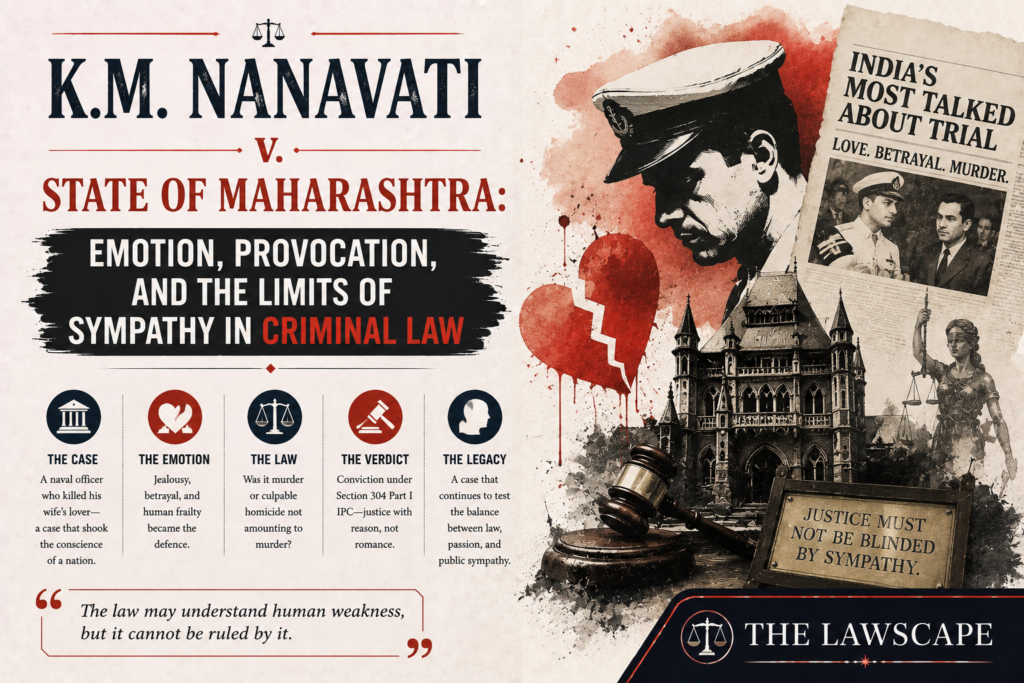
Author: Simran Singh
Student, Bharati Vidyapeeth, New law college, Pune
—————————————————————————————
💡 3 Quick Takeaways
- K.M. Nanavati v. State of Maharashtra clarified the narrow scope of the defence of grave and sudden provocation under Indian criminal law.
- The Supreme Court held that sufficient “cooling-off time” had passed between Sylvia Nanavati’s confession and Prem Ahuja’s killing, making the provocation defence unavailable.
- The case also exposed the vulnerability of jury trials to media influence and public sympathy, contributing to the decline of the jury system in India.
Introduction
The case of K.M. Nanavati v. State of Maharashtra is one of the most talked-about criminal law cases in India. Even today, it continues to be discussed not only because of the murder involved, but also because of the emotional and social issues connected with it. The case was not a simple criminal trial where one person killed another. Instead, it became a national debate about emotions, betrayal, justice, morality, and the influence of public opinion on courts.
The case attracted massive public attention because the accused, Commander K.M. Nanavati, was a respected naval officer. When people came to know that he had shot Prem Ahuja after discovering his wife’s affair with him, many immediately sympathised with Nanavati. Newspapers covered the case every single day, and public discussions around the trial became extremely intense. In many ways, the case looked less like an ordinary courtroom matter and more like a public drama unfolding before the country.
However, despite the emotional sympathy surrounding Nanavati, the courts had to decide the matter according to law and evidence. The Supreme Court eventually convicted Nanavati for murder and rejected the jury’s earlier verdict of not guilty. This judgment became important because it clarified the law relating to grave and sudden provocation and also exposed serious weaknesses in the jury system in India. The case is therefore remembered not only as a famous murder trial but also as a turning point in Indian criminal jurisprudence.
Facts of the Case
K.M. Nanavati was a Commander in the Indian Navy and lived in Bombay with his wife Sylvia Nanavati and their children. Due to his professional duties, he often remained away from home for long periods. During one such period, Sylvia developed a relationship with Prem Ahuja, who was a businessman and also known to the family.
When Nanavati returned home, Sylvia confessed to him that she had been involved with Ahuja. The confession came as a huge emotional shock to him. According to the defence, Nanavati became mentally disturbed and emotionally shattered after hearing about the affair. It is not difficult to understand why the situation affected him so deeply. From a personal point of view, he had suddenly discovered that his marriage was not what he believed it to be.
After this conversation, Nanavati took his wife and children to a cinema hall. He then drove to his ship and collected a revolver along with ammunition. He informed the authorities on the ship that he needed the weapon for safety purposes during travel. After collecting the revolver, he went directly to Prem Ahuja’s apartment.
What exactly happened inside the apartment became one of the most disputed aspects of the case. According to the defence, there was a heated conversation between the two men and the firing happened suddenly during the confrontation. The prosecution, however, argued that Nanavati had gone there with preparation and intention to kill Ahuja.
What remained undisputed was that Prem Ahuja died after being shot by Nanavati. After the incident, Nanavati did not run away or attempt to hide himself. Instead, he surrendered before the police, which further increased public sympathy in his favour.
The case soon became one of the biggest media stories of that time. Newspapers openly reported details of the trial and often presented Nanavati as a loyal husband who had emotionally broken down after discovering his wife’s betrayal. Public opinion strongly supported him, and many people believed that his actions were understandable considering the circumstances.
The trial was first conducted before a jury in the Bombay Sessions Court. The jury accepted Nanavati’s defence of grave and sudden provocation and declared him not guilty. However, the Sessions Judge believed that the verdict was unreasonable and appeared to be influenced by emotion rather than evidence. Therefore, the matter was referred to the Bombay High Court.
The Bombay High Court later convicted Nanavati for murder under Section 302 of the Indian Penal Code. The matter finally reached the Supreme Court, which upheld the conviction and agreed with the reasoning given by the High Court.
Issues Raised
The Court had to deal with several important legal issues in this case:
- Whether Nanavati’s act amounted to murder under Section 300 of the Indian Penal Code.
- Whether the defence of grave and sudden provocation was available in the present case.
- Whether there was enough time between Sylvia’s confession and the shooting for Nanavati to regain self-control.
- Whether the jury’s verdict had been influenced by public sympathy and media reporting.
- Whether the Bombay High Court was justified in setting aside the jury’s decision.
These issues made the case legally complex because the Court was required to balance emotional realities with strict legal principles.
Background of Law
Under the Indian Penal Code, intentionally causing the death of another person generally amounts to murder under Section 300 IPC. However, the law also recognises that human beings do not always behave calmly in emotionally disturbing situations. Because of this, the IPC provides certain exceptions where criminal liability may be reduced.
One such exception is “grave and sudden provocation” under Exception 1 to Section 300 IPC. The principle behind this exception is based on human psychology. The law accepts that a person who suddenly faces an extremely shocking or emotionally disturbing situation may temporarily lose self-control.
However, not every emotional reaction qualifies as legal provocation. The provocation must be both grave and sudden. More importantly, the reaction must happen before the person has enough time to calm down and think rationally. If sufficient time has passed, the law assumes that self-control has returned.
Courts also apply what is known as the “reasonable man test.” This means that the Court examines whether an ordinary reasonable person placed in similar circumstances would have reacted in the same way as the accused.
Before the Nanavati judgment, courts had already discussed provocation in several cases. However, the Nanavati case became one of the clearest examples explaining how carefully and narrowly this defence should be applied.
Judgment of the Court
The Supreme Court held Nanavati guilty of murder and upheld the conviction given by the Bombay High Court. The Court rejected the defence of grave and sudden provocation because it believed that there was enough time between Sylvia’s confession and the shooting.
The judges carefully examined Nanavati’s actions after learning about the affair. According to the Court, Nanavati did not react immediately in a sudden emotional outburst. Instead, he first dropped his family at the cinema, travelled to his ship, collected a revolver, and then went to Ahuja’s apartment. The Court believed that these actions showed planning and self-control rather than an uncontrollable emotional reaction.
The Court therefore concluded that there had been sufficient “cooling-off time” for Nanavati to regain his mental balance. As a result, the defence of grave and sudden provocation could not apply in this situation.
The Supreme Court also agreed with the Bombay High Court that the jury’s verdict appeared to be influenced by public sympathy and media pressure. Since the verdict was considered unreasonable in light of the evidence, the High Court was justified in interfering with the jury’s decision.
Accordingly, Nanavati was convicted under Section 302 IPC for murder.
Critical Analysis
The judgment in the Nanavati case remains important because it tried to maintain a balance between human emotions and legal responsibility. The Court understood that Nanavati may have been emotionally devastated after discovering his wife’s affair. However, the judges also believed that criminal law cannot function purely on the basis of sympathy or emotional understanding.
One of the strongest parts of the judgment was the Court’s discussion of the “cooling-off period.” The judges believed that Nanavati had enough time to regain self-control before confronting Ahuja. Legally, this reasoning appears sensible because criminal law must clearly distinguish between an immediate emotional reaction and a planned act of violence.
At the same time, the judgment also leaves room for debate. Human emotions are not always simple or predictable. Emotional shock cannot be measured like a mathematical formula. A person who suddenly learns about betrayal may remain emotionally disturbed for a long time. Because of this, some people believe that the Court interpreted the doctrine of provocation too strictly and did not fully consider the psychological impact of the situation on Nanavati.
Another major issue in the case was the influence of the media. Newspapers openly supported Nanavati and portrayed him as a respectable husband who had suffered emotional humiliation. As public sympathy for him increased, questions naturally arose regarding the fairness and independence of the jury’s decision.
The case therefore exposed one of the biggest weaknesses of the jury system in India. Jurors were ordinary people and, like any ordinary person, they could be influenced by emotions, media narratives, and public opinion. The Nanavati case demonstrated how difficult it could become to ensure complete impartiality in highly publicised criminal trials.
In many ways, this case contributed to the gradual disappearance of jury trials in India. After the controversy surrounding the case, public confidence in the jury system weakened considerably because people began to question whether emotional public opinion could interfere with fair justice.
The case also highlights the difference between moral sympathy and legal guilt. Morally, many people sympathised with Nanavati because they understood his emotional condition. Legally, however, the Court had to decide whether the requirements of Exception 1 to Section 300 IPC were actually satisfied. The Supreme Court ultimately chose to prioritise legal consistency and objective reasoning over emotional considerations.
Overall, even though opinions on the judgment may still differ, the decision remains legally significant because it reinforced the principle that criminal cases must ultimately be decided according to law and evidence rather than public emotion.
Conclusion
K.M. Nanavati v. State of Maharashtra continues to remain one of the most important criminal law judgments in India. The case clarified the limits of the defence of grave and sudden provocation and established that emotional anger alone cannot justify taking another person’s life.
The judgment also had a long-lasting impact on the Indian legal system because it exposed the risks of emotionally influenced jury verdicts and highlighted the dangers created by excessive media involvement in criminal trials.
What makes this case memorable even today is that it deals with deeply human emotions such as betrayal, anger, humiliation, emotional breakdown, and justice. Even now, people continue to debate whether Nanavati deserved sympathy or punishment. However, regardless of differing opinions, the case remains an important example of how courts attempt to balance human emotions with the rule of law.
Disclaimer: The views expressed in this article are those of the author and do not necessarily reflect the views of The Lawscape.
The Lawscape — clear, practical legal insight for students and future lawyers.