
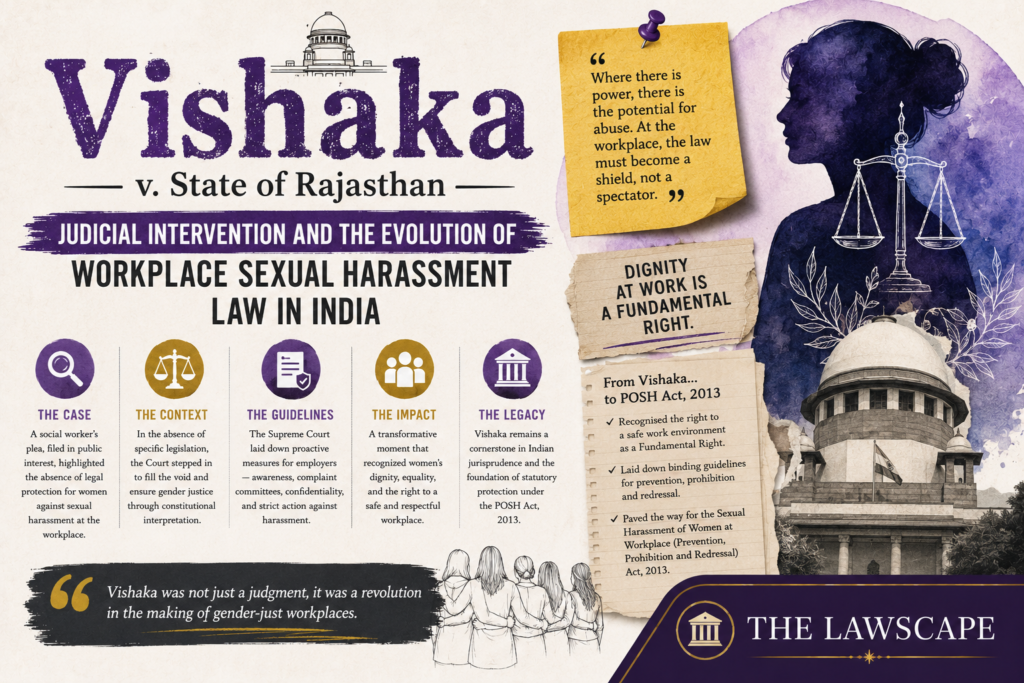
Vishaka v. State of Rajasthan: Judicial Intervention and the Evolution of Workplace Sexual Harassment Law in India
Author: Divyanshi Shakya
Student, Shri Ramswaroop Memorial University
————————————————————————————
💡 3 Quick Takeaways
- Vishaka v. State of Rajasthan recognised workplace sexual harassment as a violation of fundamental rights under Articles 14, 15, 19(1)(g), and 21 of the Constitution.
- In the absence of domestic legislation, the Supreme Court relied on international conventions such as CEDAW to frame the Vishaka Guidelines.
- The judgment imposed binding obligations on employers to prevent and redress sexual harassment at the workplace, laying the foundation for later statutory reform.
Introduction
Vishaka v. State of Rajasthan is one of the most significant judgments in Indian constitutional and labour jurisprudence. The case marked a turning point in the legal recognition of workplace sexual harassment as a serious violation of women’s fundamental rights and dignity. Decided in 1997, the judgment is widely regarded as a landmark in the judicial protection of women against gender-based violence and discrimination in the workplace.
The case arose out of the brutal gang rape of Bhanwari Devi, a grassroots social worker in Rajasthan, who was attacked in retaliation for attempting to prevent a child marriage as part of her official duties. Her case exposed not only the violence faced by women in the course of public work but also the complete absence of a legal framework addressing sexual harassment at the workplace. Against this backdrop, several women’s rights organisations and activists approached the Supreme Court under Article 32 of the Constitution, seeking judicial intervention to protect working women from sexual harassment and to fill the legislative vacuum.
The judgment delivered in Vishaka is significant not merely because it recognised workplace sexual harassment as unconstitutional, but also because it demonstrated how the judiciary may step in to protect fundamental rights when the legislature has failed to act. The Supreme Court framed the Vishaka Guidelines, which remained the governing law on workplace sexual harassment until the enactment of the Sexual Harassment of Women at Workplace (Prevention, Prohibition and Redressal) Act, 2013.
Facts of the Case
The case was triggered by the experience of Bhanwari Devi, a social worker employed under the Women’s Development Project in Rajasthan. Her work primarily involved campaigning against social evils such as child marriage and promoting awareness in rural communities.
In 1992, while attempting to prevent the marriage of an infant girl, Bhanwari Devi faced hostility and outrage from members of the local community. Her intervention angered influential persons, including Ram Karan Gujjar, who humiliated her and contributed to her social isolation within the village.
On 22 September 1992, as an act of revenge, Bhanwari Devi was brutally gang-raped by five men. The incident was followed by insensitive and callous treatment from local villagers, police authorities, and medical personnel. The investigation was delayed, and the medical examination reportedly took place more than fifty-two hours after the attack, seriously weakening the forensic evidence. Important details were also overlooked in the medical report.
Ultimately, the trial court acquitted the accused on the ground of insufficient evidence. The case generated widespread public outrage, and despite further proceedings before the Rajasthan High Court, justice remained elusive. In response, several women’s rights organisations and NGOs came together and filed a Public Interest Litigation before the Supreme Court under the name Vishaka, invoking Article 32 of the Constitution and raising broader issues concerning workplace sexual harassment, women’s rights, and the absence of an adequate legal mechanism to address such misconduct.
Issues
The Supreme Court considered the following key issues:
- Whether sexual harassment of women at the workplace violates the fundamental rights guaranteed under Articles 14, 15, 19(1), and 21 of the Constitution.
- Whether, in the absence of statutory provisions addressing sexual harassment, judicial intervention is justified to protect women’s rights.
- Whether international treaties and norms may be relied upon by the Court in interpreting and enforcing constitutional guarantees where domestic law is inadequate.
- Whether the Supreme Court, in exercise of its constitutional jurisdiction, can frame binding guidelines in the absence of legislation.
Arguments of the Parties
Petitioners’ Arguments
The petitioners argued that incidents of sexual harassment at the workplace directly violate women’s fundamental rights under Articles 14, 15, 19(1)(g), and 21 of the Constitution. It was submitted that sexual harassment undermines a woman’s right to equality, freedom from gender discrimination, freedom to practise any profession or occupation, and her right to life with dignity.
The petitioners further contended that the absence of any specific law dealing with sexual harassment at the workplace created a serious legislative vacuum. In the absence of legal safeguards and redressal mechanisms, women were left vulnerable to abuse without any effective remedy. It was argued that this legal void created an unsafe work environment for women and adversely affected both their careers and personal dignity.
The petitioners therefore requested the Supreme Court to frame guidelines and standards to govern cases of workplace sexual harassment until suitable legislation was enacted. They also emphasised that India is a signatory to the Convention on the Elimination of All Forms of Discrimination Against Women (CEDAW), and that the State was under an obligation to ensure protection against gender-based discrimination and workplace harassment. Accordingly, it was argued that constitutional guarantees should be interpreted in light of international norms and obligations.
Respondents’ Arguments
The respondents, represented by the Solicitor General, took the unusual position of broadly supporting the petitioners’ plea for judicial intervention. It was submitted that in the absence of legislative provisions specifically dealing with workplace sexual harassment, the Court could and should exercise its jurisdiction under Article 32 to protect women’s rights.
The respondents argued that employers have both a legal and moral duty to provide a safe working environment. They supported the creation of redressal mechanisms and committees to prevent, monitor, and address complaints of sexual harassment. It was also submitted that since India had ratified CEDAW, the Court should align domestic constitutional protections with international human rights standards and best practices concerning gender equality and workplace safety.
Judgment / Final Decision
The Supreme Court answered the issues in favour of the petitioners and delivered a transformative judgment.
First, the Court held that sexual harassment at the workplace amounts to a violation of fundamental rights under Articles 14, 15, 19(1)(g), and 21 of the Constitution. It observed that such conduct infringes a woman’s right to equality, her right against discrimination, her freedom to work, and her right to live with dignity and security.
Secondly, the Court acknowledged the absence of adequate legislation dealing specifically with sexual harassment at the workplace. Although provisions of the Indian Penal Code could be invoked in certain cases, the Court recognised that these provisions were insufficient to address the seriousness and sensitivity of workplace sexual harassment in a comprehensive manner.
Thirdly, the Court held that international conventions and norms may be relied upon in the absence of domestic law, so long as they are consistent with fundamental rights and constitutional guarantees. It referred to CEDAW and the Beijing Statement of Principles as interpretive tools for advancing gender equality and protecting women from sexual harassment.
Most importantly, the Court framed the Vishaka Guidelines, which were declared binding and enforceable until appropriate legislation was enacted. These guidelines imposed obligations on employers, institutions, and other responsible authorities to prevent and redress workplace sexual harassment. The judgment was thus seen as a proactive exercise of judicial power to safeguard women’s rights in the face of legislative inaction.
Ratio Decidendi
The Court’s reasoning rested on two central foundations: the constitutional guarantee of fundamental rights and the absence of any statutory mechanism to address workplace sexual harassment.
Recognition of Sexual Harassment as a Constitutional Wrong
The Supreme Court recognised that sexual harassment is not merely a matter of individual misconduct, but a constitutional issue affecting equality, dignity, and liberty. It held that sexual harassment violates Articles 14 and 15 because it perpetuates gender-based discrimination, Article 19(1)(g) because it restricts a woman’s ability to work freely, and Article 21 because it attacks her dignity and personal security.
Judicial Power to Fill Legislative Gaps
In the absence of any statutory law on workplace sexual harassment, the Court held that it was competent to frame guidelines under Article 32 of the Constitution in order to protect fundamental rights. This aspect of the judgment is often viewed as a significant example of judicial activism. The Court considered such intervention not only permissible but necessary where legislative silence leaves vulnerable groups without protection.
Use of International Law
The Court also affirmed that international conventions and human rights instruments may be used to interpret constitutional rights where domestic law is silent, provided such norms are consistent with the Constitution. CEDAW was therefore treated as an important source for understanding the State’s obligation to prevent discrimination and provide safe working conditions for women.
The Vishaka Guidelines
The Vishaka Guidelines formed the heart of the judgment. The Court defined sexual harassment to include unwelcome physical contact and advances, demands or requests for sexual favours, sexually coloured remarks, showing pornography, and any other unwelcome verbal or non-verbal conduct of a sexual nature.
The guidelines imposed a number of obligations on employers and institutions. They required express prohibition of sexual harassment in workplaces, incorporation of disciplinary rules and penalties, establishment of complaint mechanisms, and creation of conditions ensuring that women do not face a hostile work environment. The Court also directed that where the conduct amounts to a criminal offence, employers must initiate appropriate legal action. Further, victims and witnesses were to be protected from victimisation or retaliation, and victims were to be given the option of transfer where necessary.
Conclusion
Vishaka v. State of Rajasthan is a watershed judgment in Indian legal history and a defining moment in the protection of women’s rights at the workplace. It transformed a tragic instance of gendered violence into a broader constitutional conversation about dignity, equality, and workplace safety. By stepping into a legislative vacuum, the Supreme Court ensured immediate protection for working women and established a framework that shaped future legal reform.
The judgment is particularly important because it recognised that the right to work with dignity is inseparable from the right to equality and the right to life under the Constitution. It also demonstrated that the judiciary can play a constructive role in safeguarding rights where legislative inaction threatens the constitutional promise of justice.
Another enduring contribution of the case lies in its recognition of the importance of international human rights standards in domestic constitutional interpretation. By drawing upon CEDAW and related principles, the Court affirmed that the protection of women against workplace harassment is part of a broader commitment to gender justice and human dignity.
Although challenges relating to implementation and workplace culture continue to persist, Vishaka remains a powerful symbol of the struggle against gender discrimination and sexual harassment. More than a landmark judgment, it represents an assertion that women must be able to participate in public and professional life free from fear, humiliation, and violence. Its legacy continues to shape Indian constitutional law, labour law, and the discourse on women’s rights.
Disclaimer: The views expressed in this article are those of the author and do not necessarily reflect the views of The Lawscape.
The Lawscape — clear, practical legal insight for students and future lawyers.