
K.M. Nanavati v. State of Maharashtra: Reassessing Grave and Sudden Provocation under Indian Criminal Law
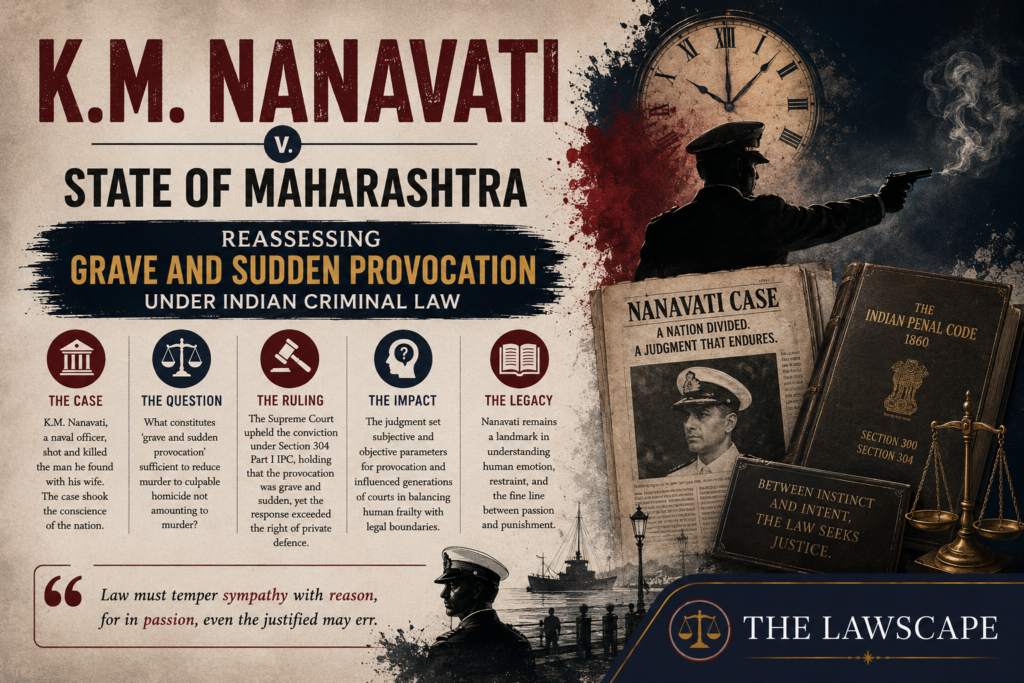
Author: Aafreen Kamil
Student, Andaman Law College, Sri Vijaya Puram
————————————————————————–
💡 3 Quick Takeaways
- K.M. Nanavati v. State of Maharashtra clarified the scope of the defence of grave and sudden provocation under Exception 1 to Section 300 of the Indian Penal Code.
- The Supreme Court held that Nanavati had sufficient time to regain self-control after his wife’s confession, and therefore the killing of Prem Ahuja could not be reduced from murder to culpable homicide.
- Beyond criminal law, the case remains significant for its constitutional discussion on executive clemency and its indirect role in the abolition of jury trials in India.
Introduction
Few criminal cases in post-independence India have captured the public imagination—or provoked as much legal debate—as K.M. Nanavati v. State of Maharashtra. At its core, the case posed a difficult and deeply human question: does the law make room for anguish arising from personal betrayal? A decorated Naval Commander, having just learned that his wife had been involved with a close friend, went and shot that man dead. The Supreme Court was therefore called upon to determine whether that act, committed in the shadow of marital betrayal, could be reduced from murder to culpable homicide on the basis of grave and sudden provocation under Exception 1 to Section 300 of the Indian Penal Code, 1860.
The Court answered in the negative. Overturning the jury’s acquittal and upholding the Bombay High Court’s conviction, the Supreme Court held that the interval of roughly three hours between Sylvia Nanavati’s confession and the shooting gave Nanavati sufficient time to regain control over his emotions. That interval, according to the Court, broke the chain of grave and sudden provocation. The judgment is important not only because it clarified the contours of a contested exception to the law of murder, but also because it addressed the limits of executive clemency during a live judicial appeal and, indirectly, contributed to the eventual abolition of jury trials in India.
This commentary takes the view that the Supreme Court reached the correct conclusion, but not entirely on the strongest reasoning. The evidence of premeditation was compelling, and the conviction was justified on that basis alone. Yet the Court relied heavily on the passage of time rather than on the more telling fact that Nanavati had deliberately armed himself before confronting Ahuja. Moreover, the judgment left unresolved a critical doctrinal question: can words of marital betrayal, without more, amount to grave provocation? Courts have had to navigate that silence ever since.
Background
Facts of the Case
Kawas Manekshaw Nanavati was a Commander in the Indian Navy, married to Sylvia Nanavati, with whom he had three children. Owing to the nature of his service, he was frequently away from Bombay for long periods. During one such absence, Sylvia entered into an intimate relationship with Prem Ahuja, a prosperous businessman and a close acquaintance of the family.
When Nanavati returned from a voyage on 27 April 1959, he sensed that something had changed. Sylvia eventually confessed to the affair. What followed was not an immediate outburst of rage, but a series of deliberate acts. Nanavati first drove Sylvia and the children to a cinema. He then returned to his ship and, on a false pretext, obtained a semi-automatic pistol and six rounds of ammunition. From there, he drove to Ahuja’s office, and upon not finding him there, proceeded to Ahuja’s residence. In the bedroom of Ahuja’s flat, a confrontation occurred, during which Ahuja was shot three times and died.
Nanavati thereafter surrendered to the Deputy Commissioner of Police and was charged with murder under Section 302 of the IPC. At trial, his defence was twofold. First, he claimed that the gun had discharged accidentally during a struggle. Secondly, he argued that even if the shooting was deliberate, it had been committed under grave and sudden provocation after learning of his wife’s infidelity. The Sessions Court placed the matter before a jury, which returned an 8:1 verdict for acquittal under Section 304 IPC. The Sessions Judge, however, was unconvinced by the verdict and referred the case to the Bombay High Court under Section 307 of the Code of Criminal Procedure.
The Law of Grave and Sudden Provocation Before Nanavati
Exception 1 to Section 300 IPC provides that culpable homicide is not murder if the offender, while deprived of the power of self-control by grave and sudden provocation, causes the death of the person who gave the provocation. The exception is rooted in the English common law doctrine of provocation, but its precise operation within Indian criminal law had not been fully settled before Nanavati.
English courts had generally applied the objective “reasonable person” test, requiring that the provocation be such as would cause a reasonable person to lose self-control. Indian courts broadly followed the same line, but several questions remained open. Who exactly was this “reasonable person”? Could words alone amount to grave provocation? How much time could elapse between the provocation and the killing before the defence was lost? The Nanavati case presented the Supreme Court with an opportunity to address these questions directly.
The case also involved an unusual procedural background. After the jury’s acquittal was referred to the High Court, the Governor purported to suspend Nanavati’s sentence under Article 161 of the Constitution while the matter was still pending before the Supreme Court. This raised a distinct constitutional issue concerning the relationship between executive clemency and ongoing judicial proceedings.
Analysis
The Right Result, Reached on Incomplete Reasoning
The conviction was correct. Viewed objectively, the sequence of events after Sylvia’s confession does not describe a man acting in the immediate heat of passion. It describes a man making a series of conscious and deliberate choices. Nanavati did not react instantaneously. He dropped his family at a cinema, returned to his ship, obtained a firearm and ammunition under a fabricated pretext, and then set out to find Ahuja—first at his office and then at his residence. Each step required decision-making and composure. None of these acts sits comfortably with the spontaneous and uncontrollable loss of self-control contemplated by the provocation defence.
The difficulty lies in the Court’s reasoning. The Supreme Court primarily rested its rejection of the provocation plea on the three-hour interval between the confession and the shooting, treating the passage of time as evidence that Nanavati had regained self-control. While this reasoning is understandable, it is somewhat reductive. Human emotion does not operate by the clock, and anguish arising from betrayal does not necessarily fade with time. A more persuasive and legally rigorous approach would have placed greater emphasis on the unmistakable evidence of premeditation. The act of returning to the ship, obtaining a pistol and ammunition, and then pursuing Ahuja strongly suggests deliberation rather than impulsive violence. That evidence, more than the passage of time alone, should have been central to the rejection of the defence.
The Criteria Laid Down for Exception 1
Despite these shortcomings, the judgment made an important doctrinal contribution by articulating the requirements for the defence of grave and sudden provocation. To successfully invoke Exception 1 to Section 300, the accused must show that:
- the provocation was both grave and sudden;
- the provocation deprived the accused of self-control;
- the killing took place while that loss of self-control continued; and
- the act was directed against the person who gave the provocation and not an innocent third party.
The Court also clarified that the test is partly subjective and partly objective. The provocative act must be judged in relation to a reasonable person placed in the position of the accused, while the accused’s response must be examined in light of whether an ordinary person of reasonable firmness might similarly have lost control.
This clarification was valuable, but the judgment stopped short of explaining what characteristics the “reasonable person” should possess. Should that person be judged in abstraction, or should the court account for the accused’s social and cultural background, emotional makeup, and circumstances? The judgment did not engage with these questions in depth, leaving later courts to work through the ambiguities. As the commentary notes, subsequent cases such as K.M. Nanavati’s doctrinal successors had to grapple with these unresolved aspects of the test.
The Unanswered Question: Can Words Alone Constitute Grave Provocation?
Perhaps the most significant omission in the judgment is its refusal to definitively address whether a verbal confession of infidelity can amount to grave provocation. Sylvia’s disclosure was, in essence, a communication of betrayal through words. Yet Exception 1 contains a proviso suggesting that words alone or information conveyed by a third party ordinarily do not suffice as provocation.
The Supreme Court acknowledged this difficulty but avoided a direct ruling on it by disposing of the case on the narrower ground that the provocation, even if assumed, had dissipated by the time of the shooting. From the standpoint of judicial economy, that may have been convenient. However, it left unresolved one of the most difficult doctrinal questions in the law of provocation.
Whether words of profound personal betrayal can ever be so grave as to deprive a person of self-control remains deeply contested. A clear ruling one way or the other would have provided significant guidance. A finding that words alone can never satisfy the threshold would have established a bright-line rule. Conversely, recognising that certain verbal revelations may, in exceptional cases, be as devastating as direct physical acts would have aligned the law more closely with lived human experience. By declining to answer the question, the Court left a gap that has continued to generate uncertainty in later jurisprudence.
Executive Clemency and Judicial Process
On the constitutional issue, however, the Court’s reasoning was much more assured. While the appeal process was ongoing, the Governor purported to suspend Nanavati’s sentence under Article 161 of the Constitution. The Supreme Court held that the executive’s pardoning or suspension power could not be exercised in a manner that interfered with a matter actively pending before the judiciary.
This was an important assertion of institutional boundaries. To allow the executive to suspend a sentence during the pendency of a judicial appeal would be to permit interference with the administration of justice and to undermine the authority of the courts. The Court therefore correctly held that executive clemency cannot operate concurrently so as to pre-empt or frustrate the judicial process. This aspect of the judgment remains one of its most enduring constitutional contributions.
The Unintended Legacy: The End of Jury Trials in India
The most far-reaching consequence of Nanavati may well have been one that lay beyond the immediate legal questions before the Court: the eventual abolition of jury trials in India. The jury’s 8:1 verdict of acquittal in a case where the evidence strongly suggested premeditation exposed serious concerns about the susceptibility of jurors to public sentiment and media influence.
Nanavati had been portrayed in the press as a wronged husband, a patriotic naval officer betrayed by both his wife and his friend. That narrative appears to have shaped public sympathy and, in turn, the jury’s perception of the case. The resulting acquittal highlighted structural weaknesses in the jury system, particularly in a context where media narratives and communal sentiment could easily overshadow evidence and legal principle.
Although the Supreme Court itself did not abolish jury trials, the Nanavati case became a major catalyst for the movement away from the jury system in Indian criminal justice. In that sense, the case is remembered not only as a leading authority on provocation, but also as a turning point in the institutional history of Indian criminal procedure.
Conclusion
K.M. Nanavati v. State of Maharashtra is one of those rare landmark decisions in which the Court reached the correct outcome but left aspects of its reasoning incomplete. The killing of Prem Ahuja was not the spontaneous act of a man who had entirely lost control of himself. It was a calculated act preceded by a sequence of deliberate decisions. The conviction for murder was therefore justified, and the Supreme Court was right to reject the provocation defence.
At the same time, two limitations of the judgment remain evident. First, the Court relied too heavily on the idea of “cooling time” rather than foregrounding the far more compelling evidence of premeditation. Secondly, it avoided the difficult but central question of whether a verbal confession of marital infidelity can, in itself, amount to grave provocation. That silence has left a fault line in the doctrine which later courts have had to navigate without clear guidance.
The significance of Nanavati extends beyond the doctrine of provocation. It also stands as a case about the constitutional limits of executive power, the vulnerability of jury verdicts to media pressure, and the broader need to adapt legal institutions to social realities. More than six decades later, it continues to be read not merely as a criminal law decision, but as a case that sits at the intersection of law, emotion, public morality, and institutional reform.
Disclaimer: The views expressed in this article are those of the author and do not necessarily reflect the views of The Lawscape.
The Lawscape — clear, practical legal insight for students and future lawyers.